

You want pupils to encounter Krishna consciousness as a living way of learning, not as religious decoration. At the same time, you are responsible for academic standards, safeguarding, family trust and the dignity of children who may not share the same faith.
The safest and most effective starting point is not a compulsory chant, a festival display or a new spiritual slogan. Choose one dharmic value, translate it into an observable learning habit, place it inside ordinary teaching and review whether it helps every pupil learn.
Start with the person you want the learner to become
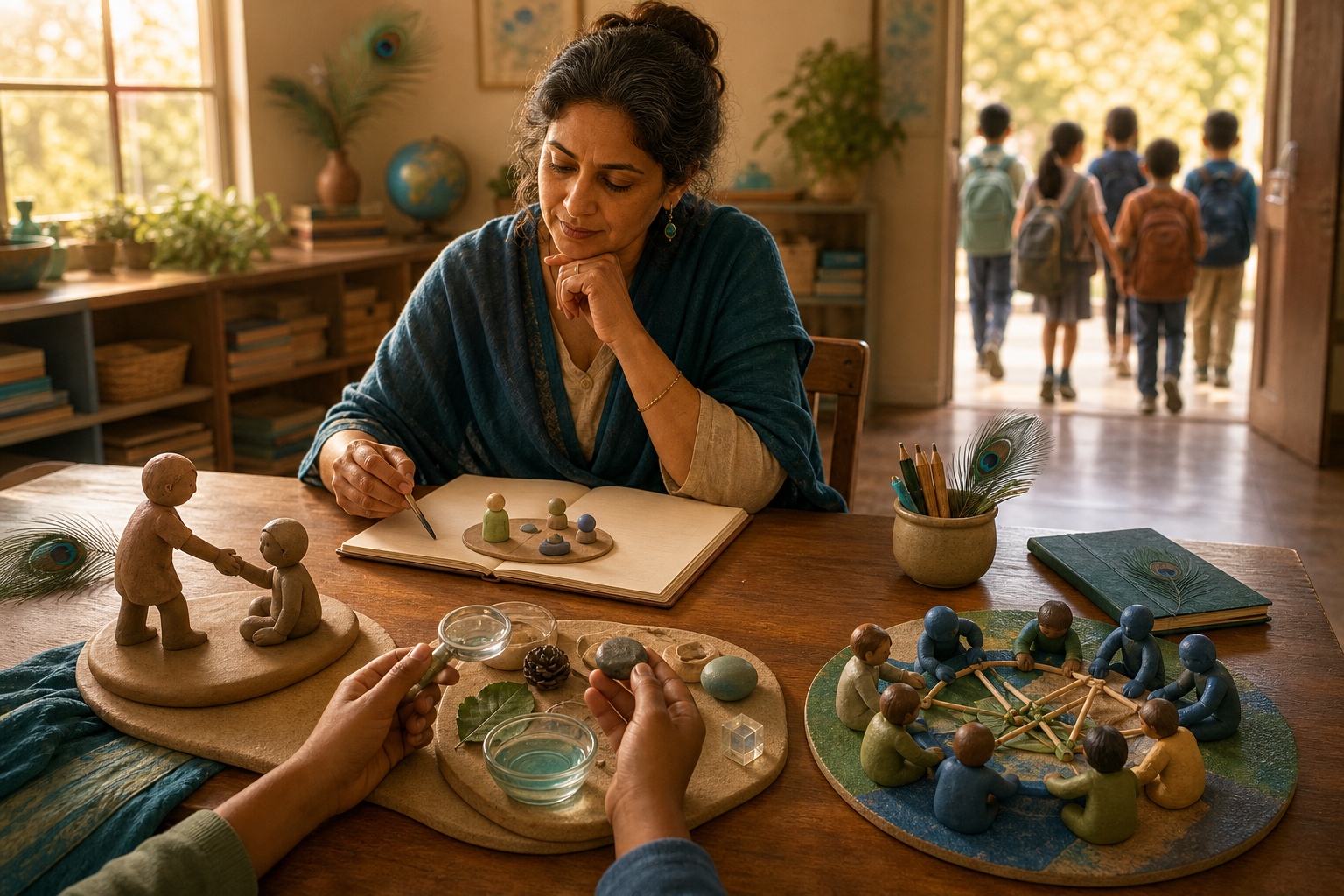
Krishna-conscious education is theological at its root: knowledge has purpose, the self is more than a bundle of appetites, and human ability should be used in responsible service. Its classroom expression, however, must be more precise than asking children to “be spiritual.”
Begin with a small vocabulary of virtues. Satya, ahimsa, karuna, dama and seva can be expressed as truthfulness, non-harm, compassion, self-discipline and service. Each word needs three layers:
- Dharmic meaning: Explain where the value comes from and why it matters within Vaishnava life. Do not erase Krishna from Krishna consciousness merely to make the language sound neutral.
- Educational purpose: State how the value supports learning. Satya supports accurate inquiry; dama supports sustained attention; seva supports responsible participation in a group.
- Observable practice: Describe what a pupil can actually do. “Shows satya” is too vague. “Corrects an inaccurate claim when contrary evidence appears” can be taught, noticed and discussed.
A confident dharmic classroom neither hides its lineage nor demands that every child imitate a believer. In a Vaishnava school, the relationship between conduct, devotion and service to Krishna can be explicit. In a secular or religiously plural school, you can identify a practice’s Vaishnava origin while framing the shared learning goal in language every family can understand. Translation is not dilution when the origin remains honest and participation remains respectful.
Use backward design before choosing activities:
- Name the enduring understanding. For example: truthful speech requires both honesty and care, or knowledge creates responsibility toward other beings.
- Decide what would count as evidence. A pupil might distinguish evidence from opinion, repair a misleading statement, complete a service role or explain the likely effect of a choice on others.
- Choose the learning experience. Only now select a narrative, discussion, reflective routine, experiment or service task that can produce that evidence.
- Check academic alignment. Attach the work to a real curriculum objective rather than treating spiritual content as an extracurricular interruption.
- Check access. Ask whether a pupil can meet the learning objective without being required to affirm a religious belief.
This sequence prevents two common errors. The first is devotional activity with no clear educational purpose. The second is generic character education whose Vaishnava foundation has become so faint that Krishna consciousness survives only in the label.
Use one repeatable routine to change classroom climate
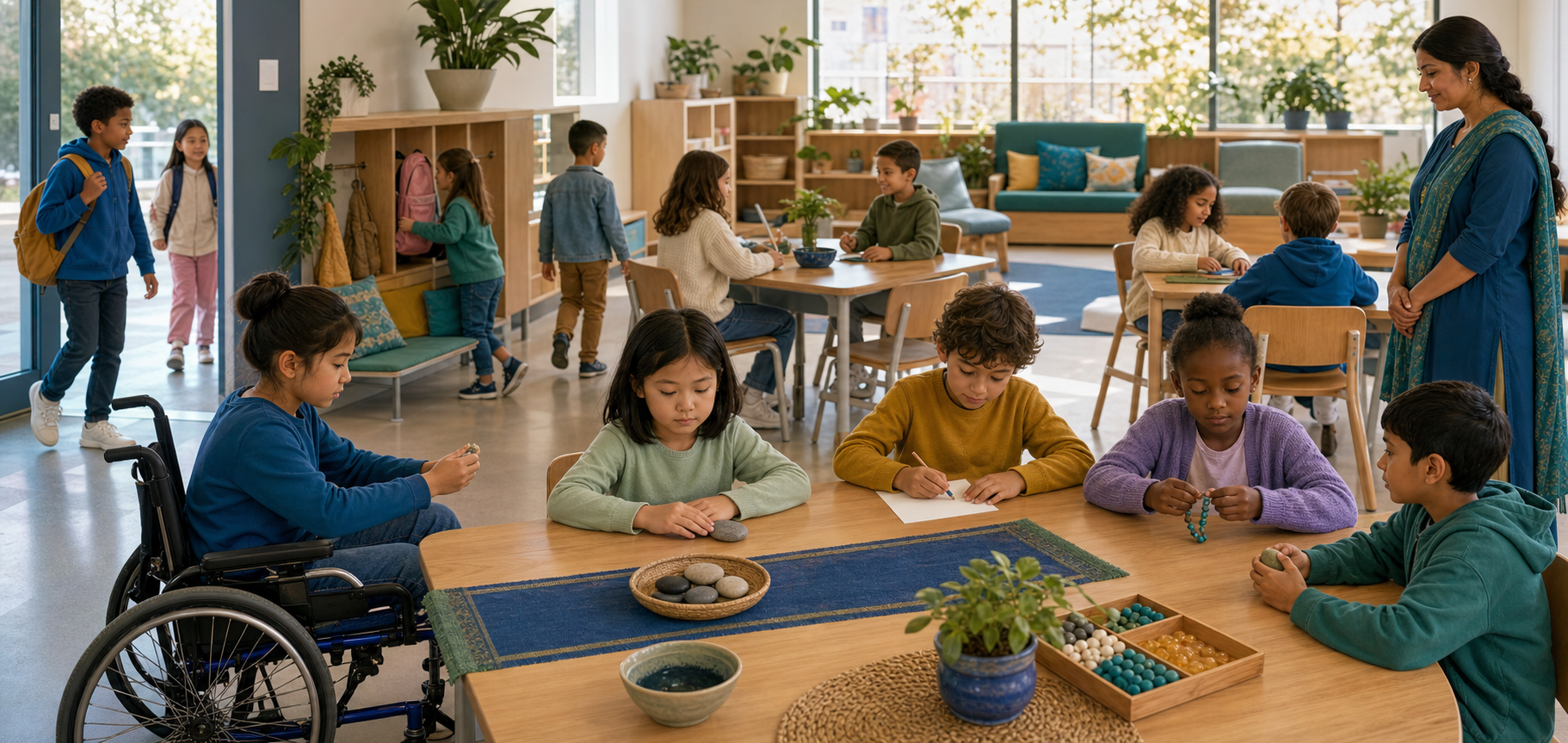
School culture is formed more reliably by repeated moments than by occasional grand events. The arrival of pupils, the transition after a lively activity and the response to conflict are therefore better starting points than a crowded programme of new initiatives.
A calm-start protocol
Introduce one calm beginning and keep its sequence stable:
- Give a consistent signal. Use the same visual, sound or spoken cue so pupils know that the transition has begun.
- Offer an accessible focus. Depending on the setting, this could be silent attention to the breath, private repetition of a sacred name, a gratitude line, quiet reflection or attentive listening to a short kirtan passage.
- Name the educational purpose. Tell pupils that the routine is meant to settle attention, notice their present state and prepare them to learn.
- Move directly into the first task. A retrieval question, reading prompt or clearly displayed instruction connects inner steadiness to purposeful work.
- Observe the transition. Notice repeated prompting, low-level interruption, readiness to begin and pupils’ ability to explain why the routine exists.
Quiet japa-inspired focus, breath awareness, gratitude writing and kirtan-based listening are all possible forms, but they are not interchangeable in every school. Explicit japa or kirtan may belong naturally in a Vaishnava setting. A plural classroom may require an invitational format and an equivalent quiet option. Decide this before launching the routine, not after a child or parent objects.
Keep four guardrails in place:
- Do not treat devotional participation as proof of good behaviour.
- Do not require pupils to disclose whether they prayed, believed or felt a spiritual experience.
- Do not turn silence, mantra or reflection into a punishment after misbehaviour.
- Do not introduce several reflective routines at once. If the classroom changes, you need to know which practice contributed and whether some pupils experienced it differently.
The teacher needs a routine too. Before pupils arrive, pause long enough to identify the disposition you intend to model: truthful speech, calm restraint, compassion with a clear boundary, or service to the learner in front of you. This is reflective practice as daily sadhana. Its classroom value appears in your tone, consistency and response under pressure, not in announcing that you have completed a spiritual exercise.
Put dharma inside academic planning, not beside it
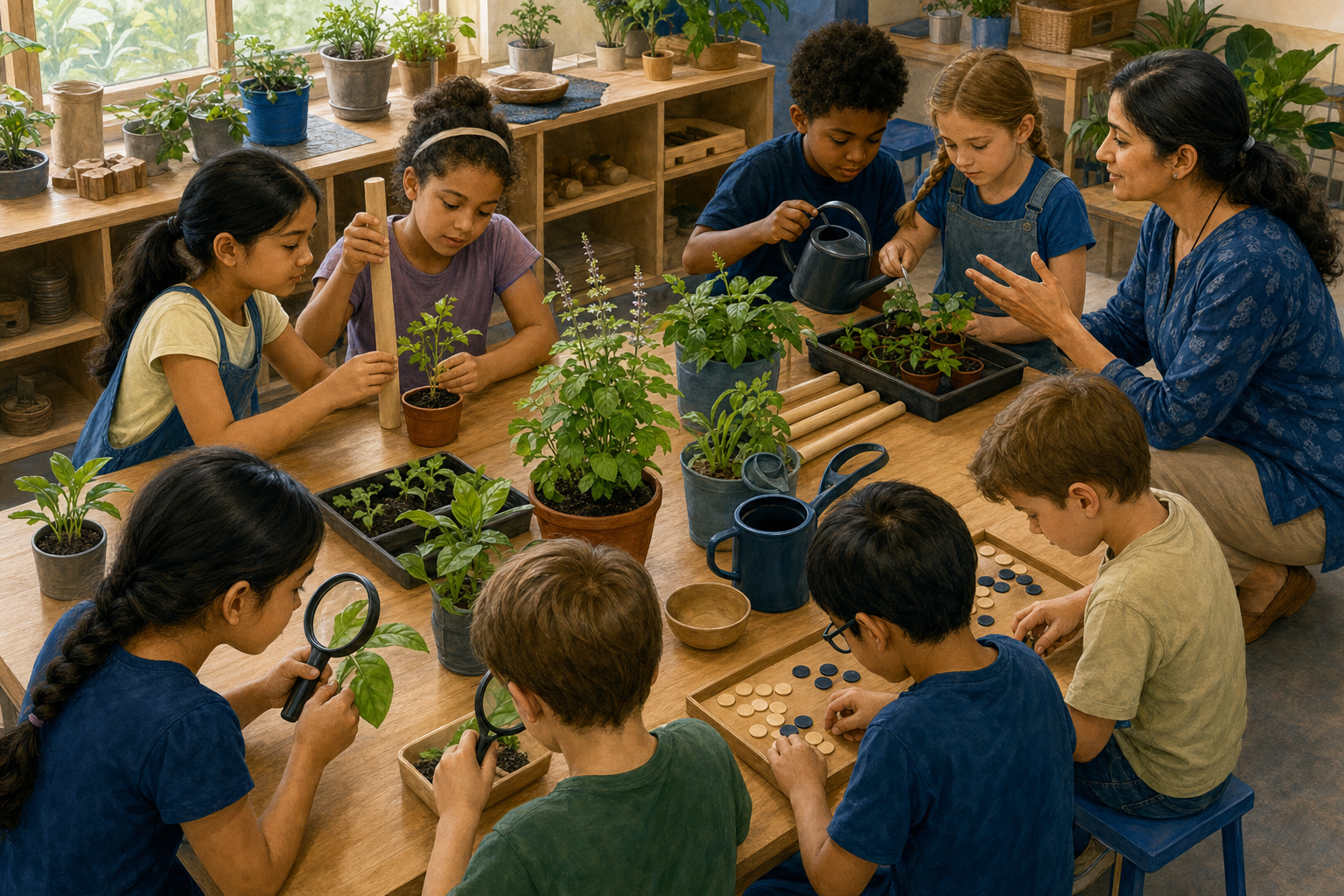
A Krishna-conscious curriculum should make academic study more coherent. If spiritual material displaces the subject objective, pupils receive neither rigorous education nor a serious encounter with tradition. If the dharmic lens changes the questions pupils ask, the evidence they examine or the responsibility they infer from knowledge, integration has begun.
| Subject | Academic purpose | Krishna-conscious lens | Visible evidence of learning |
|---|---|---|---|
| Literacy | Analyse voice, motive, character and argument | Use epic narrative or devotional poetry to examine truthfulness, duty, temptation, mercy and responsible choice | A pupil supports an interpretation with textual evidence and addresses a plausible alternative |
| History and geography | Investigate place, movement, exchange, continuity and identity | Study pilgrimage, sacred places and cultural exchange without reducing a tirtha to a tourist destination | A pupil explains how geography and belief influence one another while distinguishing evidence from assumption |
| Science | Develop inquiry, causal reasoning and evidence-based explanation | Ask how interdependence, stewardship and food ethics affect the questions people bring to scientific knowledge | A pupil distinguishes an empirical finding from an ethical conclusion, then explains how both can inform a decision |
| Mathematics | Recognise patterns, compare strategies and verify solutions | Introduce an appropriate traditional mental method as one strategy within the required curriculum | A pupil explains why the method works, checks the result and compares its efficiency with another method |
| Religious or values education | Read traditions accurately and reason about meaning | Use age-appropriate passages from the Bhagavad-gita or Bhagavata Purana with their Vaishnava context intact | A pupil identifies the teaching, interprets its ethical implications and compares it carefully with another perspective |
Each plan should contain an academic verb: analyse, compare, calculate, test, explain, evaluate or create. “Encounter Krishna culture” may describe content, but it does not yet describe learning. Require pupils to do something intellectually accountable with that content.
Science needs particular care. A spiritual worldview may shape the ethical importance of an inquiry, but it should not be presented as laboratory evidence. Pupils can investigate an ecosystem with scientific methods and then reason about stewardship as an ethical responsibility. Keeping those forms of reasoning distinct protects scientific literacy and gives the moral discussion greater credibility.
Likewise, a sacred narrative should not become a hunt for the teacher’s approved moral sentence. Let pupils identify the dilemma, examine competing duties, support interpretations and consider consequences. The teacher can state the Vaishnava understanding clearly while still teaching the intellectual habits required for meaningful assent rather than rehearsed agreement.
Assess knowledge, skill and conduct, but never faith
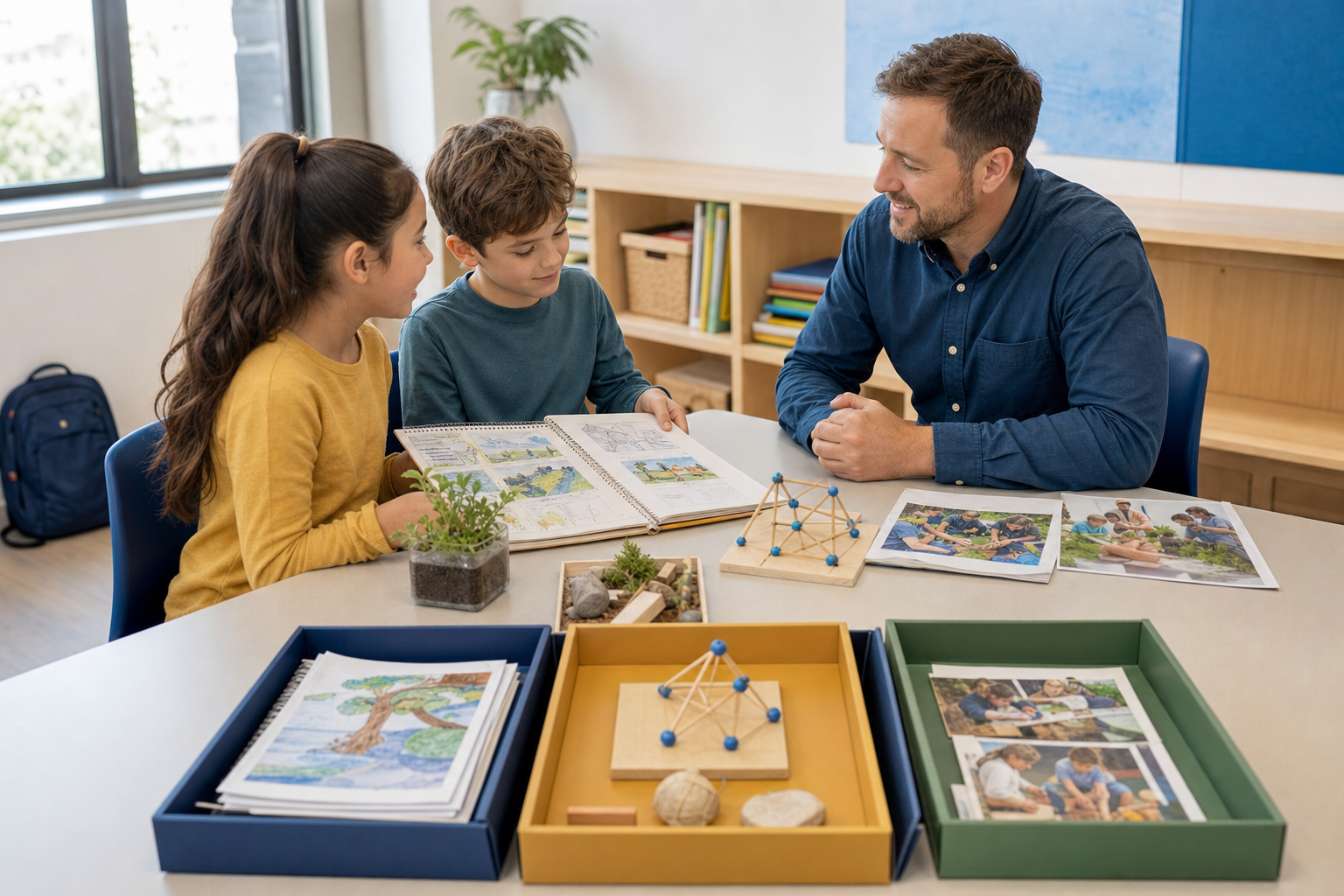
You can evaluate whether Krishna-conscious education is influencing learning without grading a child’s devotion. The line is straightforward: assess knowledge that has been taught, skills pupils have practised and conduct that can be observed. Do not score belief, spiritual emotion, mantra participation or conformity to a presumed religious identity.
- Knowledge: Can the pupil explain satya, ahimsa or seva in the context in which it was taught? Can the pupil identify the relevant teaching in a narrative?
- Skill: Can the pupil listen closely, use evidence, regulate a transition, reflect on a decision or contribute effectively to a shared task?
- Disposition: Does the pupil correct an inaccuracy, return to work after distraction, listen without interrupting, fulfil an agreed responsibility or attempt an appropriate repair after causing harm?
Reflective journals, formative checks and rubrics for cooperation, respect and integrity can make these dimensions visible. Write rubric descriptors as actions rather than personality judgements. “Completes the agreed group role and checks who still needs help” is useful evidence. “Is a selfless child” is an inference about character and may reward temperament, fluency or compliance instead of learning.
Reflection should also remain safe. A journal prompt such as “What effect did your choice have, and what would you change?” invites ethical reasoning. “Describe your relationship with Krishna” asks for a private disclosure and should not be required or graded. In devotional settings, personal spiritual reflection can have an honoured place, but adults must distinguish pastoral practice from academic assessment.
Keep compassion and accountability together
Ahimsa does not require a teacher to ignore disruption, and karuna does not remove responsibility. A restorative response can follow a clear sequence:
- Name what happened without attacking the pupil’s identity.
- Identify who or what was affected, including the learning of the class.
- Invite the pupil to explain without allowing explanation to erase responsibility.
- Agree on a proportionate repair: correcting a false statement, restoring material, repeating a task safely or making a useful contribution.
- Follow up to see whether the repair occurred and whether the underlying pattern continues.
This approach makes non-harm active rather than sentimental. Compassion without a boundary leaves other pupils unprotected; punishment without restoration may secure momentary compliance without teaching better action.
Design for choice, then improve through inquiry
Inclusion should be designed before a spiritual practice reaches the classroom. An opt-out improvised in public can embarrass a child and make non-participation look like disobedience. Build an equivalent route into the original plan so every pupil can meet the educational objective with dignity.
Before introducing a routine, festival, text or service activity, record:
- the educational purpose in plain language;
- the Vaishnava origin and meaning of the practice;
- whether participation is required, invitational or chosen from equivalent options;
- the non-devotional alternative, where one is needed;
- adaptations for sensory, communication, dietary and physical access;
- what families need to know before the activity;
- what you will observe to judge benefit, exclusion or unintended pressure.
A family note can be brief and exact: During our morning settling routine, pupils may use silent breathing, private reflection or a gratitude prompt. No pupil will be asked to affirm a belief. The routine supports attention and readiness for the first lesson. If kirtan, japa or scriptural recitation is included, say so plainly and explain the participation choices. Trust grows from clarity, not from making a devotional practice sound like something else.
The same principle applies to assemblies and festivals. Teach what the observance means, how Vaishnavas practise it and why it matters. Make invitations visibly invitational. Provide quiet space where appropriate, plan diet-aware events, and never infer a family’s belief from a child’s name, food or willingness to participate.
A dharmic frame can also deepen interfaith understanding. Vaishnava compassion and service resonate with Buddhist metta and mindfulness, Jain ahimsa and aparigraha, and Sikh seva and sarbat da bhala. Use those resonances to open careful comparison, not to claim that the traditions are identical. Name each teaching in its own setting, let practitioners retain their distinct vocabulary and ask pupils to notice both shared ethical concerns and meaningful differences.
Once the design is sound, improve it through a modest inquiry cycle:
- Choose one problem. It might be an unsettled morning transition, weak listening during discussion or difficulty repairing peer conflict.
- Record a baseline. Note repeated prompts, low-level interruptions, delayed task starts, pupil explanations and relevant work samples before changing the routine.
- Introduce one practice. Keep the signal, purpose and participation choices consistent.
- Collect more than one kind of evidence. Combine teacher observation with pupil voice, work samples, learning walks or reflective entries. Include evidence from pupils who do not choose the devotional form.
- Review both benefit and burden. Ask whether learning improved, whether the practice was understood, whether anyone felt coerced and whether staff applied it consistently.
- Retain, refine or stop. Do not scale a practice merely because adults like its symbolism. Scale it when it serves the stated educational purpose without compromising inclusion.
Attendance, punctuality, low-level disruption and pupil voice can contribute to a wider whole-school picture, but avoid claiming that one reflective routine caused every change. Look for repeated patterns and compare them with what pupils and teachers actually say. A calm-looking room is not enough if children cannot explain the purpose or if silence has been secured through pressure.
Key takeaways
- Begin with one Vaishnava value and define the learning behaviour that would make it visible.
- Name the Krishna-conscious foundation honestly while giving every pupil an accessible route to the educational objective.
- Use backward design: purpose first, evidence second and activity third.
- Connect spiritual material to a genuine subject objective and preserve the difference between theological, ethical and empirical claims.
- Assess knowledge, reasoning and observable conduct, never the presence or intensity of faith.
- Test one repeatable practice, listen to pupils and families, and expand only what proves educationally useful and inclusive.
This week, choose one class, one transition and one disposition. Write down the purpose, the participation choice and the behaviour you expect to observe. Teach the routine consistently, then examine its effect with the pupils who experience it. That is small enough to begin now and substantial enough to become a Krishna-conscious culture rather than a passing theme.
References
