

You can demand justice for students and reject anti-Hindu hostility at the same time. In fact, you should. The moment either concern is used to erase the other, someone else’s agenda has displaced the truth.
The immediate task is to keep two questions separate: what happened to the examination, and what happened at the protest. That discipline matters when you are a student deciding whether to join, a parent trying to assess alarming videos, or a Hindu organisation considering a public response.
Keep exam accountability at the centre
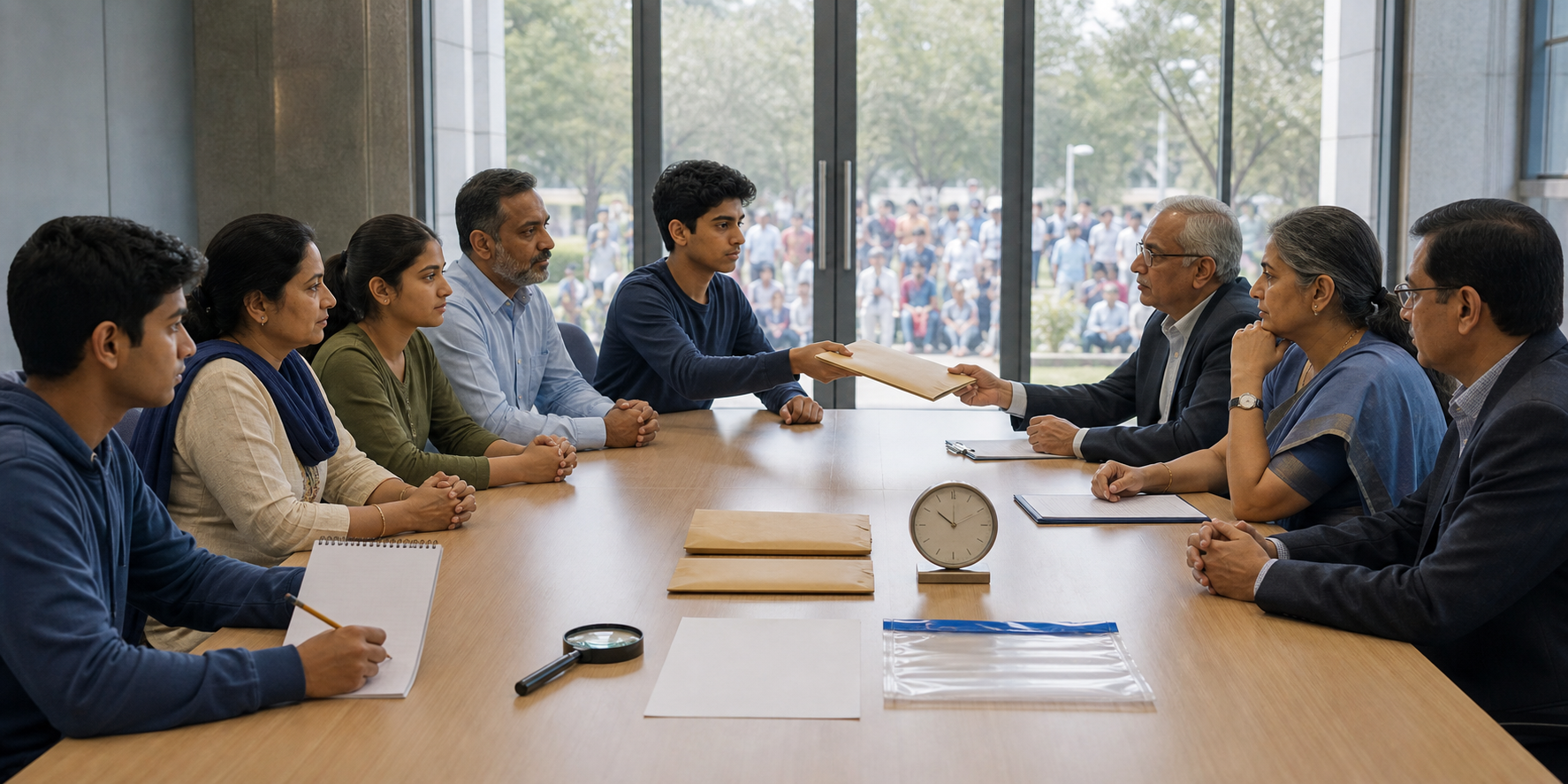
The 2026 NEET-UG protests at Delhi’s Jantar Mantar began amid allegations of examination leaks and irregularities. For candidates whose years of preparation may have been compromised, demands for an inquiry, appropriate relief, punishment of culprits and structural reform are legitimate. Later misconduct by some participants would not make the examination grievance disappear.
That does not mean every proposed remedy is automatically fair. A nationwide re-examination, for example, would impose another high-stakes test on candidates who may not have benefited from any breach. The remedy should match the verified reach of the irregularity. Before endorsing a demand, ask what evidence would justify it and which students would bear its cost.
A serious accountability campaign should put four requests in writing:
- Define the suspected failure. State what irregularity is alleged, where it allegedly occurred and what remains unknown. Do not turn suspicion into a nationwide conclusion without evidence.
- Preserve and examine the records. Demand a transparent inquiry capable of tracing responsibility rather than a vague assurance that the matter is being reviewed.
- Set a public decision process. Candidates need to know who will decide the remedy, what evidence will be considered and when the decision will be communicated.
- Match relief to proven harm. Punish those responsible, close the exploited loopholes and protect candidates who did not participate in wrongdoing.
This is the first safeguard against protest drift. When the demands are precise, written and repeatedly stated, opportunistic actors have less room to redefine the movement around an unrelated ideological cause.
Identify anti-Hindu hostility precisely

Hinduphobia is a serious charge, so it should describe identifiable conduct rather than function as a label for every hostile political opinion. Precision strengthens the Hindu case. Overstatement weakens it.
Use four tests when assessing a slogan, speech, placard or confrontation:
- Object: Is the criticism directed at an examination authority, government policy, political party or police action, or at Hindus as Hindus?
- Language: Does it make an argument, even an angry one, or does it use religious slurs, dehumanising imagery or expressions of contempt toward a community?
- Scope: Does it criticise named people for specific conduct, or assign collective guilt to Hindus and Hindu institutions?
- Effect: Does it invite disagreement, or threaten, intimidate, exclude or encourage harm because of Hindu identity?
A demand for examination accountability is not anti-Hindu. Criticism of the Union government is not automatically anti-Hindu or anti-India. Criticism of police conduct is not proof of hostility to the nation. Even an offensive opinion about a belief is not necessarily an attack on every person who holds it.
The converse also holds. A legitimate student cause does not provide immunity for religious abuse. If a speaker introduces collective contempt for Hindus, the original grievance cannot cleanse that conduct. Protest organisers should repudiate it directly and remove it from their official platform.
A Dharmic response should hold ends and means together. Justice for candidates cannot be built through hatred, while public order cannot become an excuse to neglect a credible examination grievance. This is not fence-sitting. It is the refusal to sacrifice one duty in the name of another.
Verify protest evidence before amplifying it

The controversy widened with allegations of violence, attacks on police and journalists, and participation by political, ideological and foreign-linked actors. These are serious claims, but seriousness is a reason to verify them, not a substitute for verification. A clipped video can establish that words were spoken; it may not establish when they were spoken, who spoke them, whether organisers endorsed them or how the surrounding crowd responded.
Before you repost an allegation, perform this check:
- Find the earliest available upload. Reposts often remove the date, location and surrounding footage.
- Watch what comes before and after. Record the exact words and visible actions rather than paraphrasing them into a stronger claim.
- Separate observation from inference. “A person displayed this placard” may be visible. “The entire protest adopted this position” requires additional evidence.
- Identify the relationship carefully. A speaker, attendee, organiser, invited politician and passer-by do not carry the same authority. Do not assign an identity or affiliation merely from appearance.
- Look for corroboration. A second angle, a longer recording, an official statement or a clear response from organisers can change the meaning of a short clip.
- Preserve rather than provoke. Save the original link, upload date and relevant context. If the material appears to show a threat or crime, use a lawful reporting channel. Do not publish private information, encourage a pile-on or confront the person yourself.
The same standard applies to claims of foreign involvement. A foreign connection, if established, may be relevant to funding, coordination or messaging. It does not by itself prove that a person committed violence, opposed India or expressed hatred toward Hindus. Specify the connection and the conduct separately.
Also resist collective blame in both directions. One hateful speaker does not define every student. One violent participant does not invalidate every demand. Equally, the presence of peaceful students does not make intimidation by others harmless. Judge people and organisations by evidence of their own words, actions and responsibilities.
Give each participant a concrete job

Students and parents: protect the credibility of the demand
If you are joining or supporting an exam-accountability campaign, ask organisers for a short public charter. It should name the examination grievance, the requested inquiry, the proposed relief and the standard of non-violent conduct. It should also state that religious hatred and unrelated political slogans are outside the campaign’s mandate.
Keep examination evidence separate from protest footage. Use one record for alleged irregularities and another for incidents at demonstrations. Mixing them creates the false impression that evidence of misconduct at a rally proves an exam leak, or that doubt about a rally incident disproves the examination complaint.
Before attending, find out who is authorised to speak for the campaign and how organisers will respond if the gathering is hijacked. If unrelated or hateful messaging appears, do not argue inside an agitated crowd. Move to safety, document only if it is safe, notify organisers and make your own position clear through a calm public statement.
Hindu organisations: challenge hatred without abandoning students
The most credible response has two sentences, not one: support a transparent investigation of the examination allegations, and oppose documented anti-Hindu abuse or intimidation. This prevents anyone from presenting concern about Hinduphobia as indifference to candidates.
When publishing an allegation, provide the exact words or conduct, the available context and the limit of what can be concluded. Ask organisers whether the speaker represented them and whether they repudiate the conduct. Correct the record if new footage changes the interpretation. Accuracy is not a concession to opponents; it is what distinguishes cultural advocacy from partisan rumour.
Do not circulate faces with speculative names, employers, schools or family details. That can expose an innocent person to harassment and distract from the conduct that actually needs scrutiny. Where there is a credible threat, assault or targeted incitement, preserve the evidence and pursue the appropriate lawful channel.
Organisers, officials and media: maintain separate accountability tracks
Organisers should publish their authorised demands, named spokespersons and conduct rules. When a violation occurs, they should say whether the person was affiliated with the campaign, what action was taken and whether the offending message is rejected. Silence leaves the movement’s position open to appropriation.
Officials should not make examination relief contingent on the political character of a protest. Investigate the alleged irregularities on their evidence. Investigate violence, threats or attacks on their evidence. Public updates should distinguish verified facts, active allegations and unresolved questions.
Media and commentators should describe the scale of any claim honestly: “a participant,” “several speakers,” “an organising group” and “the protest” are not interchangeable. That one grammatical choice can determine whether the public sees documented responsibility or manufactured collective guilt.
Key takeaways
- The examination grievance and alleged protest misconduct require separate evidence, decisions and remedies.
- Criticism of an authority, government or policy is not automatically Hinduphobia; identity-based contempt, collective blame, intimidation and threats cross a different line.
- A short clip can document an incident without proving who organised it or what an entire crowd believed.
- Students should insist on written demands, authorised spokespersons and a public conduct code before lending their names to a movement.
- Hindu advocates are strongest when they defend candidates, document anti-Hindu conduct precisely and reject doxxing or collective retaliation.
If you are deciding what to support, start with the two-ledger test: write down the verified examination facts in one column and the verified protest conduct in another. Demand justice in both, but never use an entry in one ledger to erase the other. That is how you keep a rightful student cause from being hijacked and a rightful defence of Hindus from being dismissed.
References
