
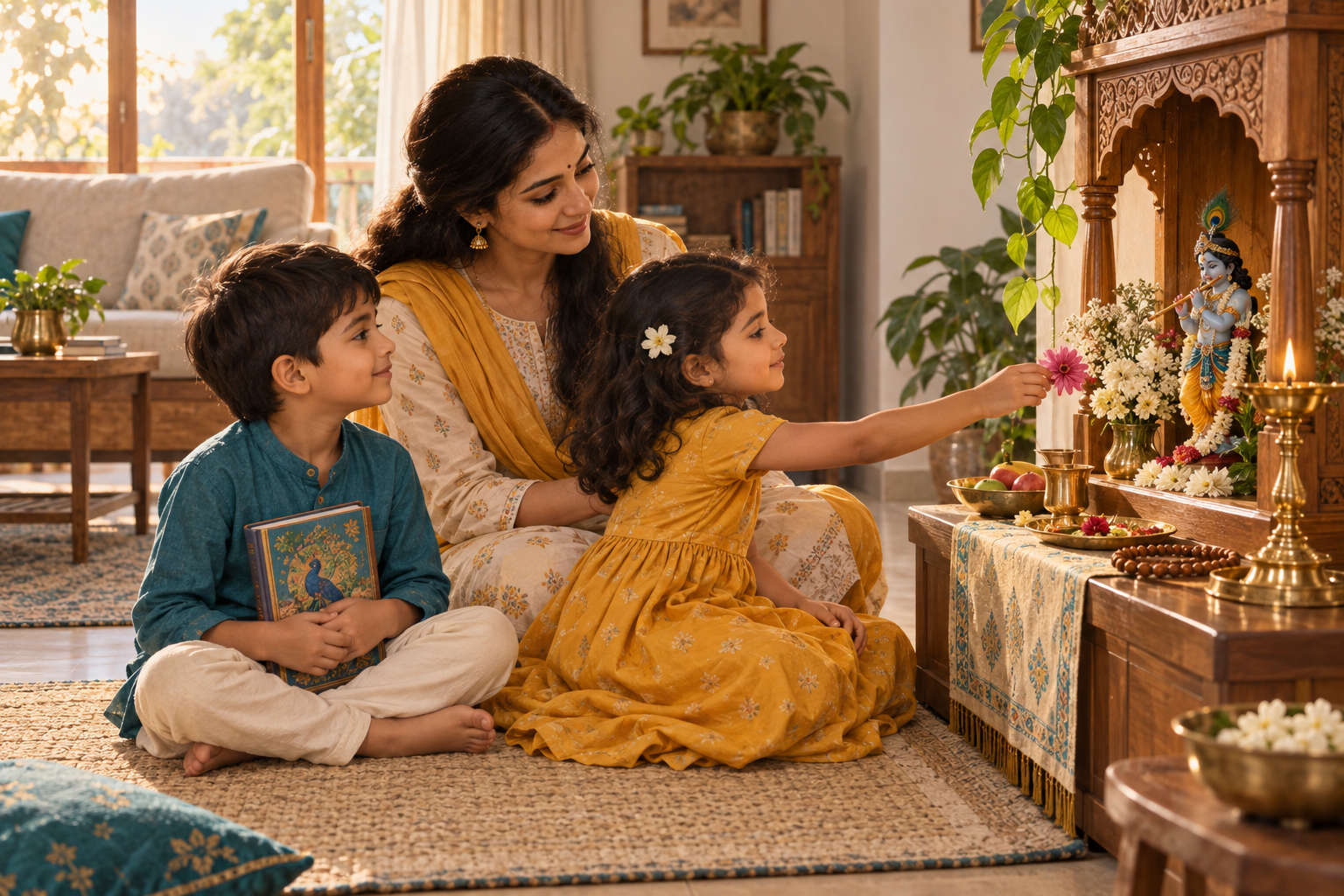
You want your child to know bhakti as a living relationship with the Divine, not as a collection of rules performed to please adults. The difficult part is rarely finding one more story or activity. It is building a home rhythm that joins devotion, understanding, conduct, and honest questions.
You do not need to turn your home into a classroom. Start with one practice your family can sustain, give your child a real part in it, and let its meaning become visible in ordinary family life.
Build a rhythm before you build a curriculum
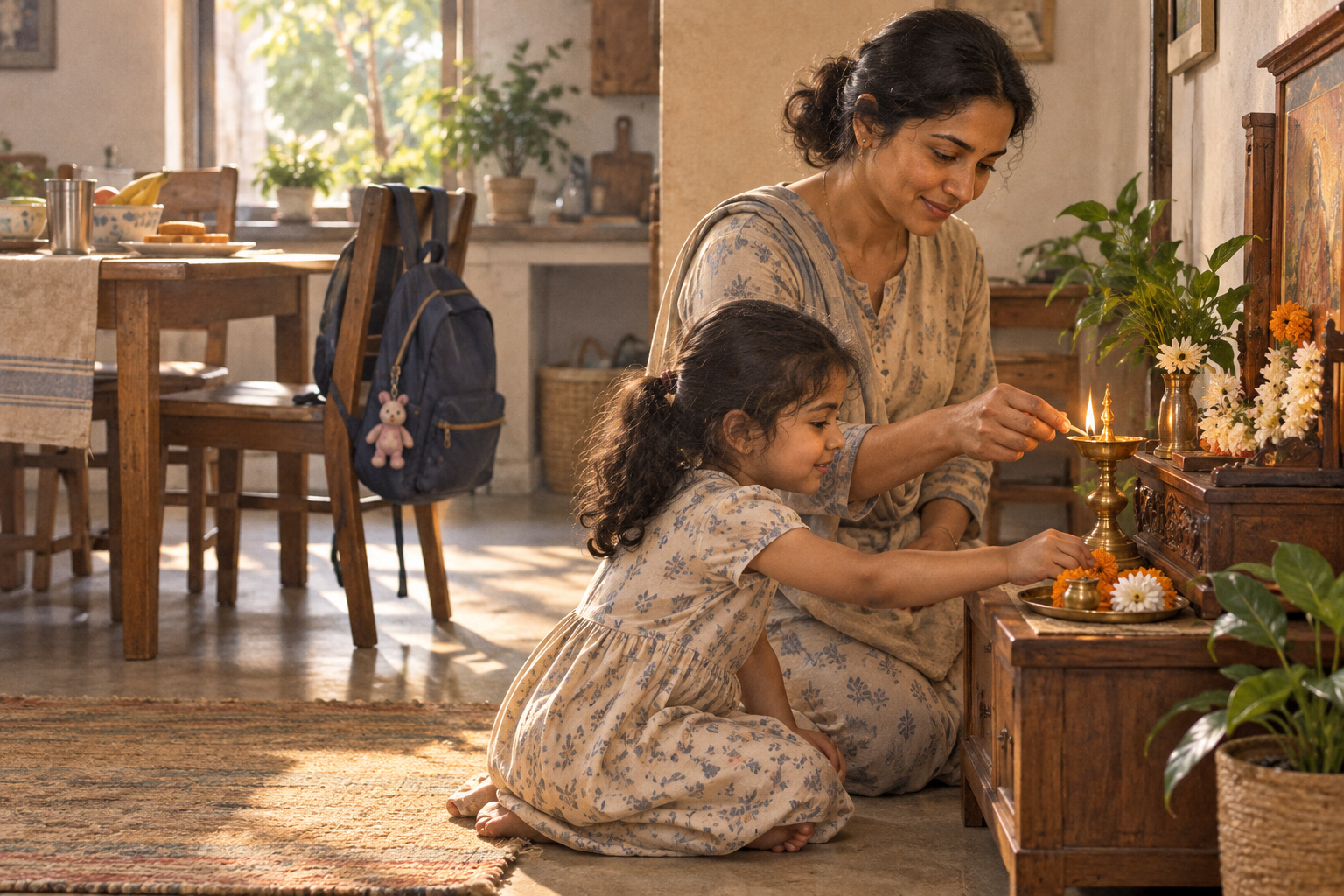
Children usually meet bhakti first through atmosphere: the lamp being prepared, an aarti sung together, a familiar mantra, folded hands, prasad shared without fuss, or a small act of seva. These repeated experiences give later explanations somewhere to land.
Choose a devotional anchor that already belongs naturally in your household. Do not begin with an ambitious schedule assembled from everything you think a Dharmic child ought to know. A smaller practice that survives busy days is more useful than an elaborate plan that appears only when everyone is rested.
- Use a stable cue. Connect the practice to something that already happens, such as waking, returning home, eating together, or preparing for sleep.
- Keep the sequence familiar. For example: prepare the space, offer or sing, sit quietly, and close with one act of gratitude.
- Give the child a real responsibility. The child might arrange the books, bring water, choose a song from an approved set, distribute prasad, or restore the space afterward.
- Explain one meaning at a time. Tell the child why this gesture matters today instead of delivering a lecture on every symbol in the room.
- End without dragging the practice out. Consistency should not depend on the child pretending to feel absorbed long after attention has gone.
Keep two things distinct. The household may have a shared observance, but you cannot command a particular inner emotion. Invite participation and teach respectful conduct; do not demand a display of devotion. That distinction protects the practice from becoming theatre.
Connect worship, story, and seva

A child can memorise devotional language without understanding how bhakti changes a choice. The remedy is not a harder quiz. It is a clear connection between worship, narrative, and action.
When you tell a sacred story, resist the urge to explain every lesson before the child has responded. Ask what the person in the story loved, feared, chose, or sacrificed. Ask where pride, loyalty, courage, compassion, or self-interest appeared. Then let the child retell the turning point in their own words. Retelling shows you what the child actually understood; recitation often shows only what was remembered.
Complete the lesson with a related act of seva. Gratitude can lead to helping prepare food or caring for the worship space. Compassion can lead to noticing someone who is being left out. Reverence can lead to careful treatment of books, food, shared spaces, animals, or the natural world. The act does not have to be grand. Its purpose is to prevent devotion from being confined to the shrine.
A simple planning pattern is enough:
- Practice: What will the child do with the body or voice?
- Meaning: What single idea will you explain?
- Story: What choice or relationship will make that idea concrete?
- Seva: What action will carry it into the household?
- Reflection: What open question will let the child speak?
Use this pattern repeatedly with different themes. Repetition is not a failure of creativity. In bhakti education, repeated forms can reveal deeper meanings as a child’s attention and judgement mature.
Match the method to the child, and make room for doubt

For very young children
Use imitation, rhythm, movement, pictures, and small physical tasks. Let the child place an approved object, join a refrain, make a simple offering, or act out a moment from a story. Give brief explanations in concrete language. At this stage, the child is learning what your family does and what emotional tone surrounds it.
For children who can read and reason independently
Invite ownership. The child can keep a reflection notebook, draw a story sequence, prepare a question, compare the motives of different characters, or choose a household seva connected to the lesson. Do not make every activity look like schoolwork. Some children will speak more freely while drawing, walking, cooking, or arranging the worship space.
For adolescents
Expect questions about truth, fairness, identity, authority, hypocrisy, and differences among traditions. A teenager who challenges an explanation may be trying to decide whether it can bear the weight of adult life. Treating every objection as disrespect teaches concealment, not conviction.
When a difficult question comes, first identify what kind of question it is. A factual question needs an accurate answer. A question about interpretation may have more than one Dharmic answer. A personal question may be about belonging, embarrassment, conflict, or trust rather than doctrine. If you do not know, say so plainly and return to it after consulting someone you trust. An honest incomplete answer is safer than an invented certainty.
Do not use divine punishment to frighten a child into compliance, and do not turn normal mistakes into evidence that the child lacks devotion. Correct the behaviour that needs correction. Then explain the value involved and show what repair looks like. Fear may produce outward obedience, but it cannot serve as proof of bhakti.
In a family containing more than one lineage or style of worship, name your own practice clearly without teaching contempt for another. A child can learn that the household follows a particular path while still recognising reverence, truthfulness, self-restraint, compassion, and seva beyond that path. Clarity about one’s inheritance does not require caricaturing someone else’s.
Use resources and sanga without outsourcing your role
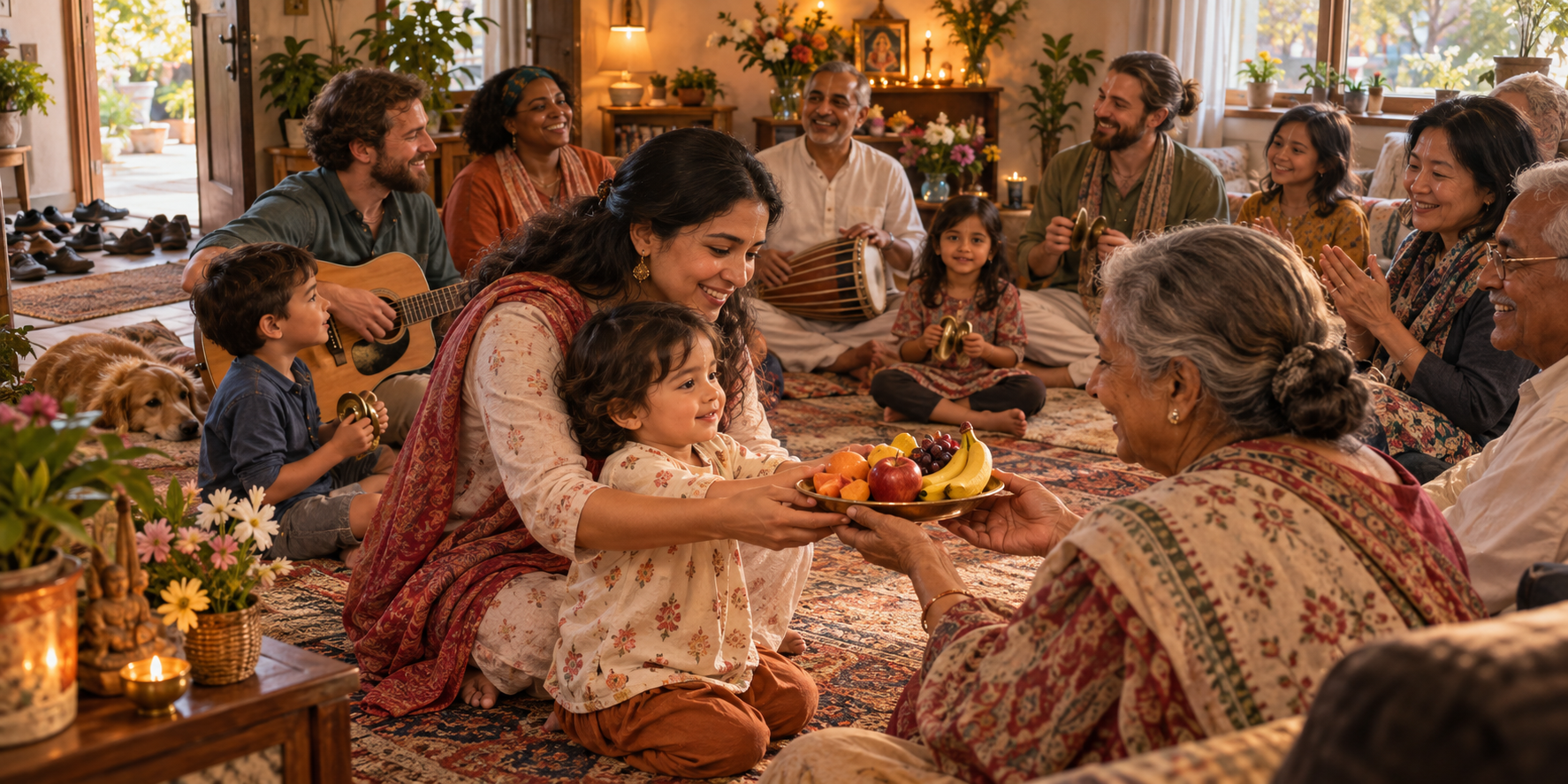
Home practice benefits from good material and a wider devotional community. Families looking for structured prompts can examine options such as a children’s bhakti newsletter, sanga registration, and a story-led journey featuring Lali and Gopal. Choose a resource because it solves a defined need, not merely because it contains more content.
Before subscribing, registering, or buying, ask what is currently missing. Do you need stories that hold the child’s attention, prompts that help you lead a discussion, contact with other families, or a structure that makes practice more regular? Select one resource against that need and use it long enough to see whether it changes the household rhythm.
Evaluate a children’s sanga with the same care you would apply to any environment where adults teach children. Look for clear supervision, age-appropriate teaching, transparent communication with parents, a way to raise concerns, and teachers who can receive sincere questions without humiliation. Watch the tone as closely as the curriculum. A group can transmit devotional vocabulary while also transmitting anxiety, rivalry, or sectarian contempt.
A newsletter, class, or book should come back into conversation at home. Ask the child to choose one idea worth remembering, one point that was confusing, and one action the family could try. If nothing travels from the resource into family life, adding more resources will probably add volume rather than formation.
Measure progress by more than recall. Notice whether the child participates with growing initiative, connects a story to a real decision, asks more precise questions, performs seva without seeking attention, or treats the practice with care even when enthusiasm varies. These are signs to observe, not a scorecard to display or compare.
Key takeaways
- Begin with one stable household practice rather than an overloaded curriculum.
- Give your child a meaningful role instead of making them a passive audience.
- Connect every lesson to worship, a story, a real choice, and an act of seva.
- Adapt the method as the child moves from imitation to independent judgement.
- Welcome difficult questions and distinguish facts, interpretations, and personal concerns.
- Choose resources and sangas for a defined need, then bring what was learned back into family life.
- Look for growing attention, responsibility, compassion, and honest reflection rather than devotional performance.
Choose the devotional moment your family can most reliably protect. At the next occurrence, give your child one genuine responsibility and ask one open question about its meaning. That modest beginning is enough. Let abhyasa deepen it.
References

Leave a Reply
You must be logged in to post a comment.