

If you are choosing a time for puja, vrata, japa, or another observance on August 1, the main trap is treating the English date as a single lunar day. It is not. The tithi changes during the evening, while the civil date and weekday remain the same.
The practical task is to place your observance on the correct side of that transition, then confirm the displayed clock time for your location. You should not treat the tithi alone as a universal declaration that a period is auspicious.
The tithi change that governs August 1
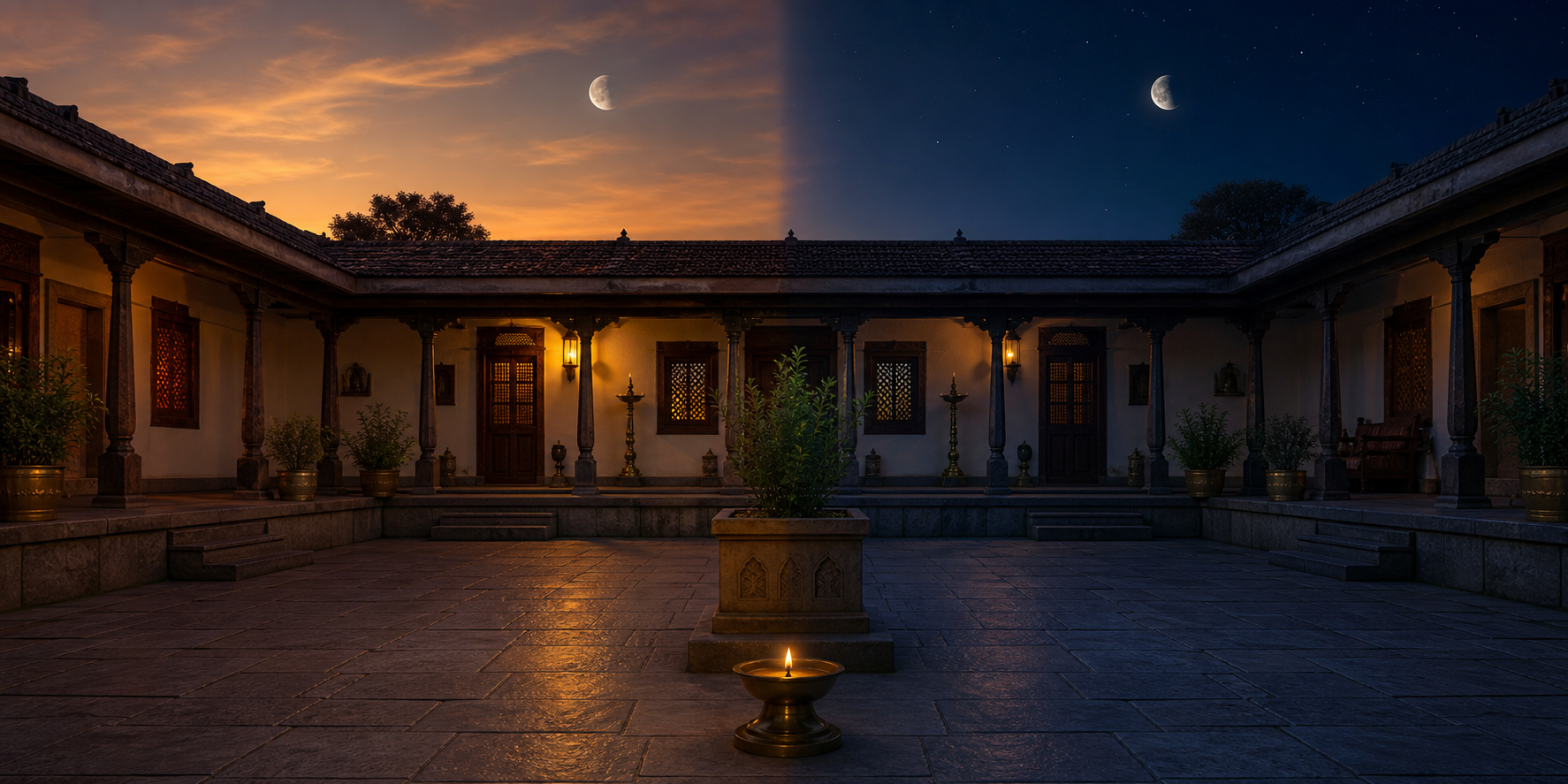
On Saturday, August 1, 2026, Krishna Paksha Tritiya continues until 9:28 PM; Krishna Paksha Chaturthi begins afterward. Krishna Paksha is the waning, or dark, half of the lunar month. Tritiya is its third tithi, while Chaturthi is the fourth.
A tithi is a lunar-day division, so its boundary does not have to coincide with midnight. This is why both Tritiya and Chaturthi occur within August 1. If a family instruction merely says that a practice belongs on Tritiya or Chaturthi, the transition gives you the first boundary to apply. A festival or vrata governed by a more specific rule may still depend on which tithi prevails at sunrise or during another prescribed part of the day.
| Portion of August 1 | Tithi | Practical reading |
|---|---|---|
| Until 9:28 PM | Krishna Paksha Tritiya | This is the relevant portion when an instruction specifically requires Tritiya, subject to the observance’s own rule. |
| After 9:28 PM | Krishna Paksha Chaturthi | Chaturthi has begun even though the civil date is still Saturday, August 1. |
Use 9:28 PM as a boundary, not as a muhurta
The change at 9:28 PM tells you when one tithi gives way to the next in the listed timing. It does not establish that every earlier Tritiya moment or every later Chaturthi moment is suitable for every ceremony. Tithi is one part of calendrical selection; a muhurta may require additional conditions.
- Name the rule you actually need. Decide whether the practice requires Tritiya, Chaturthi, the tithi present at sunrise, or a separately prescribed period. If the instruction comes from a temple, sampradaya, or family vrata tradition, use that tradition’s rule rather than replacing it with a generic calendar assumption.
- Confirm your city and time zone. Treat 9:28 PM as a listed clock time, not as a time that can automatically be copied worldwide. The local clock reading and any rule tied to local sunrise must be checked in a Panchang prepared for your location.
- Choose the correct side of the transition. For a Tritiya-specific act, plan before the confirmed local end of Tritiya. For a Chaturthi-specific act that only requires the presence of Chaturthi, plan after its confirmed local beginning.
- Leave a practical margin. Do not schedule a Tritiya requirement to begin at the exact minute Tritiya ends. Local conversion, calendar presentation, and the time needed to complete the act can all matter. Once you have verified the local timing, choose a comfortably earlier start if completion within Tritiya is required.
- Check the full Panchang when the ceremony requires a muhurta. Verify the relevant nakshatra, yoga, karana, weekday considerations, sunrise or sunset, and any avoidance periods used by your tradition. The tithi transition cannot supply those missing decisions.
What this daily entry can and cannot answer

If you only need to identify the day’s tithi, the answer is clear: August 1 begins under Krishna Paksha Tritiya, and Chaturthi follows after the evening transition. This is also enough to prevent the common error of assigning Chaturthi only to August 2.
It is not enough to settle every festival date or ceremonial time. A traditional Panchanga considers five limbs: vara, tithi, nakshatra, yoga, and karana. Calendars may also display rashi and several recommended or avoided periods. These are related calendrical readings, but one cannot be safely reconstructed from the tithi alone.
For ordinary home worship with no prescribed muhurta, follow your established daily practice and use the tithi as context. For a vrata with a sunrise rule, a temple observance, or a samskara governed by muhurta, confirm the complete local Panchang and the rule followed by the officiating priest or institution. That check matters more than simply finding a favorable-looking label on a general calendar.
Key takeaways
- August 1, 2026 is a Saturday in Krishna Paksha.
- Krishna Paksha Tritiya lasts until 9:28 PM in the listed timing.
- Krishna Paksha Chaturthi begins after 9:28 PM, before the civil date changes.
- Verify the clock time for your city before using it as an observance deadline.
- Do not mistake the presence of a tithi for a complete shubh muhurta.
Before fixing your plan, write down three things: your city, the rule governing the observance, and whether the act must begin or be completed within the required tithi. Then confirm the local transition and choose a time with enough margin to perform the practice without rushing.