
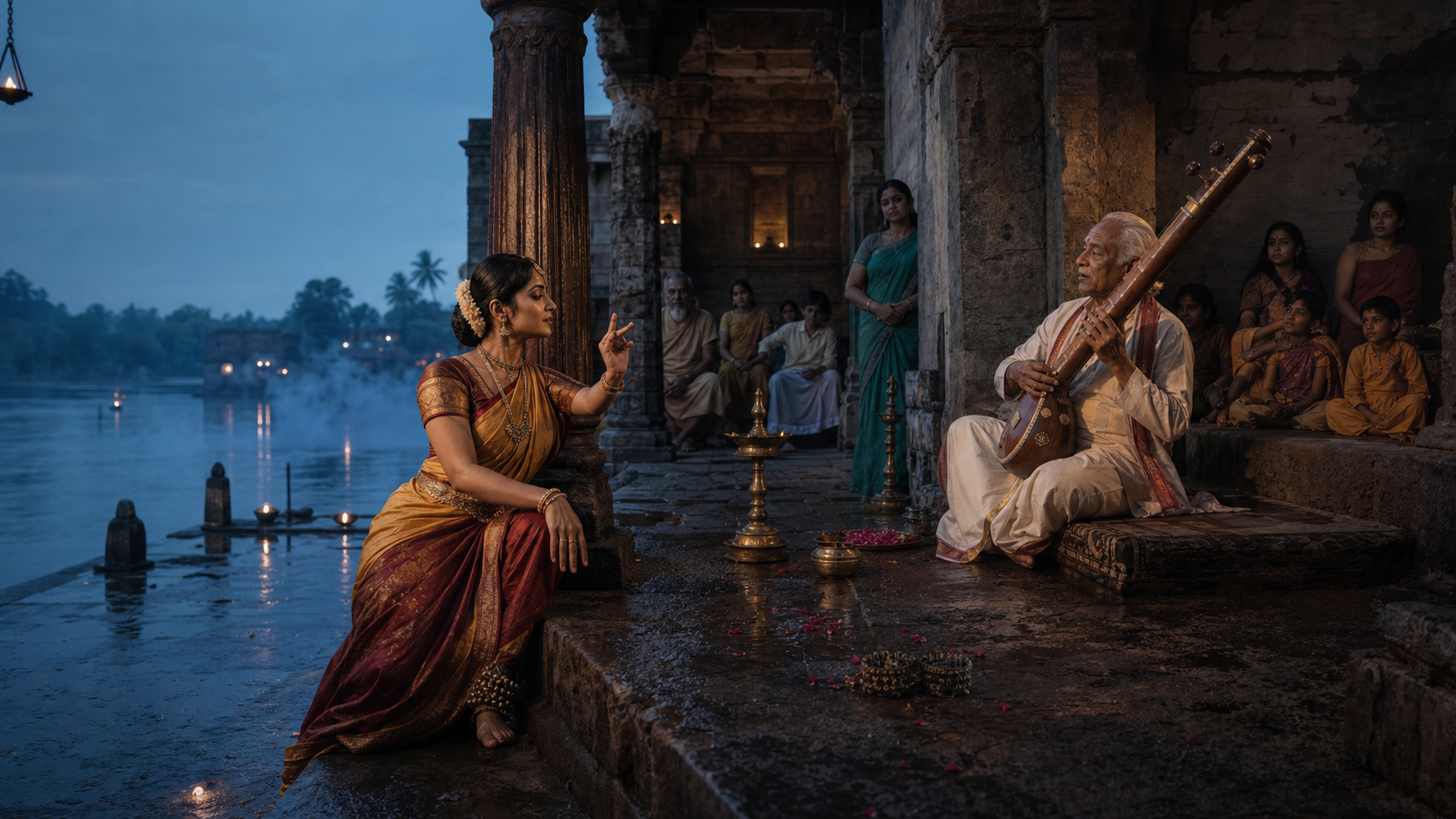
You may remember the songs, the dancers, the riverbanks, the temple courtyards and the wounded artists. But if you want to understand why K. Viswanath’s finest scenes remain moving after their plots are familiar, watch how those elements behave together. Music does not decorate the action. Ritual is not heritage wallpaper. A name, a threshold, a gesture or a line of poetry can quietly complete the emotional meaning of an entire sequence.
The most useful way to approach Viswanath, then, is not to ask only, “What social message does this film deliver?” Ask how the film prepares you to feel its truth before anyone explains it. That shift reveals a coherent cinematic grammar built from rasa, suggestion, artistic discipline and a living exchange between classical and regional culture.
Read the whole scene, not just the visible action
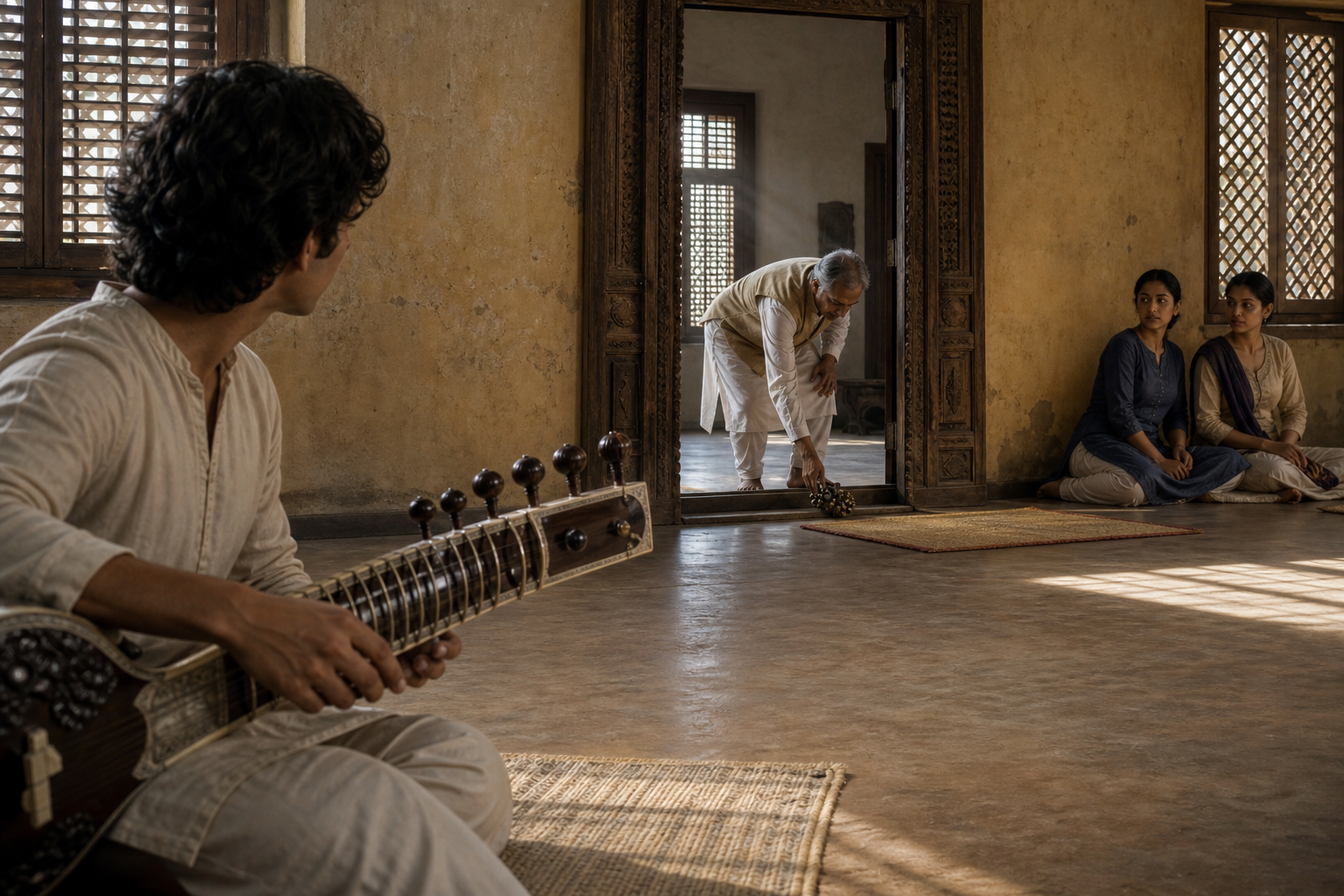
Consider the Janmashtami sequence in Sagara Sangamam. Balakrishna is drunk and hungry, yet he will not cross into his friend’s home because the ceremonial footprints of Bala Krishna lie at the entrance. A flute renders Vyasatirtha’s Krishna nee begane baaro. The protagonist’s name, the child Krishna invoked by the festival, the footprints at the threshold and Krishna’s own instrument all meet in one concentrated dramatic moment.
If you follow only the plot, the scene says that an intoxicated man refuses to enter a house. If you attend to its complete design, it reveals something harder to state directly: Balakrishna’s life is disordered, but his capacity for reverence has survived. Alcohol has damaged his conduct without erasing the sacred boundary within him. Hunger urges him forward; devotion stops his feet. The contradiction is the character.
Viswanath does not need a speech announcing that the fallen artist retains spiritual refinement. The threshold makes the argument. This is dhwani, or suggestion: the deepest significance is carried by relationships among signs rather than by literal explanation. It is also auchitya, aptness. Every chosen element belongs exactly where it has been placed. Remove the festival, the footprints, the music or the name Balakrishna, and the scene still advances the story, but its inner resonance becomes thinner.
This gives you a practical test for any celebrated Viswanath sequence. Identify the visible act, then identify at least three supporting elements: sound, setting, object, name, ritual, lyric, gesture or another character’s response. Ask whether they merely accompany the act or alter its meaning. In his strongest scenes, they converge. The scene becomes a small aesthetic ecosystem in which no element has to shout.
The same method clarifies Sirivennela. Hari Prasad is a blind flutist, while Suhasini cannot speak and expresses herself through painting. When she imagines his nose as a flute, the image does more than identify his profession. It suggests that music is his breath, identity and mode of presence. The visual metaphor and the character’s art become a single statement about his being. You do not have to translate that statement into doctrine while watching it. You first receive it as an image.
That distinction matters. Symbolism becomes clumsy when it asks you to solve a puzzle before you can care about a person. Viswanath’s more successful symbols work in the opposite order: you feel the human reality, notice the aptness of the image, and only then discover how much the scene has implied.
Rasa is the destination; technique is the route
Rasa is often reduced to the emotion displayed by a character. That is too narrow. A character may suffer grief, but the spectator experiences karuna rasa only when the film shapes that grief into something contemplative and shareable. Raw distress belongs to the character’s immediate life. Rasa is the aesthetically ordered experience available to the receptive viewer.
This is why Viswanath’s cinema cannot be understood by extracting its lessons and discarding its form. The moral concern may be clear, but its aesthetic power depends on how music, performance, silence, memory and consequence ripen the concern into experience. Indian aesthetic thought places this relish at the center: imaginative creation transforms life rather than merely copying it, and the spectator’s ordinary self-concern recedes during rasanubhava, the experience of rasa. Instruction may follow, but it is not the primary event.
A principle invoked through Sagara Sangamam traces a movement from hand to gaze, gaze to mind, mind to bhava, and bhava to rasa. The important point is continuity. A performed gesture is not complete merely because it is technically correct. The eye must inhabit it, attention must gather around it, and an intelligible emotional state must emerge. Only then can the spectator relish what the performer embodies. Viswanath dramatizes this aesthetic sequence through character and action instead of stopping the film for a lesson in theory.
Three terms help you see how that route works:
- Auchitya, or aptness: Does each artistic choice suit the character, occasion and emotional temperature? A devotional lyric is powerful only when the surrounding action has earned it.
- Dhwani, or suggestion: What does the scene allow you to infer without verbal explanation? Look especially at objects, repeated motifs, names, pauses and spatial boundaries.
- Rasa, or aesthetic relish: What settled experience remains after the immediate action passes? It may be compassion, wonder, tranquility or a blend that cannot be reduced to one character’s mood.
Use the terms in that order while watching. First ask whether the components fit. Then ask what their arrangement suggests. Finally ask what quality of experience the complete scene leaves with you. Beginning with a rasa label and forcing every detail beneath it turns interpretation into classification. Beginning with the film’s actual choices lets rasa emerge from evidence.
The song Adi Bhikshuvu in Sirivennela shows why tone cannot be read literally. It is framed as nindastuti, praise conducted through apparent reproach. Hari Prasad asks what can be sought from Shiva, himself an ascetic beggar whose offering is ash. On the surface, the lyric sounds accusatory. Within the character’s world, it becomes a meditation on expectation, deprivation and composure. Its power lies in the tension between complaint and surrender, not in choosing one and cancelling the other. That tonal doubleness gives the sequence its density of suggestion.
You can apply the same distinction whenever a Viswanath song seems to pause the narrative. Ask whether the plot truly stopped. Did the song disclose an inward conflict, reinterpret a relationship, place private pain inside a sacred vocabulary or prepare the emotional key of what follows? If so, the song is not an interlude. It is narrative conducted through another form.
Marga and Deshi meet as living culture
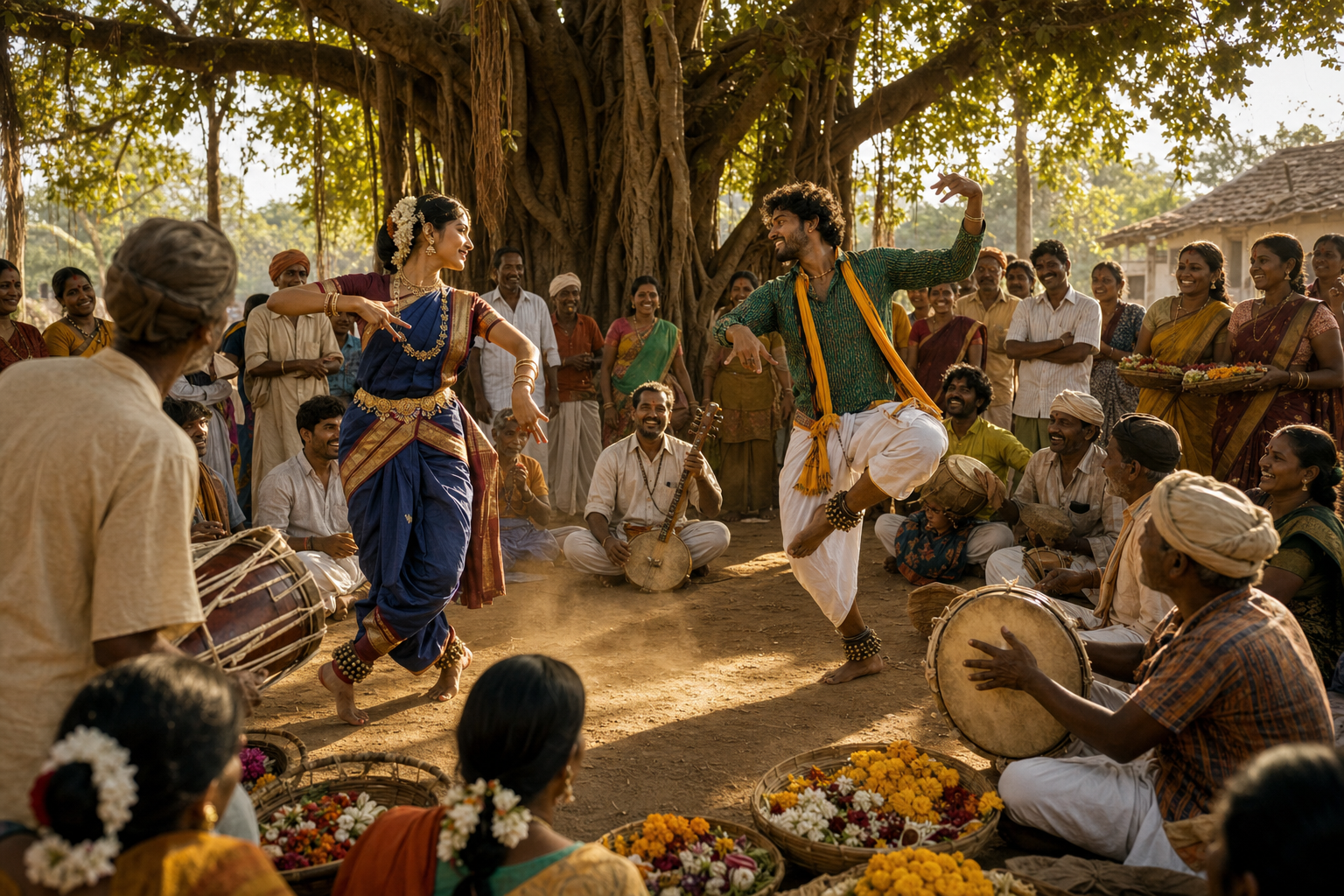
Another key to Viswanath’s aesthetic is the complementarity of Marga and Deshi. Marga names the codified, cultivated or classical path. Deshi names the regional idiom through which a community speaks, sings, jokes, worships and remembers. Treating them as enemies creates a false choice between rigid classicism and unformed spontaneity. In a living tradition, practice moves in both directions: codified knowledge enters local expression, while successful local expression can be studied, transmitted and eventually codified.
Viswanath stages this relationship rather than merely endorsing it. Apadbandhavudu places Marga poetry in the care of an unschooled Deshi youth. The youth performs difficult, selfless labor to publish the poetry of the master he reveres. Classical learning supplies the inheritance, but devotion and service carry it into the world. The episode makes cultural transmission a human obligation, not an automatic process.
This helps correct a common misreading of tradition on screen. A mantra, temple or classical composition is not automatically evidence of cultural depth. It can remain a detachable emblem. What matters is whether it changes the relationships, choices or atmosphere of the film. Viswanath’s use of Mantrapushpam, the Ghanapathi in Swarnakamalam, the blessing Shatamanam Bhavati, and Bhartrhari’s verse in Sagara Sangamam works because such material is embedded in the social and emotional life of the characters.
The Deshi side is equally purposeful. Songs such as Govullu tellana Gopayya nallana in Saptapadi (1981), Aura ammaka chella in Apadbandhavudu, and Suvvi suvvi and Taalibottu testanani in Swati Muthyam (1985) use accessible diction and regional texture without severing themselves from a wider civilizational memory. Epics, Puranic associations and Telugu folklore can enter through ordinary speech, household custom, a washerwoman, a lullaby or a village setting. The bearer of memory need not look like an institutional authority.
Laali Laali in Swati Muthyam offers a particularly clear example. The lullaby addresses an infant, yet its tenderness also holds the infant’s childlike father. One song can therefore operate simultaneously as domestic action, characterization and compassionate interpretation. Its simplicity is not an absence of sophistication. Simplicity is the exact form the situation requires.
When you evaluate Viswanath’s use of inherited culture, ask four concrete questions. Who carries the tradition? In what register do they carry it: scholarly, ritual, professional, domestic or folk? What act of service allows it to continue? What happens when social recognition disappears? These questions reveal an ecology of culture. Gurus need disciples, artists need discerning listeners, texts need custodians, and regional communities need enough confidence to make tradition their own.
This Marga-Deshi exchange also explains why the films can be unmistakably Telugu and still speak to a broader dharmic audience. Universality does not require cultural thinning. Sadharanikarana, or universalisation, occurs when a particular situation is imaginatively shaped so that viewers can enter its emotional truth. The riverbank, dialect, rite and raga need not be erased. Their apt particularity can become the very means by which the experience travels.
The artist is measured by conduct before applause
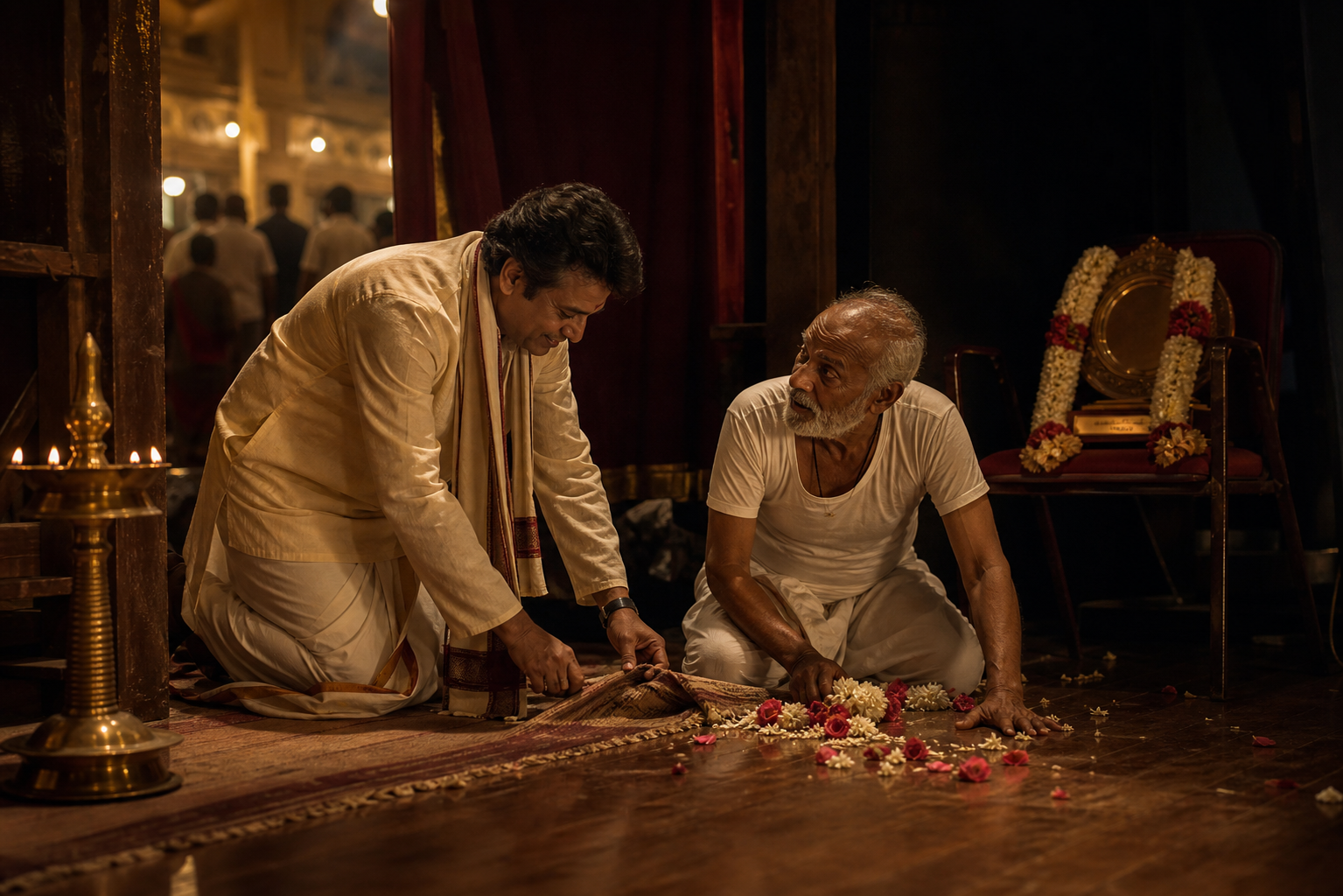
Viswanath admires art deeply, but he does not flatter artists. Talent grants a responsibility, not an exemption from ordinary moral discipline. His artistic protagonists and their communities repeatedly confront the same question: does the person serve the art, or use the art to enlarge the person?
Applause provides an immediate diagnostic. At the opening of Sagara Sangamam, a danseuse interrupts the current of her performance to savor the audience’s response. In Swarnakamalam, the hunger for photographs creates a related disturbance. The problem is not that an artist enjoys appreciation. It is that self-display breaks concentration and reverses the proper order. Recognition ceases to follow the offering and begins to govern it. The persona then threatens to become more important than the art.
That danger is useful far beyond the performing arts. If you create, teach or preserve culture, ask what changes in your work when nobody is watching. Does the practice retain its rigor without praise? Do you select material because it suits the work, or because it advertises your sophistication? Do photographs, credentials and public deference document the practice, or have they become its purpose? Viswanath’s answer is demanding: artistic stature is revealed most clearly when status and discipline point in opposite directions.
Sankara Sastry in Sankarabharanam embodies this demand. Public taste has moved away from him, reverence has faded and material hardship has arrived, yet his musical practice continues within his own home. His friend helps articulate what such persistence means, while Tulasi’s devotion to his music supplies a second form of testimony. Rather than instructing you to admire Sankara Sastry, the film reveals him through the discipline he maintains and the regard he awakens in others.
This indirect characterization is one of Viswanath’s most reliable tools. A protagonist’s greatness is not established by self-description. It becomes visible in the memory of a friend, the reverence of a disciple, the cost borne by a devotee or the continuity of practice under neglect. The method also leaves room for self-critique. The artist can be worthy of reverence without being emotionally complete, socially successful or immune to failure.
Swarnakamalam builds a parallel revelation around the Kuchipudi guru Seshendra Sharma. His daughter resists the discipline associated with his vocation. His stature becomes legible to her when a large body of students comes to honor him on Guru Purnima. The homage is not a substitute for character; it is accumulated evidence of transmission. The students show that the guru’s work has entered lives beyond his household.
Viswanath also shows what happens when discipline fails. The gifted but inexperienced brothers in Shruti Layalu are seduced by metropolitan vice. Balakrishna in Sagara Sangamam turns to alcohol when he cannot master his emotional upheaval. These are not arguments that skill is unreal. They show that skill without self-command cannot protect its possessor. Art may provide a path of formation, but the artist still has to walk it.
Nor does integrity mean inflexible innocence. In Sutradharulu, corrupt charity is rejected and cast into the Godavari, but the larger point is strategic fidelity: ideals have to survive adverse conditions. A principle that cannot guide action under pressure remains ornamental. Viswanath’s moral world therefore joins purity of purpose to practical discernment.
This is also the right frame for approaching disability in Sirivennela. Hari Prasad and Suhasini should not be reduced to symbols of lack or devices for eliciting pity. Music and painting are modes of agency, communication and mutual recognition. The film’s emphasis on inward steadiness does not settle every social question concerning disability, nor should cinema be made to do so. It does, however, direct your attention from deficiency toward personhood: what does each character perceive, create, give and awaken in the other?
The resulting sensibility can resonate across the dharmic family without pretending that its traditions are identical. Hindu bhakti, Buddhist karuna, Jain commitments shaped by ahimsa and Sikh devotional remembrance provide distinct vocabularies, yet each can recognize the ethical seriousness of self-restraint, service, compassion and a decentered ego. Viswanath’s cinema makes room for those correspondences because it begins with formed human experience, not a slogan about unity.
A six-pass way to watch a Viswanath sequence
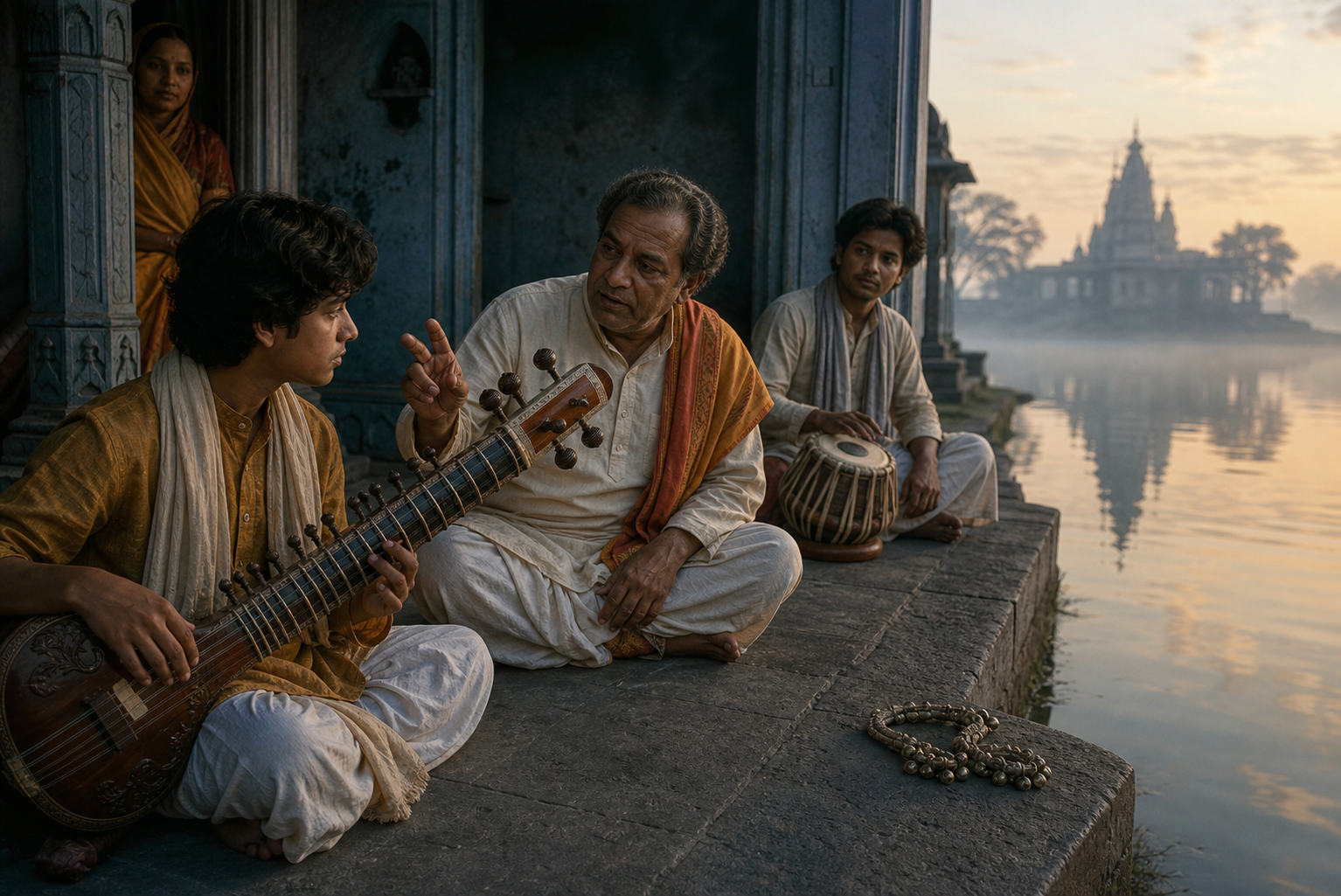
You do not need specialist training in music or dance to perform a serious close reading. Choose one bounded sequence rather than an entire film. The Janmashtami threshold in Sagara Sangamam, the painting metaphor in Sirivennela, the Guru Purnima homage in Swarnakamalam or the lullaby in Swati Muthyam will each support the method.
- Watch first for action. State what physically occurs in one or two plain sentences. Do not interpret yet. This prevents an attractive symbol from replacing the actual drama.
- Listen without treating music as background. Note when the song, instrument, recitation or silence enters. Ask whose inner state it voices and whether its words affirm, complicate or contradict the visible action.
- Mark the scene’s signs. Write down significant names, objects, gestures, locations, rites and boundaries. In the Janmashtami sequence, the threshold, footprints, flute, lyric and name Balakrishna belong on this list.
- Map the witnesses. Notice who recognizes the artist’s worth, failure or transformation. Friends, students, devotees, family members and connoisseurs often disclose what the central character cannot credibly announce.
- Test the ethical order. Ask what the scene places above what: art above applause, practice above status, service above possession, discernment above rigidity, or acceptance above agitation. Then check whether action supports that hierarchy.
- Name the residue. After the scene ends, describe what remains in you. Avoid beginning with a Sanskrit label. First use ordinary language such as compassionate sorrow, quiet admiration, unease or serenity. Only then ask whether karuna, shanta or another rasa helps refine the description.
Run the six passes separately at least once. Trying to notice everything simultaneously makes close reading vague. On the final viewing, bring the observations together and look for convergence. If the music, object, action and ethical choice all lead toward the same emotional realization, you have found the scene’s aesthetic center. If they pull in different directions, ask whether the tension is deliberate before calling it inconsistency.
This process also guards against two opposite mistakes. The first is nostalgia: assuming that every classical or ritual element is profound because it is inherited. The second is reduction: treating inherited forms as decorative signs of conservatism while ignoring their dramatic work. Auchitya supplies the test in both cases. Does the element belong to this character, at this moment, in this emotional key? If it does not, pedigree alone cannot save it. If it does, familiarity should not make it invisible.
Key takeaways
- Viswanath’s fundamental unit is not an isolated image or song but a convergence of action, music, symbol, setting and character.
- Auchitya explains why the elements fit; dhwani explains what they imply; rasa names the experience into which they ripen.
- Marga and Deshi are partners in cultural transmission. Classical inheritance lives through regional language, domestic practice, service and community memory.
- The artist’s decisive test is conduct without recognition. Applause may acknowledge the offering, but it cannot become the reason for it.
- Begin a close reading with concrete action and end with rasa. Starting from a label encourages you to see only what the label permits.
For your next viewing, choose one scene and resist the urge to hunt immediately for its message. Follow the gesture, hear the music, notice the witnesses and wait for the suggested meaning to assemble. That patience is not incidental to Viswanath’s cinema. It is the kind of spectatorship his aesthetic rewards.
References
- DharmaRenaissance Blog — Discover the Complete Aesthetic Alchemy in K. Viswanath’s Cinema: Art, Artist, Artistry
- DharmaRenaissance Blog — Discover the Proven Aesthetic Secret: K. Viswanath’s Mastery of Rasa and the Marga-Deshi Fusion
