
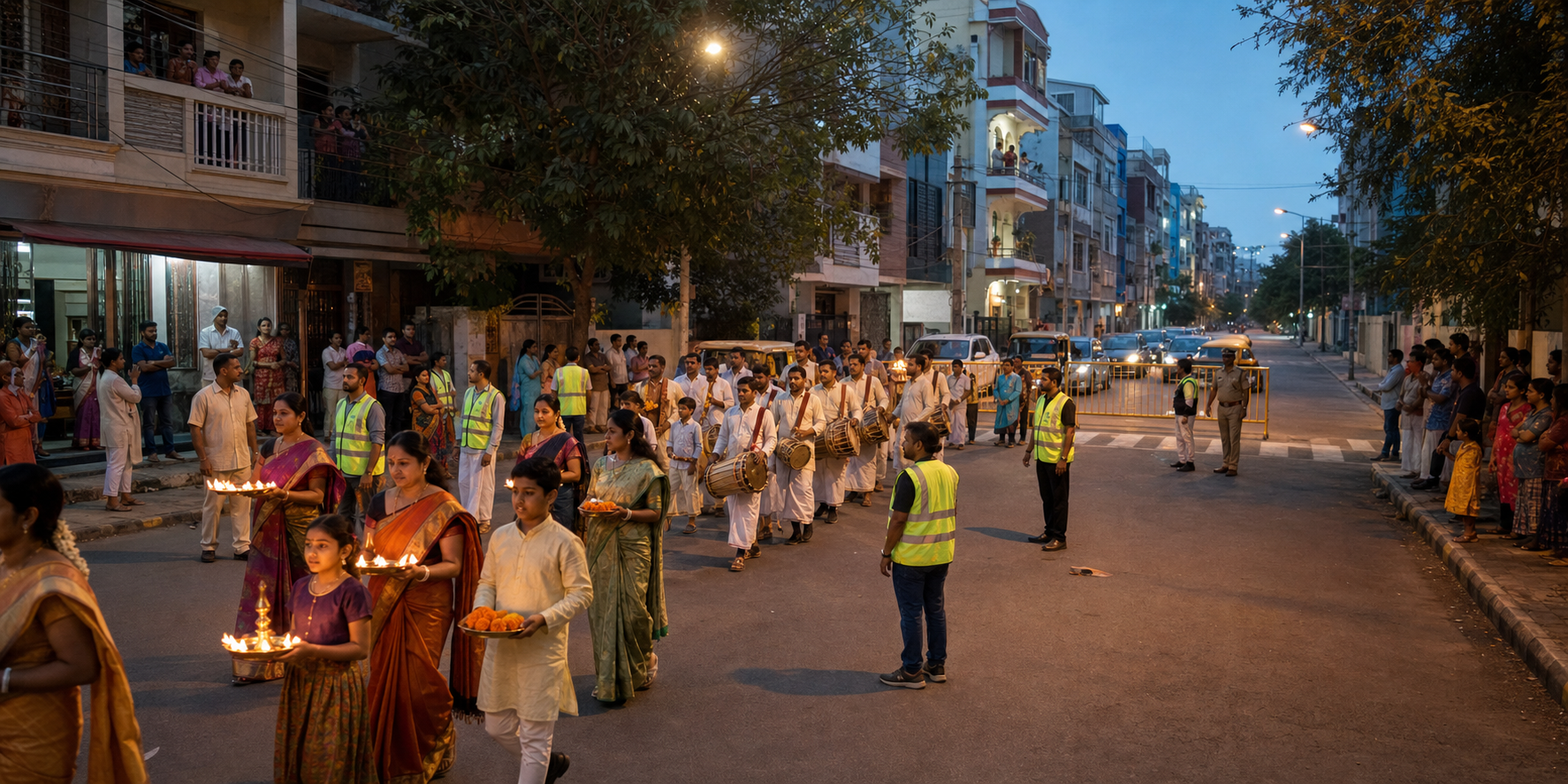
If a procession, Aarti, prayer gathering, or festival route in your locality is becoming tense, your first duty is not to win the argument on WhatsApp. It is to move people out of danger, keep an exit open, preserve reliable evidence, and help lawful worship continue without creating a second crowd.
For a Hindu family, temple committee, festival mandal, market association, or concerned resident, restraint does not mean accepting intimidation. It means pursuing protection and justice in a way that identifies the people actually responsible. That is firmer, safer, and more dharmic than letting an allegation become a licence for indiscriminate retaliation.
When tension starts, switch from argument to incident control
The first dangerous mistake is allowing spectators to become participants. When shouting, stone-pelting, crowd compression, or a suspected weapon is reported, curious residents often move toward the disturbance while angry messages summon still more people. That creates a counter-crowd, blocks emergency access, and makes it harder for police to separate an assailant from a bystander.
If you are an organiser or volunteer, use this sequence:
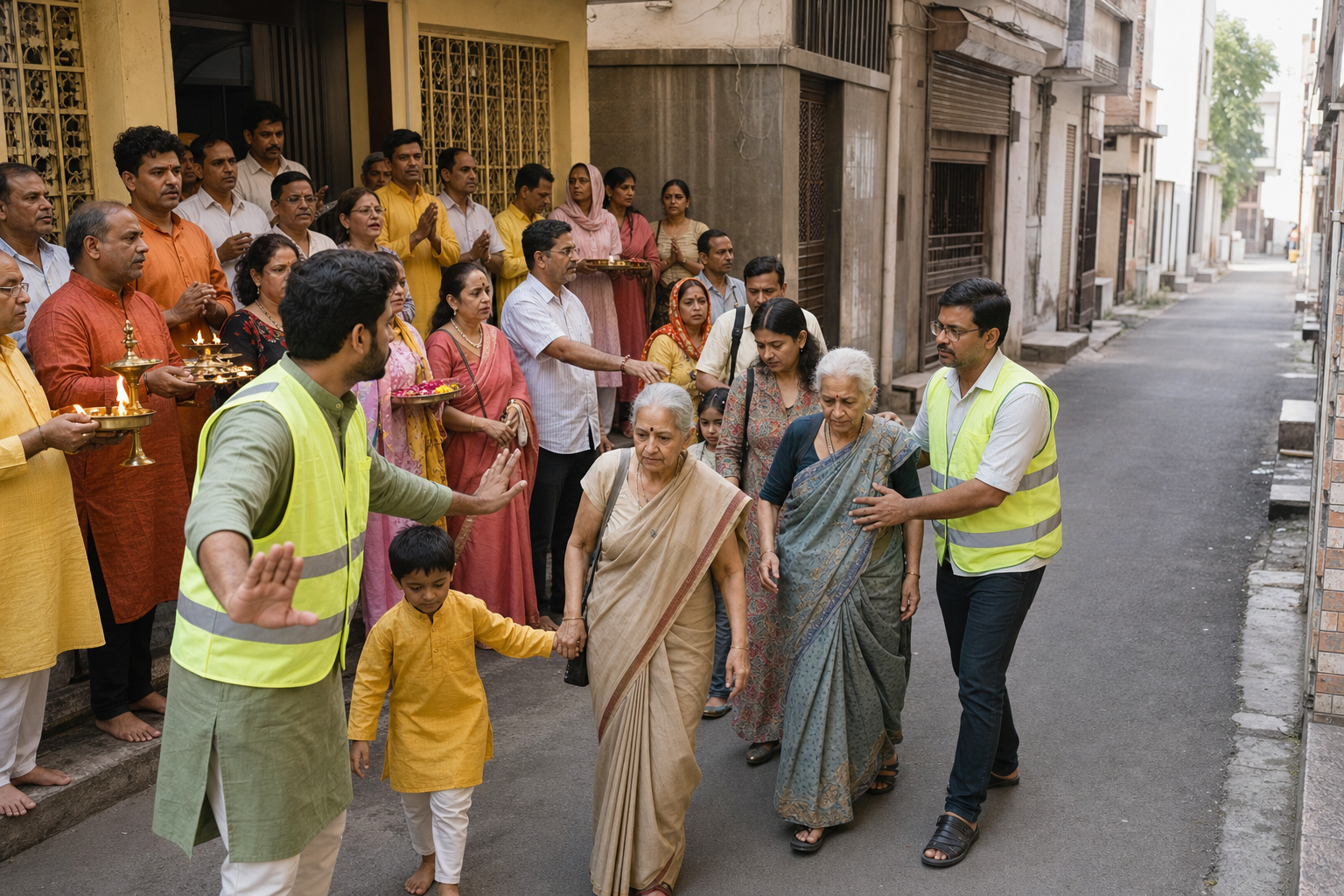
- Move children, elders, injured people, and uninvolved worshippers away from the point of confrontation. Direct them toward a known open route, not into another narrow lane.
- Keep an emergency corridor clear. Do not allow motorcycles, barricades, musical equipment, or onlookers to close the only usable exit.
- Give police the exact location, the nearest fixed landmark, the direction in which the crowd is moving, and what you directly observed. Separate that from what someone else told you.
- Stop speeches, slogans, and competitive use of loudspeakers. Use the public-address system only for calm safety instructions until the immediate risk has passed.
- Assign a recognised organiser to speak with police and another trusted person to preserve evidence. Conflicting instructions from several leaders make crowd control harder.
- Do not pursue suspected attackers into a house, rooftop, place of worship, or unfamiliar lane. That can expose volunteers to injury, contaminate evidence, and turn a local offence into a wider communal confrontation.
If stones or weapons are involved, do not risk your safety to obtain dramatic footage. Record only from a safe position. Preserve the original file, note the time and location separately, and give investigators access to the unedited material. A forwarded clip with a provocative caption may attract attention, but the original recording is far more useful for establishing what happened.
Organisers should also resist pressure to announce a culprit before the scene is secure. You can state what is confirmed: an incident occurred, the route has changed, medical help is needed, or police have asked people to disperse. Naming a community or circulating an unverified identity does nothing to protect the Mandir and may expose innocent families to retaliation.
Plan the route as a shared civic space
At street level, communal tension often takes an operational form before it becomes an ideological battle. Route overlap, high-volume sound near prayer venues, procession halts, and congestion at narrow junctions can combine during overlapping observances. None of these conditions makes violence inevitable. They do tell you where preparation must be concentrated.
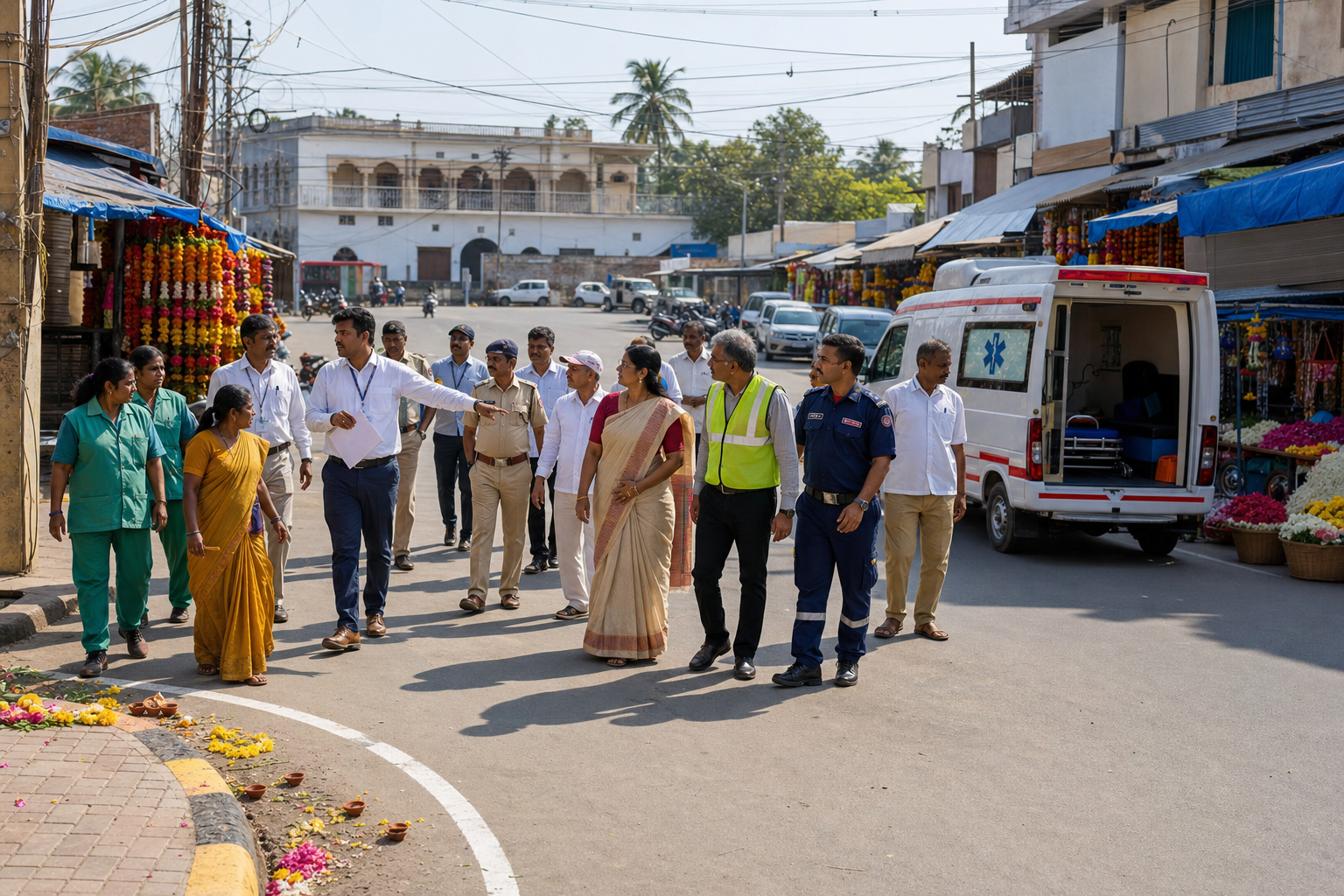
Walk the proposed route before the event with representatives of the organising mandal, nearby places of worship, the market, and the local administration. Mark the following on the same route map:
- Narrow lanes, blind turns, busy intersections, roadside stalls, parked vehicles, and stretches where a stopped procession would trap people.
- Mandirs, masjids, gurdwaras, Jain or Buddhist institutions, hospitals, schools, and other locations requiring quiet access or an unobstructed approach.
- The expected times of Aarti, azan, congregational prayer, procession arrival, cultural performances, and market closure.
- Safe dispersal routes, emergency vehicle access, medical posts, temporary lighting, and locations where removable barricades may be needed.
- Terraces or rooftops overlooking sensitive stretches, especially where loose debris could be misused. Access control must be lawful, coordinated with property owners, and handled by authorities rather than self-appointed patrols.
Turn that map into a written operating agreement. It should identify the authorised route, stopping points, sound expectations near places of worship, rules for pyrotechnics, banner placement, the people permitted to issue instructions, and the process for handling an unexpected delay. Publish the agreed route and timing locally so residents do not have to rely on rumours.
Reciprocity is important. A temporary reduction of amplified sound in the immediate vicinity of a masjid during azan can coexist with the uninterrupted right to hold a lawful Hindu procession. In the same spirit, a scheduled prayer should not become a pretext for cancelling an authorised celebration. A narrow, time-bound adjustment is an act of civic discipline; it is not surrender by either side.
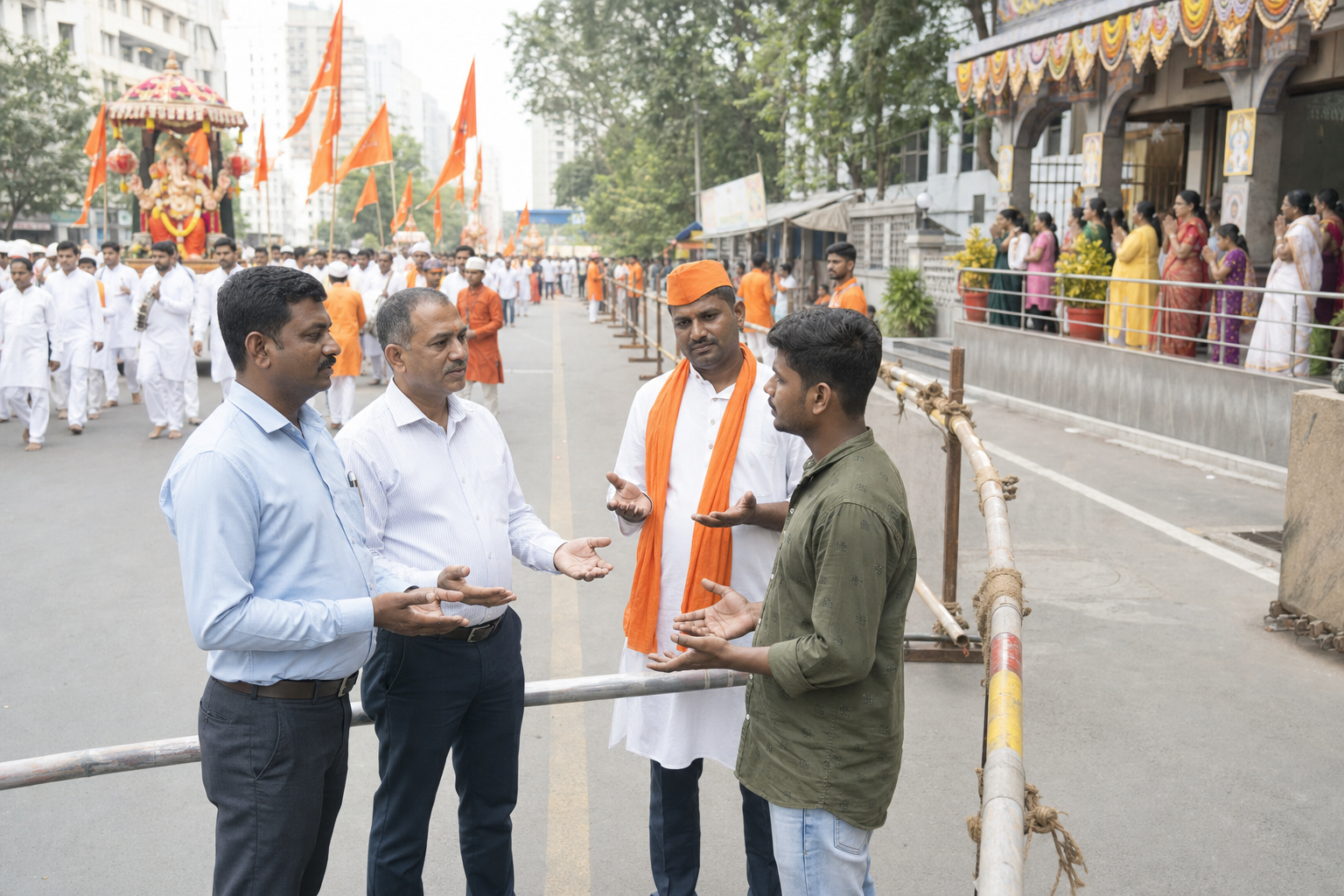
Visible route wardens make the agreement usable. Give them identification, defined stretches of responsibility, and a secure way to contact the joint control point. Their job is to report a bottleneck, redirect participants, keep the emergency lane open, and relay verified instructions. It is not to argue with residents, search buildings, punish misconduct, or improvise a new route.
A commemoration of Chhatrapati Shivaji should reflect the civic protection and sound governance associated with his public legacy. Invoking Shivaji while tolerating indiscipline, harassment, or uncontrolled crowd behaviour confuses strength with spectacle. Rajadharma is demonstrated when the vulnerable are protected, the celebration remains dignified, and an offender is handed over to lawful authority.
Treat every viral claim as unverified until checked
A tense locality does not need every resident to become an online commentator. It needs a small number of people who can distinguish observation, allegation, and confirmation. Those are different categories even when the allegation appears plausible.
Before forwarding an image, video, voice note, or list of names, ask:
- Did you personally witness this, or are you repeating another person’s account?
- Does the image contain a recognisable local landmark, route sign, shopfront, or other feature that can establish where it was recorded?
- Is there evidence that it was recorded during the current incident rather than an earlier disturbance elsewhere?
- Has the district administration, police, or an identified organiser confirmed the claim?
- Will sending it help someone reach safety or preserve evidence, or will it merely increase anger?
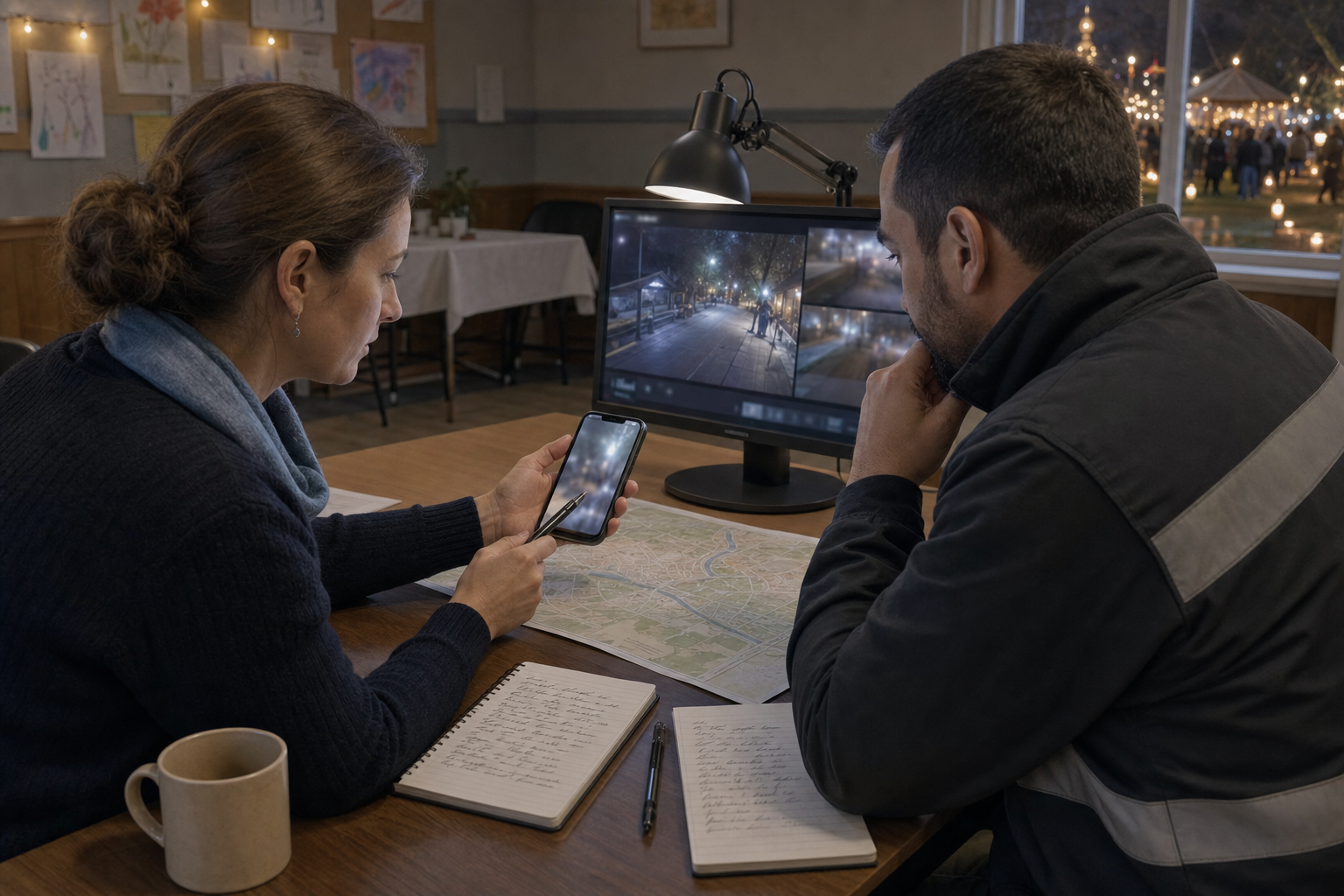
Where practical, compare visible landmarks with the claimed location and use a reverse-image search to detect recycled visuals. Do not add dramatic music, arrows, slow motion, or a speculative caption to evidentiary footage. Keep the original intact and record the context separately.
Create a single verified local information channel before the observance. Updates should be time-stamped and limited to actionable facts: a route is open, a junction is closed, a prayer window is beginning, an official dispersal direction has been issued, or a circulating claim is false. A quick correction in the languages used by the neighbourhood can prevent an old clip or misunderstood photograph from defining the mood of the street.
If you cannot verify a claim, say that plainly. The responsible wording is: there is an unverified report, it has been sent to the police, and residents should avoid the specified location. Do not convert uncertainty into certainty by adding phrases such as “everyone knows” or “it has been planned.” Repetition is not corroboration.
Pursue justice without turning suspicion into collective guilt
Demand an investigation that can survive scrutiny
Allegations of stone-pelting at a Mandir, harassment of women, damage to a sacred space, or the storage of weapons are serious. They must not be trivialised. They also remain allegations until police verification, lawful recovery, forensic work, witness statements, and an auditable chain of custody establish what occurred. Claims surrounding an incident near Aarti in Sihora illustrate why public anger and evidentiary certainty must not be treated as the same thing.
A credible demand for justice is specific. Ask whether the scene was secured; whether approach roads, terraces, and possible projectile paths were photographed; whether public and private CCTV footage was preserved; whether injuries were medically documented; and whether seized objects were recorded through lawful search procedures, panchnamas, video, and chain-of-custody controls. If a claim concerns material allegedly found inside a place of worship, procedural transparency is especially important because an unsupported accusation can endanger an entire neighbourhood.
As a witness, provide what you know without filling gaps. Record the time, location, direction of movement, visible clothing, vehicle details, and the sequence of acts you actually observed. Preserve original files and identify any edits or copies. Do not coordinate a common story with other witnesses, publish vulnerable witnesses’ identities, or circulate the names of suspects before verification.
The constitutional baseline is not ambiguous: Articles 25-28 protect religious freedom, while Article 19(1)(b) protects peaceful assembly subject to public-order restrictions. This gives the state a duty to protect Hindu worship and other lawful observances without fear or favour. It does not grant a crowd the power to investigate, convict, or punish.
Collective blame weakens the case against actual offenders. It replaces evidence with identity, encourages retaliatory offences, frightens potential witnesses, and gives instigators the larger conflict they wanted. Name the act, preserve the proof, pursue the actor, and refuse to inherit hatred toward uninvolved neighbours.
This is where ahimsa is frequently misunderstood. Ahimsa is not indifference to assault, vandalism, or intimidation. It disciplines the means by which justice is pursued. Karuna protects the innocent from inherited blame. Seva moves the injured to safety. Rajadharma requires the authority to restrain the aggressor and protect sacred life. Firm accountability and moral restraint belong together.
Use the first days after disorder to prevent a second crisis
The street becoming quiet is not the end of the incident. Unanswered damage claims, selective arrests, ambiguous police statements, and continuing online rumours can produce another confrontation. Within 24-72 hours, mixed-neighbourhood meetings, verified-loss assessment, transparent review, and incorporation of lessons into future procedures can begin restoring confidence.
That meeting should be practical, not ceremonial. Bring the route map, the incident timeline, a register of verified injuries and property damage, the status of complaints and investigations, and a list of safety failures. Ask whether lighting failed, an emergency lane was blocked, a scheduled sound adjustment was misunderstood, a police liaison was unreachable, or a false message travelled without correction. Assign each corrective action to a responsible institution or committee before the next observance.
Protection must also be visibly impartial. Guarding Mandirs after an attack allegation is necessary; protecting other nearby sacred spaces from retaliation is part of the same duty. Impartial protection does not erase the original harm. It prevents another offence from obscuring it.
Residents can help restore ordinary life once authorities confirm that the area is safe. Reopening normal pedestrian routes, resuming lawful worship, assisting injured families, and participating in a verified cleanliness or repair effort deny provocateurs the permanent division they sought. No one should be pressured to reopen a shop, attend a meeting, or enter a tense street before it is safe.
Key takeaways for the next observance
- Protect people before protecting the programme: clear the vulnerable, preserve exits, and prevent spectators from forming a counter-crowd.
- Put routes, prayer windows, stopping points, sound expectations, emergency access, and organiser authority in writing before the event.
- Use identified wardens to report conditions and relay instructions; do not let volunteers become improvised police.
- Label information honestly as direct observation, allegation, or official confirmation. Preserve original files and stop recycled media before it spreads.
- Demand scene preservation, CCTV retrieval, medical documentation, lawful searches, transparent seizures, and evidence-based arrests.
- Reject collective guilt without minimising violence. Protecting innocent neighbours makes the pursuit of actual offenders more credible.
- Review the route, response, verified losses, and communication failures soon after an incident, then change the plan before the next festival cycle.
Before the next observance, bring the Mandir committee, nearby religious institutions, market representatives, route volunteers, and the police liaison around the same printed map. Resolve the predictable friction while the street is calm. The dharmic standard is prepared courage: worship is protected, evidence is preserved, offenders face lawful accountability, and no neighbour is treated as guilty by birth.
References
- Hindu Existence – Communal Tension Erupt Across Three States: Muslims Attack Shivaji Jayanti Celebrations and Processions
- Hindu Human Rights – Video: Hindu Temple Attacked by Islamists in Jabalpur, Madhya Pradesh
