
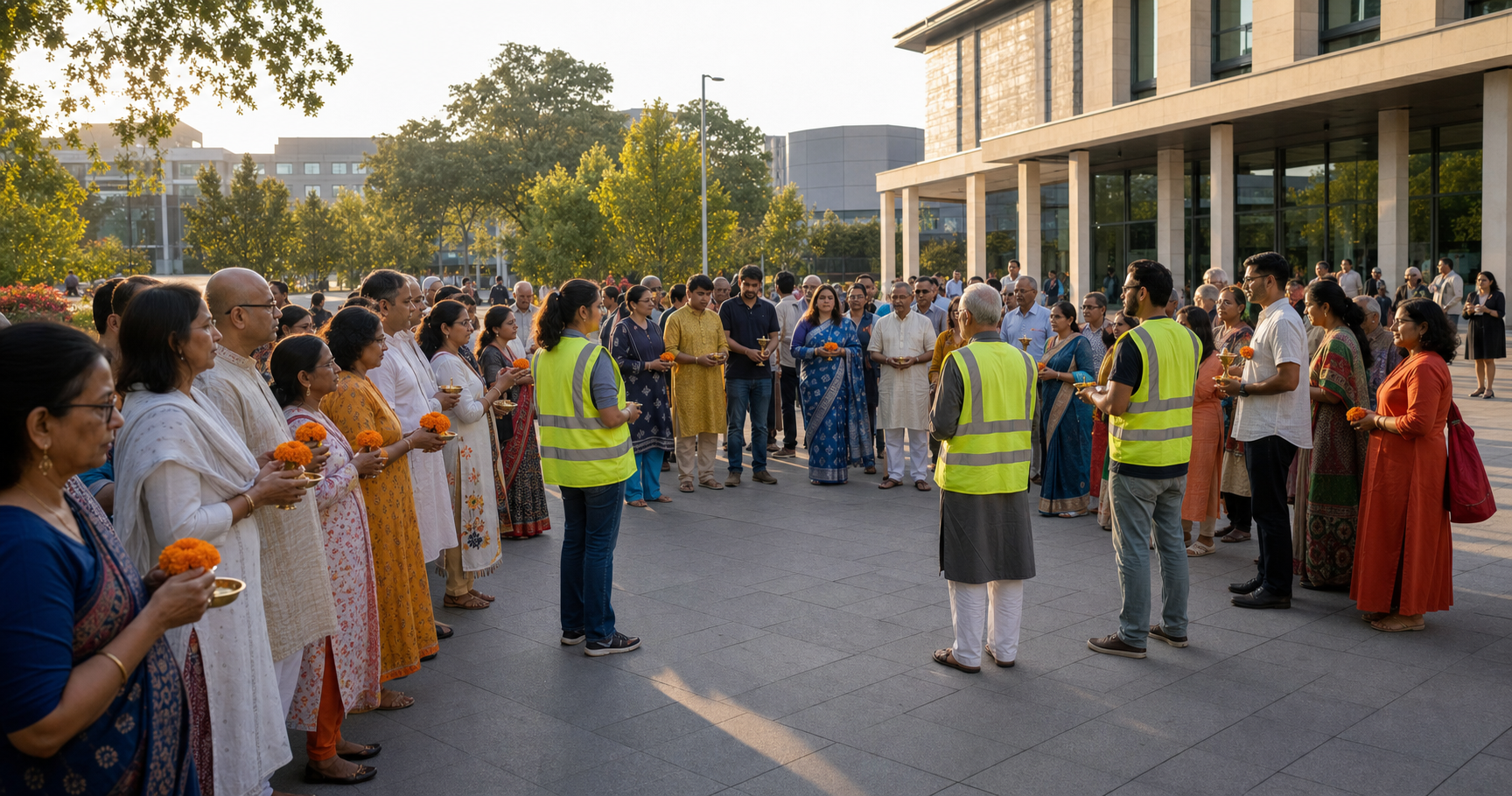
If you are preparing a Hindu vigil, march, rally, delegation, or public meeting, the central question is not whether your community’s concern is real. It is whether the event will turn that concern into a precise civic demand without creating preventable legal, safety, or reputational problems.
A strong assembly is peaceful without being passive. It identifies who can act, asks that person or institution to do something specific, protects participants and neighbours, and creates a path for follow-through. Here is how to build one.
Turn community pain into a decision someone can make
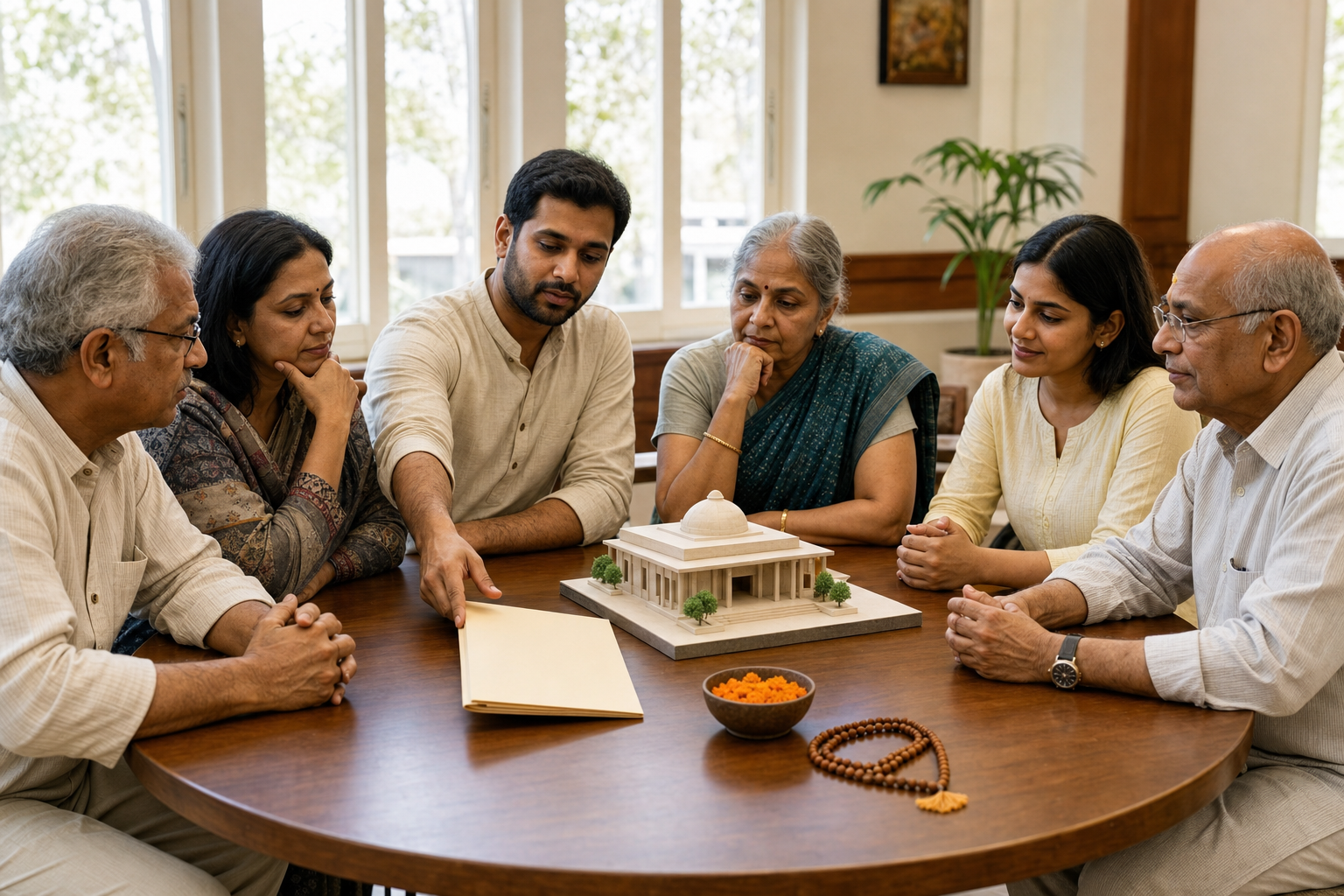
People often begin with the date, venue, poster, and list of speakers. Begin instead with the decision you want. A large crowd cannot compensate for an unclear objective.
Write the objective as a sentence containing an accountable institution, a requested action, and the people the action is meant to protect. For example: ask a foreign ministry to raise temple security and minority protection in a diplomatic dialogue; ask elected representatives to seek a formal response from the relevant government; or ask an investigating authority to pursue transparent legal accountability for documented attacks. The correct decision-maker will depend on the jurisdiction and the underlying harm.
Then build a short decision brief around these elements:
- The harm: State what has happened in restrained, supportable language. Separate verified incidents from allegations that still require investigation.
- The affected people: Name the community without turning its suffering into a claim against an entire religion, nationality, or ethnicity.
- The responsible office: Identify the minister, legislator, council, diplomatic mission, police authority, or other institution that can take the requested step.
- The action: Ask for something observable, such as a meeting, official representation, transparent investigation, protection of places of worship, prosecution through due process, or a written response.
- The next contact: Name the person who will receive replies, provide supporting material, and continue the engagement after the crowd disperses.
Keep fact, principle, and demand in separate lanes
Your public message becomes easier to trust when every speech, placard, press note, and social post follows the same structure.
- Fact: What can you responsibly establish, and what remains alleged or disputed?
- Principle: Which civic value is engaged: religious freedom, equal protection, human dignity, public safety, pluralism, or rule of law?
- Demand: What should the named institution do now?
This separation matters when campaigners use legally or politically contested terms. At Westminster, for example, organisers characterised violence against Bangladeshi Hindus as genocide while also advancing concrete demands concerning temples, attacks, investigations, and accountability. If a term represents an organiser’s position rather than a formal legal determination, preserve that attribution. Moral urgency does not require you to present a contested characterisation as an adjudicated fact.
Choose language that survives scrutiny outside the sympathetic audience. Protect Hindus is a civic demand. Punish a whole population is collective blame. Investigate documented attacks is actionable. Everyone knows what is happening asks the listener to accept a conclusion without evidence. Satya requires accuracy even when exaggeration appears useful.
Protect the right to assemble through law and logistics
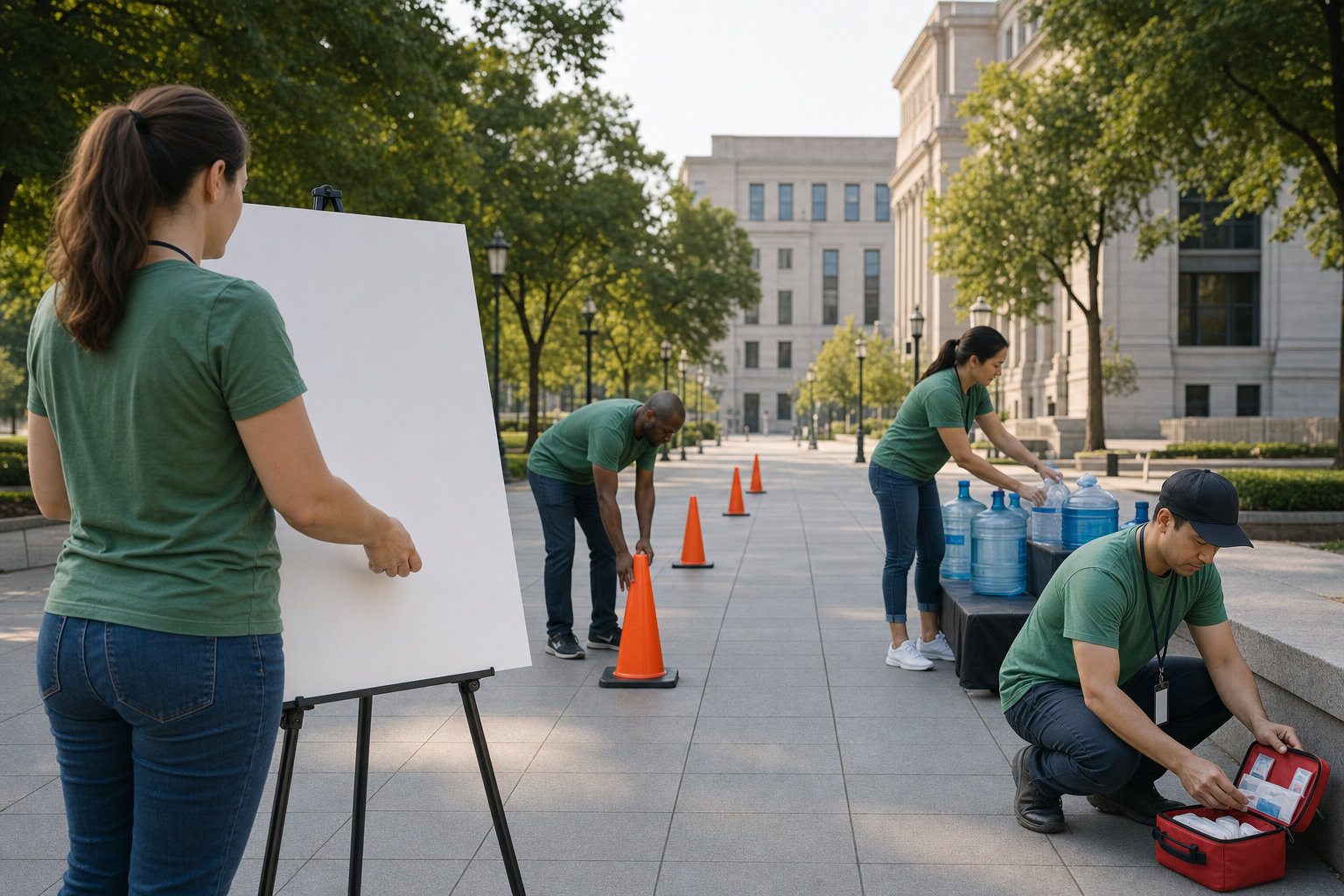
Peaceful assembly is a protected civic practice, but it is not a licence to ignore public order, safety, traffic, property rights, or the freedoms of other people. In India, the relationship between protected expression and reasonable restrictions was visible when the Telangana High Court cleared a Hyderabad mobilisation on 22 January 2026 subject to applicable law and administrative safeguards. Court clearance or official permission does not erase operating conditions; it makes compliance part of the organisers’ responsibility.
Notification and permission rules differ by country, state, city, landowner, venue, route, event format, and anticipated attendance. Do not copy another organisation’s procedure or assume that a previous event created permission for yours. Confirm the requirements with the competent local authority. Where legal exposure is uncertain, obtain advice from a qualified lawyer in that jurisdiction before announcing a route or instructing participants.
Resolve the operating conditions before mobilisation
Your liaison team should know the answer to every item below before issuing final participant instructions:
- Is the event approved, acknowledged, pending, or exempt from a particular process? Keep the relevant written communication available to the event lead.
- What are the authorised site, route, assembly point, entry and exit arrangements, operating times, and dispersal expectations?
- What limits apply to amplified sound, vehicles, structures, signs, leafleting, road use, and conduct that could amount to incitement?
- Which access lanes must remain open for emergency services, residents, workers, disabled people, and nearby premises?
- Who is the named organiser-authority liaison, and how will urgent instructions reach the event lead and marshal coordinator?
- What is the process if the route, crowd conditions, weather, security assessment, or official direction changes?
Translate every binding condition into a participant or marshal instruction. A permission letter stored on one organiser’s phone will not control a crowd. A route map, dispersal plan, sound cutoff, prohibited-conduct rule, and clear chain of communication might.
Reduce friction with the surrounding community as well. Give residents, commuters, shopkeepers, and neighbouring institutions accurate information about access and expected disruption when appropriate. Use the languages people around the venue actually understand. Clear public communication does not weaken the protest; it demonstrates that Hindu civic expression can be firm while respecting ordinary civic life.
Plan for disagreement without planning a confrontation. If a counter-demonstration is expected, discuss separation, movement, and liaison arrangements with the relevant authority. Participants should not leave the authorised area to argue with opponents. Marshals should redirect attention to the event’s purpose and refer threats or imminent danger to emergency services.
Make ahimsa an operating discipline, not a slogan
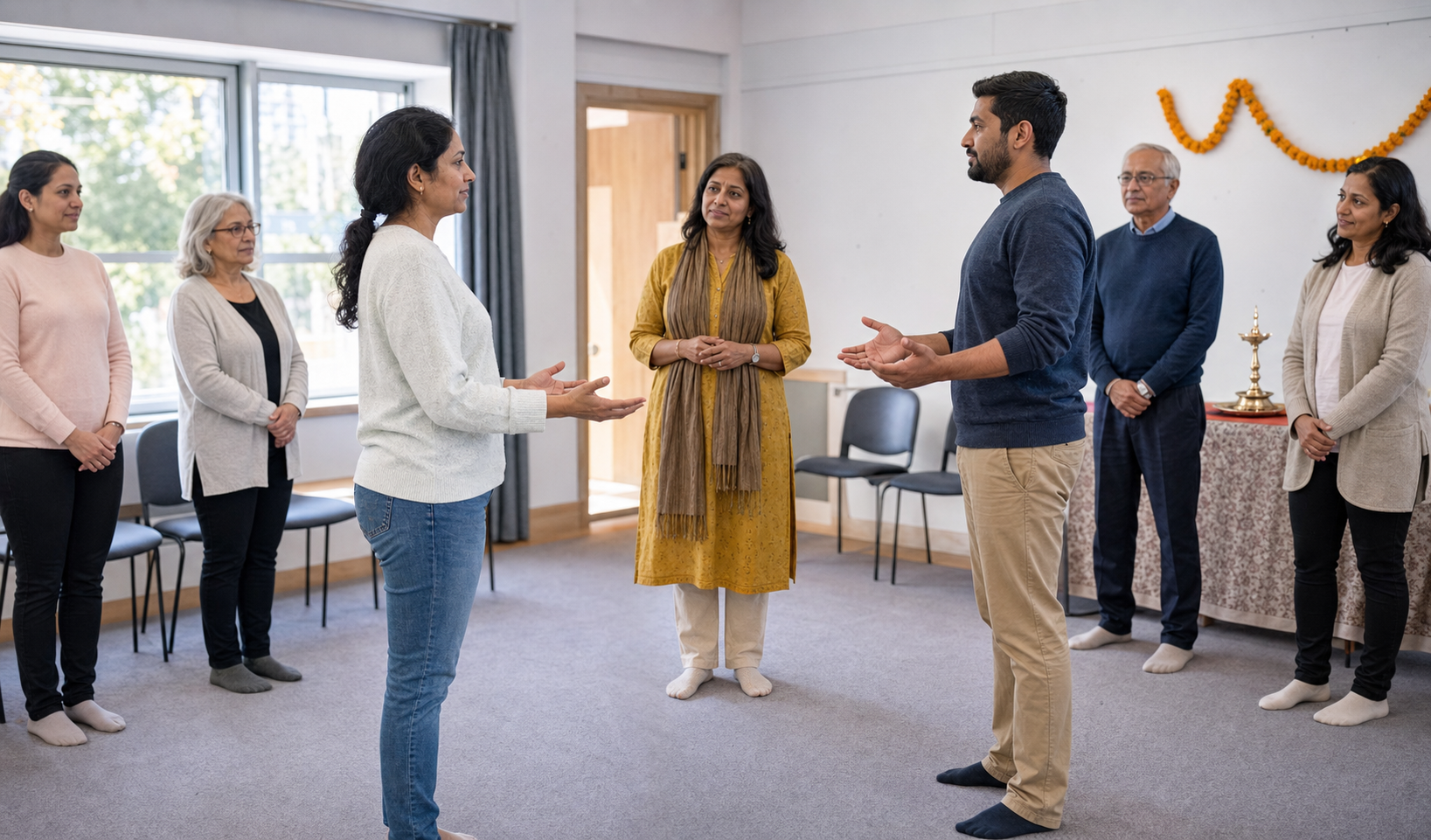
Ahimsa does not mean silence, timidity, or indifference to injustice. It means refusing to reproduce the harm you are opposing. In a public assembly, that principle needs visible rules, assigned responsibilities, and a response to provocation.
A workable volunteer structure includes an event lead, an authority liaison, a marshal coordinator, identifiable marshals, a welfare contact, a media spokesperson, and a documentation lead. Small events may combine roles, but everyone should know who can change the programme, speak to officials, pause a procession, correct misinformation, or initiate dispersal.
Give participants a concise code of conduct before they arrive:
- Remain peaceful and comply with lawful site, route, timing, and safety instructions.
- Use no threats, slurs, dehumanising language, or collective accusations against a religious or ethnic community.
- Do not bring weapons or objects intended for intimidation.
- Do not obstruct emergency routes, entrances, or people who are not participating.
- Do not pursue, surround, touch, or independently confront a provocateur or counter-protester.
- Report threats, dangerous crowd movement, medical needs, or serious breaches to a marshal.
- Respect privacy and consent when photographing children, victims, witnesses, or people whose relatives may face danger elsewhere.
- Leave calmly when the authorised event ends or when the event lead communicates a lawful safety direction.
Marshals are not a private police force. Their job is to observe, communicate, guide movement, support compliance, and bring serious issues to the proper authority. They should identify the behaviour that must stop rather than debate a person’s beliefs. A useful direction is simple: Please step back; this is a peaceful event; take the concern to the liaison. If the behaviour creates an immediate danger, move participants away and contact emergency services.
Control the platform without erasing legitimate anger
Speakers and signs shape how officials, journalists, neighbours, and online audiences understand the whole gathering. Brief speakers on the verified facts, the agreed demands, the time available, and the prohibition on incitement or collective blame. Prepare a small set of approved chants so an improvised slogan does not pull the crowd away from its purpose.
Make each placard carry one legible idea: protect temples, investigate attacks, prosecute offenders through due process, defend religious freedom, or meet the affected community. A slogan should point back to the decision brief. Dense text may contain more information, but it usually communicates less in a moving crowd or a short video.
The Westminster mobilisation showed how coordinated placards, chants, testimony, and a mobile digital display can reinforce the same demands. The lesson is not that every campaign needs an expensive display. It is that every visible element should serve the same civic ask. Spectacle without message discipline produces attention that officials can easily disregard.
Dharmic and interfaith allies can strengthen the moral and civic frame. Hindu, Buddhist, Jain, and Sikh traditions provide a vocabulary of ahimsa, karuna, maitri, satya, and seva. Allies can endorse equal protection, witness the peaceful character of the gathering, help secure institutional meetings, and reject religious persecution without displacing the voices of those directly affected. Advocacy for Hindus remains pro-Hindu when it asks for safety and justice without demanding insecurity for someone else.
Make the assembly produce an institutional next step
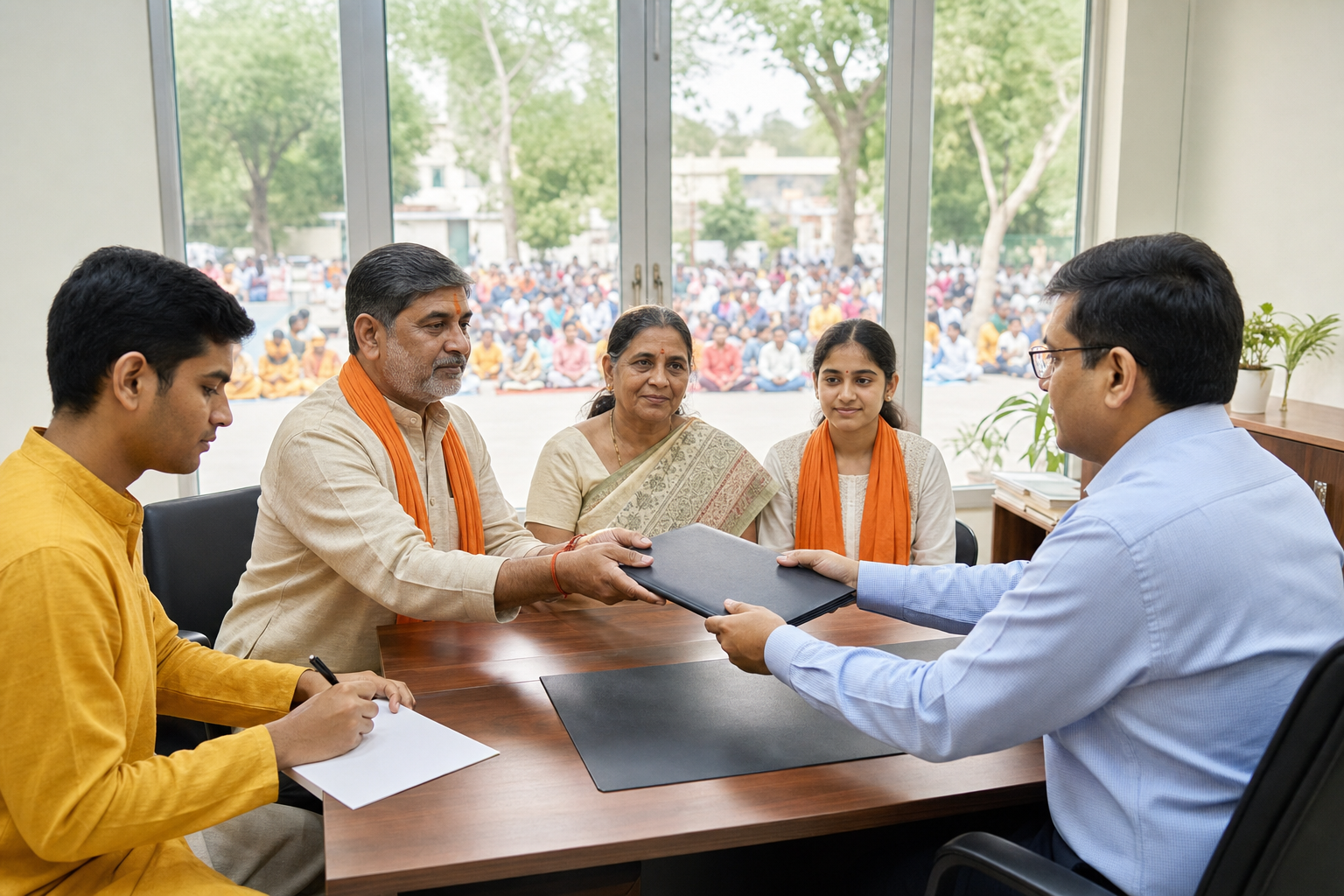
The day of assembly is the visible middle of a campaign, not its endpoint. If the organising team has no plan for evidence, delivery, response, and escalation, the event may release emotion without changing an institution’s behaviour.
Before participants arrive, prepare a campaign packet containing the agreed demands, a careful record of the relevant incidents, the names of supporting organisations, the responsible campaign contact, and the requested next action. Keep the main request short enough for an official to understand immediately. Supporting material can sit behind it.
During the event, maintain separate records for safety and public communication. A safety log should record the time, location, observed conduct, action taken, authority notified, and outcome of any significant incident. Public documentation should capture the demands, speakers, turnout without inflated claims, interactions with officials, and peaceful conduct. Keep original files where documentation may later be needed as evidence. Do not publish identifying images of vulnerable victims or witnesses merely because those images increase engagement.
Digital amplification can carry a local assembly beyond the people physically present. Short recordings from Westminster communicated participants’ fear for relatives and their demand for dignity and security. Use that reach deliberately: add enough context to prevent misrepresentation, distinguish testimony from independently verified findings, and link every update back to the institutional request.
After the gathering, deliver the campaign packet to the named decision-maker and record what happened next. Track the recipient, request, date of contact, acknowledgement, substantive response, promised action, owner of the follow-up, and next escalation. Appropriate escalation may include a meeting request, a written question to an elected representative, a public update on an unanswered demand, further evidence submitted through a proper channel, or another lawful assembly. Do not let the contact list, documentation, and relationships disappear with the event team.
Judge the event by civic outcomes, not photographs alone. Ask whether the intended office received the demand, whether officials understood it accurately, whether participants and bystanders remained safe, whether the community preserved its credibility, whether allies know their continuing role, and whether an institutional next step now has an owner.
Key takeaways
- Start with a decision-maker and an observable request, then design the assembly around them.
- Separate verified facts, Dharmic and civic principles, contested characterisations, and concrete demands.
- Confirm the local legal process and convert every official condition into an operational instruction.
- Give marshals limited, clear roles focused on communication, movement, de-escalation, and liaison.
- Reject incitement and collective blame without softening the demand for protection, investigation, and accountability.
- Prepare the follow-up mechanism before the crowd gathers; attention matters only if someone converts it into sustained civic action.
Before announcing your event, finish the decision brief and the conduct plan. If either is vague, keep organising. When both are clear, your community can assemble with courage and restraint, leaving officials less room to misunderstand the demand and opponents less room to misrepresent it.
References
- DharmaRenaissance Blog — Powerful Westminster Protest Urges UK Action to Protect Hindus in Bangladesh
- DharmaRenaissance Blog — Telangana High Court Clears ‘Jago Bhagyanagar – Chalo Balapur’ Rally, Peace and Public Order First
