

If you heard about the Dapoli campaign and are worried about a daughter, relative or friend, the hardest question is not whether to care. It is how to act without overlooking real danger, damaging family trust or accusing someone merely because of their religion.
The useful standard is disciplined vigilance: look for deception, coercion, isolation and threats; verify what can be verified; keep communication open; and use lawful help when danger is concrete. That approach protects young people while keeping Dharmik concern anchored in truth, dignity and self-command.
Key takeaways
- Treat “love jihad” as the campaign organizers’ framing, not as a diagnosis that can be applied to every interfaith relationship.
- Religious difference is a fact about a couple. Deception, coercion, blackmail, stalking and forced isolation are behaviors. Do not confuse the first with evidence of the second.
- Apply the same checks to every prospective partner: truthful identity, marital status, financial expectations, respect for family ties, freedom of belief and the ability to accept “no.”
- Do not respond with confinement, public accusations, communal hostility, hacking, doxxing or a crowd confrontation. These actions can increase danger and destroy trust.
- Dharmik practice should strengthen satya, ahimsa and viveka—truthfulness, non-harm and discernment—not demand unthinking obedience.
- When there is an immediate threat, a missing minor, sexual exploitation, forced confinement or violence, move beyond discussion and contact the appropriate police or emergency service.
What the Dapoli campaign asks you to consider
Hindu Janajagruti Samiti held an awareness drive in Dapoli under the “Beti Surakshit, Rashtra Surakshit” campaign. The initiative framed what its organizers call “love jihad” as a threat requiring vigilance, Dharmik values and spiritual practice.
That is the organizers’ position. An awareness meeting does not, by itself, prove that a particular relationship is fraudulent or establish that religious identity predicts abuse. If you carry the campaign’s concern into your home or community, the responsible way to do it is to test claims against conduct and evidence.
The term can otherwise collapse several different questions into a single accusation. Did someone lie about a material fact? Is a person free to maintain family relationships? Is religious change being chosen or compelled? Can either partner postpone or reject marriage without retaliation? Is there a threat, or only family disagreement? Each question demands its own answer.
This distinction does not weaken vigilance. It makes vigilance credible. A freely chosen interfaith relationship and a relationship built on deception are not the same. A voluntary change of belief and a coerced conversion are not the same. Disapproval is not proof of danger, but affection is not proof of safety either.
Judge conduct before religious identity

When you are worried, begin with behaviors that can be described without a communal label. The same warning signs matter whether the couple belongs to different religions, the same religion, different castes or the same social circle.
- Material deception: conflicting claims about name, age, marital status, family, employment, education, debt or the intended future of the relationship.
- Isolation: pressure to stop speaking with parents, siblings, friends, teachers or trusted elders, especially when the partner insists that every outside question proves disloyalty.
- Control: demands for passwords, constant location access, control over money, monitoring of calls, restrictions on movement or punishment for independent decisions.
- Religious coercion: threats, humiliation or conditional affection used to force conversion, concealment of belief, abandonment of practice or participation in a rite.
- Forced urgency: pressure for a sudden marriage, travel, elopement, financial transfer or irreversible commitment before basic facts can be checked.
- Sexual or digital abuse: unwanted recording, threats involving private images, blackmail, stalking, impersonation or repeated contact after consent has been withdrawn.
- Retaliation for “no”: threats of self-harm, violence, exposure, reputational damage or harm to relatives when a person tries to slow or end the relationship.
No single awkward interaction establishes a hidden plot. Look for a pattern, ask what has actually been verified and distinguish firsthand information from rumor. If a warning depends only on the partner’s name or religion, it has not yet identified the harmful act.
Use the same due diligence you would want before any serious marriage. With the adult concerned involved and consenting, clarify identity, existing marital commitments, work or education claims, financial obligations, expectations about children and worship, living arrangements, contact with both families and each partner’s freedom to retain or change beliefs. Verification should use direct questions, consensually shared records and lawful public information. It should not involve impersonation, account intrusion or secret public shaming.
The daughter-centered slogan expresses a protective concern, but a sound safeguarding standard also applies to sons and to abuse within same-faith relationships. Daughters are not vessels of family honor, and sons should not be excused from honesty, restraint and respect. Protection becomes stronger when every young person learns both how to recognize coercion and how never to practice it.
Make the family safer before a crisis

Start a conversation that does not drive the relationship underground
A frightened parent may begin with an accusation, confiscate a phone or insult the partner’s faith. Unless there is immediate danger, that opening often shifts the discussion away from safety and toward a struggle for control. The young person then has a reason to hide information precisely when the family most needs honest contact.
Begin with a concrete observation and an invitation: “You have seemed under pressure since this relationship became serious. We want to understand what is happening, and we will listen before deciding what we think.” Then ask questions that make room for an honest answer:
- What do you value in this relationship?
- Which important facts about each other have you independently confirmed?
- Can you disagree, delay a decision or end a conversation without being punished?
- Are you free to speak with family and friends without reporting every detail afterward?
- Has anyone asked you to conceal an identity, marriage, debt, religious expectation or travel plan?
- Are you being pressured to marry, convert, send money, share private images or leave home quickly?
- What kind of help would make it easier for you to think without pressure?
Listen for facts before offering a verdict. Repeat back what you understood. If the person is an adult and no immediate threat is present, allow time for reflection. You can state your concerns firmly without treating disagreement as proof of manipulation.
Keep the door open even if the relationship continues. Isolation benefits a controlling partner; a dependable family connection gives the person somewhere to turn if conditions change. Do not make future help conditional on an admission that the family was right.
Use Dharma to develop judgement, not compliance
The Dapoli initiative connects vigilance with Dharmik values and spiritual practices. That connection becomes practical when it changes how a family thinks and behaves.
Three Dharmik tests are especially useful. Satya asks whether important facts are being spoken truthfully. Ahimsa asks whether fear, humiliation or harm is being used to control anyone. Viveka asks whether a decision remains sound when urgency and emotional pressure are removed. These tests apply to the romantic partner, the young person, the parents and campaign volunteers alike.
Shared prayer, japa, meditation, scriptural study, satsang or seva can create steadiness and keep a young person connected to living tradition. They work best when accompanied by questions and willing participation. Spiritual practice used as punishment, surveillance or a loyalty test teaches concealment rather than conviction.
Nor is spiritual practice a substitute for practical help. Prayer may steady the mind during a crisis, but threats, assault, stalking, forced confinement and blackmail require appropriate professional or legal intervention. Dharma should guide the manner of action; it should not become a reason to postpone necessary protection.
Turn awareness into disciplined community action
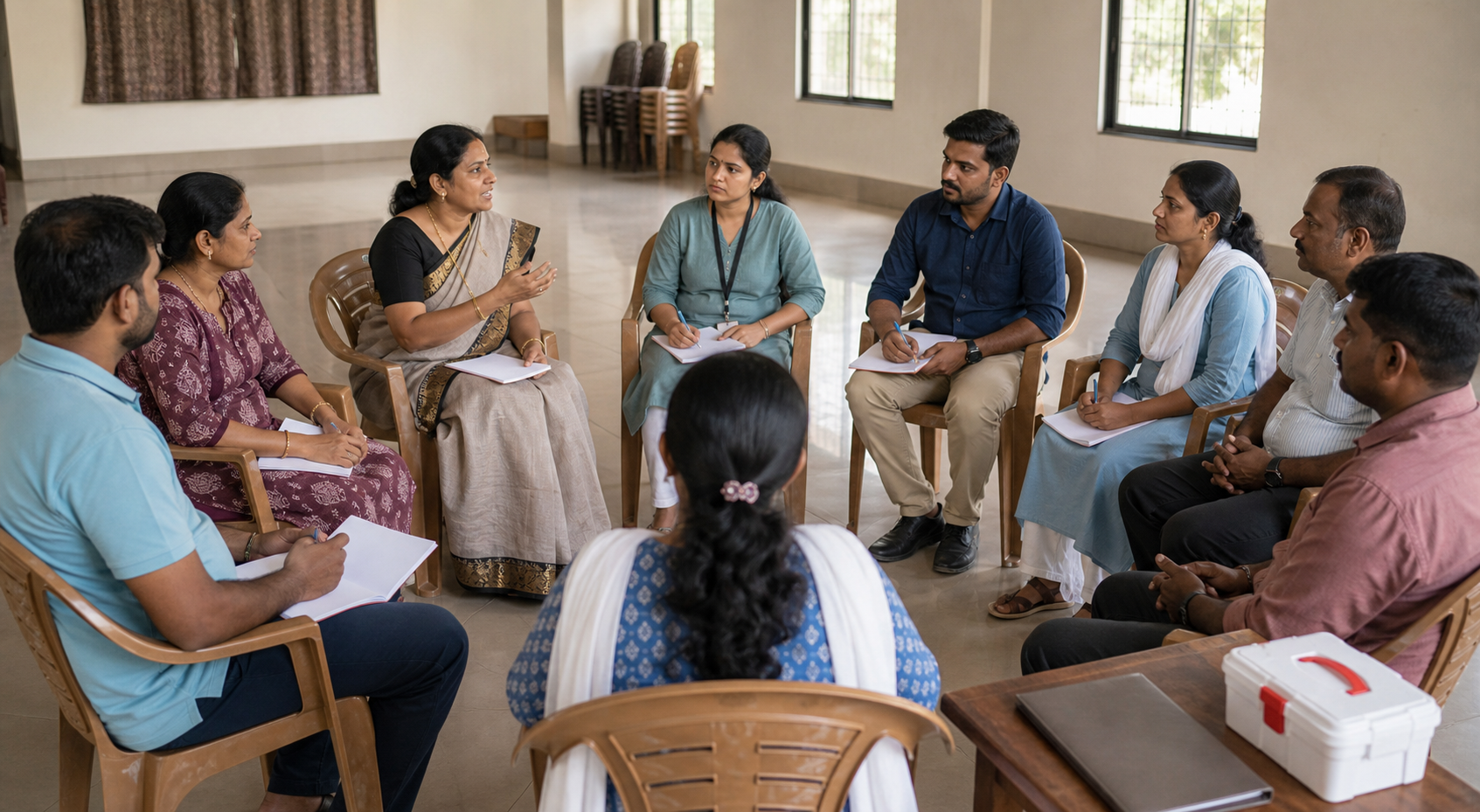
If you are organizing an awareness meeting
A responsible campaign should leave participants better able to identify coercion and help someone safely. It should not leave them suspicious of every interfaith friendship or licensed to punish people on rumor.
- Define the conduct under discussion. Name deception, coercion, blackmail, stalking, forced isolation and violence. State plainly that religious difference alone does not establish any of them.
- Separate verified facts from circulating claims. Do not present a local allegation as fact unless it can be substantiated through an appropriate process. Rumor repeated from a stage remains rumor.
- Teach consent and digital safety. Explain that consent must remain voluntary and can be withdrawn. Include account security, private-image abuse, impersonation and online stalking.
- Protect confidentiality. Use anonymized scenarios for instruction. Do not display a young person’s name, photograph, phone number, address or private messages to an audience or circulate them online.
- Build a referral path. Know which qualified counselor can support a distressed person, which lawyer can answer legal questions and which authority should receive evidence of an immediate offence or danger.
- Reject vigilantism in advance. Tell attendees not to gather a crowd, threaten a couple, confront another family in anger or publish accusations. A campaign loses moral discipline when it turns concern into intimidation.
- Include young people in the discussion. Speak with sons and daughters about healthy relationships, truthful courtship, religious freedom, family responsibility and the warning signs of control. Do not speak only about them.
The meeting’s success should be judged by whether a worried person knows what to notice, how to speak and where to seek help—not by how much fear the meeting produces. Evidence-led instruction is also harder for opponents to dismiss as communal rhetoric.
If you are worried about a specific person
Move in a calm sequence. First, check for immediate danger. If a minor is missing, or if anyone faces violence, sexual exploitation, forced confinement or a credible threat, contact the appropriate police or emergency service. Do not arrange a private confrontation with the suspected person.
If the danger is not immediate, speak privately with the person you are trying to protect. Write down what is verified, what was directly observed and what remains an assumption. This simple separation prevents a religious label from filling gaps in the facts.
Where possible, preserve threatening messages or other relevant material without editing or publicly forwarding it, and respect the affected person’s consent when handling private information. A qualified lawyer can advise on legal questions; a trained counselor can help with fear, trauma or coercive control; police are the appropriate channel for immediate threats or suspected offences.
If the person is an adult, the relationship is voluntary and the feared behavior cannot be substantiated, family disagreement does not justify confinement or harassment. Express your values, ask for ordinary due diligence and maintain the relationship. Continued trust gives you more protective capacity than a forced break followed by silence.
Before sharing another warning about “love jihad,” begin a calm family conversation about honesty, consent, religious freedom and the checks that should precede any serious commitment. That is a form of vigilance you can practice now—without waiting for fear, rumor or crisis to decide how your family will act.
References
