

Your mandir, sangha, or sangat can be full of activity while a struggling member remains effectively alone. People may offer warm greetings at gatherings, yet no one notices when an elderly devotee stops attending, a newcomer cannot find their place, or a family quietly carries an overwhelming burden.
The answer is not another slogan about compassion. You need a simple care structure that turns seva into dependable relationships: someone notices, someone listens, someone coordinates practical help, and someone follows up. The structure must also protect consent, privacy, spiritual freedom, and access to professional help when a situation exceeds the community’s competence.
Seva begins where good intentions stop
Sri Caitanya Mahaprabhu’s example sets a demanding standard because his service was personal, humble, and concrete. He bowed before devotees, washed and folded their cloth by the Ganges, brought clay for tilaka, and helped carry their loads. None of these acts depended on a platform, title, or public ceremony. The need in front of him became the field of devotion.
You do not need to reproduce those particular gestures literally. You do need to preserve their direction. Seva moves toward another person’s real burden. It does not wait for the task to become prestigious, visible, or spiritually glamorous.
This gives your community a practical test. Do not ask only whether members are friendly or whether service projects happen. Ask what occurs when a person needs care that is quiet, inconvenient, or sustained:
- Who notices when someone begins to disappear from community life?
- Does a newcomer know a safe person they can approach without embarrassment?
- Can a member request practical help without having to disclose their difficulty publicly?
- Does anyone follow up after the first conversation?
- Can a person decline advice or assistance without being judged as spiritually weak?
If the answers depend on chance, charisma, or personal access to a leader, care is still informal. Informal kindness matters, but it cannot assure belonging. A seva-centered system makes responsibility visible before a crisis exposes the gap.
This approach also gives Dharmic communities a meaningful basis for cooperation. Hindu seva, Buddhist karuna and maitri, Jain ahimsa, and Sikh traditions of seva and sangat converge in their call for compassionate action, dignity, and mutual support. They need not be declared identical. Each arises within a distinct spiritual discipline and understanding of the human condition.
For inter-tradition work, place the shared commitment at the level of conduct: listen without humiliation, reduce avoidable suffering, refuse exploitation, and help with the task at hand. Let each tradition explain the deeper spiritual basis in its own language. Unity becomes stronger when it does not require theological flattening.
Build care around named relationships
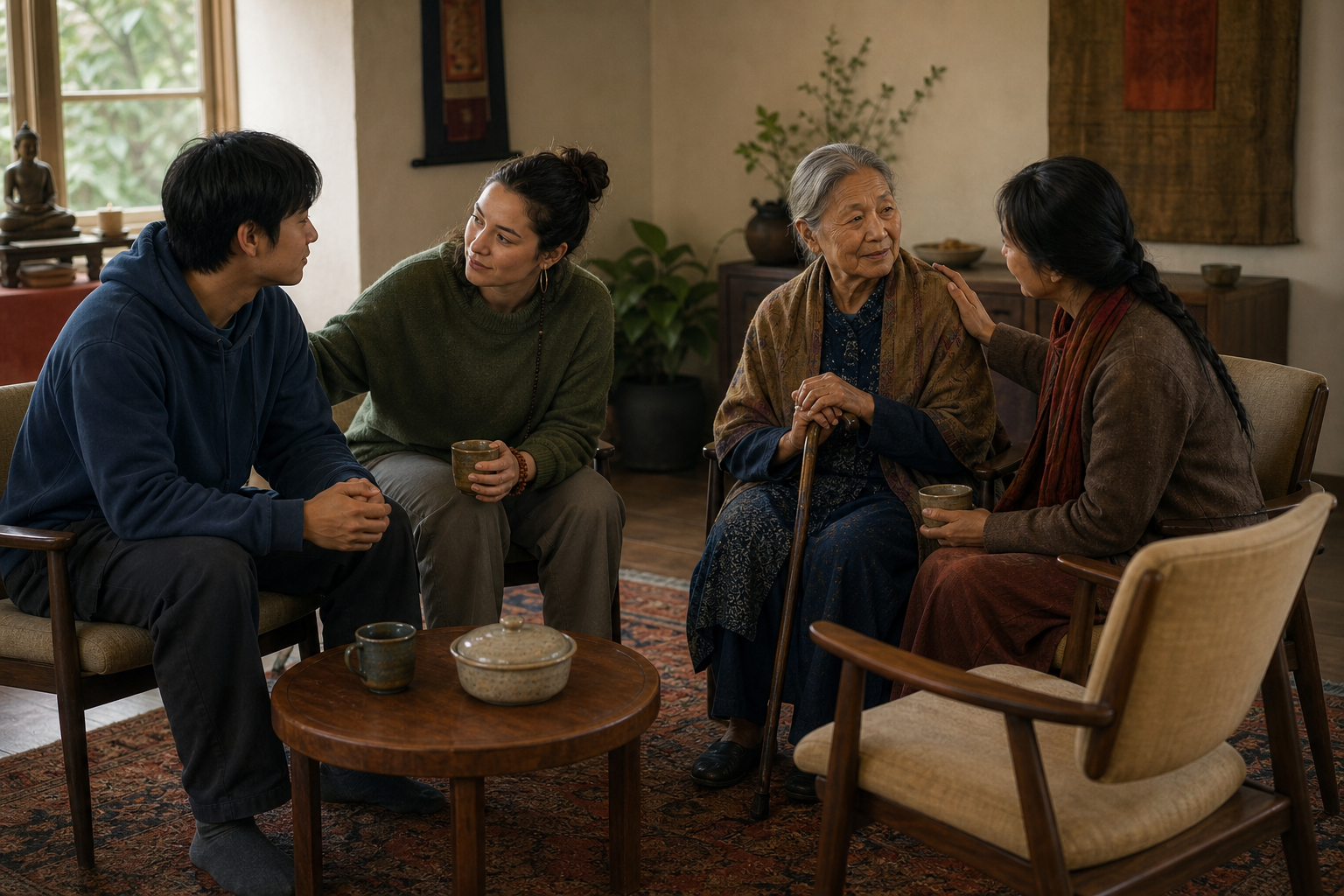
A counselor or mentor system gives compassionate intent a dependable shape. In various Vaishnava communities, including ISKCON, this model connects practitioners through small groups, recurring check-ins, sacred study, cooperative service, practical assistance, and companionship. Its value lies less in the label than in the relationship: a member knows who will listen and the counselor knows whom they have agreed to remember.
The word counselor can create confusion, so define it locally. A community counselor is not automatically a therapist, doctor, social worker, guru, or legal adviser. The role is to offer spiritual companionship within the tradition, listen attentively, coordinate ordinary assistance, and connect the person with qualified help when necessary.
You can establish the system through the following sequence:
- Write the role before selecting people. State what counselors may do, what they must not do, how confidentiality works, and when they must seek additional help.
- Invite participation rather than assigning intimacy. Explain the system and let each person choose whether to join, whom they feel comfortable approaching, and how they prefer to be contacted.
- Select counselors for steadiness, humility, discretion, and the ability to listen. Scriptural knowledge matters, but it does not compensate for unreliability, coercion, gossip, or an appetite for authority.
- Form small care circles around genuine accessibility. Language, life stage, location, mobility, and existing trust may matter more than administrative convenience.
- Agree on a recurring rhythm. The schedule should be predictable enough that silence is noticed and realistic enough that counselors can keep their promises.
- Combine conversation with shared practice. Sacred study, prayer, kirtan where appropriate, and cooperative seva can deepen relationships without turning every meeting into an interrogation about personal problems.
- Create a clear route for additional help. Counselors should know whom to contact for safeguarding concerns, urgent material needs, conflict resolution, and qualified medical, psychological, legal, or financial assistance.
- Review whether anyone is being overlooked. Newcomers, people with limited mobility, caregivers, members who work unusual hours, and those who do not belong to an influential social circle may require a different point of access.
Keep only the information needed to make care possible. A private working roster might contain a member’s preferred contact method, language, accessibility needs, counselor, and permitted emergency contact. It should not become a storehouse of confessions, diagnoses, family disputes, or opinions about spiritual standing. Record logistics with consent; do not create a hidden dossier.
Give members a plain way to ask for help. A dedicated contact person, private message channel, or request form can reduce the social cost of approaching a senior leader in public. Say what kinds of assistance the community can reasonably coordinate, such as transport to gatherings, meals during illness, appropriate home or hospital visits, help understanding community activities, or connection to outside services. Do not advertise support that no one has agreed or is equipped to provide.
Give counselors a clear way to respond

Listen before deciding what the problem is
A care conversation is not a test of how quickly the counselor can produce a verse or solution. Scripture may offer genuine guidance, but first establish what the person is asking for. They may need to be heard, need a practical task completed, want help thinking through a decision, or need support that the community cannot safely provide.
A simple response sequence keeps the encounter focused:
- Receive: give the person your attention and let them describe the situation without immediately correcting their interpretation.
- Clarify: ask what feels most difficult, what has already been tried, and what kind of help would be useful.
- Agree: identify the next action together. Do not assume permission to contact relatives, leaders, or other members.
- Act: complete the practical commitment or make the agreed connection. A promise to check is not the same as checking.
- Return: follow up after the action. Confirm whether the need was met and whether further support is wanted.
Suppose a regular attendee says they cannot come to the temple anymore. Do not immediately interpret the absence as diminished faith. Transport, caregiving, work, illness, interpersonal conflict, accessibility, or simple uncertainty about belonging could all require different responses. Ask before you assign a spiritual meaning. The correct seva may be a ride, a visit, mediation, a schedule adjustment, an introduction, or respectful space.
The same discipline applies when someone asks for advice. Distinguish among a scriptural principle, a counselor’s personal judgment, and a matter requiring professional competence. Presenting personal preference as Dharma can make disagreement feel like disobedience. A trustworthy counselor can say that they do not know.
Know when companionship is not enough
Seva-centered care must never be presented as a substitute for medical treatment, mental-health care, safeguarding intervention, legal advice, or emergency assistance. If someone describes immediate danger, abuse, severe medical distress, self-harm, or an inability to remain safe, stop treating the matter as an ordinary mentoring conversation. Use the appropriate local emergency, safeguarding, or professional pathway. Do not promise absolute secrecy when safety may require disclosure.
The counselor’s continuing role is still important. Referral should not mean abandonment. With the person’s consent and within appropriate boundaries, the community can remain present through meals, transport, prayer, visits, childcare arranged under safeguarding rules, or help staying connected. Professional care addresses the problem requiring expertise; seva helps ensure that the person does not face it without human companionship.
Protect dignity with boundaries and accountability

A caring role carries influence. A member may reveal grief, conflict, financial difficulty, doubt, or experiences they have not shared elsewhere. Without boundaries, a system created for companionship can become a channel for gossip, factional control, spiritual pressure, or unhealthy dependence.
Publish a short care charter that members and counselors can both understand. It should include these protections:
- Participation is voluntary. Declining a counselor, requesting another counselor, or leaving a care circle is not a spiritual offence.
- Private information is not shared for curiosity, status, fundraising, recruitment, discipline, or factional advantage.
- Limits to confidentiality are explained before sensitive disclosures, especially where immediate safety or safeguarding obligations may apply.
- Counselors ask permission before giving personal information to leaders, relatives, or other volunteers, except where an urgent safety duty overrides ordinary confidentiality.
- Spiritual guidance is not enforced through threats of exclusion, loss of aid, damaged reputation, or claims that obedience to the counselor proves devotion.
- Where practical, the person providing intimate pastoral care is not also the sole decision-maker over discipline, money, housing, or access to essential material support.
- Members have a confidential route to report misconduct, request reassignment, or seek review by someone outside the immediate care relationship.
- Counselors can step back when exhausted, conflicted, or beyond their competence. Reassignment is safer than continuing resentfully or pretending expertise.
- Work involving children or vulnerable adults follows the community’s safeguarding procedure and applicable local requirements, not informal exceptions based on trust or seniority.
The Guru-Shishya relationship may nourish the spiritual ethos of a Vaishnava counselor system, but a community counselor does not thereby become the member’s guru. The counselor helps a practitioner remain connected to authentic spiritual guidance and community life; they should not place themselves between the practitioner and every other source of support.
Watch for the difference between belonging and dependence. Belonging expands a person’s healthy relationships and confidence to participate. Dependence concentrates access, interpretation, and approval in a single gatekeeper. If members believe they cannot seek help, serve, ask a question, or speak to leadership without one counselor’s permission, the structure needs correction.
Accountability should examine ordinary reliability as well as serious misconduct. Are promised calls made? Are practical requests handed off and then forgotten? Are quieter members heard? Do counselors monopolize conversations? Does help preserve the recipient’s agency, or does it produce indebtedness? These questions keep seva grounded in service rather than reputation.
In a multi-tradition Dharmic setting, add another boundary: shared care must not become covert conversion or theological absorption. A Buddhist, Jain, Sikh, or Hindu participant should be able to receive practical support without being required to adopt another community’s vocabulary, ritual, teacher, or metaphysics. Shared service can strengthen Dharmic solidarity precisely because distinct paths remain recognizable.
Key takeaways: the minimum viable care system

- Give each willing participant a named, consent-based point of contact rather than relying on general friendliness.
- Use small circles and recurring check-ins so absence, isolation, and practical needs can be noticed.
- Teach counselors to listen, clarify the request, agree on an action, complete it, and follow up.
- Define the role narrowly: spiritual companionship and practical coordination, not unqualified therapy, medicine, legal advice, or guru-like authority.
- Publish rules for consent, confidentiality, safeguarding, complaints, reassignment, and urgent escalation.
- Measure success by reliable care, wider belonging, and preserved agency, not by the counselor’s influence or the program’s size.
At your next community meeting, choose a limited group whose needs are regularly missed, define what care you can honestly sustain, name responsible coordinators, and publish a private way to ask for help. Start small enough that every promised check-in and practical action can actually be completed. Seva becomes a culture when people learn that asking will lead to a respectful response – and that no one has to become important before being remembered.
References
