
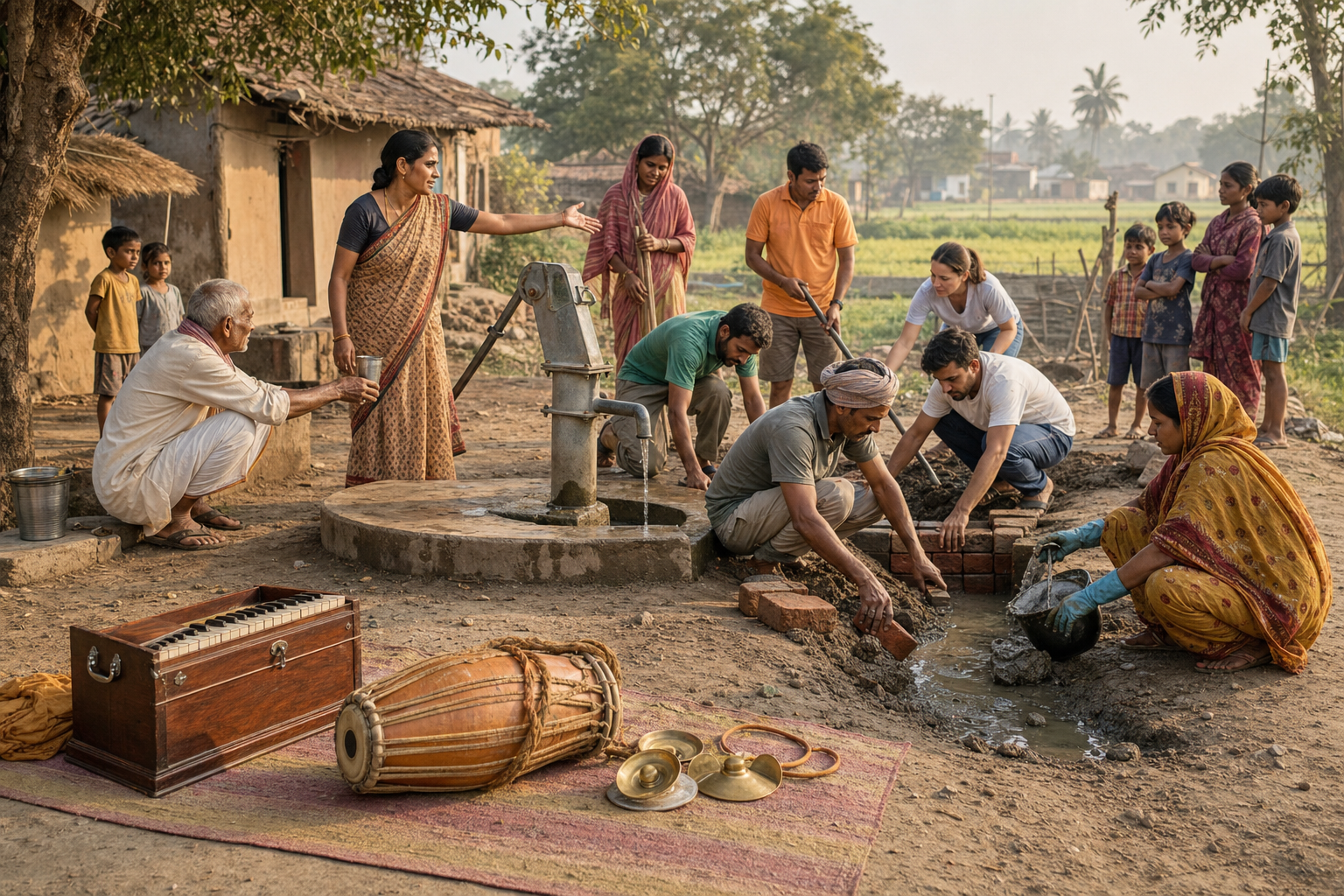
You may have a committed kirtan team and a village that receives it warmly, yet still wonder whether anything changes after the singing stops. That is the right concern. Attendance, emotion, and devotional goodwill are not rural transformation.
If your aim is durable seva, treat kirtan as the beginning of a relationship rather than the centerpiece of a visit. Its practical value is to create enough trust for villagers and visitors to identify one shared problem, act on it together, and return to see whether the new habit held.
Kirtan is social infrastructure, not a technical solution
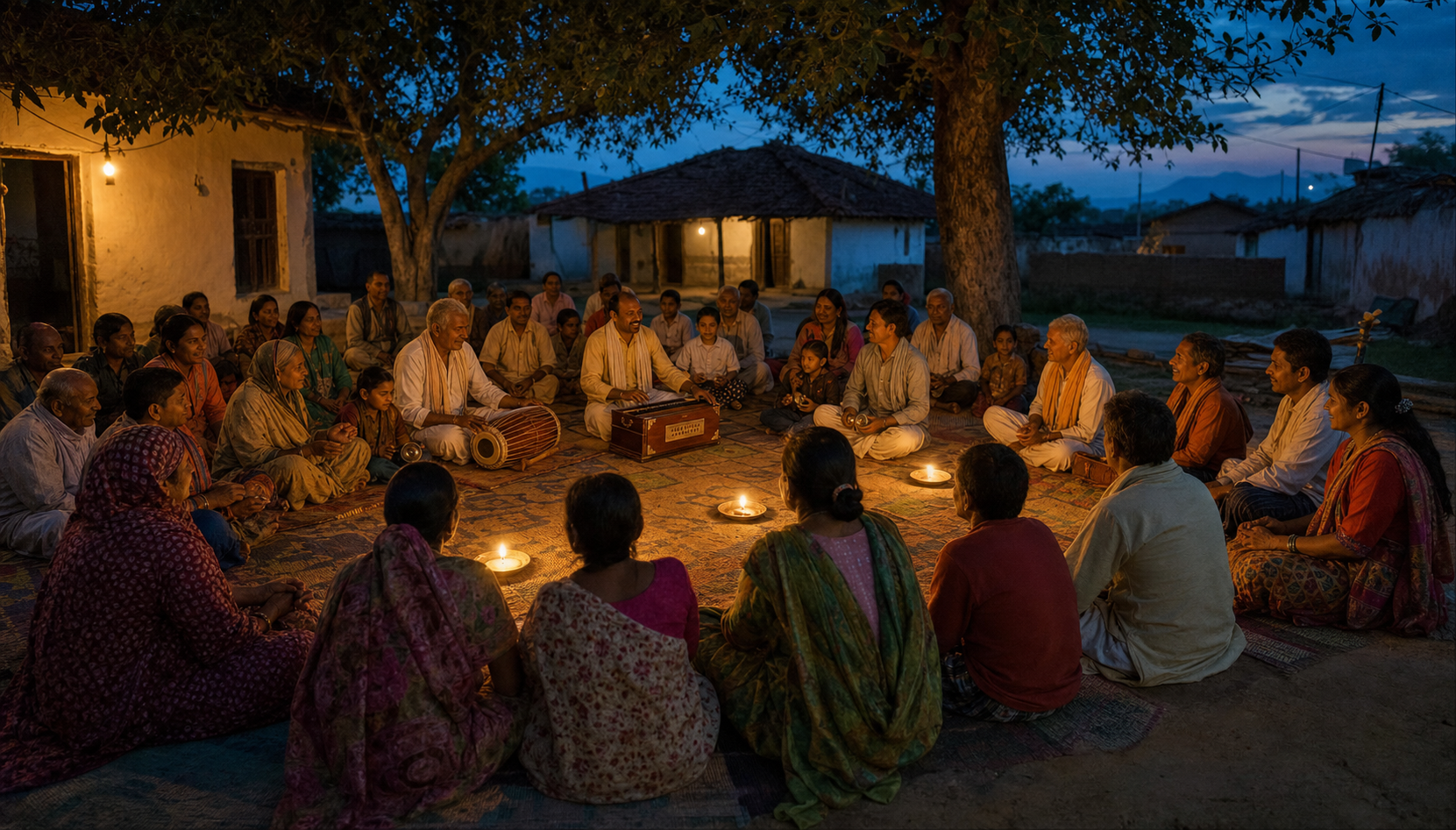
A village may already know that a path needs cleaning, water is being wasted, or organic material could become compost. Knowing is not the same as coordinating. Someone must call the meeting, households must trust the process, responsibilities must be distributed fairly, and people must believe that others will keep their commitments.
That coordination is difficult where daily life is constrained by seasonal income, limited time, gendered divisions of labor, and uneven access to formal services. An outside team that arrives with a long project list can add another demand to an already crowded day.
Kirtan changes the starting conditions. Call-and-response participation aligns attention, voices, and timing. It gives people with different levels of literacy a common way to join. A circle can temporarily soften social distance and make cooperation feel less risky. The low-cost outreach pattern associated with Govardhan Eco Village uses that opening well: arrive consistently, sing together, listen carefully, and connect the gathering to simple acts of service.
But kirtan cannot harvest rainwater, separate waste, maintain a kitchen garden, or decide who will care for planted trees. It prepares people to cooperate; it does not replace the work. You can tell whether the gathering is becoming useful by watching what happens immediately afterward:
- Do elders, women, and young people all have a practical way to speak?
- Can a local resident name the priority in ordinary language?
- Does the discussion end with one specific action rather than several aspirations?
- Is a local person or group responsible for the next step?
- Does everyone know when progress will be checked?
If the answer is repeatedly no, adding more songs, volunteers, posters, or environmental modules will not solve the underlying problem. Improve the listening and decision process first.
Key takeaways
- Kirtan builds readiness for cooperation; it is not evidence that a village problem has been solved.
- Seva becomes locally durable when the community chooses the task, assigns responsibility, and reviews the result.
- Begin with one manageable action that produces a visible shared benefit.
- Use calendars, stickers, and other cues only after a behavior has been agreed upon.
- Measure participation and repeated behavior, not merely devotional attendance.
- Keep every activity voluntary, inclusive, and clearly separated from proselytization.
Start with a listening cycle, not a project list
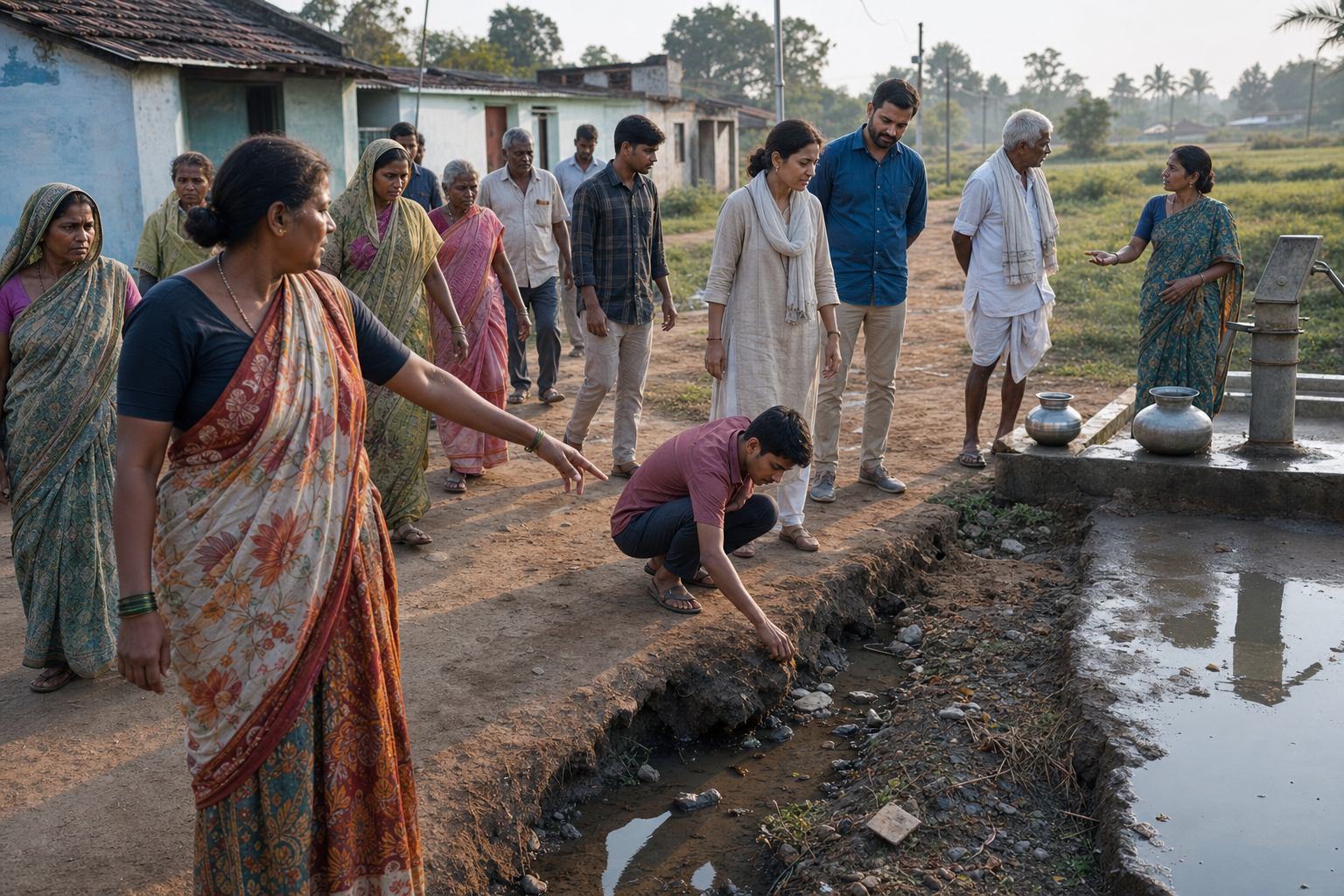
The first practical mistake is to assume that a technically sensible intervention is therefore the right starting intervention. Greywater reuse may be worthwhile, for example, but a village may be more ready to organize a shared-path cleaning day. The best first task is the one residents consider important and can realistically carry through.
Use a repeatable visit sequence:
- Find the village rhythm. Ask when cattle are tended, water is collected, fields require attention, and household work is heaviest. Schedule around those routines. Do not assume that a time convenient for visitors is convenient for residents.
- Open the gathering without attaching conditions. Explain that people may sing, listen, or sit out. Access to the seva activity must never depend on devotional participation.
- Map needs with the community. Use a simple participatory sketch to mark water points, common paths, waste areas, gardens, trees, and places where work repeatedly breaks down. Invite elders, women, and youth to describe what each location means in daily life.
- Select one starting behavior. Choose something that can be managed with available skills and modest resources, fits the seasonal workload, benefits more than one household, and can be observed without a complicated survey.
- Make ownership visible. Record the action, the local owner, the visiting team’s support, the location of shared tools, and the next check-in. Keep the task list where participants can see it.
- Return when promised. Begin the next gathering by asking what happened, what failed, and what needs to change. A predictable return visit does more for trust than an ambitious launch followed by silence.
Choosing one action is not a lack of ambition. It protects the relationship from the fatigue created by several unfinished activities. A successful round of path cleaning, source segregation, composting, or water stewardship gives the village a working pattern that can later carry a second task.
Suppose residents choose waste segregation. The group first agrees on what will be separated, where each category will go, and who will check the shared point. A clear cue is then placed where the decision occurs. At the next visit, count whether sorting is actually happening. If it is not, examine the workflow: the location may be inconvenient, responsibilities may be vague, or the disposal arrangement may be incomplete. Do not treat weak compliance as weak devotion.
The same discipline applies to water, gardens, sanitation, and tree planting. Diagnose the practical barrier before delivering another motivational message.
Keep seva voluntary, Dharmic, and locally owned
Kirtan-led seva can draw strength from a shared Dharmic ethical vocabulary without pretending that all traditions are identical. Hindu, Buddhist, Jain, and Sikh communities express compassion, non-harm, generosity, remembrance, and service through distinct teachings and practices. Vaishnava kirtan, Sikh kirtan and naam simran, Buddhist chanting, and Jain stavan can resemble one another in their participatory and devotional spirit, but those family resemblances are not permission to erase their differences.
Use the name, language, melody, and form that local participants recognize. If a community calls its practice stavan, naam simran, bhajan, or chant, do not relabel it merely to make a visiting program look uniform. Unity in diversity becomes credible when people can participate as themselves.
Ethical safeguards should be stated before the work begins, not introduced after someone feels pressured:
- Participation in singing and service is opt-in.
- No household loses access to a civic benefit because it declines a religious activity.
- The visiting team states a clear no-proselytization norm.
- Consent is requested before collecting personal stories, perception scores, photographs, or other identifying material.
- Women, youth, and elders are included in decisions rather than invited only after the plan is fixed.
- Local participants can question the task, change the method, or end an activity that is not serving them.
Inclusion also requires attention to how a meeting actually works. A general invitation does not guarantee that everyone can speak. If existing roles make it difficult for women or young people to contradict senior men in a large circle, hold additional listening conversations and bring those priorities back into the shared decision. This is not a symbolic courtesy. Women and young people often see constraints in household water use, sanitation, caregiving, mobility, and livelihood work that a visitor will miss.
Women’s self-help groups and youth clubs are especially useful continuity partners because they already organize repeated activity. Invite them to keep the task list, lead a skills session, maintain a garden or seed-saving practice, coordinate first-aid learning, or conduct the next public check-in. If visiting brahmacharis hold the microphone, define the problem, control the tools, and keep the records, the program is creating dependence rather than capacity.
Translate the shared feeling into one durable habit
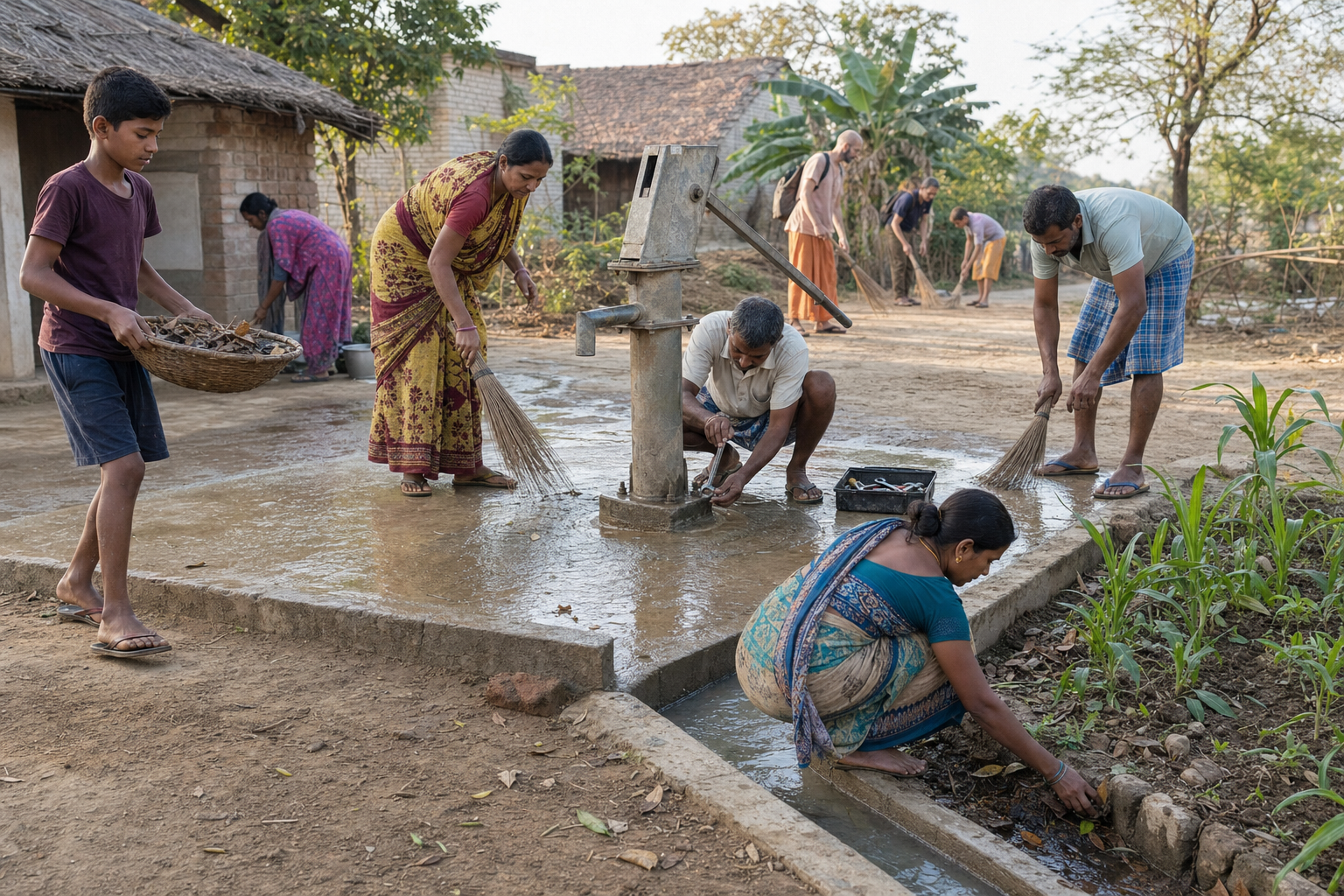
The emotional lift of a gathering is temporary. A new behavior needs a cue in the place where the daily decision occurs. This is where a calendar or sticker can be useful, but only when it is connected to an agreed action. A giveaway with no behavioral purpose is decoration, not community infrastructure.
Choose the row that matches the village’s selected priority. Do not launch every module at once.
| Local priority | First manageable practice | Useful cue | What to observe |
|---|---|---|---|
| Shared paths | Collective shramdaan for cleaning | A calendar marking the next cleaning day | Whether the task occurs and who participates |
| Mixed household waste | Source segregation | A clear sticker at the disposal point | Whether materials remain separated in daily use |
| Water stewardship | An agreed water-use practice or appropriate greywater reuse | A cue at the relevant water point | Whether the agreed practice is followed between visits |
| Household food growing | Kitchen-garden composting | A calendar reminder for routine upkeep | Whether composting and garden care continue |
| Local biodiversity | Planting suitable native trees | A seasonal care reminder | Whether planted trees continue to receive care |
The cue should be readable in the local language, understandable through simple imagery where literacy varies, and placed at the decision point. A handwashing cue belongs near the water point. A calendar above the hearth can carry cleaning days, water-use commitments, tithis, seasons, and festival reminders. Agricultural do-and-don’t cues belong where the relevant farm or storage decision is made.
Give each cue one main job. A sticker crowded with sanitation, agriculture, road safety, and devotional messages is easy to ignore. The team should be able to complete this sentence: When a person sees this cue, we want them to do ______. If no one can fill the blank precisely, the material is not ready.
Public-health learning can fit naturally around a trusted gathering. Handwashing practice near a water point and menstrual-hygiene education led by local women are practical examples. Health information should be accurate and respectfully delivered, and personal health concerns should be directed to an appropriate health professional. A devotional gathering can open the door to sound education; it is not a substitute for medical care.
Finally, do not confuse the survival of a sticker with the survival of a habit. If the cue remains on the wall but waste is still mixed or the cleaning day no longer happens, change the workflow, responsibility, or cue. The artifact serves the behavior, not the other way around.
Govern, measure, and scale the work without losing trust
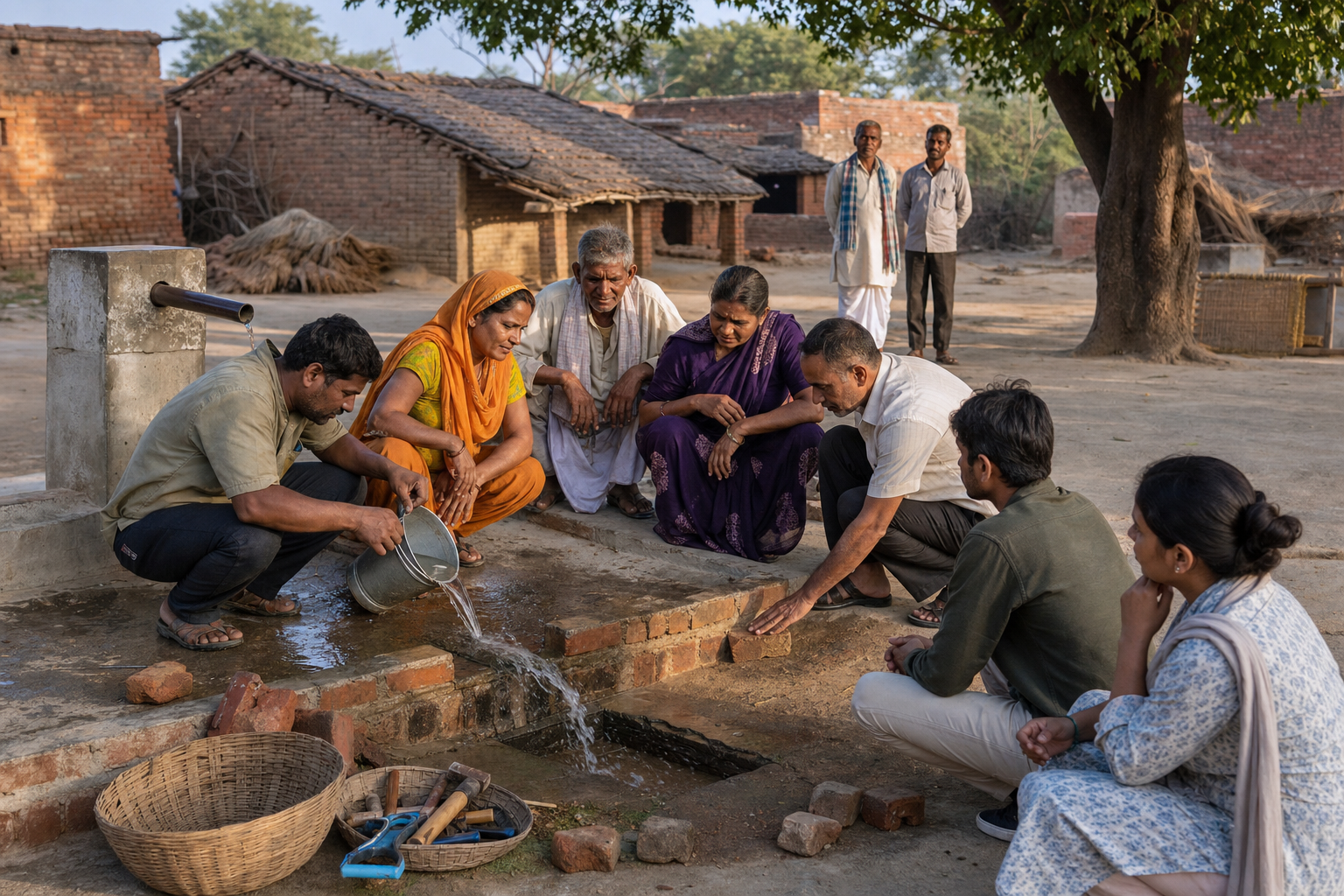
Trust built through song can be spent quickly through opaque decisions. Keep responsibilities public. Shared tools need an agreed location and custodian. Tasks need owners and review dates. A short check-in during an evening bhajan can reveal blocked work before frustration becomes conflict.
Accountability should remain proportionate to the activity. A path-cleaning group does not need a burdensome reporting system. It does need a visible commitment, a way to record whether the work occurred, and a place to raise obstacles without embarrassment.
A minimum measurement dashboard
Do not begin with a complicated impact report. Use a small set of measures that answer different questions:
- Participation: Record attendance, but also notice whether elders, women, youth, and different social or religious groups are represented in discussion and task ownership.
- Perception: Use the same short questions before and after a defined activity cycle to examine trust, willingness to cooperate, and perceived well-being.
- Behavior: Count the action that matters: segregation compliance, completed cleaning days, continued garden upkeep, water practices, mutual-aid activity, or care of planted trees.
- Experience: Capture Most Significant Change stories on a quarterly rhythm to understand what participants consider important and why.
- Partner value: Where a panchayat needs a broader case for support, prepare a modest Social Return on Investment sketch and state every assumption plainly.
Each measure has limits. Attendance shows reach, not transformation. A change in perception does not by itself prove that kirtan caused an environmental or livelihood outcome. Stories reveal meaning and unintended effects, but they do not replace behavior tallies. Use the measures together and keep claims no larger than the evidence.
A clear theory of change helps prevent exaggerated conclusions: kirtan creates a temporary opening for trust; inclusive facilitation converts that opening into a locally chosen task; visible ownership and repeated cues support the task between visits; observed behavior shows whether the practice is becoming habitual; only then should the team discuss wider effects on cleanliness, water stewardship, mutual aid, or livelihoods.
If one link in that chain is missing, do not leap to the final claim. A crowded kirtan followed by an unmaintained garden is not a successful garden intervention. It is evidence that the handoff from gathering to ownership needs repair.
Scale only what local people can carry
Before taking the model to another village, check whether the present village can sustain its essential parts:
- A local team can facilitate the gathering and practical check-in.
- Residents can select the next priority without waiting for visitors to decide.
- The task continues between outside visits.
- Responsibilities, tools, and results remain visible to participants.
- Women, elders, and youth have a real route into decisions.
- People can decline devotional participation without losing access to service.
Once those conditions hold, training local trainers and arranging village-to-village immersion visits can spread working practices without forcing every community into the same template. Where the chosen activity fits, coordination with Swachh Bharat, Jal Shakti Abhiyan, or the National Rural Livelihoods Mission can connect local energy to public programs. Start with the village priority, then find the relevant institutional support; do not redesign the priority merely to fit a scheme.
At your next visit, bring fewer promises: a familiar kirtan, a blank community map, and a plain task sheet. Ask residents to choose one behavior to test before you return. Leave one cue tied to that choice, then come back and examine the habit with them. When local hands own the next step, kirtan has begun to do civic work without ceasing to be sacred.