

If you are starting a weekly pāṭha, kīrtana circle, Hanuman Chalisa kendra, youth satsanga, or scripture gathering, the difficult question is not how to hold the opening event. It is how to make later gatherings disciplined, welcoming, and useful without burying devotion beneath administration.
A durable devotional institution gives people a sacred practice they can enter, relationships they can trust, and service through which practice becomes character. Build in that order. Begin with sādhana, organize people around it, and let sevā carry its values into the neighborhood.
Begin with a sacred centre, not a catalogue of activities
Many local initiatives begin with enthusiasm and immediately add lectures, festivals, children’s classes, charity drives, social media, pilgrimages, and cultural performances. The calendar fills before the institution knows what it exists to preserve. Volunteers become tired, participants receive an uneven experience, and the gathering depends on whoever happens to be available.
Choose the devotional centre first. It might be congregational kīrtana, Hanuman Chalisa recitation, nāma-japa, a regular pāṭha, meditation, or study within a clearly identified sampradāya. A daily or weekly recitation cycle can form the stable core around which teaching, fellowship, and service develop. People should be able to answer a simple question after attending: what do we practise here, and why?
Continuity also requires a declared relationship to teaching authority. Bhagavad-gita 4.2 places transmission within paramparā, while 4.34 joins humble approach, service, and relevant inquiry in the learner’s conduct. That combination of lineage, inquiry, and sevā protects a community from two opposite failures: mechanical ritual without understanding and improvised spirituality without accountability.
Write a short charter before expanding the program. It should complete these statements:
- Our centre exists to help people practise…
- Our principal text, teaching lineage, or recognized authority is…
- The part of every gathering that remains fixed is…
- The local need we will address through sevā is…
- Participants can expect conduct marked by…
- Questions about teaching, money, safety, or behavior go to…
This is not a marketing statement. It is a decision filter. If a proposed activity does not deepen the core practice, strengthen trustworthy fellowship, or enable responsible service, postpone it.
Give the regular gathering a recognizable rhythm:
- Welcome newcomers and explain what will happen.
- Begin the shared devotional practice on time.
- Explain a manageable portion of the text, hymn, or teaching.
- Allow relevant questions without turning the session into an argument.
- Name the current sevā commitment and any help required.
- Close in the customary manner and make the next gathering easy to find.
Predictability is hospitality. A first-time visitor should not need private knowledge to follow the gathering. If an observance follows a tithi, state which local calendar the centre uses; traditional dates can vary slightly by geography. Publish changes early, particularly when families, elders, or participants travelling from another area are involved.
Turn attendance into belonging through real responsibility
An audience consumes a program. A community carries it. You cross that boundary when participants receive meaningful duties, preparation, mentoring, and permission to grow into leadership.
Name the recurring functions even if the same volunteer initially covers several of them:
- A practice steward prepares the recitation, music, altar, text, or meditation space.
- A teaching steward checks references and keeps explanations aligned with the declared tradition.
- A welcome steward notices newcomers, explains etiquette, and prevents established friendship circles from becoming a closed gate.
- A safeguarding steward maintains the conduct policy, protection procedures for minors, and route for raising concerns.
- A sevā steward defines the current project, its partners, and the work volunteers may safely perform.
- A communications steward manages the calendar and consent-based reminders.
- A finance steward records contributions and expenses in an inspectable ledger.
These are responsibilities, not honorific titles. Each steward should have a written run-sheet and should teach someone else how the function works. The centre becomes resilient when a competent substitute can open the room, lead the established practice, find the materials, and close the gathering properly.
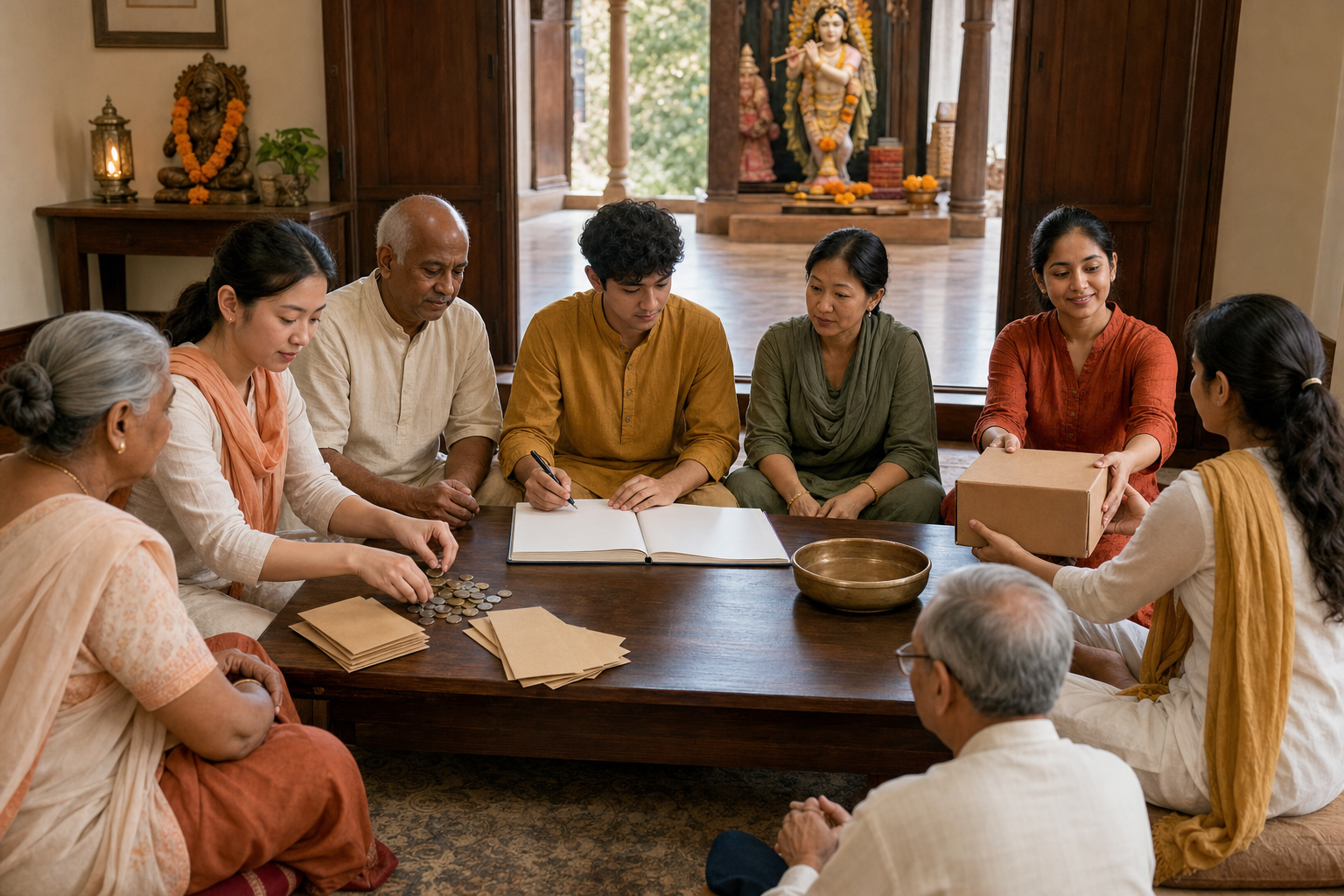
Give newcomers a visible path into participation. On their first visit, explain the practice and let them observe without pressure. Before they leave, tell them when the next gathering occurs and ask before adding them to any contact list. As familiarity grows, offer a contained task such as arranging books, preparing learning aids, welcoming families, helping with prasāda, or supporting a service project. When someone shows steadiness, pair that person with an experienced steward rather than handing over an undefined burden.
Youth and women should not be treated as audiences for a program designed elsewhere. Young participants can learn to lead recitation segments, prepare multilingual materials, assist with digital coordination, or organize heritage activities. Women can lead across teaching, operations, family scheduling, safety, and service according to the community’s tradition and local circumstances. Mentored roles and concise facilitator notes make participation depend on preparation rather than insider status.
Accessibility does not require dilution. Use the languages people actually understand. Offer call-and-response learning, consistent transliteration, source-language text, an accurate translation, and audio support where useful. Define unfamiliar terms the first time they appear. If a regional-language contribution enters a shared archive, an English synopsis can widen access without replacing the original voice.
Watch for a revealing warning sign: the same person leads, explains, approves, spends, announces, and resolves complaints. That may look efficient while the group is small, but it confuses spiritual respect with operational control. Distribute duties before strain or suspicion forces the issue.
Make sevā the public test of devotional maturity
Devotion gathers force when it changes how people keep promises, treat neighbors, use resources, and respond to need. Sevā gives a community a disciplined way to practise those changes together. It should arise from worship, not compete with it, and it should never become a publicity exercise loosely attached to a sacred name.
Select a focused seasonal priority instead of collecting unrelated causes. A suitable project should meet these tests:
- The need is recognizable to people who live nearby.
- The work matches the actual competence of the volunteers.
- The scope is clear enough to complete or repeat.
- Children, elders, or inexperienced volunteers receive appropriate supervision.
- The timing respects the local sacred, school, work, and agricultural calendars.
- The work can remain non-partisan and free from pressure to convert, endorse, or campaign.
- A competent local institution can be involved when specialist knowledge is required.
Practical options include student tutoring, organized support for elders, neighborhood cleanliness, environmental stewardship, or preparedness education delivered with an appropriate civic partner. Health activity should be handled with qualified clinics or recognized organizers; a devotional team should not present itself as a medical provider. Define who is responsible, what volunteers may do, what they must not do, and when a concern must be referred to someone qualified.
Sevā can also create principled cooperation across the Dharmic family. A Hindu centre may work with a gurdwara, Buddhist vihāra, or Jain derāsar on a shared civic need while each institution retains its own liturgy, authority, and language. Langar and sevā, mettā, maitri-bhāva, ahiṃsā, and bhakti offer points of mutual recognition; they are not interchangeable doctrines.
That distinction matters. Dharmic unity does not require a composite ritual or vague claim that every tradition teaches the same thing. Collaborate on the work. Let each community describe itself. Use language of respect instead of appropriation. A project built this way produces cooperation without asking anyone to surrender conviction.
Measure enough to learn, not enough to turn the centre into a reporting office. Useful signs include regular attendance, newcomers who return, volunteers trained to facilitate, completion of promised sevā, hours actually delivered, and participants’ reported growth in devotional understanding and neighborly trust. Also notice who remains absent. A rising headcount can conceal weak retention, exhausted volunteers, inaccessible language, or a program that families do not consider safe.
Use light governance to protect trust and continuity
Keep the operating system visible
Governance is not foreign to devotion. It is how a community makes duty observable. The aim is not bureaucracy; it is to ensure that sacred authority, money, private information, and vulnerable participants are never managed through ambiguity.
| Area | Minimum practice | Failure it helps prevent |
|---|---|---|
| Teaching | Name the principal texts, lineage, and person responsible for checking instruction. | Doctrinal drift and confident misinformation. |
| Schedule and venue | Publish the calendar basis, access details, changes, and rules for sound. | Confusion, exclusion, and conflict with neighbors. |
| Money | Record contributions and expenses, retain supporting records, and make the ledger inspectable. | Undisclosed spending and avoidable suspicion. |
| Safety and conduct | Adopt rules on respectful behavior, protection of minors, complaints, and incident response. | Preventable harm and pressure to remain silent. |
| Communications | Use opt-in contact lists, role-based access, and minimal data retention. | Privacy loss, spam, and uncontrolled circulation of personal details. |
| Succession | Maintain run-sheets, shared learning resources, and prepared substitutes. | Founder dependence and loss of institutional memory. |
For a public gathering, check local requirements concerning venues, sound, safeguarding, fundraising, and public events rather than assuming that a religious purpose creates an exemption. If a requirement is unclear, obtain local qualified advice before accepting money, announcing a large event, or placing minors in a program.
Keep the digital system equally modest: a shared calendar, a searchable set of approved teaching materials, and consent-based reminders may be enough. Role-based access and minimal retention of personal data let coordination grow without treating every attendee as a record to be collected.
Publish a grievance route that does not require someone to complain directly to the person involved. Record the concern, protect privacy, avoid retaliation, and refer matters beyond the centre’s competence to the proper authority. A suggestion box or periodic feedback form can reveal ordinary friction earlier, but it is not a substitute for a clear response to allegations of harm.
Make remembrance an annual audit
Festivals honoring a guru or teaching lineage can renew more than emotion. They can preserve institutional memory and convert gratitude into a disciplined commitment for the next cycle. In the Gaudiya Vaishnava setting, for example, Vyāsa-pūjā brings together guru-pūjā, kīrtana, flower offerings, written homages, communal reading, and prasāda. The written offerings become an archive of how teaching entered actual lives.
The same principle can inform reflection around Guru Purnima and other tradition-specific observances. Buddhists, Jains, and Sikhs honor teacher and teaching through their own authorities and forms; acknowledging that shared reverence should deepen respect for difference, not erase it.
Before the community’s principal annual observance, ask participants and stewards to reflect on these questions:
- Which teaching governed our choices when convenience pulled in another direction?
- Which element of sādhana became steadier?
- Who learned to carry a responsibility that previously depended on someone else?
- What promised sevā did we complete, and what remained unfinished?
- Where did trust weaken, and what operating change is now required?
- What concrete commitment will we carry until the next observance?
A useful written homage can begin with respectful praṇāms, identify a teaching that shaped the writer’s conduct, describe a concrete change, and end with a commitment that can later be reviewed. Check quotations, verse references, sacred names, and transliteration before preserving the offering. Editing should clarify the writer’s thought without replacing a living devotional voice with institutional prose.
This annual practice reveals whether the institution is merely repeating events or transmitting character. It also leaves future participants something more valuable than photographs: an account of what the community learned, whom it served, which duties it handed on, and how it remained accountable to its Dharma.
Key takeaways
- Choose a stable sacred practice and declared teaching authority before adding programs.
- Use a short charter to define sādhana, lineage, sevā, conduct, and accountability.
- Give participants named duties, written run-sheets, mentoring, and a path into leadership.
- Make learning accessible through local languages, reliable translations, transliteration, and guided participation.
- Select focused sevā that matches local need and volunteer competence; use qualified partners where specialist work is involved.
- Cooperate across Dharmic traditions through shared service while preserving distinct teachings and ritual boundaries.
- Protect trust with transparent finances, safeguarding, consent-based communications, grievance handling, and succession planning.
- Use the principal annual observance to review practice, service, trust, and commitments for the next cycle.
At your next gathering, place a short charter before the volunteer team. Name the fixed practice, the current sevā, the steward for each recurring duty, the route for raising a concern, and the next date. A devotional gathering becomes an institution when people can depend on its practice, trust its conduct, and inherit its responsibilities.



References
- DharmaRenaissance Blog — Srila Prabhupada’s 2026 Vyasa-puja: Inspiring Guide to Meaning, Homage Writing, and Dharmic Unity
- DharmaRenaissance Blog — Dr Pravin Togadia in Hajipur: A Powerful Call for Hanuman Chalisa Kendras to Unite Dharmic India
