
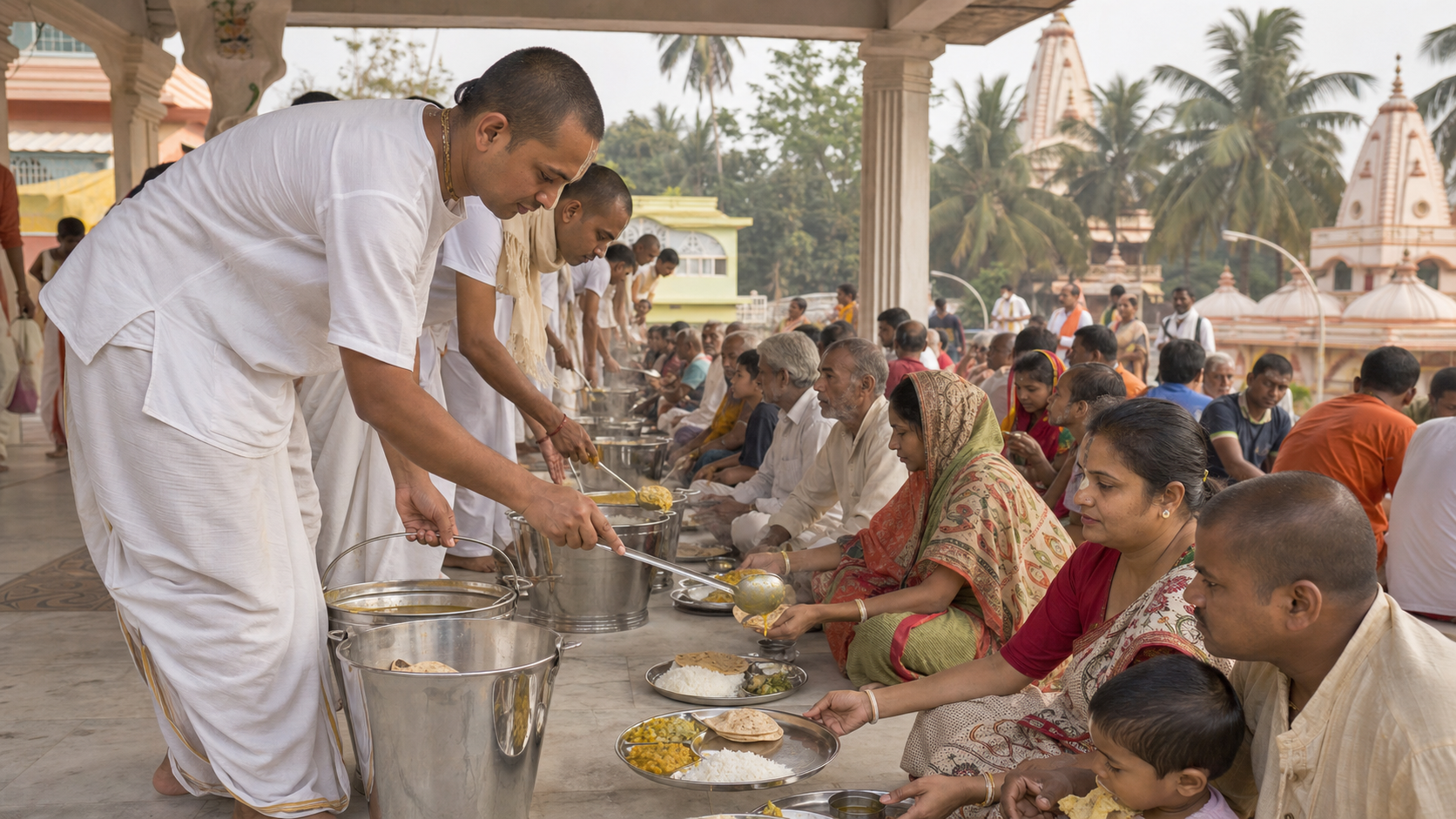
If you are helping a temple serve the wider public, your first question may be whether to begin with philosophy, worship, or practical assistance. Mayapur offers a disciplined answer: begin with an act in which worship and assistance are already joined. In Gaudiya Vaishnava life, that act is the preparation, offering, and distribution of prasadam.
This approach works only when three things remain aligned: the food is genuinely offered in bhakti, every recipient is treated with dignity, and the operation is competent enough to protect the people it serves. That gives you a clear standard for organizing prasadam distribution, welcoming civic participation, and preventing devotional service from becoming either an empty spectacle or an unsafe meal.
Prasadam changes the purpose of the meal, not just its menu
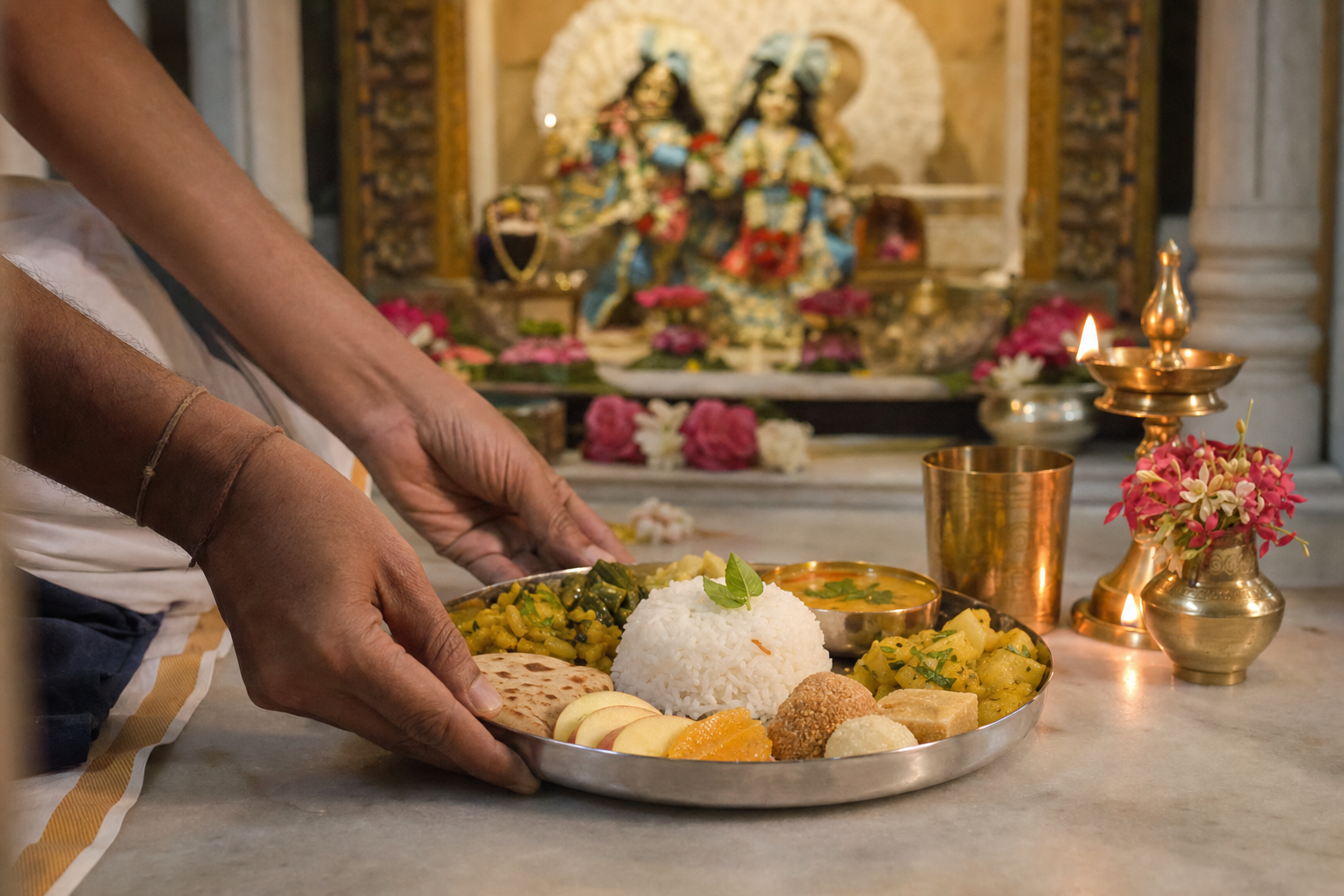
Your first decision is not how many plates to serve. It is whether the meal will remain an act of bhakti from the kitchen to the final recipient. A vegetarian preparation is not automatically prasadam. Within Gaudiya Vaishnava practice, food is prepared for Krishna, offered with devotion, and then received and shared as mercy.
Bhagavad-gita 9.26 expresses the theological foundation through the words patram pushpam phalam toyam: even a simple leaf, flower, fruit, or water is accepted when it is offered with sincere devotion. The size or expense of a meal therefore does not establish its spiritual character. Bhakti does.
Sravanananda remembered Srila Prabhupada giving this principle an unusually direct public purpose during an early discussion in Vrindavan:
Prasadam is the most important thing to bring people out of darkness.
A. C. Bhaktivedanta Swami Prabhupada, as remembered by Sravanananda
The instruction places prasadam at the meeting point of theology and compassion. It is not merely a reward for people who already understand Vaishnava doctrine. It can be their first encounter with devotional life: grace made tangible through food, hospitality, and attention.
Treat that as a design constraint rather than a slogan. If the food is offered but carelessly sourced, handled, or served, the outward conduct contradicts the meaning of seva. If the distribution is efficient but the offering and devotional identity disappear, the program may still be worthwhile charity, but it is no longer clear why it should be called prasadam distribution.
Before announcing an event, settle three responsibilities in writing: who will oversee preparation, who will ensure that the food is offered according to the temple’s practice, and who will be accountable for safe and dignified service. Spiritual intention should govern the whole process, but it should never be used to excuse operational neglect.
Let the plate precede the lecture without turning it into bait
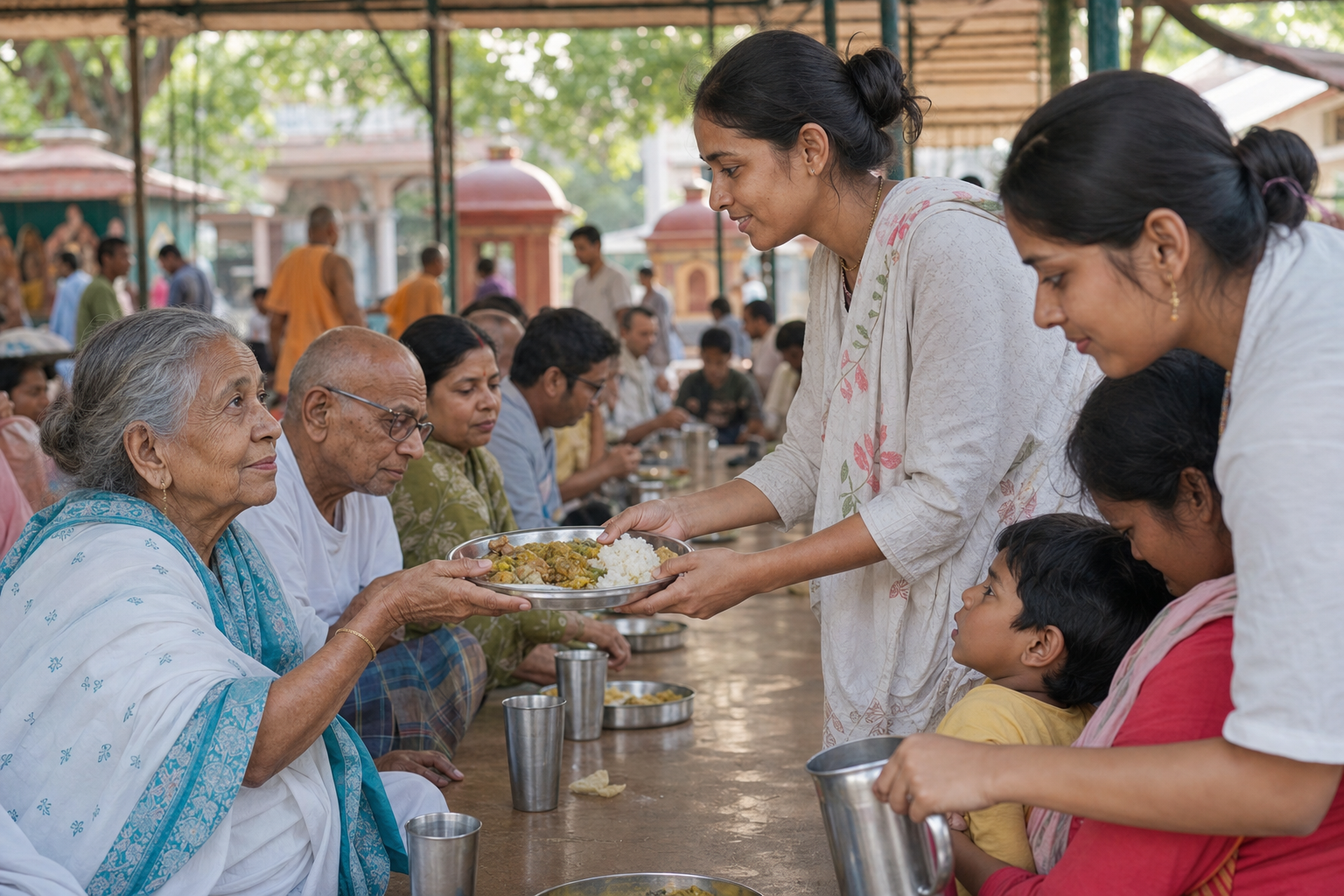
A person can receive prasadam before understanding terms such as bhakti, seva, or acintya-bheda-abheda. That is part of its public strength. Food addresses an immediate human need, while the act of offering gives the meal a devotional meaning that can be explained without demanding prior agreement.
Shared food also lowers barriers that a formal discourse may leave intact. A guest can sit, eat, observe how devotees serve one another, and ask a question when ready. Aroma, taste, gratitude, and hospitality make the encounter concrete. The person is not being asked to master a system before entering the community.
This does not mean that every recipient will undergo a dramatic transformation. Sravanananda described Govardhan Puja prasadam as the experience that broke a deep personal attachment, but that is devotional testimony, not a promised result for every diner. Your responsibility is to offer the encounter honestly and well, not to manufacture an emotional response or count plates as conversions.
A sound public distribution follows a simple sequence:
- Welcome people without testing their beliefs, status, caste, nationality, political preference, or ability to donate.
- Identify the food plainly as vegetarian prasadam that has been offered to Krishna. Give ingredient and allergen information where needed.
- Serve a complete portion with patience and allow the recipient to eat without being trapped in a sales pitch, donation appeal, or compulsory sermon.
- Offer a voluntary next step after the meal: darshan, kirtan, a short explanation of the offering, a festival invitation, or a conversation with a devotee.
The distinction between invitation and leverage matters. If food is withheld until someone listens, registers, donates, or performs devotion, hospitality has become a transaction. Prasadam should communicate mercy before it communicates institutional ambition.
Other dharmic traditions make compassionate nourishment visible in their own ways. Hindu annadana, Sikh langar, and food offerings within Jain and Buddhist communities all show that feeding people can carry ethical and spiritual meaning. These traditions should not be flattened into one theology. The useful civilizational connection is narrower and stronger: generosity, restraint, gratitude, and service can be practiced through the giving of food. Prasadam distribution gives that shared dharmic ethic a specifically Krishna-centered form.
Keep civic participation inside the discipline of seva
Mayapur is not only a place where individual pilgrims perform private devotion. Near Nabadwip, the birthplace of Sri Chaitanya Mahaprabhu, its sacred landscape includes the Sri Mayapur Chandrodaya Mandir, Srila Prabhupada’s Pushpa Samadhi, and the Temple of the Vedic Planetarium. It functions simultaneously as a pilgrimage center, a global Vaishnava institution, a heritage site, and a host to visitors from India and abroad. Public responsibility follows naturally from that scale.
Aarti illustrates how public visibility can remain ordered around worship. Incense, a ghee lamp, water, cloth, flowers, and ceremonial fans are offered to the deity amid the sounds of conch, bell, mridanga, kartals, and congregational chanting. The flame is then shared with the assembled devotees. Many people participate, but the deity remains the center.
That order provides a useful test when politicians or other prominent guests enter a sacred institution. During a visit to Mayapur, Suvendu Adhikari performed aarti and offered respects at memorials to Srila Prabhupada while devotees welcomed him with kirtan. Civic presence entered an existing devotional setting; it did not need a new ritual built around the visitor.
Political participation is not automatically the politicization of a temple. Public officeholders can acknowledge civilizational heritage, learn what a pilgrimage center requires, and show respect for living traditions. The danger begins when ordinary devotees become scenery, worship becomes a campaign image, or institutional hospitality is presented as partisan endorsement.
If you are coordinating a public visit, use four boundaries:
- Keep the established worship protocol. The guest participates as a guest. The deity, guru, sacred calendar, and congregation do not become supporting characters in the guest’s appearance.
- Describe the visit factually. Respectful hospitality does not require the temple to endorse every position held by a visitor, party, or government.
- Protect ordinary pilgrims. Security arrangements may be necessary, but they should not create avoidable humiliation, prevent darshan without notice, or displace prasadam recipients for the sake of a photograph.
- Turn attention toward service needs. Accessibility, crowd movement, transport, heritage care, sanitation, and ecological stewardship are more valuable public outcomes than applause alone.
The same standard applies to donors, celebrities, and institutional leaders. Ask what remains after the cameras leave. If the answer is safer access, better service, stronger preservation, or wider understanding of Vaishnava practice, the visit has served a public purpose. If nothing remains except publicity, the temple has lent out its sacred capital without receiving a corresponding benefit for pilgrims or the surrounding community.
Make food safety and festival capacity part of the seva
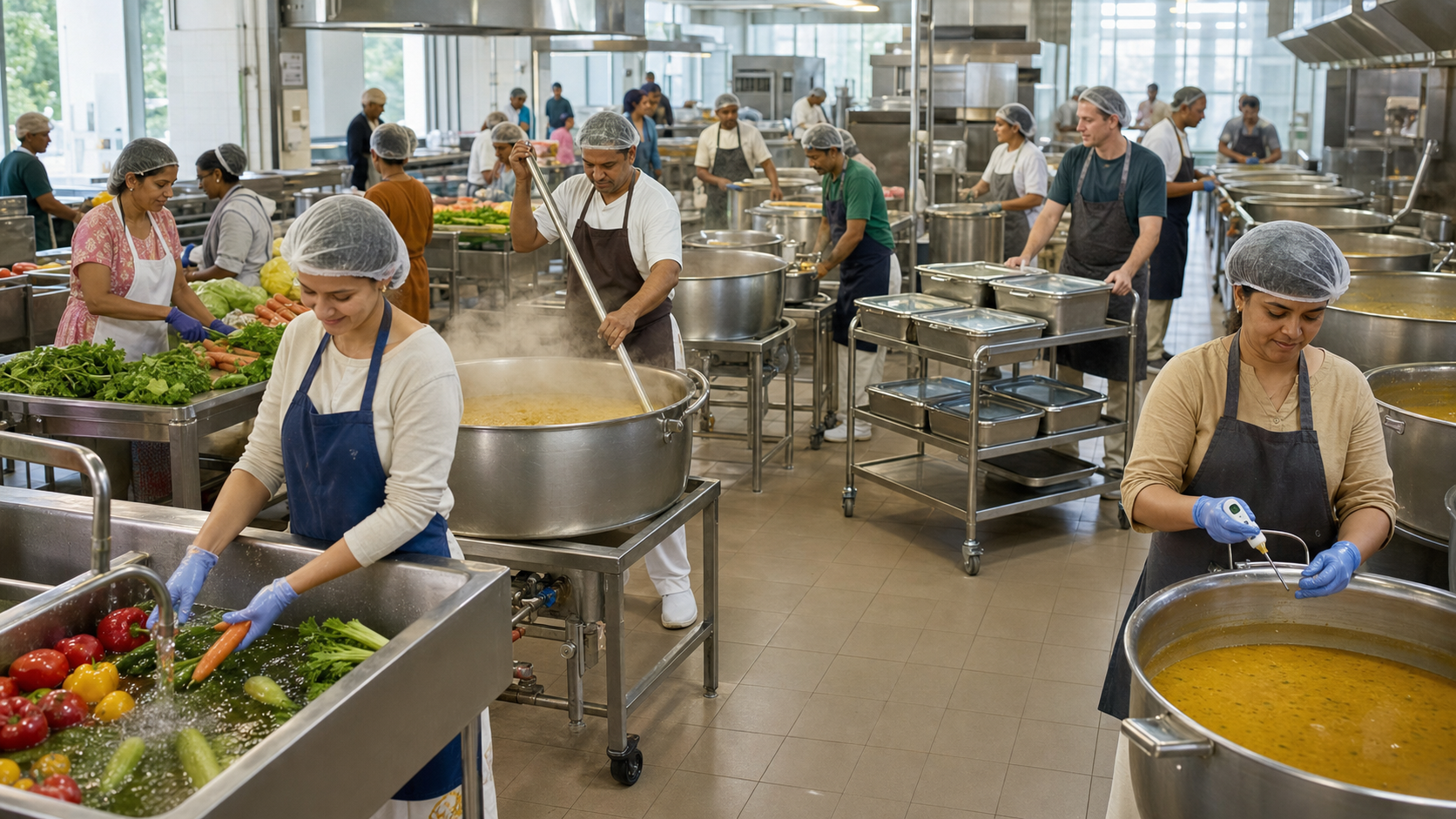
Large devotional gatherings expose every weakness in a service system. A kitchen that manages an ordinary day may struggle when demand surges, ingredients arrive from unfamiliar suppliers, volunteers change shifts, and prepared food must move quickly to several serving points.
A remembered incident at Mayapur in 1974 or 1975 shows why compassion must include readiness. Many devotees became acutely ill during a festival, probably because of poor-quality cooking oil. Srila Prabhupada noticed their condition, called for a homeopathic doctor, and accompanied him as he attended to them. Participants reported rapid improvement and understood it through the grace of their guru. The recollection joins pastoral attention, medical intervention, and devotional interpretation.
That memory should not be converted into a medical protocol or proof that homeopathy can treat foodborne illness. If people become acutely ill at a present-day distribution, obtain appropriate professional medical help and follow applicable public-health and food-safety requirements. Prayer, kirtan, and pastoral care may accompany treatment, but they must not delay or replace it.
The practical lesson is that Srila Prabhupada noticed suffering and acted immediately. You can build the same attentiveness into the event before a crisis occurs:
- Name accountable leads. One person should have authority over the kitchen and another over distribution. Volunteers need to know who can stop service when something is wrong.
- Check ingredients before cooking. Reject questionable oil, damaged supplies, or ingredients whose condition cannot be established. Do not let sunk cost or festival pressure overrule judgment.
- Record what is served. Keep the menu, major ingredients, allergen information, supplier or batch details where available, preparation times, and serving locations accessible to the responsible team.
- Match volume to safe capacity. Do not accept more food or diners than the kitchen, storage, transport, serving crew, and cleaning system can handle under local food-safety rules.
- Prepare the service environment. Confirm potable water, handwashing, cleaned utensils, protected food, orderly queues, waste collection, and suitable access for children, elderly pilgrims, and people with limited mobility.
- Write an incident response. If several diners develop similar symptoms, pause distribution of the suspected batch, keep it separate, record what happened, alert organizers, and seek medical and public-health guidance promptly.
Faith changes the meaning of care; it does not lower the standard of care. A devotee who checks the oil, cleans a vessel, labels an allergen, guides an elderly pilgrim to a seat, or stops an unsafe serving line is not doing work beneath the spiritual program. That work is part of the spiritual program.
Mayapur’s location in the Ganga-Jalangi river system adds another responsibility. Pilgrimage management there includes ecological mindfulness as well as crowd care. Decide how plates, cups, leftover food, wash water, and packaging will be collected and handled before distribution begins. A generous meal should not transfer its hidden cost to a sacred river, the temple grounds, or the local community.
Key takeaways for your next prasadam service
- Establish the devotional chain. Know who prepares the food, how it will be offered to Krishna, and who releases it for distribution.
- Serve without coercion. A recipient should not have to profess belief, hear a compulsory lecture, make a donation, or provide personal data before eating.
- Explain without diluting. Call it prasadam, identify its Krishna-centered meaning in one clear sentence, and make deeper conversation voluntary.
- Protect dignity at every scale. Plan portions, queues, seating, accessibility, and volunteer conduct with the same care given to the visible ritual.
- Put safety in writing. Assign authority, inspect ingredients, follow local food rules, retain useful service records, and prepare a response for suspected illness.
- Give public figures a proper role. Let them honor the sacred institution and support its public needs without turning worship into partisan theatre.
- Complete the service. Cleanup, waste handling, ecological care, and an optional path into darshan, kirtan, or study belong to the event rather than to an undefined later phase.
Before your next distribution, bring the worship, kitchen, serving, safety, and cleanup coordinators together for one walk-through from ingredient receipt to the final cleared plate. Find every point where dignity or safety currently depends on improvisation and assign it to someone. Then let the meal do what prasadam does best: offer the public a first experience of bhakti through service that is reverent, open, and trustworthy.
References
- Dandavats – Prasadam as Light: Srila Prabhupada’s Vision from Vrindavan Dialogues to Mayapur Grace
- Dandavats – Devotion and Public Service: Suvendu Adhikari leads Aarti at ISKCON Mayapur, West Bengal
