
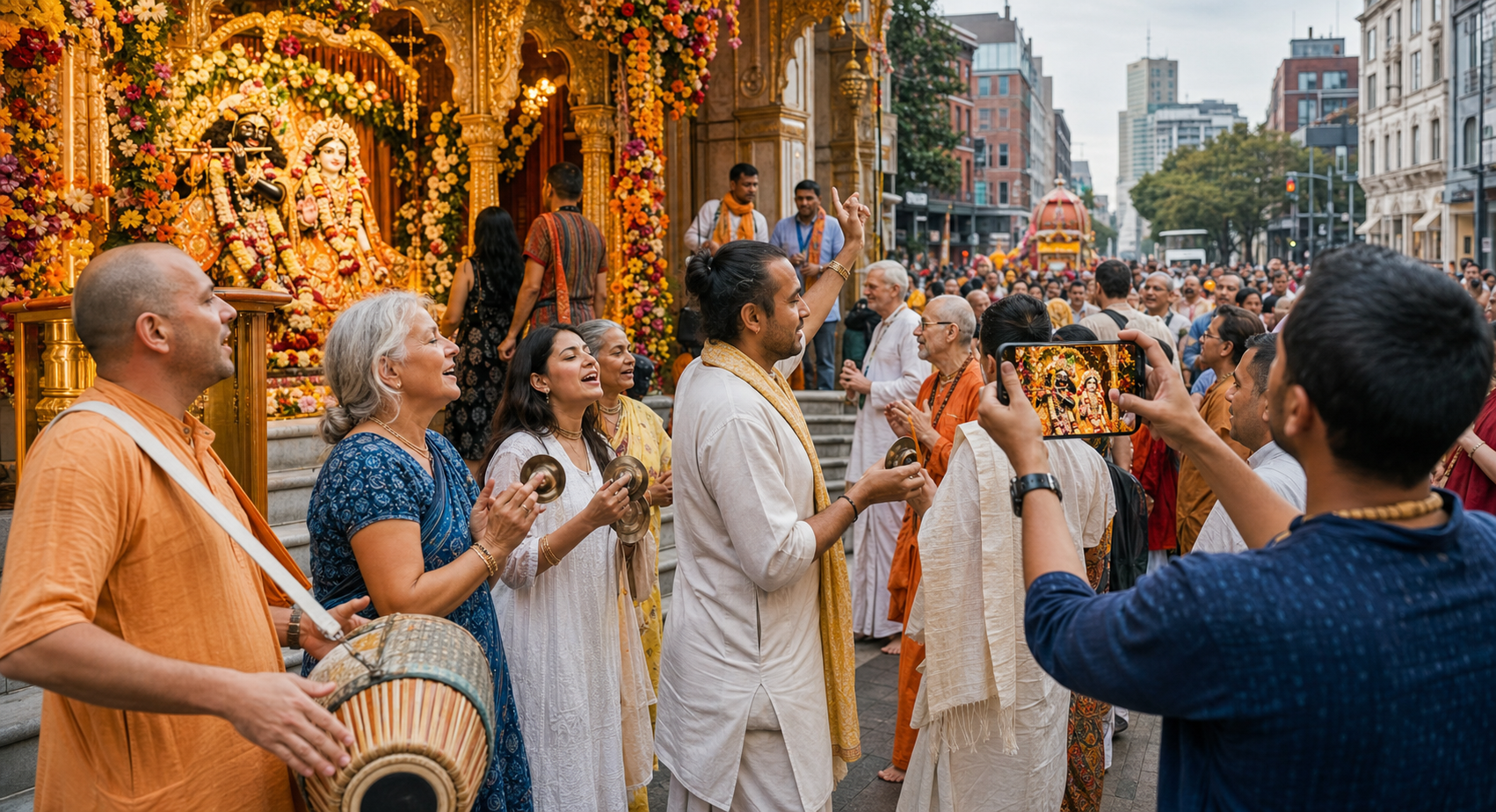
Four accounts of ISKCON life reveal a devotional culture moving among altar, assembly, procession and screen. Dallas presents Deity worship and digital darshan; Paris interprets the sacred choreography of Ratha-yatra; a Sunday program joins guru-puja with scripture; and London carries kirtan into an urban street.
Read together, these settings explain how a global congregation can remain recognizable without becoming uniform. Shared practices provide continuity, while temples, teachers, organizers and media adapt participation to different places and circumstances.
One devotional architecture across four settings
The reports converge on a central point: congregational devotion is not a single activity. The Dallas account places kirtan beside arati, Deity care, food offerings and community programs. The Paris study connects chanting with scriptural memory, coordinated service and humility. The Sunday reflection situates it within guru-puja and Bhagavatam study, while the London report shows it becoming publicly accessible through rhythm, movement and call-and-response.
This convergence is thematic rather than independent verification: all four articles come from DharmaRenaissance Blog and examine different materials. Their combined value lies in the pattern they disclose. Sacred sound gathers participants, but worship also requires an object of devotion, a lineage of instruction, disciplined service and a community capable of sustaining repeated practice.
The resulting unity is closer to a shared devotional grammar than to a standardized program. A livestreamed altar, a scripture class, a carefully arranged procession and an open street kirtan use different forms, yet each directs attention away from private preoccupation and toward Krishna, service and association.
The temple joins sacred presence, learning and daily conduct
The Dallas article offers the clearest example of a fixed sacred centre. It reports that the Dallas community developed in the early 1970s and that Deities associated with Jaipur were brought to the United States in 1972. According to that account, Srila Prabhupada named the presiding Deities Sri Sri Radha Kalachandji. These reported details give the congregation a particular history and relationship rather than an interchangeable religious setting.
That relationship helps explain the significance assigned to live darshan. The Dallas source presents the broadcast as a way for students, elders, parents, travellers and others unable to attend physically to orient themselves toward the altar. It also explicitly distinguishes mediated access from embodied temple life: a screen cannot supply the shared singing, incense, gestures, prasadam and physical association experienced on site. Its contribution is continuity, not equivalence.
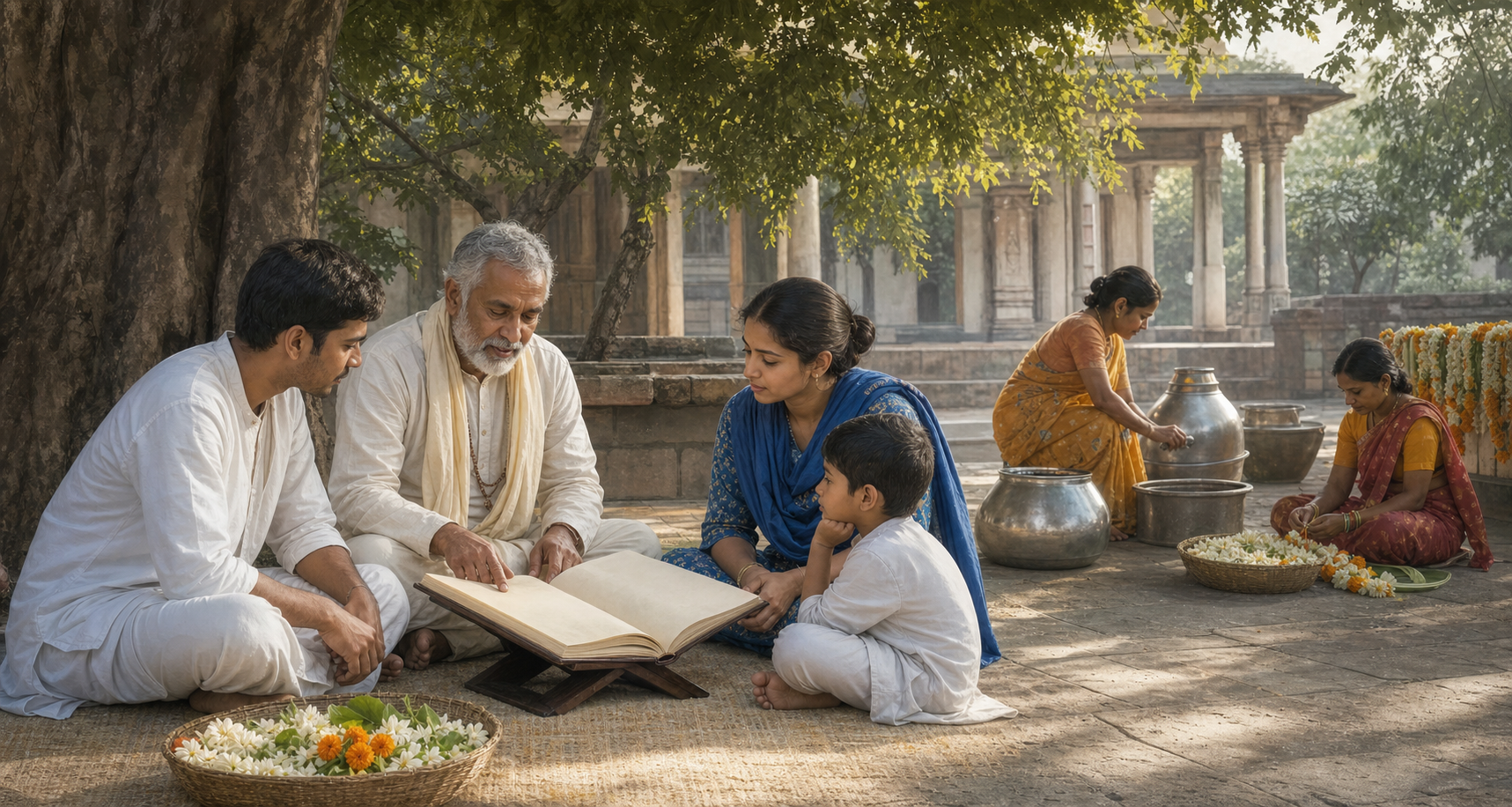
The Sunday-program source illuminates another layer of temple continuity. Its available evidence consists of a title and event metadata for a guru-puja and Srimad Bhagavatam class by HG Adi Karta Prabhu dated 28 June 2026; the article appropriately declines to invent the lecture’s contents. Even within that limit, the announced sequence is significant. Guru-puja locates knowledge within parampara, kirtan prepares collective attention, and scriptural hearing gives devotion an intellectual and ethical discipline. Regular gathering becomes part of the teaching.
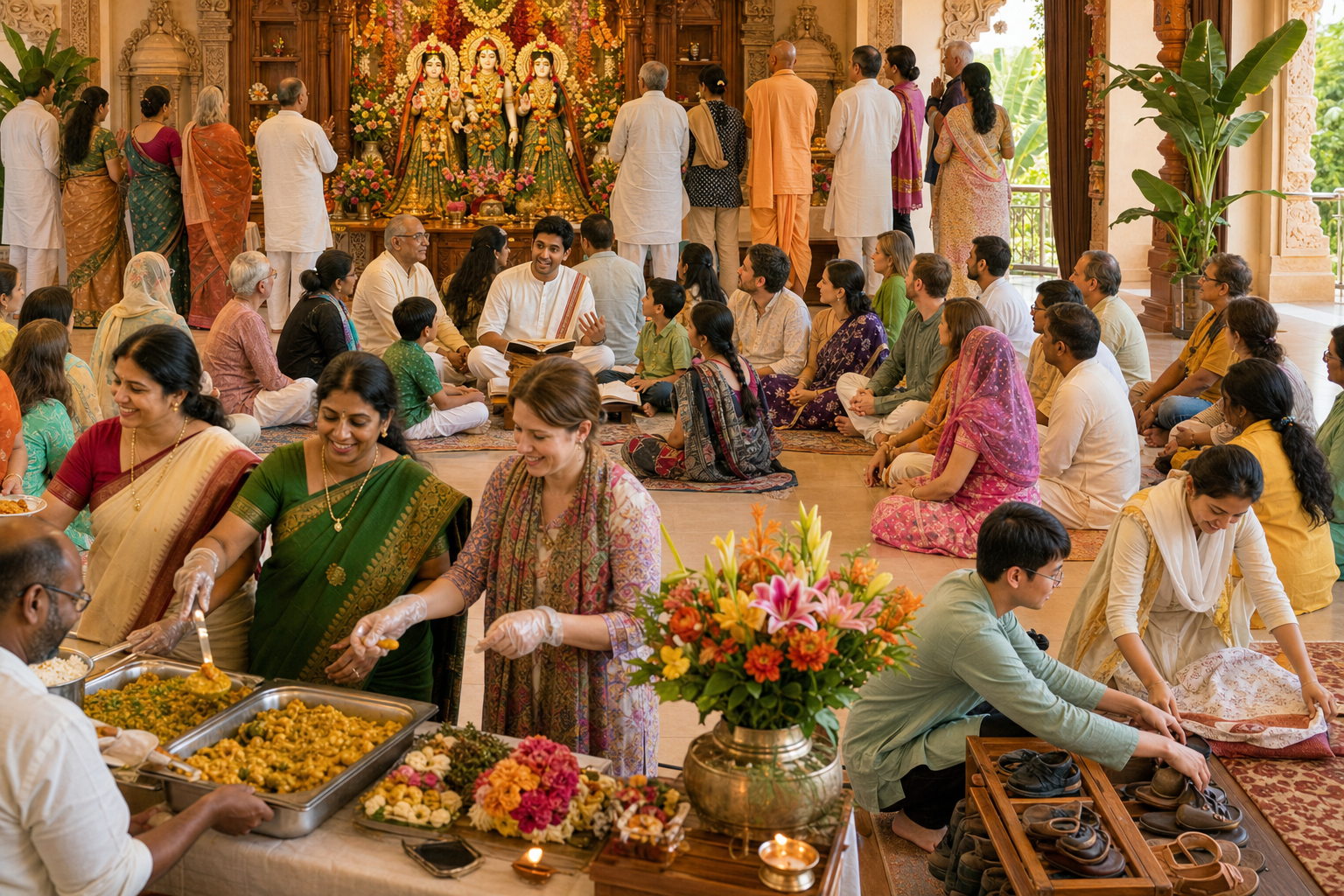
Dallas also extends worship into food and hospitality. Its report says the temple-associated Kalachandji’s restaurant has served vegetarian meals since 1982 and describes a kitchen discipline excluding meat, fish, eggs, onion and garlic. Within the article’s Vaishnava framing, cooking is not detached from the altar: offering food, distributing prasadam, serving guests and cleaning can all become seva. Ahimsa is therefore expressed through ordinary institutional choices as well as devotional language.
These accounts suggest that a temple sustains congregational life by joining several kinds of formation. The altar cultivates attention, the teacher transmits interpretation, the gathering builds relationships, and food turns theology into hospitality. Removing any one dimension would narrow the community’s ability to carry bhakti across generations.
Sacred sound needs both structure and openness
The Paris article interprets Caitanya-caritamrita, Madhya-lila 13.47-60 as a model of organized ecstasy. It reports seven sankirtana groups and fourteen drums arranged around Lord Jagannatha’s chariot, with parties positioned in front, at the sides and behind. The point of this reported choreography is not numerical display. Singers, responders, dancers, instruments and spatial order combine to make a congregation capable of acting as one devotional body.
The same source draws out two theological lessons from the passage. First, Sri Caitanya Mahaprabhu is experienced as present with each chanting group, presenting divine attention as abundant rather than competitive. Second, King Prataparudra’s service of sweeping before the chariot places humility above rank. In this reading, organization is spiritually credible only when leadership remains service-oriented.
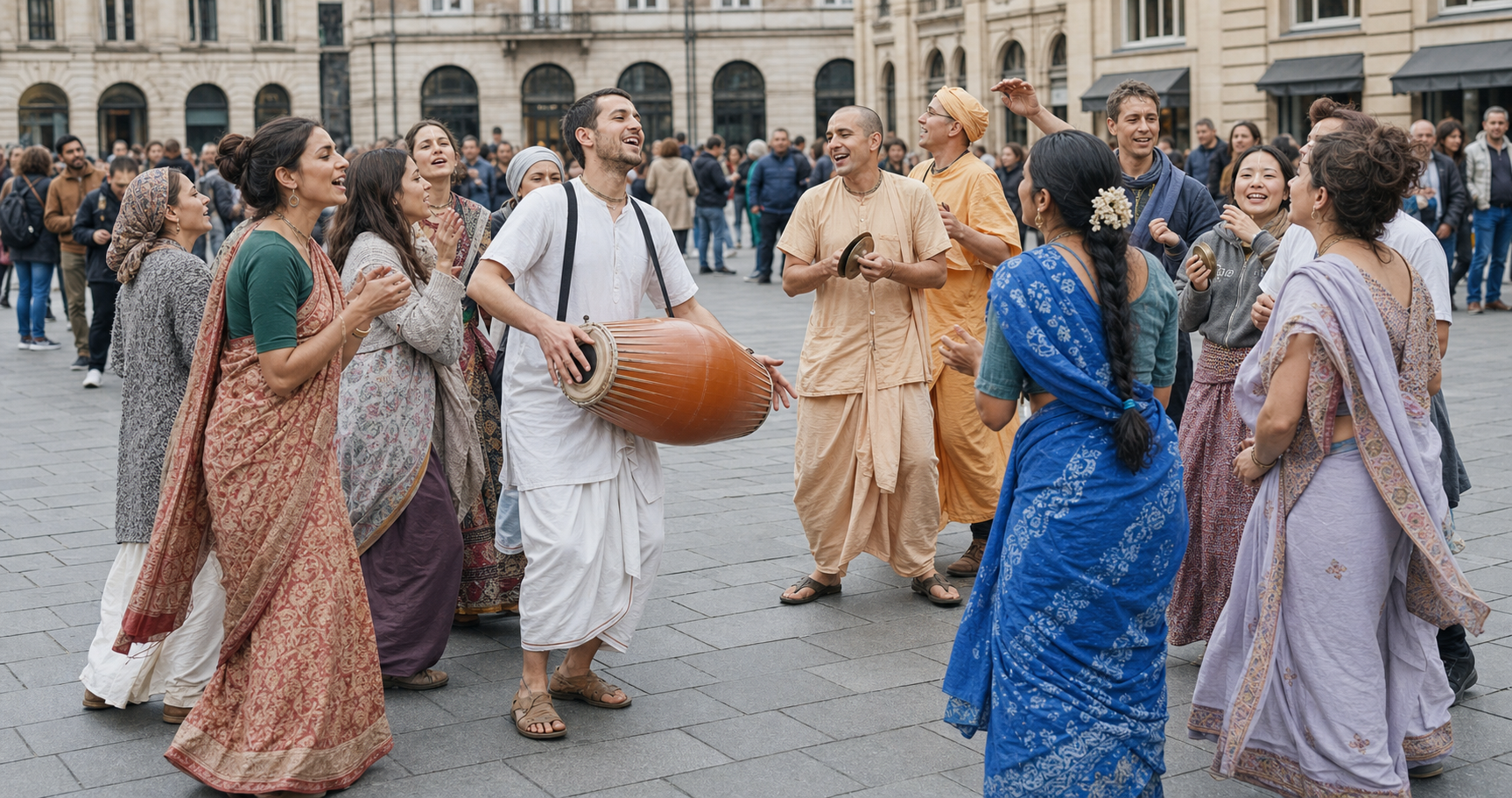
The London report approaches congregational sound from the listener’s side. It describes devotees chanting and dancing in London’s streets on 27 June 2026, accompanied by drums and hand cymbals, as pedestrians encountered the event. The article distinguishes the visible festivity from an ordinary dance party: for practitioners, public chanting is worship, spiritual discipline and outreach, even when observers initially experience it simply as music or shared joy.
Paris and London thus illuminate complementary requirements. The Paris discussion shows that structure can concentrate devotion and coordinate many participants. The London scene shows that a simple refrain and responsive rhythm can lower the threshold for newcomers. Openness does not require formlessness, and discipline need not make participation inaccessible.
Both sources also imply a caution about spectacle. Chariots, instruments, dancing and crowds can attract attention, but visibility alone does not disclose the event’s inner purpose. Its devotional integrity depends on whether public energy remains connected to remembrance, humility and service rather than becoming an end in itself.
Global continuity is adaptation, not simple replication
The sources document different ways of carrying a tradition beyond a single sacred geography. In Dallas, a Deity tradition reported as connected with Jaipur is maintained through a North American temple, English-language communication, community meals and video. In Paris, a Bengali Gaudiya Vaishnava text about Jagannatha’s procession supplies a framework for contemporary teaching. In London, chanting enters a multicultural civic space where participants need not share one ethnicity or prior religious education.
These adaptations do different work. A livestream supports those already seeking darshan but separated from the temple. A class trains listeners to interpret ritual and scripture. A weekly program turns remembrance into habit. Street kirtan creates an initial point of contact for strangers. None is a complete substitute for the others, because each addresses a different barrier: distance, unfamiliarity, inconsistency or social separation.
This distinction is useful when assessing digital or public-facing religious activity. Reach alone is an incomplete measure. A broadcast is most valuable when it encourages sustained practice rather than passive viewing; a public festival retains depth when joy remains anchored in seva; reverence for teachers remains healthy when it directs attention toward scripture and Bhagavan; and food ethics carry weight when compassion is embodied in preparation and sharing.
Global ISKCON life, as represented in these reports, is therefore held together less by identical surroundings than by recurring relationships: devotee and Deity, student and lineage, singer and congregation, host and guest, local community and wider public. Technology and urban culture alter the channels through which those relationships are entered, but they need not displace the practices that give them meaning.
Key takeaways
- Congregational devotion functions as an ecosystem of worship, chanting, teaching, service, ethical food practice and association.
- Temple livestreams can preserve devotional continuity across distance, but the Dallas account does not treat them as replacements for embodied worship.
- The Paris Ratha-yatra study shows how coordination and humility can protect the purpose of a large devotional gathering.
- The London report demonstrates how public kirtan can welcome participation before a passerby possesses detailed theological knowledge.
- Global continuity depends on adapting access while keeping media, leadership and celebration accountable to remembrance and seva.
The continuing task for congregations is to make participation more accessible without allowing access to become shallow. When screens lead toward practice, public joy toward inquiry, and institutional routines toward service, adaptation can strengthen rather than thin the devotional tradition.

References
- DharmaRenaissance Blog — ISKCON Dallas Live Darshan: A Powerful Window Into Radha Kalachandji’s Legacy
- DharmaRenaissance Blog — Powerful Lessons from ISKCON Paris on Ratha Yatra, Humility, and Sacred Kirtan
- DharmaRenaissance Blog — Powerful Sunday Reflections on Guru Puja, Bhagavatam, and Living Bhakti
- DharmaRenaissance Blog — When Hare Krishna Kirtan Turned London’s Streets into a Powerful Dance of Devotion