
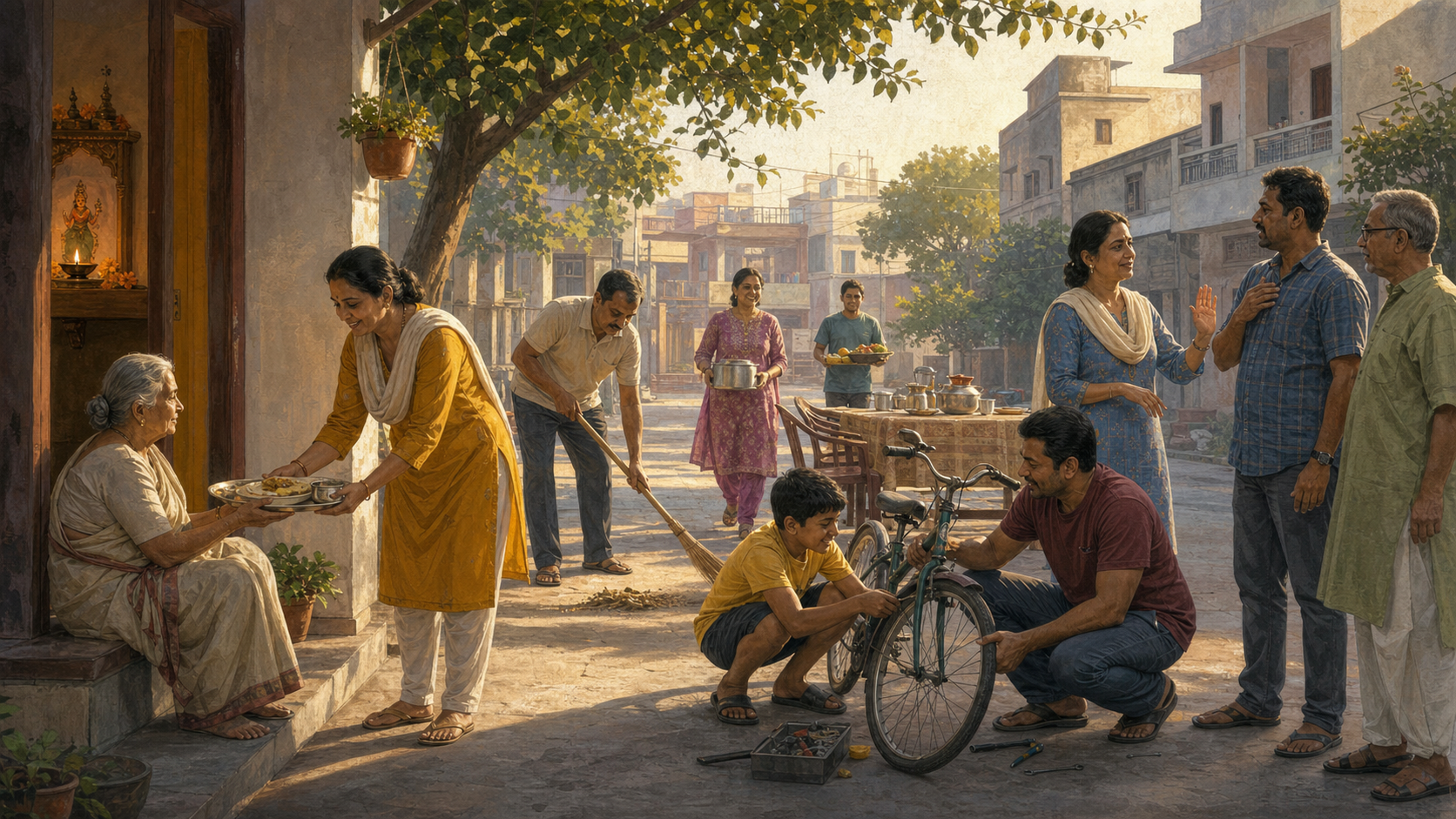
You may light a lamp, repeat a mantra, read scripture, and still wonder why the street outside remains distrustful, lonely, or divided. Private devotion matters, but a community changes only when inner discipline becomes conduct that other people can rely on.
The practical question is how to carry dharma from the shrine into meals, work, conflict, service, and shared civic life without turning it into coercion. The answer is a repeatable movement: steady the mind, govern your conduct, gather voluntarily, serve a visible need, and examine whether trust is actually growing.
Community change begins when conduct becomes predictable
The smallest unit of communal transformation is not a slogan, institution, or religious identity. It is reliable conduct. When you tell the truth even when concealment would be convenient, keep a commitment without being chased, restrain anger before it becomes humiliation, and use resources without exploiting others, your practice becomes socially legible. People know what they can expect from you.
The progression is straightforward. Attention creates a pause before reaction. That pause makes restraint possible. Repeated restraint becomes character. Character makes a person dependable. Dependable people can cooperate with less suspicion, and repeated cooperation builds trust. Every link matters. A peaceful meditation followed by dishonest trade breaks the chain at conduct; an inspiring gathering with no follow-through breaks it at cooperation.
Sanatana Dharma gives worldly life a structure rather than dismissing it. The puruṣārthas place dharma, artha, kāma, and mokṣa within the same field of human flourishing. You may earn, enjoy, create, raise a family, and pursue freedom, but desire and wealth remain answerable to right conduct. The household, workplace, market, school, and public square therefore become places of sādhanā, not interruptions to it.
A transformed community is not one in which everyone worships the same form or agrees on every doctrine. It is one in which differences do not prevent truthful exchange, mutual aid, non-violent disagreement, or protection of the vulnerable. Its unity is ethical and participatory, not compulsory.
Key takeaways
- Choose daily practices by the conduct they are meant to train, not by how impressive they appear.
- Make truthfulness, non-harm, fairness, restraint, and service visible in ordinary decisions.
- Use collective chanting to support calm and belonging, but do not promise that chanting alone will solve crime or conflict.
- Keep communal participation voluntary and allow each Dharmic tradition to retain its own integrity.
- Attach gatherings to accountable seva, then observe whether neighborly help and trust actually increase.
Give daily practice a path out of the shrine

A sustainable routine does not require recreating a monastic schedule inside a busy household. It needs a few transitions at which you remember what governs the next action. A dawn intention, mantra or prayer, gratitude before food, Karma Yoga in work, seva, reflection, and restorative rest can turn the natural cadence of a day into ethical training.
- Set an actionable saṅkalpa on waking. Avoid a vague wish to be spiritual. Name conduct that another person could notice: disclose an error instead of hiding it, refuse to pass along an unverified accusation, finish a neglected duty, or speak without contempt during a difficult exchange.
- Steady attention before entering the day’s demands. Sit quietly, watch the breath, perform japa, or offer a simple prayer. The immediate purpose is not an extraordinary experience. It is enough to become less available to haste, resentment, and compulsive reaction.
- Turn a meal into gratitude and responsibility. Remember the labor, soil, water, fire, and living systems that made the food possible. Let that remembrance affect waste and sharing. Anna-dāna begins when reverence for food results in somebody being fed, not merely when the idea is praised.
- Apply Karma Yoga at work. Do the task carefully, exchange value fairly, and remain accountable for the result. Non-attachment does not mean indifference to quality or consequences. It means refusing to let praise, fear, greed, or wounded pride decide what is right.
- Hold ahiṃsā and satya together during conflict. Non-harm is not permission to conceal wrongdoing, and truth is not permission to be cruel. State what happened, name the duty or boundary involved, and remove the insult that adds pain without adding clarity.
- Close the day with an honest review. Ask where desire, anger, attachment, pride, or greed made the decision. If someone was harmed, identify the repair instead of converting the review into private guilt. An apology, correction, returned item, fulfilled promise, or changed procedure carries reflection back into the world.
- Treat rest as stewardship. Exhaustion makes restraint harder. Dharmic life includes the disciplined recovery of body and attention; neglecting rest is not proof of devotion.
Families can use the same rhythm without forcing identical practices. One person may approach through bhakti, another through meditation, study, or service. Hindu traditions themselves offer Bhakti, Jñāna, Karma, and Rāja Yoga as different doors. The practical test is whether each path forms a person who is more truthful, compassionate, self-governing, and useful to others.
This also prevents ritual from becoming a substitute for responsibility. If the lamp is lit but household labor is treated as beneath you, if a mantra is repeated but employees are deceived, or if sacred food is offered while edible food is wasted, the missing practice is not another ceremony. It is alignment.
Build a voluntary gathering around shared sound
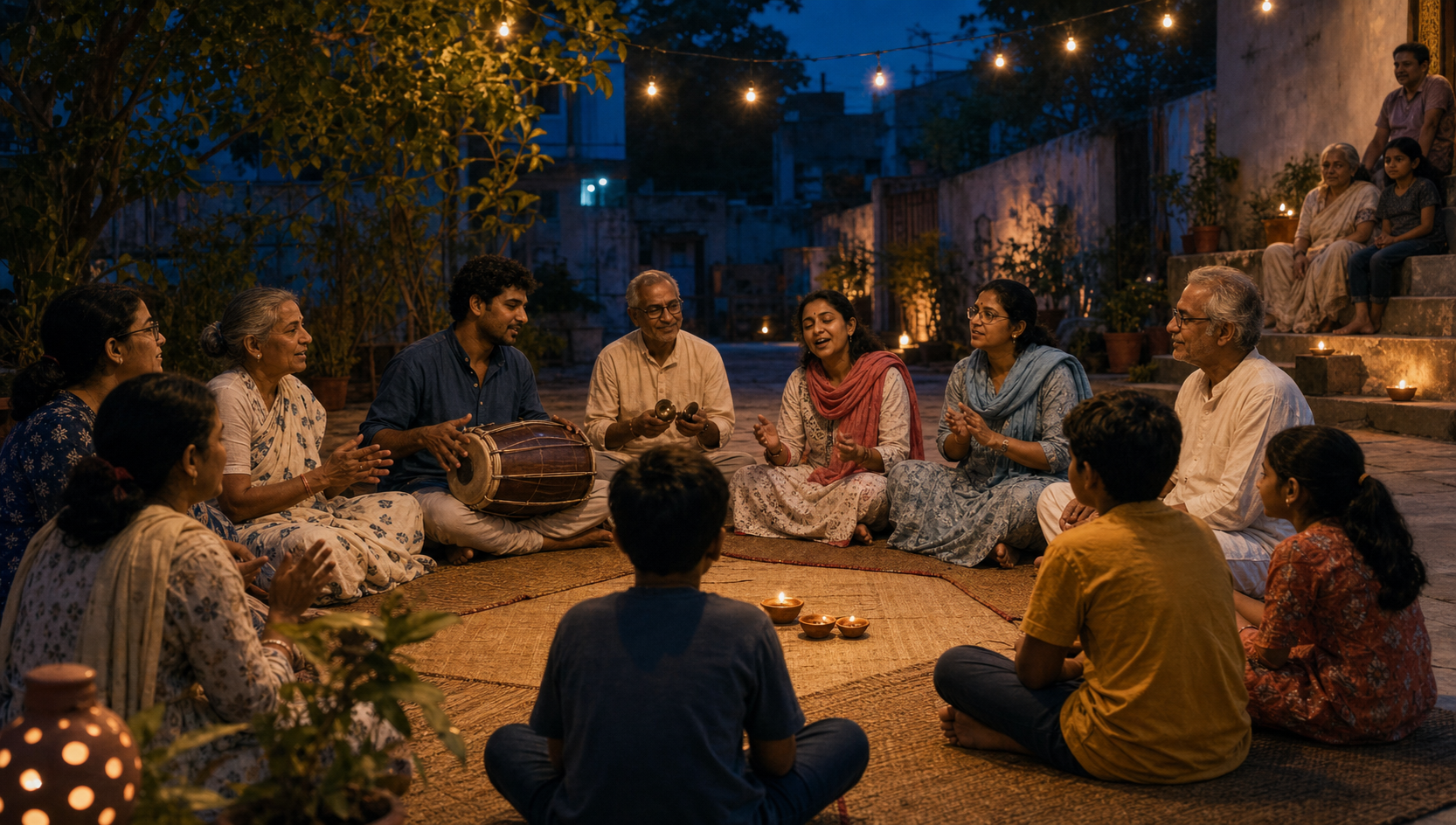
Individual discipline becomes easier to sustain when a community has a wholesome recurring rhythm. Saṅkīrtana is especially useful because it combines sacred meaning with melody, paced breathing, attentive listening, and participation. Shared tempo and vocalization can settle arousal and create a felt sense of belonging. Findings from group music-making and adjacent contemplative practices make those mechanisms plausible, but they do not establish that a chanting program by itself will reduce a neighborhood’s crime rate. Treat saṅkīrtana as formation and social infrastructure, not magic.
A weekly session lasting 60 to 75 minutes is substantial enough to create a recognizable communal rhythm while remaining manageable for families. One workable 70-minute format is:
- 5 minutes of quiet grounding and comfortable breath awareness;
- 15 minutes of Hindu bhakti kīrtana;
- 10 minutes of Sikh shabad kīrtana;
- 10 minutes of Buddhist refuge or paritta chanting;
- 10 minutes centered on the Jain Navkār Mantra or an appropriate contemplative element;
- 10 minutes of a common peace refrain such as Śānti; and
- 10 minutes of silent sitting, followed by a concise invitation to undertake seva.
This structure is a template, not a demand that every community combine every tradition at every meeting. A Hindu mandir, Sikh gurdwara, Buddhist vihāra, or Jain derāsar may properly center its own form. A plural neighborhood circle can rotate leadership. What matters is that inclusion does not flatten sacred practices into interchangeable entertainment.
Use facilitators who can pronounce and contextualize what they lead. Provide transliteration and local scripts where possible, explain the meaning briefly, and let participants listen silently when they do not wish to vocalize a particular invocation. Participation must never be treated as assent to a doctrine. Children, employees, students, inmates, and others subject to institutional authority need a genuine option not to participate without punishment or stigma.
Set the civic boundaries before the first gathering: no proselytizing, no partisan slogans, no ridicule of another path, no competition over whose segment receives the loudest response, and no use of the attendance list for unrelated campaigning. Rotate facilitators across participating traditions, keep amplification moderate, observe local noise rules, and publish the session format in advance. These details protect both freedom of conscience and neighborly goodwill.
Shared Dharmic ground does not require theological sameness. Hindu practice offers nāma and mantra; Sikh life joins nām-simran with seva; Buddhist chanting can cultivate refuge, compassion, and steadiness; Jain practice gives radical seriousness to ahiṃsā and many-sided understanding through anekāntavāda. Acceptance means allowing those forms to remain distinct while cooperating through non-harm, truthfulness, compassion, restraint, and service.
Chanting also has limits. It cannot substitute for lawful protection, addiction treatment, mental-health care, conflict mediation, or action against abuse. If there is an immediate threat or an actual offence, use the appropriate safety and legal channels. The gathering should help people become calmer, more connected, and more willing to act responsibly; it should never be used to silence a person reporting harm.
Make seva the proof of devotion
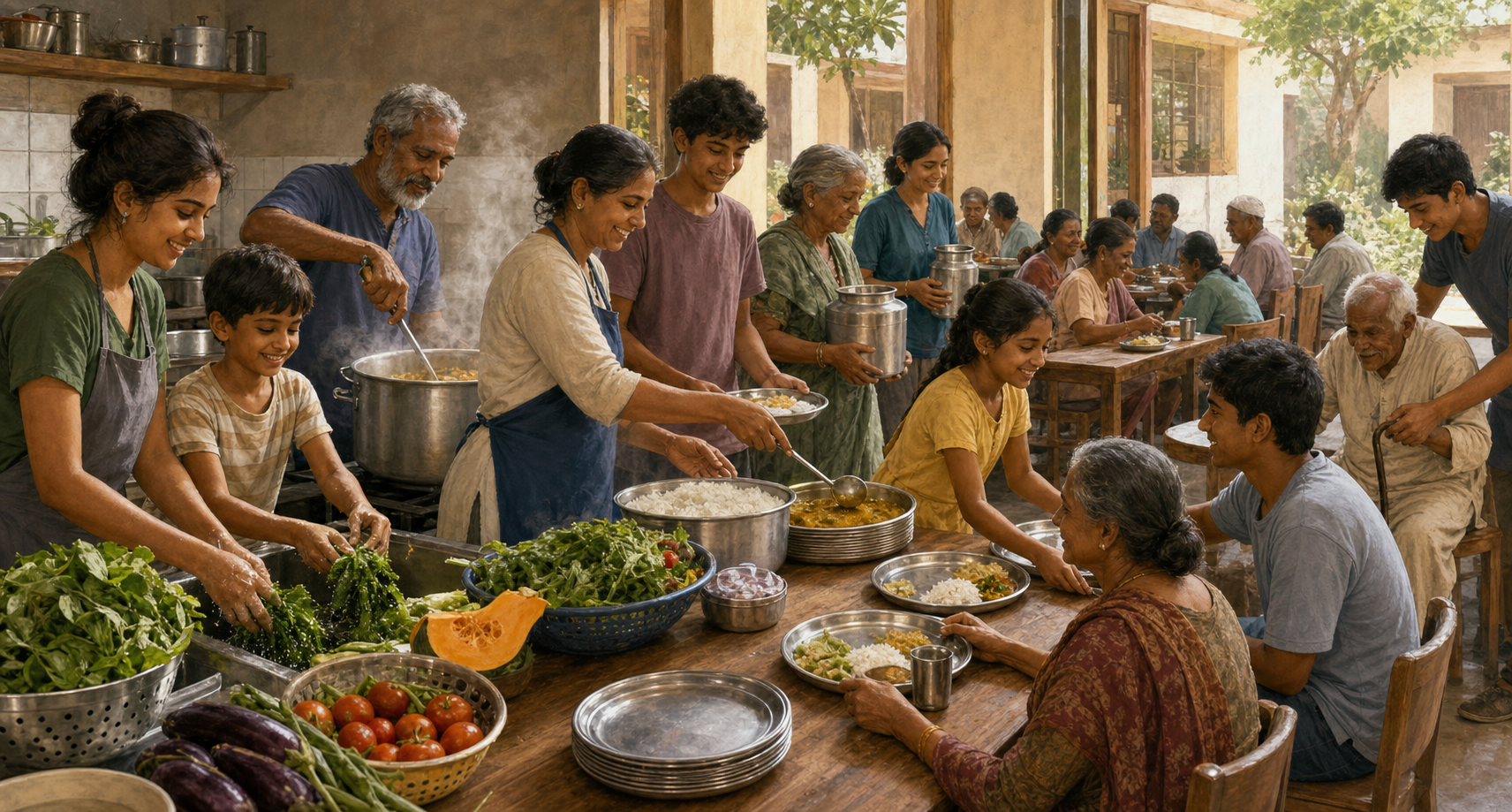
A gathering begins to transform its surroundings when shared feeling becomes shared responsibility. Without seva, participants may enjoy an elevated hour while the same isolated elder, hungry family, neglected public space, or struggling young person remains unseen. Service is the bridge between devotional belonging and public trust.
Choose a need that is visible and within the group’s actual capacity. Anna-dāna, a neighborhood clean-up, practical help for elders, support for families in difficulty, or constructive activity for young people can all work. Do not begin with a grand civilizational claim. Begin with a duty that can be assigned, completed, and verified.
- Name the need precisely. Replace a general promise to help the community with a defined task, place, and intended beneficiary.
- Ask before serving. Speak with the people affected instead of assuming what they need. Service performed without listening can become vanity or intrusion.
- Give the task a steward. Goodwill needs a person who confirms materials, permissions, communication, and completion.
- Protect dignity. Do not turn recipients into devotional publicity. Obtain consent before using names or images, and do not condition help on attendance, chanting, or conversion.
- Report completion plainly. Say what was done, what remains, and what resources were used. Transparent service strengthens trust; vague claims weaken it.
- Carry lessons into the next action. If volunteers failed to arrive, supplies were wasted, or the intended help was unsuitable, correct the process instead of hiding the failure.
This is where temples can exercise their full civilizational role. They remain places of darśana and worship, but they can also hold learning, music, food distribution, cultural memory, and organized care. The temple is a center of Dharmic life rather than its outer boundary; the kitchen, classroom, workplace, park, and neighborhood are also fields of duty.
The same principle applies when no temple is nearby. A household can prepare food, a professional group can mentor students ethically, shopkeepers can agree on fair dealing, and neighbors can maintain a shared space. The institution helps, but conduct gives the institution meaning.
Service will eventually expose disagreement. Return first to the shared ethical floor: ahiṃsā, satya, asteya, dayā, restraint, and seva. Let each tradition govern its own doctrine and sacred form; let the group deliberate together about common service, money, safety, and access. If someone is demeaned or excluded, repair that failure openly. Unity that cannot admit a mistake is only conformity.
Measure the change and correct course
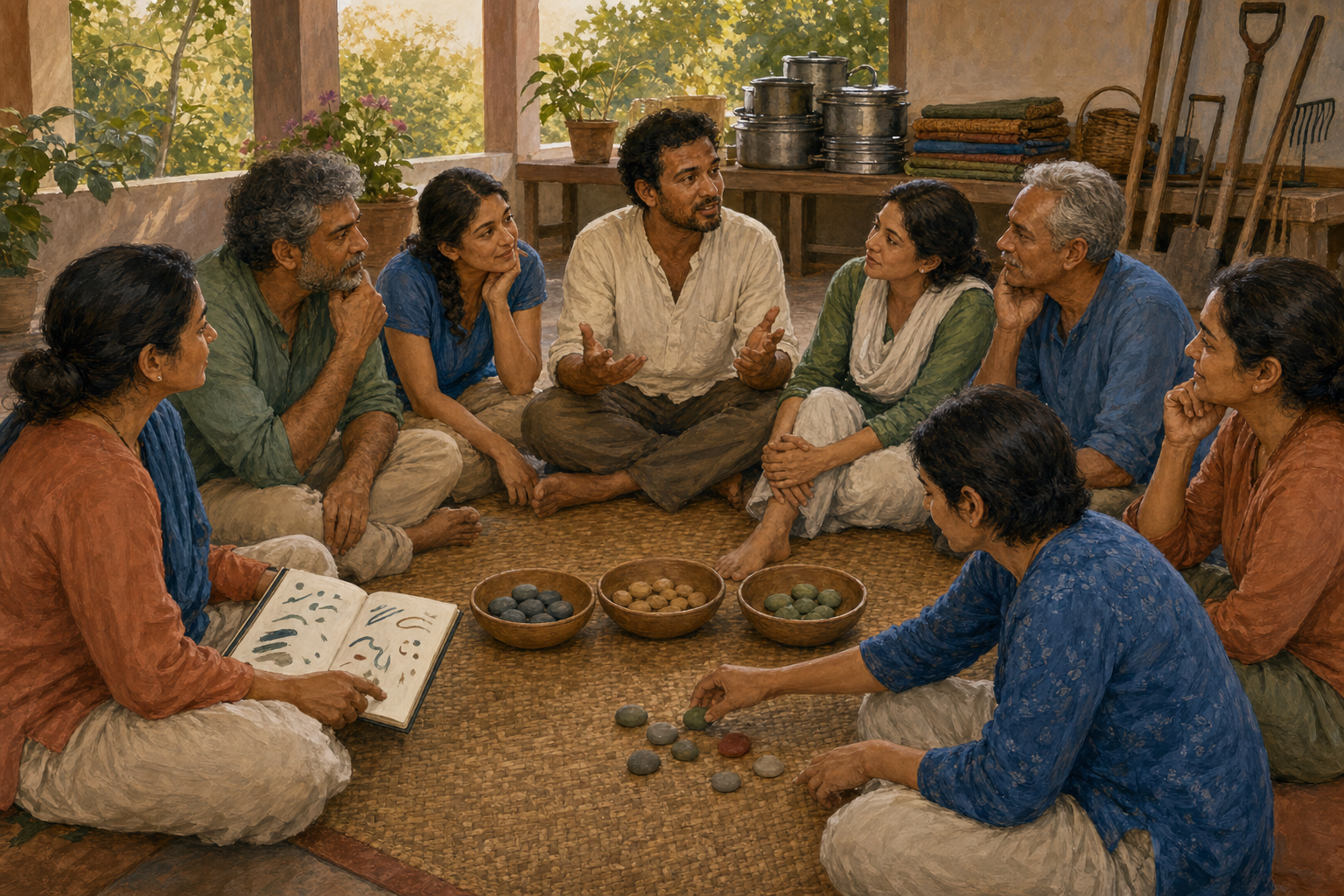
Communities usually make one of two mistakes when judging transformation. They either declare success because a gathering felt powerful, or bury a living practice under excessive administration. A better approach tracks a small set of observable signs without pretending that every human change can be reduced to a score.
Before beginning, record what is already happening in the same categories you intend to review later. Otherwise, rising attendance or a quiet month can be mistaken for proof of impact. Keep claims proportional: an association between a program and improvement is not enough to establish that the program caused it.
- Participation quality: attendance, return participation, voluntary involvement across ages and traditions, and whether people feel able to decline.
- Immediate formation: self-reported calm, ability to pause during conflict, completion of saṅkalpas, and willingness to acknowledge and repair mistakes.
- Relational trust: neighborly help, shared tasks completed, disputes addressed without humiliation, and new cooperation beyond the gathering.
- Service reliability: commitments accepted, commitments completed, resources accounted for, and feedback from the people meant to benefit.
- Relevant community indicators: school disciplinary incidents, property-damage complaints, youth-police friction, or repeat-offence patterns where qualified institutions can examine them lawfully and responsibly.
- Integrity safeguards: complaints of coercion, domination by one faction, misuse of funds or contact details, excessive noise, and pressure placed on vulnerable participants.
The interpretation matters more than a flattering total. If attendance rises but seva never leaves the planning stage, you have built a music event, not communal responsibility. If service succeeds only because the same exhausted people carry it, participation is not yet sustainable. If calm is celebrated while bullying or abuse is suppressed, the language of peace is protecting harm. If one tradition controls every decision, plural unity has become decorative.
Schools, correctional settings, and police-community initiatives require additional care because the power to reward or punish is present. Spiritual participation must remain voluntary, leaders must not endorse a compulsory theology, and any evaluation must protect privacy. Officials can support lawful assembly and safe space without becoming religious authorities. Contemplative practice may complement education, rehabilitation, counseling, and public safety, but it must not replace them.
When the indicators are weak, do not immediately make the program larger or louder. Return to the broken link. If people are reactive, strengthen daily discipline and facilitation. If they feel calm but remain strangers, create more listening and cooperative work. If relationships improve but promises fail, tighten stewardship and reporting. If participation feels coercive, restore a real choice before doing anything else.
Begin at the next natural transition in your day. Choose a saṅkalpa another person can feel, carry it through work and conflict, and repair the first lapse you can honestly name. Then help create a modest voluntary gathering and attach its shared devotion to a service commitment. Dharma is moving outward when you become less reactive, more truthful, more dependable, and more capable of serving beside people whose path is not identical to yours.
References
- DharmaRenaissance Blog — Beyond Temples: The Timeless Power of Sanatana Dharma in Daily Life and Dharmic Unity
- DharmaRenaissance Blog — Beyond Policing: Evidence-Backed Sankirtana and Dharmic Chanting for Crime Prevention
