
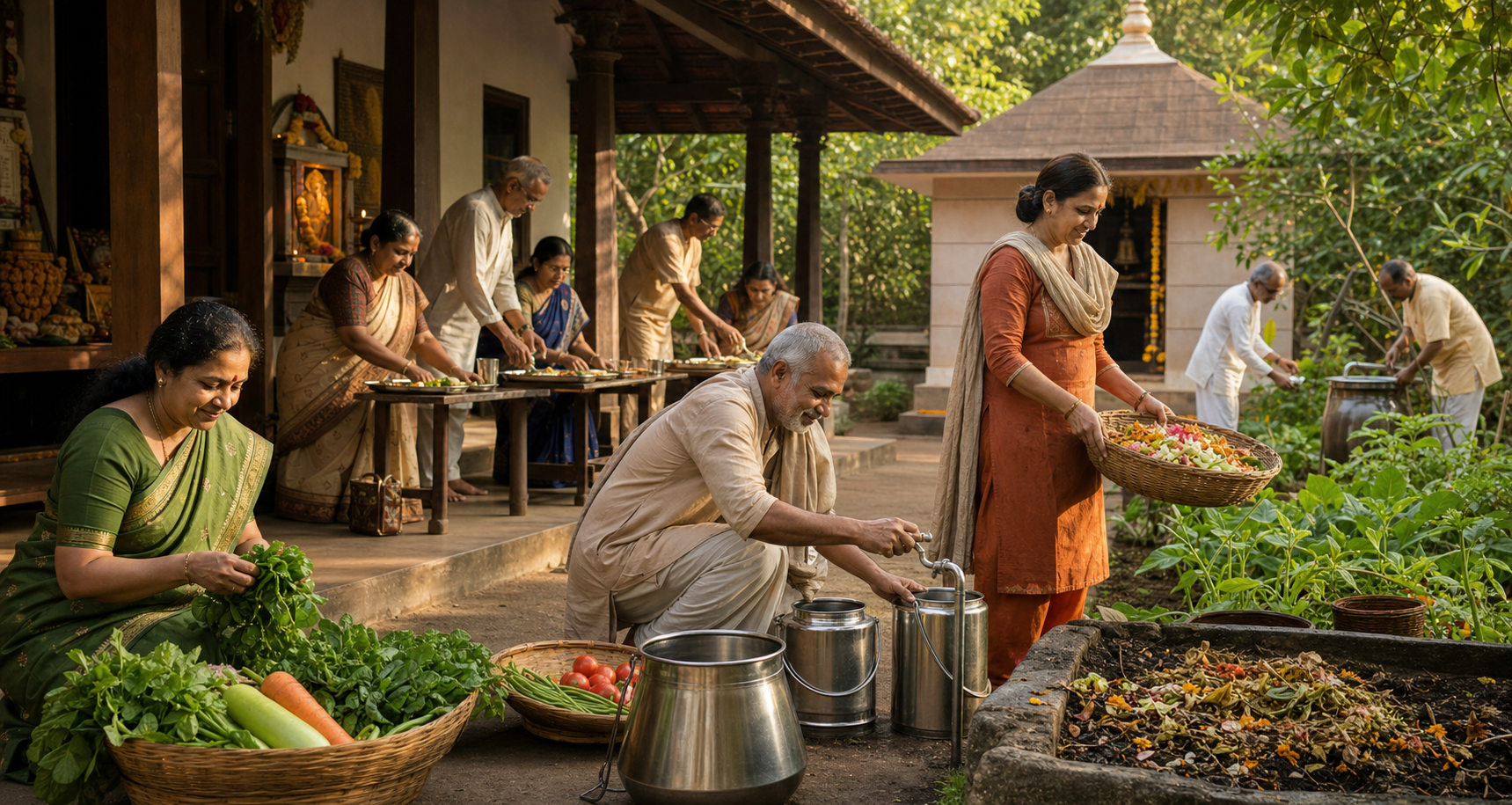
If you help run a temple, ashram, farm community or local sangha, you may recognise an uncomfortable gap. Worship is disciplined, yet food is routinely overprepared, useful materials enter the wrong waste stream, maintenance falls to the same tired volunteers, or a garden flourishes only while one enthusiastic person carries it.
You don’t need a separate environmental identity to close that gap. You need to make care for food, land, animals, buildings and shared resources part of recurring seva. The practical test is simple: can the community keep doing the work when enthusiasm dips, the weather changes and the festival crowd goes home?
Begin with the devotional purpose, not a green label
Ecological stewardship becomes durable when it is understood as care for what has been entrusted to us. In a devotional community, grain, water, soil, animals, heat, buildings and human labour aren’t merely inputs to be consumed. They support worship, hospitality, learning and service. Wasting them weakens those purposes.
Several dharmic principles make this practical. Ahimsa asks you to notice avoidable harm. Seva turns concern into useful work. Prasadam disciplines the entire passage of food from selection and cooking to offering, serving and responsible handling afterward. Satsanga gives private intention a social rhythm. Hindu, Buddhist, Jain and Sikh traditions don’t have identical theology, but non-harm, service, restraint, good company and humility form a shared ethical grammar without erasing their differences.
Gaudiya Vaishnava thought describes shraddha as intelligent trust that matures through practice, sound reasoning and association. The Bhakti-rasamrita-sindhu places it at the threshold of a progression that includes sadhu-sanga, regulated devotional practice and, eventually, nishtha or steadiness. That sequence matters here. An ecological promise has little value while it remains a sentiment. It becomes trustworthy when repeated service turns it into a stable habit.
Sweden’s Almvik Farm shows how that integration can look in a Gaudiya Vaishnava setting: worship, japa, kirtana and scriptural learning remain central while agriculture, composting, seasonal horticulture, careful resource use and shared work become expressions of the same devotional intention. The lesson isn’t that every congregation should reproduce a Scandinavian farm. It is that outer practice becomes coherent when it grows from the community’s spiritual centre.
Before adopting an ecological project, put it through a devotional filter:
- Does it reduce avoidable harm or waste in a recurring part of community life?
- Will it support worship, hospitality, education or care rather than compete with them?
- Does it fit the local climate, building, budget and available skills?
- Can a named person perform it as a defined seva, with a backup when that person is absent?
- Can you explain its purpose to a newcomer without turning it into a display of moral superiority?
If the answer to the first questions is unclear, don’t buy equipment or announce a campaign. Clarify the service first.
Trace the whole life of prasadam
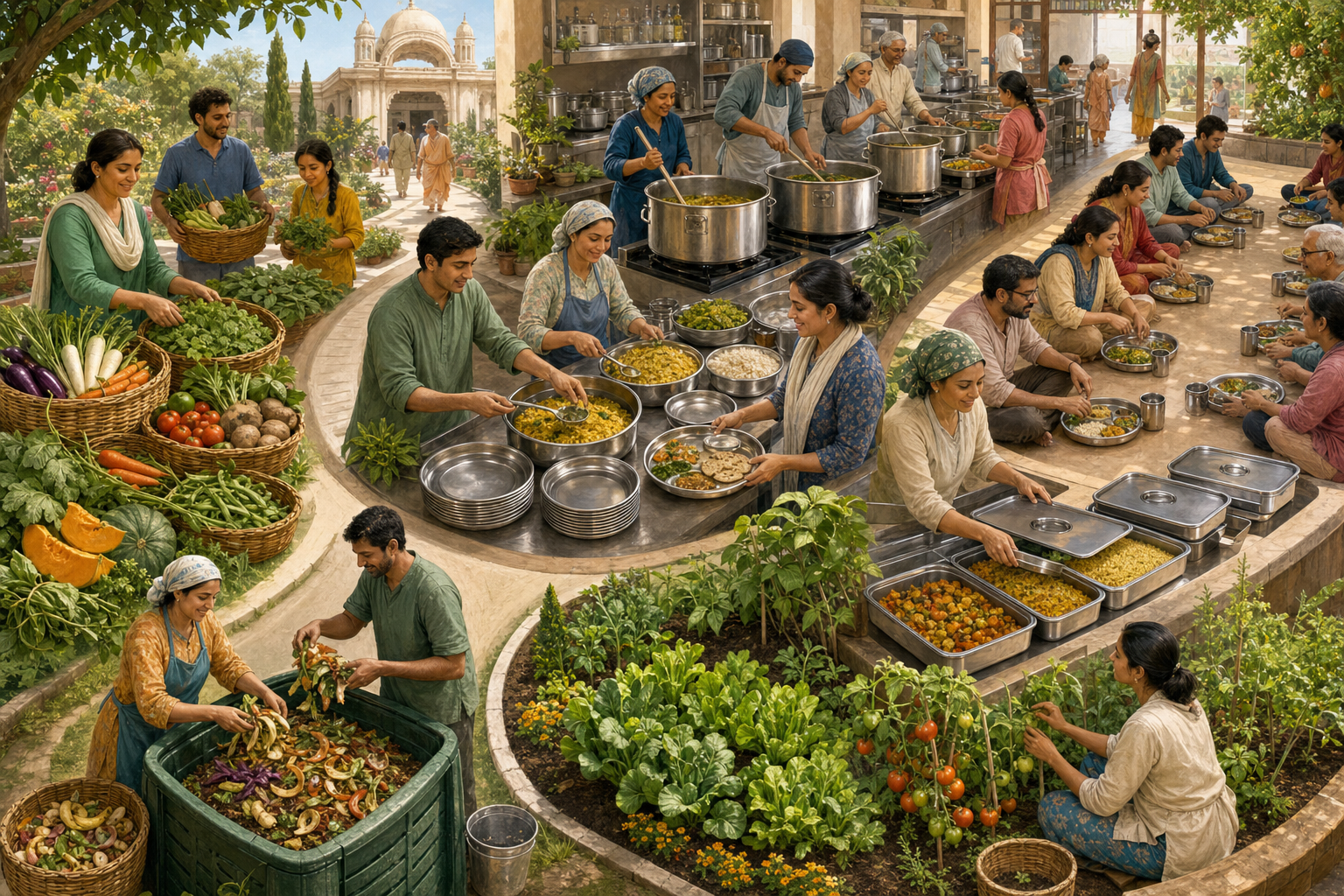
The kitchen is usually the best place to begin because it joins devotion, ecology and community care in one visible cycle. Prasadam isn’t just the food on a plate. Decisions about menus, purchasing, storage, preparation, serving, leftovers and cleanup all determine whether reverence survives contact with daily operations.
Start by observing an ordinary meal and a busy festival meal. Don’t begin with new bins or ambitious targets. Follow ingredients from arrival to final disposal, and note where quantity, labour or responsibility becomes uncertain.
- Plan from actual use. Compare the menu and quantities with attendance at similar meals. Notice ingredients that repeatedly remain in storage, prepared dishes that reliably come back from serving, and items purchased out of habit rather than need. Adjust the next comparable meal instead of relying on memory.
- Separate during preparation. Keep usable ingredients, suitable kitchen trimmings, compostable material and non-compostable packaging distinct from the beginning. Sorting a mixed container after cleanup creates unpleasant work and makes contamination more likely.
- Serve for appetite rather than appearance. Make additional servings easy while allowing a guest to begin modestly. This respects both hospitality and the offered food. Untouched surplus should be handled through a clear process rather than an improvised decision made at the end of a long day.
- Close the loop deliberately. After the meal, distinguish untouched food, plate waste, suitable compost material and ordinary rubbish. Record the recurring pattern, decide what should change at the next comparable service, and tell the person who plans purchasing.
Food safety remains part of seva. Follow the requirements that apply in your location, and don’t distribute food when its storage, temperature or handling history is uncertain. Reverence for prasadam doesn’t justify exposing guests to preventable risk.
Shared meals are also social infrastructure. Cooking, offering and eating together can reduce social distance between residents, visitors, elders, children and newcomers. That benefit disappears when the kitchen team is chronically exhausted or when cleanup is treated as low-status work. Rotate visible and invisible duties, and include cleanup in the service plan before cooking begins.
A useful kitchen review therefore asks more than whether waste declined. Did guests receive enough? Was the offering prepared with appropriate care? Were volunteers able to join important parts of the devotional programme? Did surplus reach an appropriate use safely? Ecological seva succeeds when these answers improve together.
Give every promise an owner, a rhythm and a measure
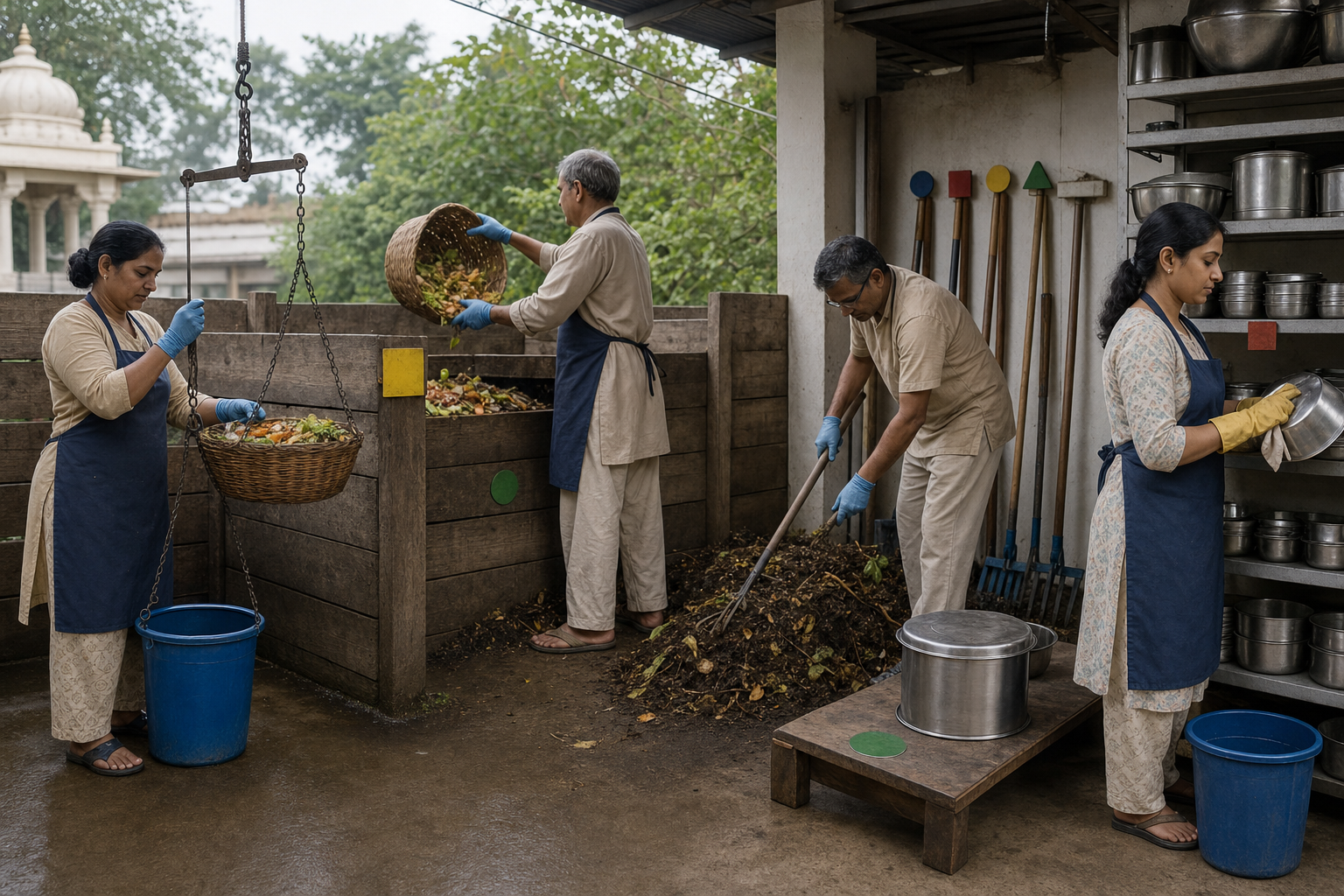
Most community commitments fail at the handoff. Everyone agrees that composting, animal care or energy conservation matters, but no one knows who acts after the kitchen closes, who covers an absence, or who decides that the process needs to change. Calling something everyone’s responsibility often makes it no one’s dependable service.
Write each recurring practice in operational terms:
- Practice: the concrete action, such as separating kitchen material suitable for compost.
- Trigger: the event that starts the task, such as completion of meal cleanup.
- Steward: the person or service team responsible for completing it.
- Backup: the person who covers illness, travel, festivals or seasonal pressure.
- Definition of done: the observable condition that confirms completion.
- Review point: the normal meeting or service handoff where recurring problems are corrected.
Under that structure, composting is no longer a vague virtue. The kitchen team separates appropriate material; a named steward moves it after cleanup; a backup covers high-attendance days; and the gardening team decides when and where mature compost can be used. Each handoff is visible.
Shared decision-making doesn’t require every member to approve every routine action. Spiritual guidance should establish theological and ethical boundaries, particularly around offerings, animal care and worship. Operational stewards can then make ordinary decisions within a clear mandate. Decisions involving common funds, major changes or disputed priorities require transparent community review. This preserves spiritual clarity without turning every practical adjustment into a prolonged assembly.
Measure enough to learn, not enough to make the community feel like an audit office. Useful observations include:
- whether purchasing increasingly matches attendance and actual cooking needs;
- which foods or ingredients repeatedly remain unused;
- whether compostable material is kept free of contamination;
- whether garden beds and workflows are ready for the relevant season;
- whether energy use is reviewed against comparable weather and building activity;
- how often a rota gap creates an emergency request or interrupts sadhana;
- whether the same volunteers repeatedly absorb unfinished work.
These are diagnostic measures, not scores of personal purity. A lower volume of kitchen waste isn’t a success if guests leave hungry. A larger garden isn’t a success if the people maintaining it lose their prayer and study time. Ethical language around dairy isn’t credible if animal care is invisible or underfunded. When a measure improves by shifting harm elsewhere, revise the system.
Volunteer fatigue deserves the same seriousness as depleted soil or neglected equipment. Peak seasons and major festivals concentrate work; difficult winters can add logistical and emotional strain. Use finite service periods, genuine rest, mentoring for new volunteers and backups for essential roles. Before accepting a new project, identify who will carry its ordinary maintenance after the initial enthusiasm has passed. A practice that only works when its most energetic founder is present isn’t yet a community practice.
Adapt the practice to climate, scale and capacity
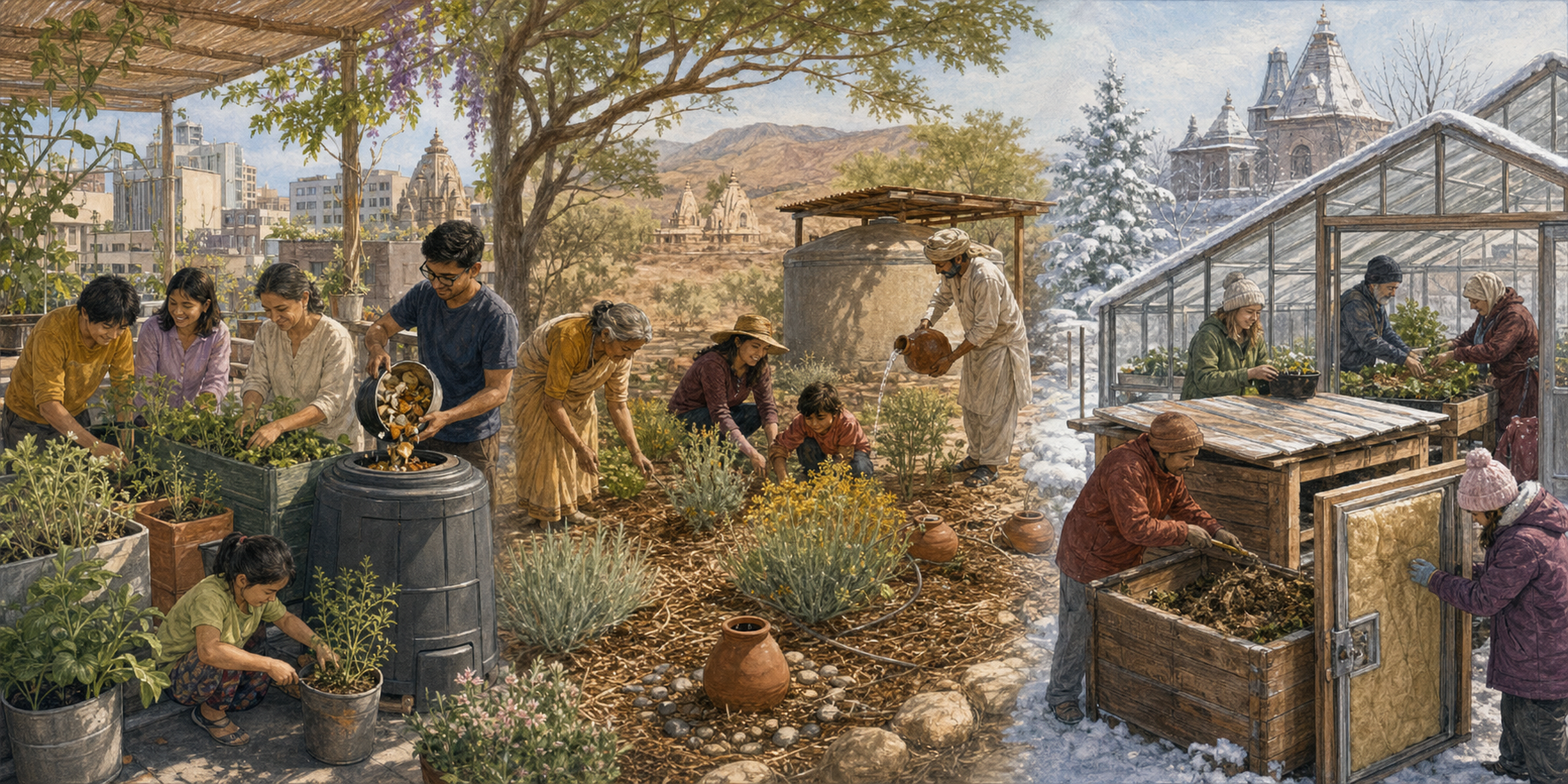
Bhakti can travel across cultures; agricultural technique cannot simply be copied from one place to another. Northern conditions at Almvik call for insulation, deliberate energy budgeting, greenhouse cultivation, cold-hardy crops and winter-ready workflows. Those are responses to a Scandinavian setting, not universal badges of devotional authenticity.
Begin your local design with constraints rather than ideals:
- Which resource is genuinely scarce: land, water, heat, storage, money, technical skill or volunteer time?
- Which seasons change attendance, growing conditions, energy demand and transport?
- What local rules govern compost, food redistribution, waste handling and animal care?
- Which skills already exist in the congregation, and which jobs require outside expertise?
- Can the practice continue during festivals, severe weather, school examinations and periods of low attendance?
- What is the safe, simple version of the practice when capacity is reduced?
This prevents an urban temple from imitating rural self-sufficiency for appearance’s sake. A farm community may connect soil improvement, horticulture, responsible animal care and food production in one place. A city congregation may have greater impact by planning prasadam accurately, maintaining its building well, reducing avoidable packaging, sharing infrequently used equipment and making waste separation intelligible to visitors. The forms differ; attentiveness and accountability remain.
Dairy requires particular honesty in communities that invoke ahimsa. If dairy is used, responsibility for the animals’ care cannot end at purchasing language or sentiment. The conditions, duties and costs behind the claim should be knowable. Where a community cannot verify what it is promising, it should not describe the arrangement as compassionate merely because that description is reassuring. Vegetarian and vegan prasadam can both be approached deliberately within the community’s theological guidance and practical capacity.
Children and young people can take part through age-appropriate gardening, cooking, music, storytelling and cooperative tasks. Give them a complete, understandable responsibility rather than using them as spare labour. A child who plants, tends, harvests, helps prepare and shares food can see the relationship between soil, patience, gratitude and hospitality. Adult supervision and safe tools remain part of that lesson.
Festivals provide a valuable stress test. A system that works only for residents may fail when guests arrive. Place serving guidance and separation points where visitors actually make decisions, assign stewards to help without scolding, and include final cleanup in the festival rota. Public devotion is most persuasive when hospitality, order and care for common goods are visible without a lecture.
Key takeaways
- Frame ecological care as recurring seva rooted in ahimsa, prasadam and responsibility, not as a separate identity campaign.
- Begin with a normal community activity, especially a shared meal, and trace resources from planning through cleanup before purchasing new equipment.
- Give every practice a steward, backup, trigger, definition of completion and regular place for review.
- Judge results across devotion, hospitality, ecology and volunteer well-being; improvement in one area shouldn’t quietly damage another.
- Adapt agriculture, energy use, waste handling and animal care to the actual climate, scale, rules and skills of your community.
- Choose practices that remain workable during festivals, difficult seasons and periods of reduced volunteer capacity.
At your next planning meeting, choose one recurring activity and map it from inputs to final cleanup. Name its steward and backup, decide what completion looks like, and observe both an ordinary cycle and a demanding one. Steady ecological seva begins when one shared duty becomes clear enough to keep.