
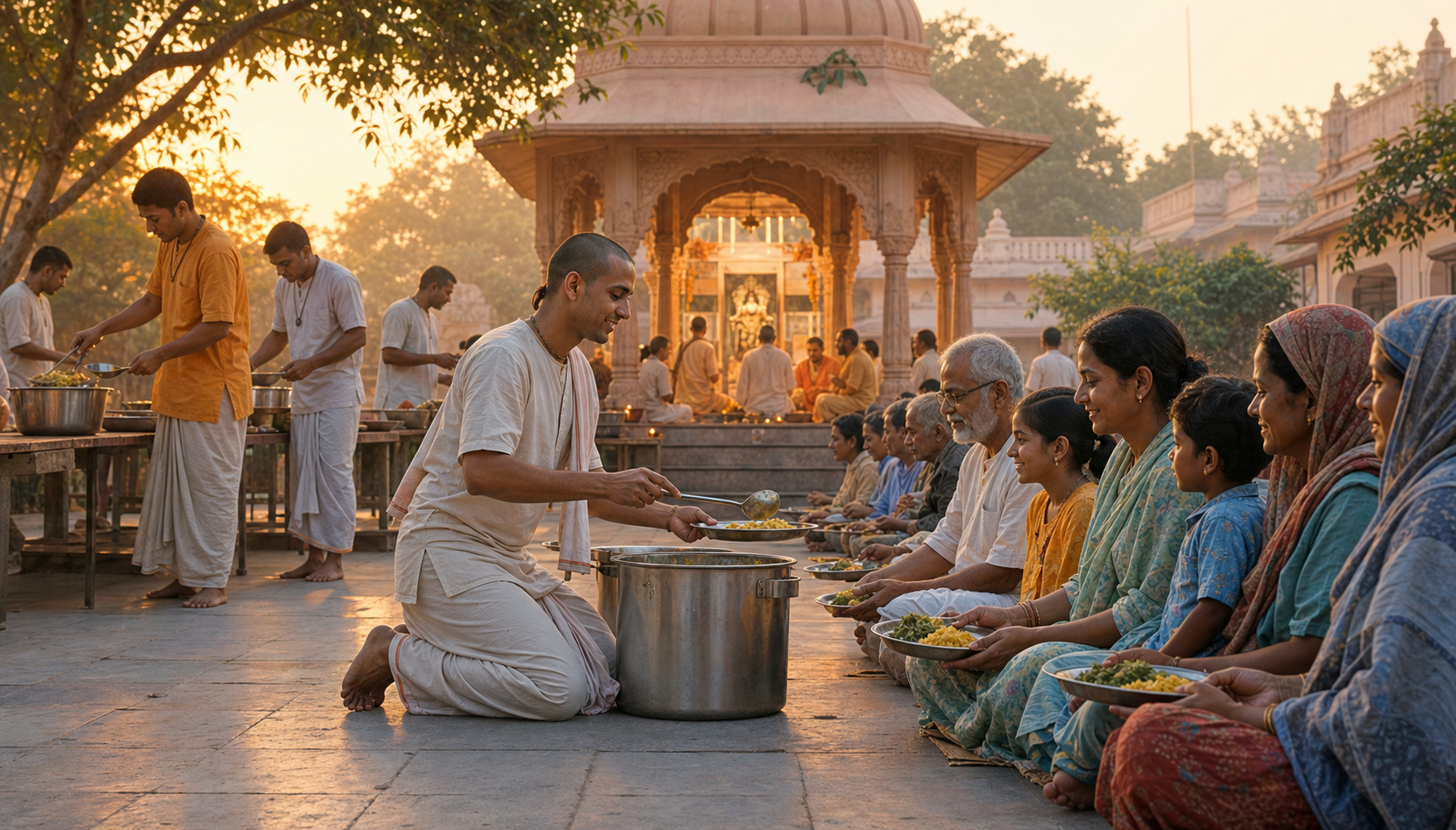
Gaudiya Vaishnava leadership becomes clearest when viewed as a chain rather than a rank: disciplined spiritual practice forms the servant, love governs the use of authority, prasadam turns intention into public care, and education carries the mission beyond one person’s presence. Read together, five reports provide a practical standard for judging whether leadership is genuinely serving devotion and community.
The sources are not equivalent kinds of evidence. They include a theological reading of an evening program without a full transcript, an essay on a leadership theme, a contemporary service report, a devotional memorial, and a retelling of a sacred festival narrative. Their details therefore require attribution. Their collective value lies in the pattern they reveal, not in treating reflection, remembrance, and program reporting as independent verification of one another.
Key takeaways
- Spiritual authority begins with practices that discipline attention, speech, desire, and the demand for recognition.
- Love-based leadership combines compassionate treatment with clear standards and respect for human agency.
- Public seva becomes credible through suitable service, reliable systems, dignified interaction, and consistent delivery.
- Leadership becomes durable when knowledge, responsibility, and pastoral care are transmitted across generations.
Authority begins with the leader’s inner formation

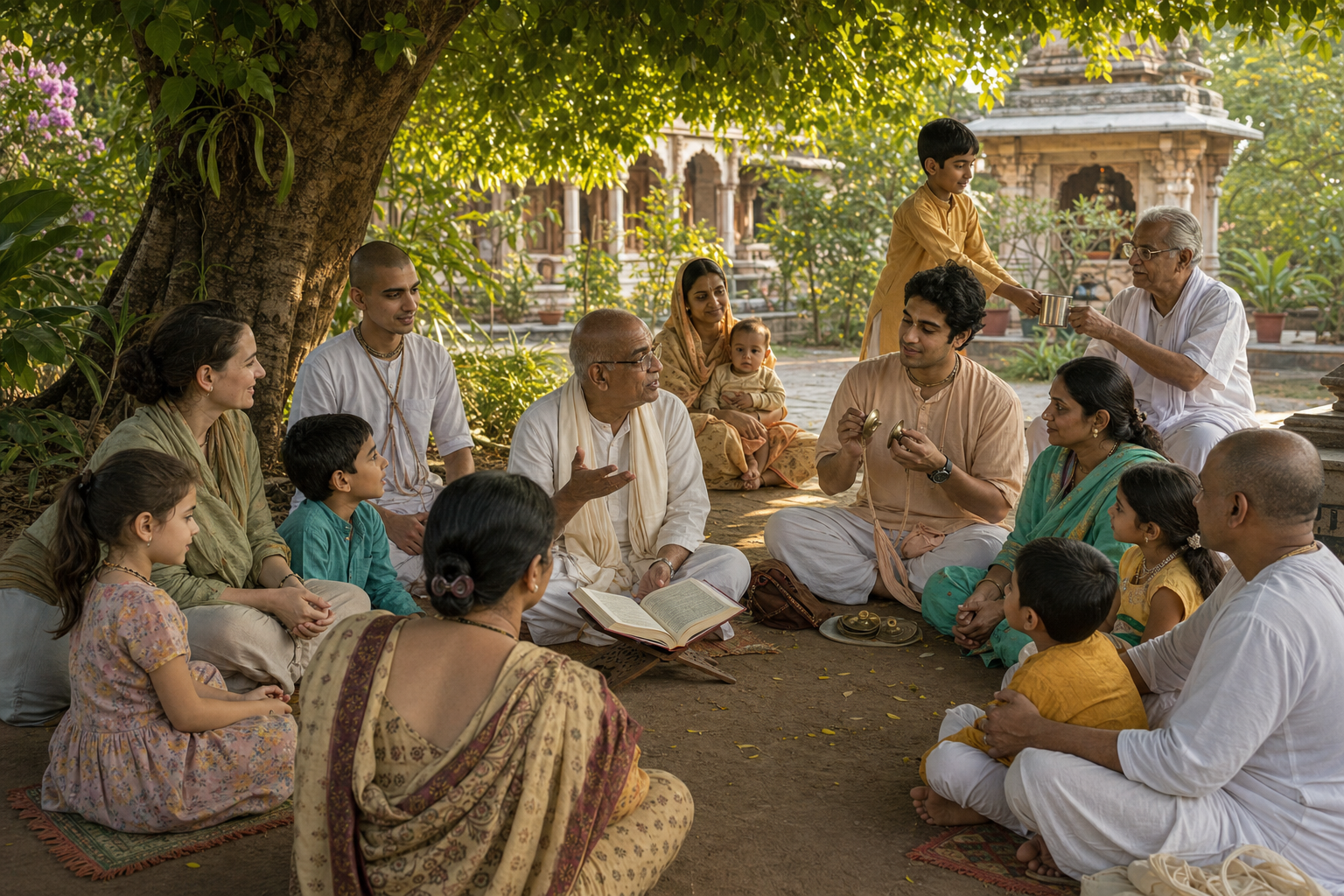
The DharmaRenaissance Blog article on an evening with HH Candramauli Swami explicitly notes that its available material did not include a full transcript. It consequently should not be read as a record of particular statements made by the teacher. Instead, the article uses the occasion to explain how satsanga ordinarily joins attentive hearing, chanting, remembrance, reflection, and communal renewal.
That distinction is instructive for leadership itself. Reverence for a senior teacher does not eliminate the need to distinguish documented instruction from interpretation. Responsible devotional writing, like responsible spiritual guidance, avoids making authority say more than the evidence supports.
Within the article’s theological framework, hearing and chanting train more than religious sentiment. Repeated attention shapes memory; memory influences speech and conduct; disciplined conduct gradually changes character. The article presents spiritual development as a progression through association, practice, purification, steadiness, deepening attraction, and mature love. Leadership therefore begins long before someone receives a title. It begins in the repeated practices through which ego, distraction, and harmful habits are confronted.
The DharmaRenaissance Blog essay on ISKCON Houston’s “Lead By Love” theme applies the same logic directly to authority. It argues that love in bhakti is a cultivated capacity grounded in sadhana, humility, seva, scriptural reflection, and compassionate conduct. Position without such formation can intensify the desire for prestige, whereas sincere service can exercise leadership without institutional visibility.
Taken together, these accounts make inward discipline an accountability issue rather than a private ornament. A leader’s practice should become visible in reduced reactivity, patient listening, truthful speech, willingness to serve, and freedom from constant demands for honor. Charisma, learning, or administrative responsibility cannot substitute for those effects.
Love gives both purpose and limits to authority
The Houston essay rejects a common false choice between compassion and discipline. Standards remain necessary, but their purpose is to steady the mind and direct conduct toward devotion. Discipline detached from care can harden into control; warmth detached from guidance can leave people without a path of growth. Love-based leadership holds welcome and formation together.
The essay reads Krishna’s guidance to Arjuna in the Bhagavad Gita as a model: Krishna teaches, reasons, consoles, challenges, and ultimately leaves Arjuna with responsibility for his choice. In this interpretation, authority does not produce mature disciples by securing passive compliance. It helps people understand why a course of action matters and equips them to accept responsibility voluntarily.
The Dandavats account of the Panihati Chida-Dahi Festival presents a different but complementary mode of guidance. In its retelling of the traditional narrative, Sri Chaitanya Mahaprabhu had earlier advised Raghunatha Dasa to return home, behave steadily, and avoid premature external renunciation. Later, Lord Nityananda playfully imposed a feast for the assembled devotees as Raghunatha’s “punishment” for remaining at a distance. The command redirected his wealth, organizational capacity, and spiritual longing into hospitality.
The two accounts describe different contexts rather than a single leadership technique. The Bhagavad Gita model emphasizes reasoned instruction and moral agency. The Panihati narrative depicts willing submission within an established devotional relationship, where correction becomes an opportunity to serve. Both resist ego-centered authority: the guide is not seeking personal comfort, and the disciple is not being trained merely to flatter the guide.
This synthesis also clarifies the meaning of humility. Humility does not require leaders to avoid decisions or communities to abandon standards. It requires authority to remain accountable to a devotional purpose beyond the officeholder. Correction should protect growth rather than humiliate; delegation should develop others rather than secure dependence; and respect for a teacher should deepen scriptural engagement and moral responsibility rather than suspend them.
Prasadam seva tests whether ideals can become reliable care
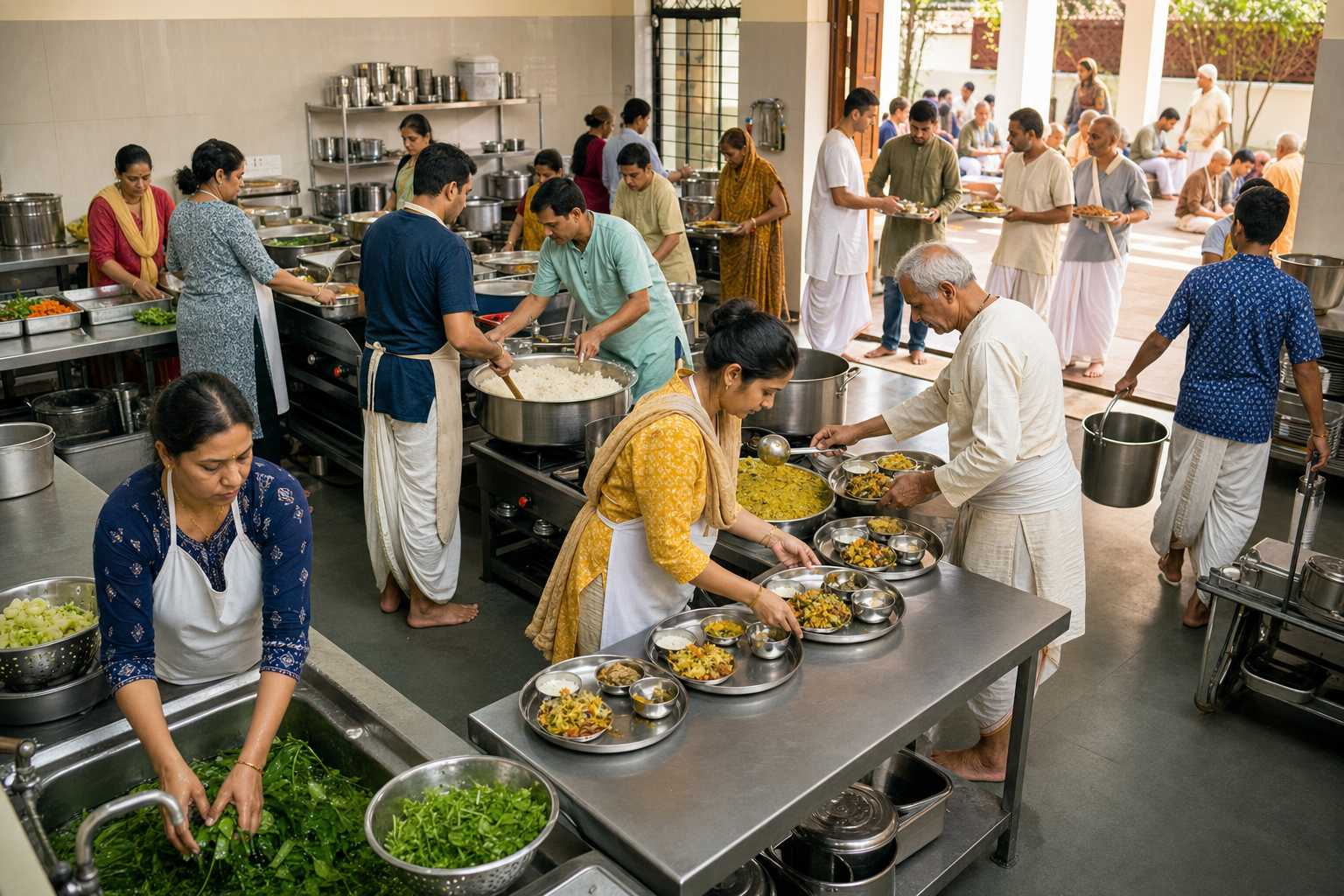
Panihati and a reported contemporary meal program illuminate two different scales of service. One is a sacred festival narrative centered on an abundant public feast; the other is an account of a recurring urban initiative. They do not verify each other’s historical particulars, but they share an operational insight: devotional generosity requires planning as well as feeling.
In the Panihati account, Raghunatha Dasa responds to Nityananda’s instruction by obtaining ingredients, gathering earthen vessels, organizing multiple preparations, and accommodating a growing assembly on the bank of the Ganga. The narrative treats procurement and distribution as part of the devotional event itself. Its theological point is expressed through logistics: resources become spiritually meaningful when they are organized for the honor and nourishment of others.
The Dandavats report on Hare Krishna TV’s Khichadi Prasadam Seva states that the program began in January 2026 and operates daily at 12:30 PM near Indira Gandhi Hospital in Mira Road East. According to that report, the Hare Krishna TV and ISKCON Desire Tree team distributes approximately 350 to 400 portions and serves a varied group that includes patients’ attendants, pregnant women, students, laborers, and rickshaw drivers.
The account also reports that the menu is adjusted for Ekadashi and that Srila Prabhupada’s kirtan accompanies distribution. These details show an attempt to maintain devotional identity without separating it from a practical response to hunger. The fixed location and time are equally significant from a leadership perspective: people can place trust in a service only when it is sufficiently consistent to be found and relied upon.
The report says there is scope to double the quantity distributed. That possibility makes operational discipline more important, not less. Expansion must preserve food safety, punctuality, kitchen capacity, transport, orderly service, volunteer sustainability, and respectful treatment. Plate totals can describe reach, but they do not by themselves establish quality or dignity.
Both food-service accounts also challenge the idea that generosity flows downward from a superior benefactor. In the Vaishnava framing, food is first offered and then received as grace; servers are stewards rather than owners of mercy. Leadership is therefore measured not only by whether nourishment reaches people, but also by whether recipients are treated as participants in a sacred exchange rather than as instruments of publicity.
Continuity depends on education, care, and shared practice
The problem of continuity becomes especially visible when a senior teacher dies. The Dandavats remembrance of HH Dhirasanta Dasa Goswami reports that he received initiation from Srila Prabhupada in 1972, assisted early ISKCON work in Mayapur, Delhi, and Bombay, and later devoted substantial effort to preaching and community development in Europe, particularly Scandinavia and the Baltic states. It also emphasizes educational work for children and adults, fatherly care for followers, and his departure amid chanting.
As a devotional memorial based on an official announcement and the recollections of followers, the article is not an independent assessment of every aspect of his public life. It is nevertheless valuable evidence of what the community regards as exemplary: fidelity to a lineage, long-term service, teaching across cultural settings, intergenerational education, and personal care.
Those qualities connect the memorial to the other reports. Satsanga places teaching within a shared room rather than leaving it as private consumption. Panihati preserves theology through repeated festival practices, food, sound, gesture, and hospitality. The Mira Road initiative turns service into a dependable routine. Education enables children, adults, and newer participants to understand why such practices matter. Remembrance then asks successors to carry principles forward instead of merely preserving affection for a departed personality.
A durable community can therefore examine leadership through four connected responsibilities: whether leaders continue their own spiritual formation, whether authority respects agency while maintaining meaningful standards, whether public service is operationally trustworthy, and whether knowledge and responsibility are being transferred to others. Weakness in any one area eventually strains the rest.
The next stage of Gaudiya Vaishnava leadership will depend less on expanding the language of service than on making these responsibilities observable in temples, households, educational projects, festivals, and welfare programs. When disciplined practice, humane authority, reliable seva, and thoughtful succession reinforce one another, leadership can remain devotional without becoming fragile or personality-dependent.
References
- DharmaRenaissance Blog – A Powerful Evening with HH Candramauli Swami: Bhakti, Discipline, and Inner Renewal
- DharmaRenaissance Blog – Lead by Love: Powerful Bhakti Leadership Lessons from ISKCON Houston
- Dandavats – How Hare Krishna TV’s Khichadi Prasadam Seva Brings Dignity to Mira Road
- Dandavats – Dhirasanta Dasa Goswami’s Powerful Legacy of Devotion, Service, and Grace
- Dandavats – Panihati Chida-Dahi Festival: Powerful Lessons from Raghunatha Dasa Gosvami