

If you wanted to take part in ISKCON’s 2026 global gathering, the important question was not simply whether you could open the webcast. It was whether your concern could travel from a worldwide devotional conversation to a clear decision, a responsible body, and a visible next step.
The Online Maha Istagosthi connected with the 2026 GBC Annual General Meeting was announced as a structured devotional forum for devotees and well-wishers around the world. That design could widen access substantially. Yet access, consultation, deliberation, and accountability are different achievements. You need to distinguish them if you want to participate constructively or judge the gathering fairly.
A global webcast opens the door, but participation has levels
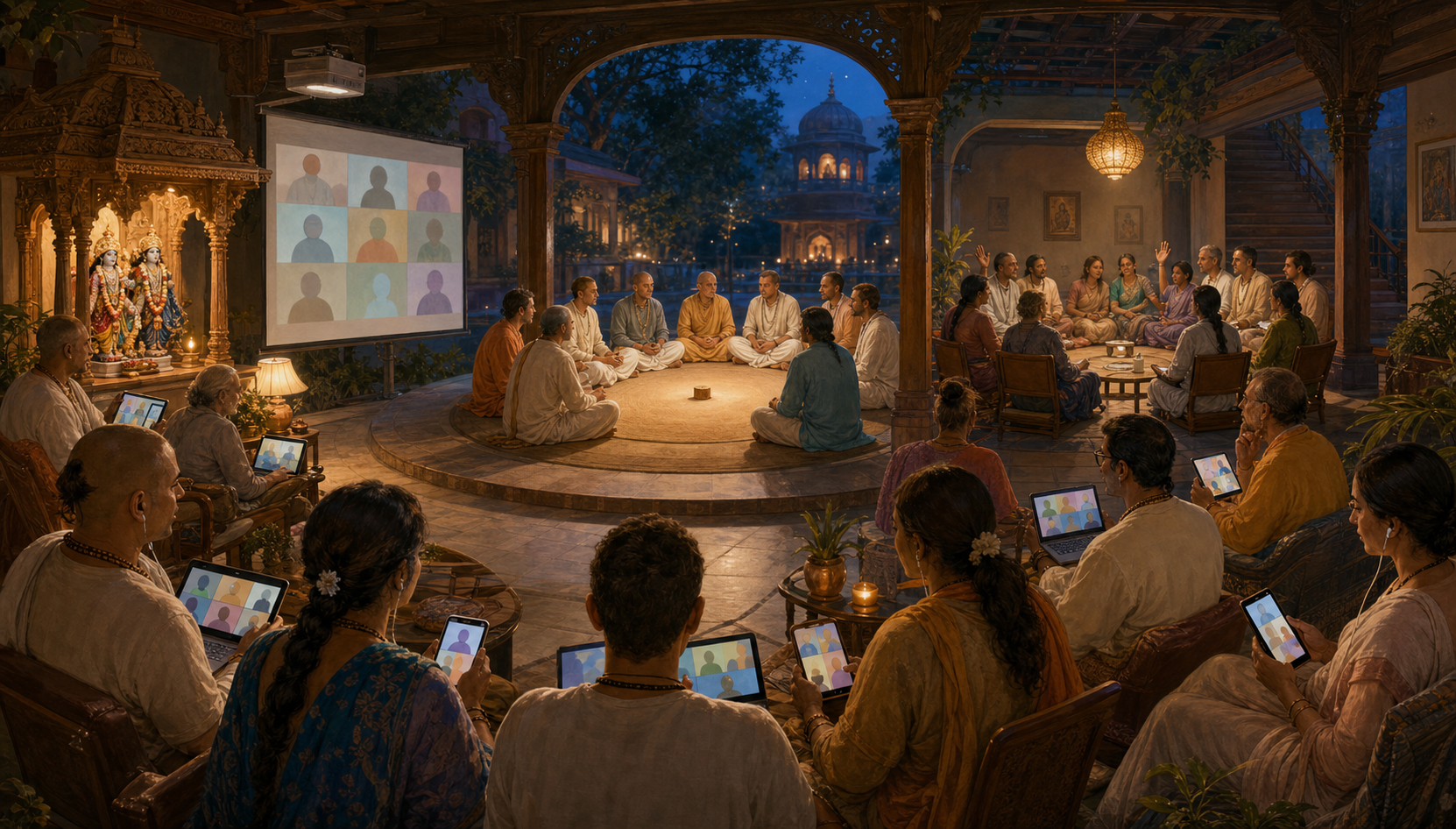
The Maha Istagosthi was scheduled for 8 February 2026 at 6:00 p.m. IST, with reference times of 7:30 a.m. in New York, 9:30 a.m. in Buenos Aires, and 12:30 p.m. in London. Those reference times made its worldwide ambition concrete. They did not, by themselves, show whose concerns entered the discussion or what happened to those concerns afterward.
A useful way to assess participatory governance is to separate four levels that are often blurred together:
- Access: People can hear the same presentation without travelling to the meeting.
- Consultation: People can submit experiences, questions, objections, and proposals through a defined channel.
- Deliberation: Competing needs and possible responses are examined, with reasons given for the trade-offs.
- Accountability: Each material issue receives a status, an appropriate decision-making body, an owner, and a point for reporting back.
A live webcast directly supports the first level. A structured and interactive Istagosthi is intended to support the second. The format alone cannot establish whether deliberation occurred or whether follow-through was assigned. This is not a reason to dismiss the gathering. It is a reason to use precise language: a welcoming global conversation is valuable, but it is not automatically shared decision-making.
This distinction also protects the GBC process from unrealistic expectations. Participatory governance does not mean that every participant becomes a final decision-maker or that every suggestion must be adopted. It means that people can understand where a concern went, who has authority over it, and why a particular response followed.
Turn devotional concern into a question that can be governed
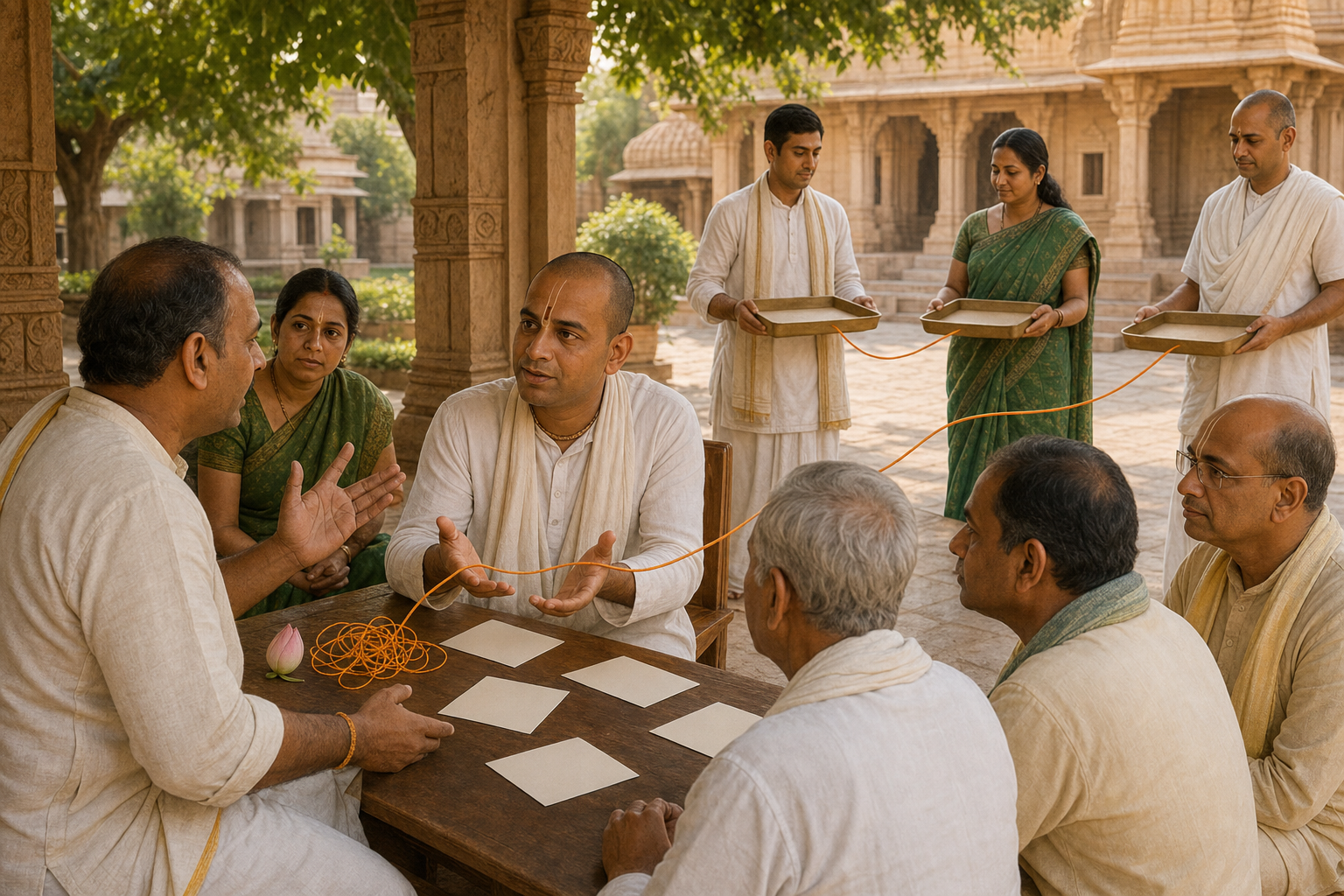
The gathering’s announced areas of attention included Srila Prabhupada’s guidance, temple and congregational service, safeguarding standards, youth engagement, outreach, digital kirtan and satsanga, and leadership that is both accountable and compassionate. These subjects do not all belong at the same level of authority. A global standard, a regional coordination problem, and a local programme decision require different responses.
Before raising an issue, ask what kind of decision you actually need. Do you need a GBC-wide principle, regional coordination, clarification from a responsible body, or action within one temple? A global meeting becomes congested when every local difficulty is framed as a global policy question. Local leaders, however, should not use that distinction to deflect matters that genuinely concern movement-wide standards.
You can make a contribution easier to hear and harder to lose by giving it four parts:
- State the observation. Describe what happened, where it arose, and whom it affected. Separate what you observed from what you heard from someone else.
- Name the governing concern. Connect the observation to service, safeguarding, faithful transmission of Srila Prabhupada’s teachings, community care, or another relevant responsibility. A principle should clarify the issue, not replace evidence about it.
- Ask for the correct jurisdiction. If you do not know whether the matter belongs locally, regionally, or globally, make that uncertainty part of your question.
- Request traceable follow-through. Ask which role or body will consider the matter, how its status will be recorded, and when participants should look for an update.
For example, “youth must be included” expresses a worthy intention but gives leadership little to act upon. A governable request would ask whether youth input on a named issue will be gathered locally, regionally, or globally; who will compile it; and where the response will be recorded. The second form does not guarantee agreement. It does make a real answer possible.
Safeguarding concerns need a further distinction. Do not place allegations, names, or identifying personal details into a public webcast comment. Ask for the appropriate confidential reporting channel and for confirmation that the matter has reached the responsible function. Transparency about process must coexist with privacy and protection for the people involved.
Global access is not the same as equal voice
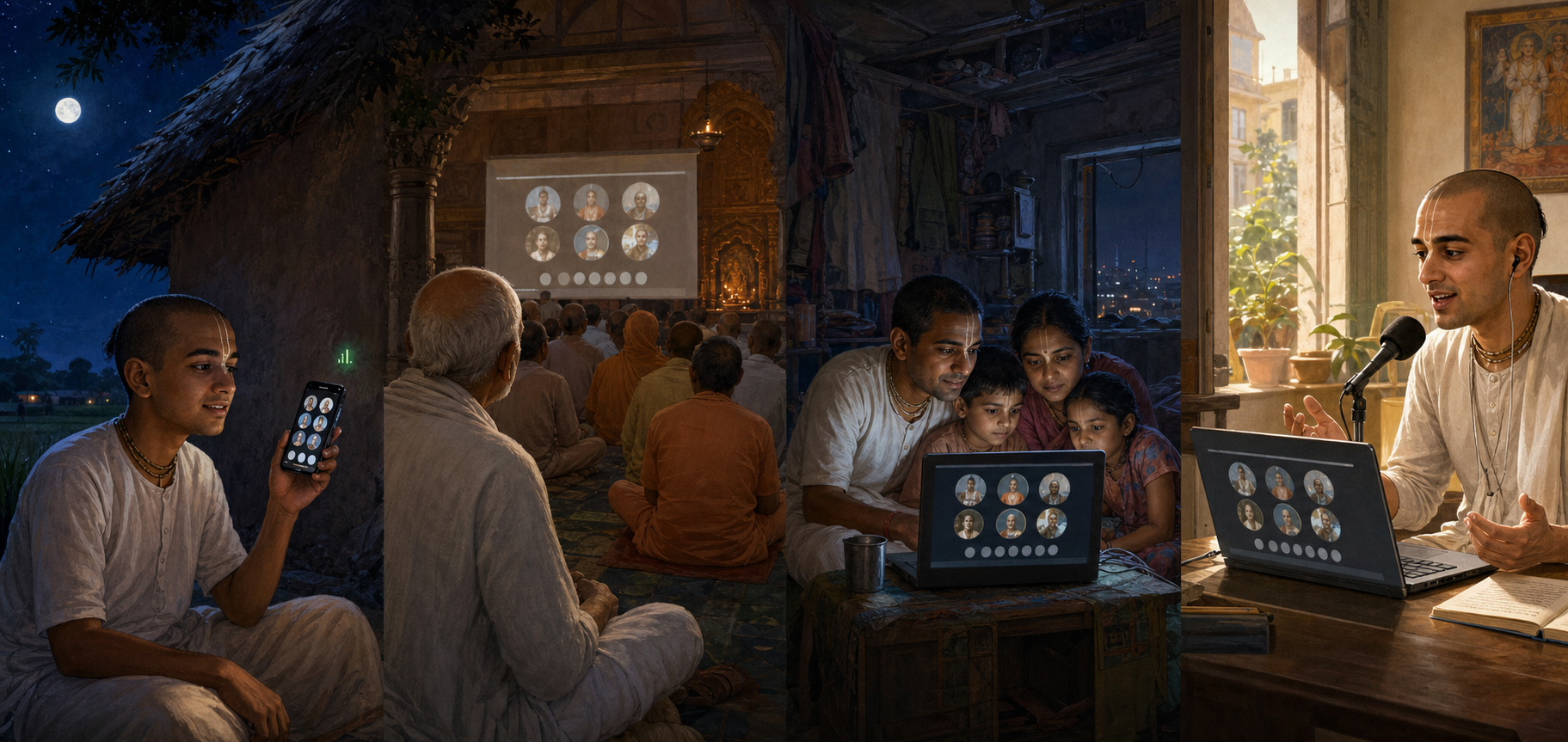
An online event removes the need to travel, but one synchronous time still lands differently across regions. Internet reliability, language, confidence in public speaking, work or study obligations, disability, and local hierarchies can all affect who contributes. A worldwide link therefore expands the possible audience without making participation automatically representative.
A stronger consultation design gives people more than one route into the discussion:
- Before the live session: Circulate the same focused prompts and accept concise written or recorded submissions.
- During the session: Mark each intervention as a question, proposal, experience report, or request for clarification. That prevents unlike contributions from being collapsed into a vague list of comments.
- After the session: Keep an input window open for people who could not attend live. A replay gives access to information; it does not give access to consultation unless responses can still be submitted.
- Across languages: Use regional summaries built from a common template. Preserve unresolved or minority concerns instead of translating every difference into artificial consensus.
- Across levels of responsibility: Invite input from congregational devotees, ashram communities, families, students, and local servants as well as recognised leaders. Record the participant group with the issue so that missing perspectives remain visible.
The Maha Istagosthi’s wider Dharmic significance also needs precision. Compassion, service, and ethical stewardship resonate across Hindu, Buddhist, Jain, and Sikh traditions, and they can strengthen the temperament in which people listen to one another. They do not erase ISKCON’s Gaudiya Vaishnava identity or transfer the GBC’s responsibilities to an undefined interfaith consensus. Unity in diversity should improve mutual respect without blurring who holds authority for a specific decision.
Devotional courtesy and candid scrutiny belong together. Courtesy without candour can conceal unresolved harm or institutional weakness. Candour without discipline can turn consultation into accusation without remedy. The practical middle path is to question conduct and process specifically, protect personal dignity, and request an answer that can be followed.
The real test begins when the webcast ends

A participatory gathering becomes governable when each substantial issue leaves a trace. You do not need a transcript of every spoken word. You need a concise record that distinguishes what was heard from what was decided.
Look for six elements in any follow-up:
- Issue record: A faithful summary of the question or proposal, including important concerns that could not be answered live.
- Status: A clear label such as answered, accepted for consideration, referred, awaiting further information, unresolved, or outside the body’s remit.
- Jurisdiction: Whether the matter belongs with the GBC, a regional council, a local temple, or another responsible function. The event’s emphasis on collaboration among local, regional, and global levels only becomes practical when routing is explicit.
- Ownership: A named body or role responsible for the next action. “Leadership will consider it” is not enough to support follow-through.
- Next review point: A date, meeting, or reporting stage at which the status will be checked again, even when no final decision date can yet be promised.
- Closure: A short explanation of what was done, declined, or redirected and why. Confidential matters can report procedural status without exposing personal information.
Do not infer adoption from a warm response during a devotional gathering. Equally, do not infer rejection merely because a complex matter was not resolved live. Without a status and a next step, both interpretations are guesses. A visible decision trail replaces those guesses with accountable reasoning.
If no central tracker is available to you, keep a one-page personal ledger for the matter you raised. Record the date, the exact issue, the forum in which it was submitted, the requested level of action, the response received, the responsible role, and the next follow-up point. Do not present your ledger as an official GBC record, and verify its details before circulating it. Its purpose is to help you ask a precise follow-up through whatever official local, regional, or global channel is available.
Key takeaways
- A global webcast creates access; it does not by itself create consultation, deliberation, or shared decision power.
- A useful contribution combines an observable concern, a relevant governing principle, a jurisdiction question, and a requested next step.
- Worldwide participation needs asynchronous and multilingual routes as well as a live session.
- Safeguarding allegations and personal details belong in a confidential reporting process, not a public comment stream.
- The clearest evidence of accountability is a recorded status, an appropriate owner, a review point, and an eventual explanation of closure.
For the next consultation, bring one well-formed issue rather than a cluster of general frustrations. Ask where it belongs, who will hold it, and when its status can be checked. Then preserve the answer and follow up through the appropriate channel. That disciplined habit is how a worldwide devotional conversation becomes institutional memory and responsible service.
References
