
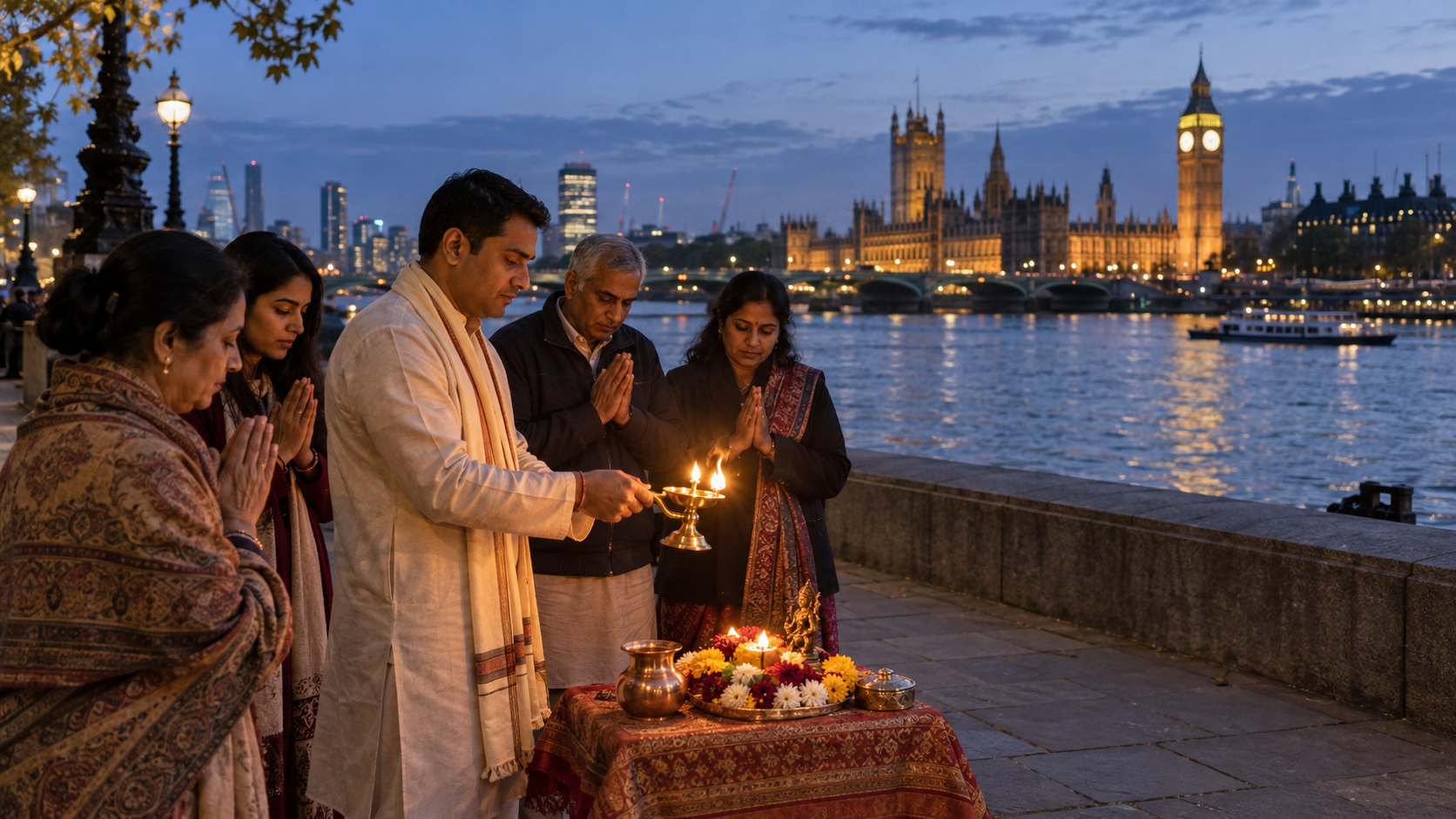
If you heard that Ganga was worshipped beside the Thames and wondered whether devotees were treating the two rivers as identical, the clearest answer is no. The rite honoured Ganga from within London’s landscape. Ritual can make a sacred relationship present without pretending that two places are geographically the same.
That distinction helps you understand both the devotion and its significance for Hindus living outside Bharat. Sacred memory can travel, but it remains meaningful only when the object of worship, the tradition guiding the worship and the duties created by it are kept clear.
What happened beside the Thames
On Sunday evening, 13 September 2026, delegates from Bhaktivedanta Manor joined thousands of participants for ceremonial worship of Ganga beside the Thames in London. The location placed an ancient Hindu relationship with a sacred river inside the everyday geography of a modern European city.
Bhaktivedanta Manor president Visakha Dasi addressed the gathering by video. She presented Ganga through a Krishna-bhakti understanding, connecting the sacred river with Sri Krishna, the Bhagavad Gita, transcendental happiness and freedom from karmic consequences.
This context matters. The gathering should not be flattened into a generic multicultural river festival. It was a devotional observance involving a particular Vaishnava institution and a recognisably Krishna-centred theological vocabulary. Nor should that vocabulary be treated as the only possible Hindu account of Ganga. Other sampradayas may use different texts, mantras and explanations while sharing profound reverence for her.
Ganga’s presence does not erase the Thames
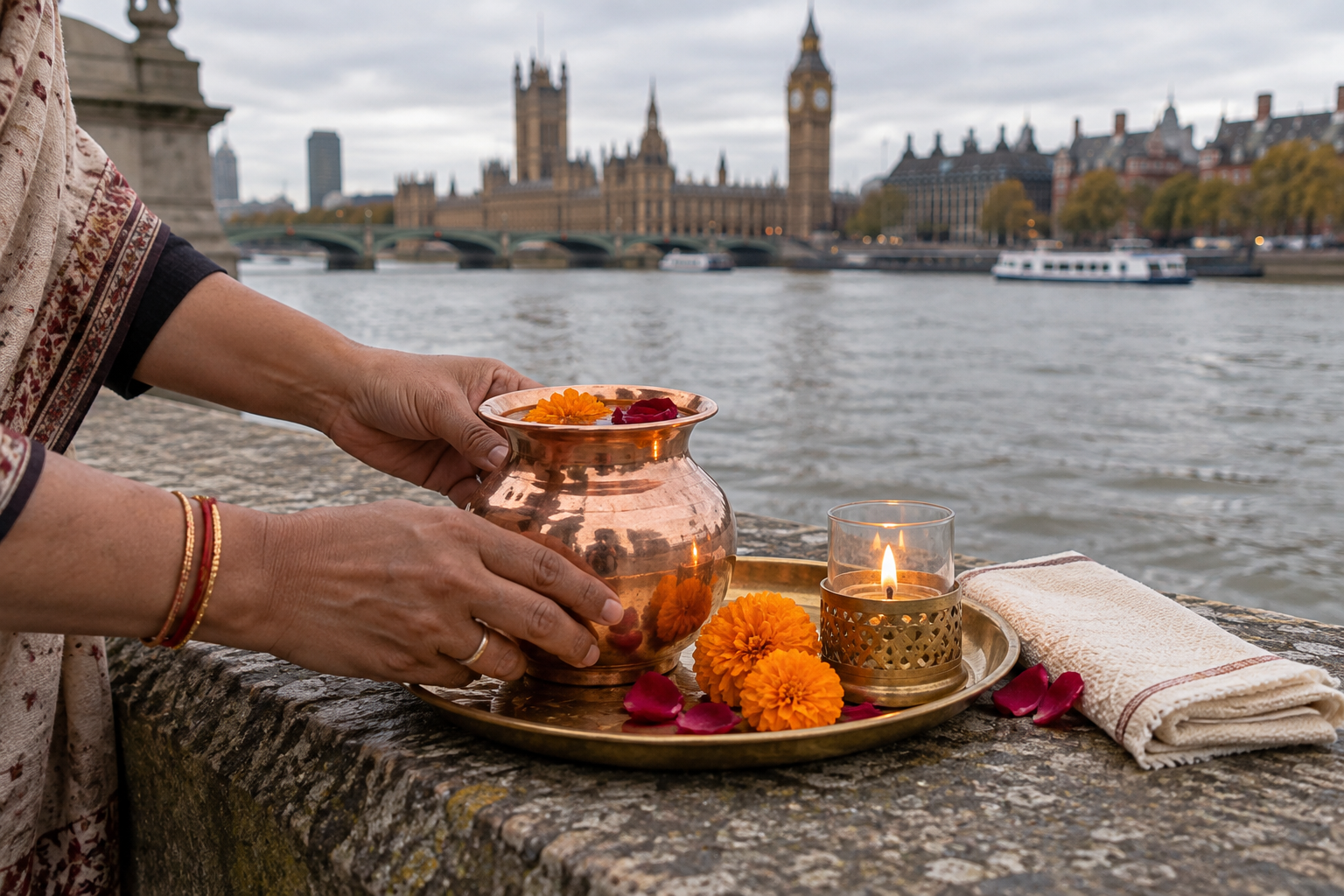
For devotees, Ganga is not merely a national emblem, a poetic image or a useful body of water. She is a sacred presence. Her physical course therefore matters, but a devotee’s relationship with her is not suspended whenever the devotee leaves Bharat.
Many Hindu traditions sustain sacred relationships through remembrance, prayer and a clearly stated ritual intention. These practices do not require the worshipper to confuse symbol with geography. At the London ceremony, three realities could remain distinct at the same time:
- Ganga remained the sacred river being honoured.
- The Thames remained the actual local river beside which the congregation had assembled.
- The act of worship connected a diaspora community in London with a sacred relationship rooted in Bharat.
This is more precise than saying that the Thames became Ganga. It is also more faithful than reducing Ganga to a metaphor for all water. Hindu ritual can bring a distant sacred relationship into the worshipper’s present place without dissolving the identity of either place.
The riverbank setting nevertheless carries a practical demand. If worship directs your attention towards the sacred character of water, it should make you more careful with the river in front of you. Reverence for Ganga and responsibility towards the Thames are not rival loyalties. The first can deepen the second.
How to participate without turning worship into spectacle
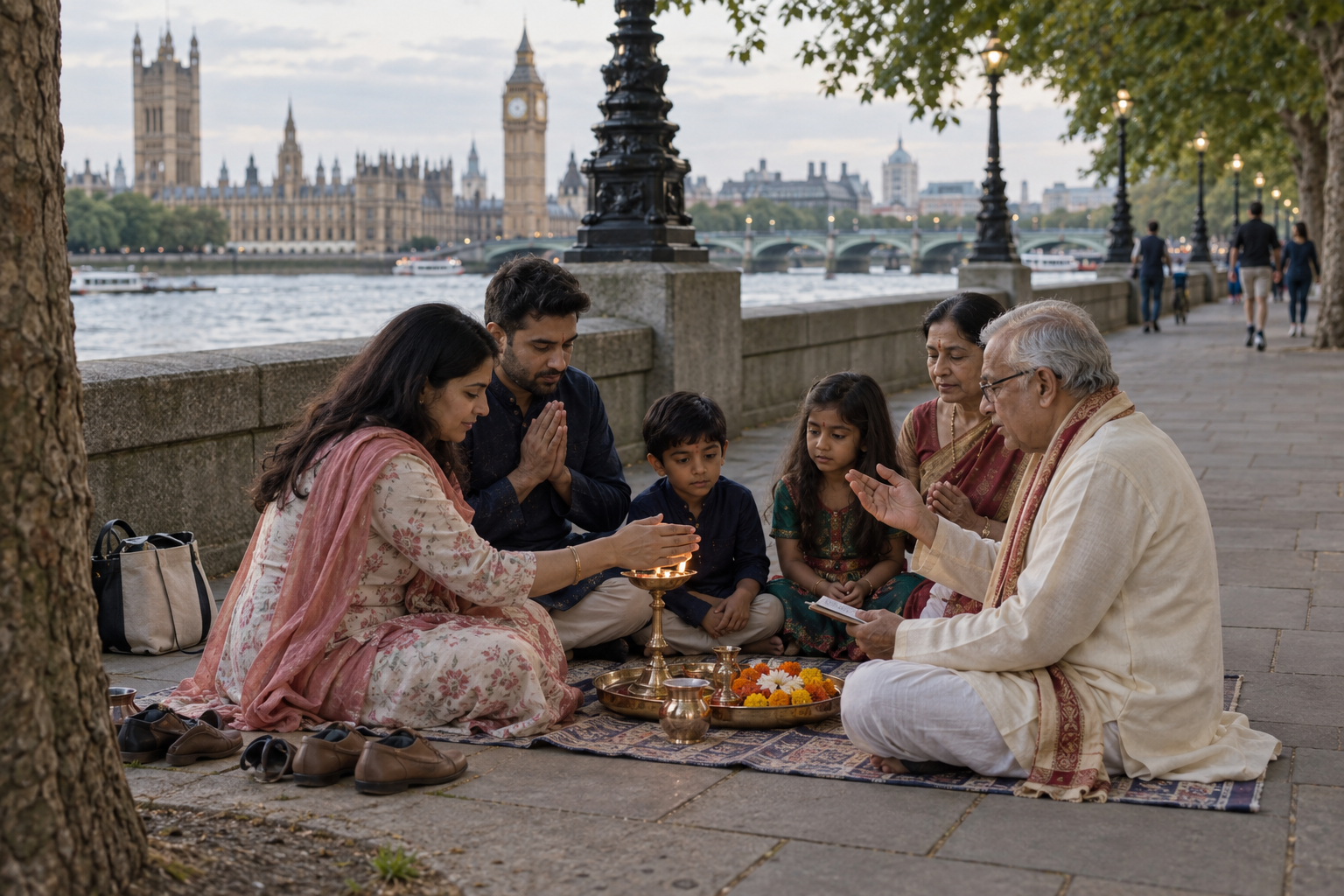
If you attend a similar gathering, you do not need to know every mantra before arriving. You do need to recognise that you are entering an act of worship rather than watching a cultural performance staged for photographs. A few choices will keep your participation grounded.
- Learn the stated intention. Find out who or what is being honoured and which community is leading the rite. At this gathering, Ganga worship was presented through Bhaktivedanta Manor’s Krishna-bhakti setting.
- Follow the liturgical lead. Chant or make gestures when invited. If you are uncertain, attentive silence and folded hands are sufficient; there is no need to imitate actions you do not understand.
- Keep offerings under the organisers’ direction. Do not place flowers, containers, food, ash or other material in a river merely because release into water appears traditional. If an item is not expressly permitted and environmentally suitable, retain it for the disposal method the organisers provide.
- Keep ordinary safety rules in force. A sacred occasion does not make unfamiliar urban water safe to enter. Do not approach or enter it beyond the boundaries established by the venue and organisers.
- Ask before making close-up recordings. A large public gathering may be visible to everyone, but individual prayer is not automatically an invitation for intrusive filming.
- Listen for the tradition’s own language. Terms such as Ganga, Krishna and Bhagavad Gita carry theological meaning. Do not translate the ceremony into nothing more than heritage, community wellbeing or environmental symbolism.
If you are explaining the occasion to a child, one sentence can prevent a great deal of confusion: We are honouring Ganga from the place where we live, while also respecting the river beside us. That preserves the relationship between sacred origin, present home and responsible conduct.
What diaspora communities should preserve
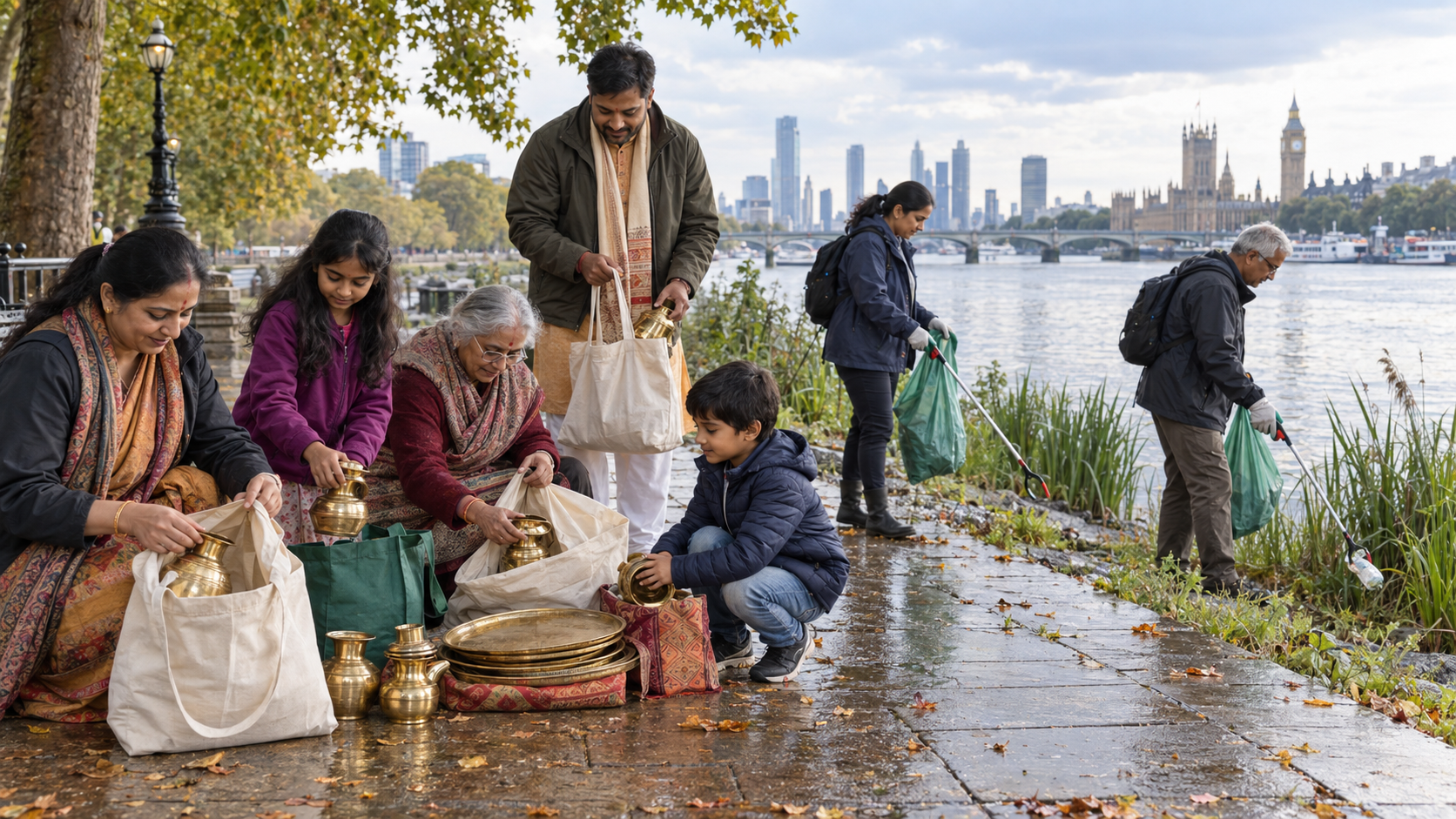
The central challenge for a diaspora tradition is not that its outward setting changes. London cannot look like every tirtha in Bharat, and it does not need to. The deeper risk is losing the grammar that tells the next generation whom the community is worshipping, why the act matters and what way of life should follow from it.
Three questions provide a useful test for any public Dharmic ceremony:
- Is the sacred presence named clearly? Here, the focus was Ganga, not an undefined celebration of rivers.
- Is the devotional lineage visible? The participation of Bhaktivedanta Manor and Visakha Dasi’s Krishna-centred address supplied that context.
- Does the ritual produce an obligation? Worship should shape conduct: serious spiritual attention, hospitality towards guests and disciplined care for the local place.
Plain-language explanation alongside prayer is not a dilution of tradition. It is part of transmission. A short note in an event programme can explain the Ganga-Thames distinction, identify the sampradaya leading the worship, tell newcomers when participation is appropriate and state that nothing should be released into the river without approval.
The use of a video address offers another practical lesson. A contemporary medium need not weaken an inherited practice when it carries genuine instruction into the gathering. The useful question is not whether every outward form is old. It is whether the form serves the worship or distracts from it.
Organisers can make that service visible by naming the rite accurately, allowing time for its meaning to be explained, providing a quiet way for newcomers to observe, and setting unambiguous environmental and safety boundaries. Those details keep a public ceremony from drifting into either empty display or careless improvisation.
Key takeaways
- Worshipping Ganga beside the Thames honours a sacred relationship from London; it does not require claiming that the two rivers are geographically identical.
- The 13 September 2026 gathering involved Bhaktivedanta Manor delegates, thousands of participants and a video address from temple president Visakha Dasi.
- The ceremony’s explanation was specifically shaped by Krishna bhakti, even though reverence for Ganga extends across multiple Hindu traditions.
- Respectful participation means following the ritual lead, observing ordinary safety rules and placing nothing in the river without explicit direction.
- A durable diaspora practice names its sacred focus, identifies its lineage and turns reverence into responsible conduct where devotees now live.
When you encounter Ganga worship outside Bharat, do not judge it only by whether its surroundings resemble those of India. Ask whether the worship clearly remembers its sacred centre, teaches the next generation what the rite means and honours the local place through careful conduct. If those elements are present, Dharma is not being left behind. It is being lived faithfully across distance.
References

Leave a Reply
You must be logged in to post a comment.