
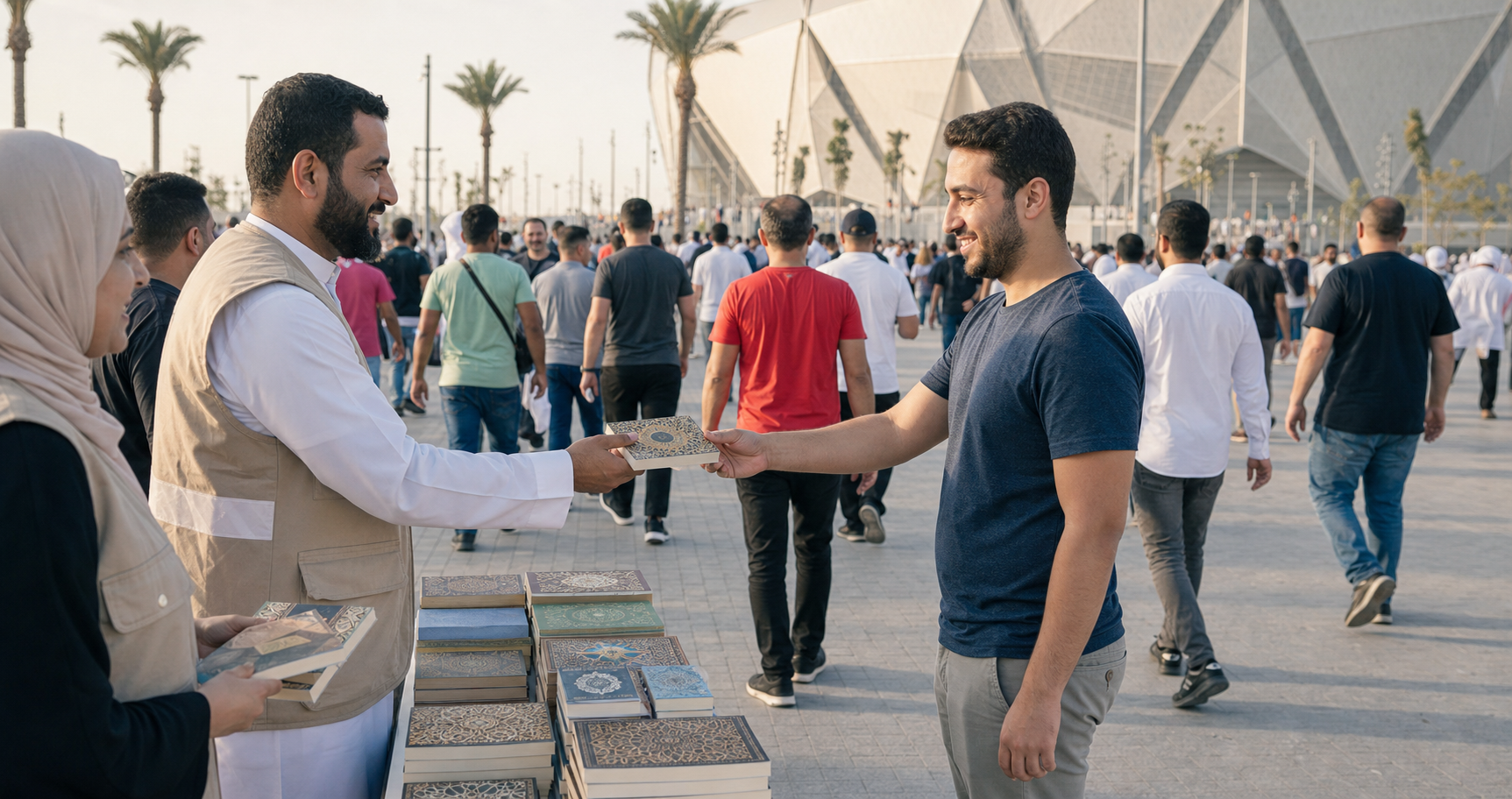
If you are deciding whether public book distribution still matters, the World Cup campaign offers a concrete answer. Thousands of Arabic and Farsi books changed hands in a setting where players, supporters, and visitors from across the Middle East had gathered.
But the most useful lesson is not simply that the total was large. It is that meaningful dharmic outreach depends on language, personal choice, accurate counting, and intellectual honesty about what distribution can and cannot prove.
What the World Cup campaign actually achieved
The campaign distributed 4,280 small books and 864 books classified as MahaBig. Both categories included Arabic and Farsi editions. Added together, the recorded distribution was 5,144 books.
- Small Arabic and Farsi books: 4,280
- MahaBig Arabic and Farsi books: 864
- Total books distributed: 5,144
The separate format totals are useful because they show that the organizers did more than publish one impressive aggregate. At the same time, the tally does not define MahaBig, identify the individual titles, or separate the Arabic count from the Farsi count. We should therefore use the reported categories without guessing what they contained.
The recipients included players, supporters, and other visitors from nine Middle Eastern nations. They were described as Arabs and Iranians, but no country-by-country or audience-by-audience breakdown was reported. You can responsibly say that the effort crossed several national and linguistic boundaries. You cannot say that every nation, language, or kind of recipient was reached equally.
There is another distinction worth preserving: 5,144 is a count of books, not necessarily a count of unique people. A person may receive more than one book, while one book may later be read by more than one person. Without recipient-level figures, neither number should be assumed.
Arabic and Farsi made the outreach more than symbolic
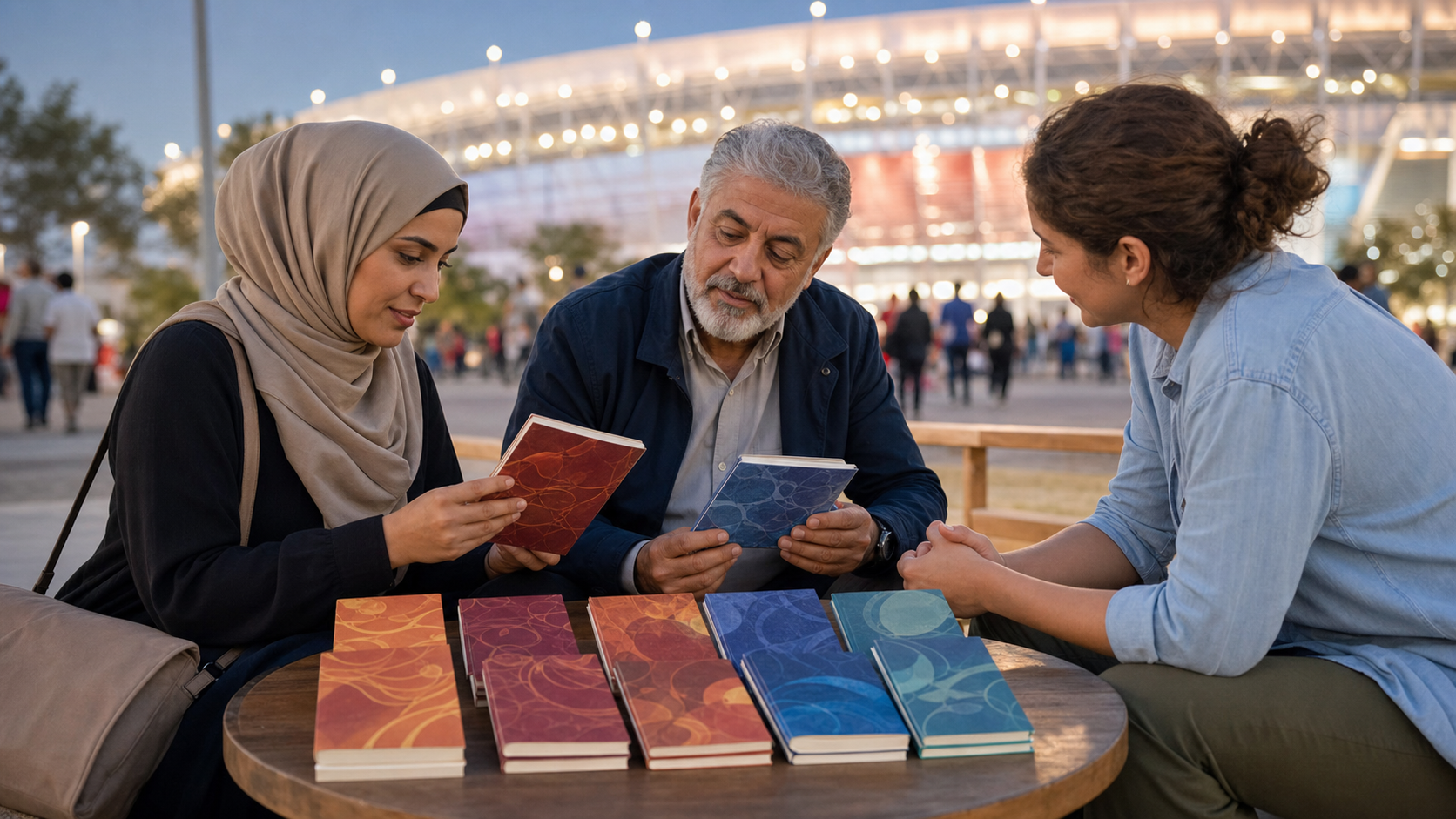
A spiritual book cannot invite serious reflection if its recipient cannot comfortably read it. Offering Arabic and Farsi editions removed an immediate barrier: the reader did not first have to pass through English or another intermediary language to encounter Krishna consciousness.
That choice matters especially when literature is being offered to visitors from places where access to Krishna consciousness books was described as extremely limited. A translated book is portable. It can be opened privately, revisited after the noise of the event has faded, taken home, or voluntarily shared. None of those later actions is guaranteed, but the possibility begins with a book the recipient can read.
Language also communicates respect. The recipient is approached as a reader with an intellectual and cultural world of their own, not merely as another mark on a distribution sheet. This is where translation becomes part of seva rather than a mechanical publishing task.
Future organizers should not treat nationality, ethnicity, and preferred reading language as interchangeable. The practical question at the handoff is simple: which language would you prefer? That question is more reliable than guessing from a passport, name, appearance, or team jersey.
The same care belongs upstream. A translated edition should preserve the teaching accurately, use language that a contemporary reader can follow, and clearly identify the book and tradition being offered. A large quantity cannot compensate for a translation that readers find confusing or inaccessible.
Three questions that keep the result in perspective
Did the campaign deliver books to nine countries?
It delivered books to people who had come from nine Middle Eastern nations. Organizers expected recipients to take the books home and share them with relatives and friends, but that expectation is not the same as verified arrival in nine countries. Until follow-up evidence exists, describe the recipients’ origins rather than converting them into confirmed destinations.
Does the total show that thousands of books were read?
No. It shows that thousands of books were distributed. Reading, completing, discussing, sharing, and returning to a book are different outcomes. They require different evidence. This does not make the distribution total unimportant; it makes the total precise. It measures the opening of an opportunity, not everything that may follow from it.
Can spiritual influence be reduced to a campaign metric?
No. Devotees understand Srila Prabhupada’s books as carrying spiritual potency, and from within that bhakti understanding even one sincere encounter can matter deeply. But a devotional conviction is not a measured reading outcome. We can affirm the sacred purpose of the seva while remaining exact about the public evidence.
This distinction protects the dignity of the work. Inflated claims make outreach look like publicity. Honest claims let the real achievement stand: devotees placed a substantial body of Krishna consciousness literature, in two relevant languages, directly into the hands of an unusually international audience.
A better working method for future book distribution
If you are helping to plan dharmic book outreach at a sporting event, festival, university, or public gathering, use the World Cup result as a starting point rather than a script. Preserve what made it strong, then build the information needed to understand what happens next.
- Define the reader before selecting the stock. Identify the likely preferred languages, the kind of introduction appropriate for a first-time reader, and whether a shorter or longer work suits the setting.
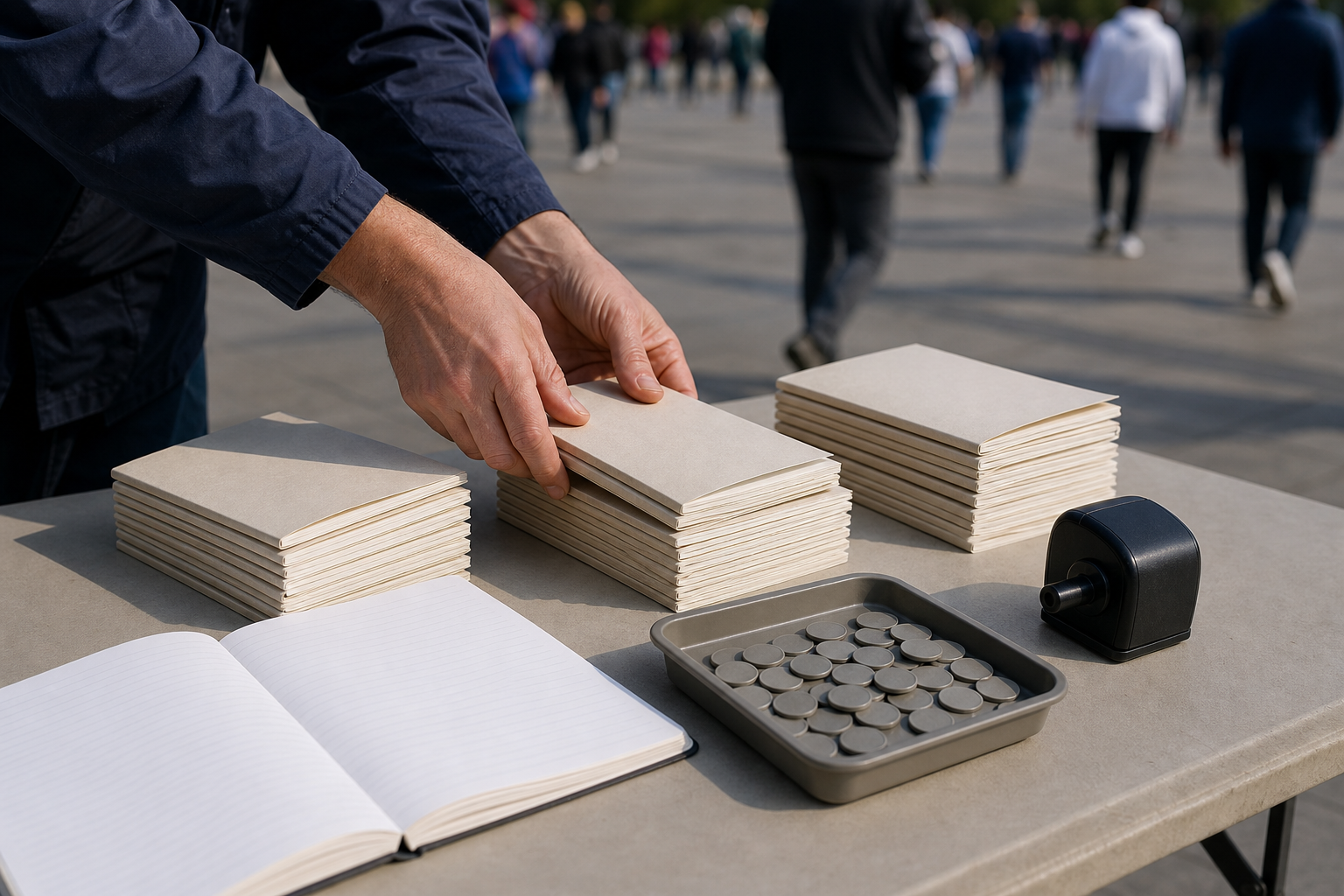
- Record editions precisely. Track title, language, format, and quantity separately. A final total is useful, but it should be possible to see what readers actually received.
- Verify permission and local requirements. Event policies and local rules differ. Confirm that distribution is allowed before bringing books into a venue or carrying out outreach across borders.
- Make the exchange voluntary. Briefly identify the book and allow an easy refusal. A person who freely chooses a book is a reader with agency, not an object of a campaign.
- Count handoffs consistently. Decide in advance what counts as distributed. Books handed to individual readers, books transferred in a batch, and unused stock should not be merged into one ambiguous figure.
- Offer a reader-controlled next step. A website, email address, local contact, or short reading guide can help someone who wants to continue. Follow-up should remain optional, and personal information should not be collected without clear consent.
- Report output and outcome separately. Publish the distribution number as distribution. If readers later opt into discussions, request more literature, or provide feedback, report those as separate forms of engagement.
This method may produce a more modest headline, but it produces knowledge that future volunteers can use. It can reveal which language ran out, which edition readers chose, whether the format suited a crowded event, and where translation or follow-up needs improvement.
It also prevents a common mistake: treating the largest number as the only number that matters. Reach, suitability, consent, comprehension, and continued engagement describe different parts of the same seva. None should be hidden inside a single total.
The deeper Dharmic lesson is presence without pressure

Book distribution occupies a distinctive place in bhakti practice. A conversation ends, an event closes, and travellers return home, but a book can remain. It allows the reader to approach the teaching at a time and pace of their own choosing.
That delayed encounter is important. The loudest moment of a World Cup is not necessarily the moment in which a spiritual idea is understood. A book may be opened later in a quiet room, discussed with another person, or left unread. Distribution creates freedom for the encounter; it does not control the result.
For a wider Dharmic audience, the lesson extends beyond one lineage. A living tradition needs texts that people can obtain, language they can understand, and representatives who can offer them without contempt or coercion. Cultural confidence does not require exaggeration. It is strong enough to make an honest invitation and leave the response to the reader.
This is also why the World Cup setting mattered. The tournament brought together people who might otherwise have remained separated by national borders and limited access to particular literature. Devotees used that temporary meeting point to make bhakti books available in Arabic and Farsi. The stadium was the occasion; the private act of reading was the possibility they placed in each recipient’s hands.
If you want to carry this work forward, begin with one concrete improvement: obtain the right translated edition for a real reader, help an outreach team count its books more clearly, or create a voluntary path for readers who want to learn more. Do not chase a larger total until you can say exactly what the present total means.