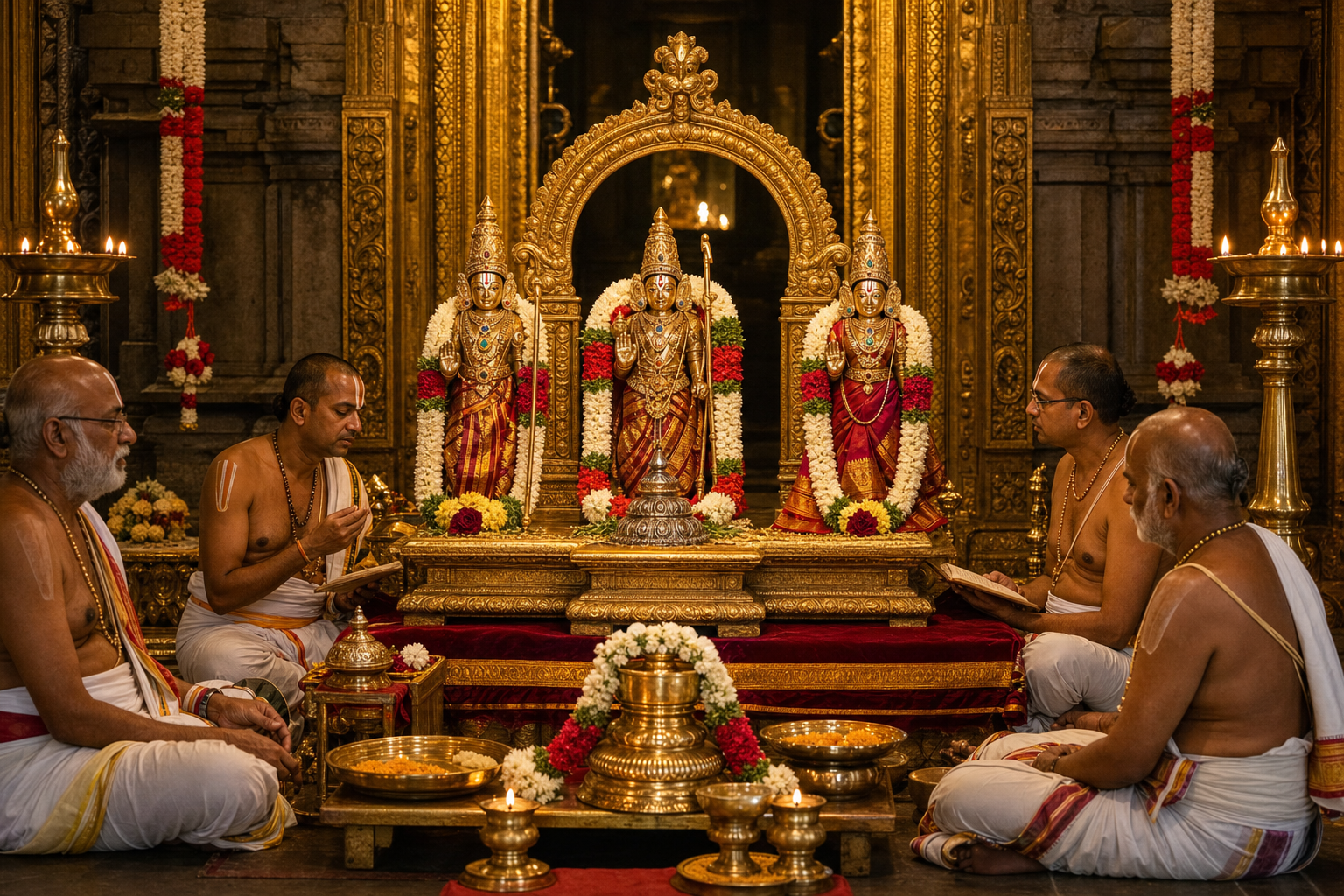
If you are planning a Sri Rama Navami visit to Tirumala, the name Pattabhisheka Asthanam may leave you with a practical question: are you going to witness a coronation tableau, listen to the Ramayana, or attend a formal temple assembly? All three descriptions contain part of the answer, but the order matters. This is first a sacred act of hearing and worship, not a historical pageant arranged for spectators.
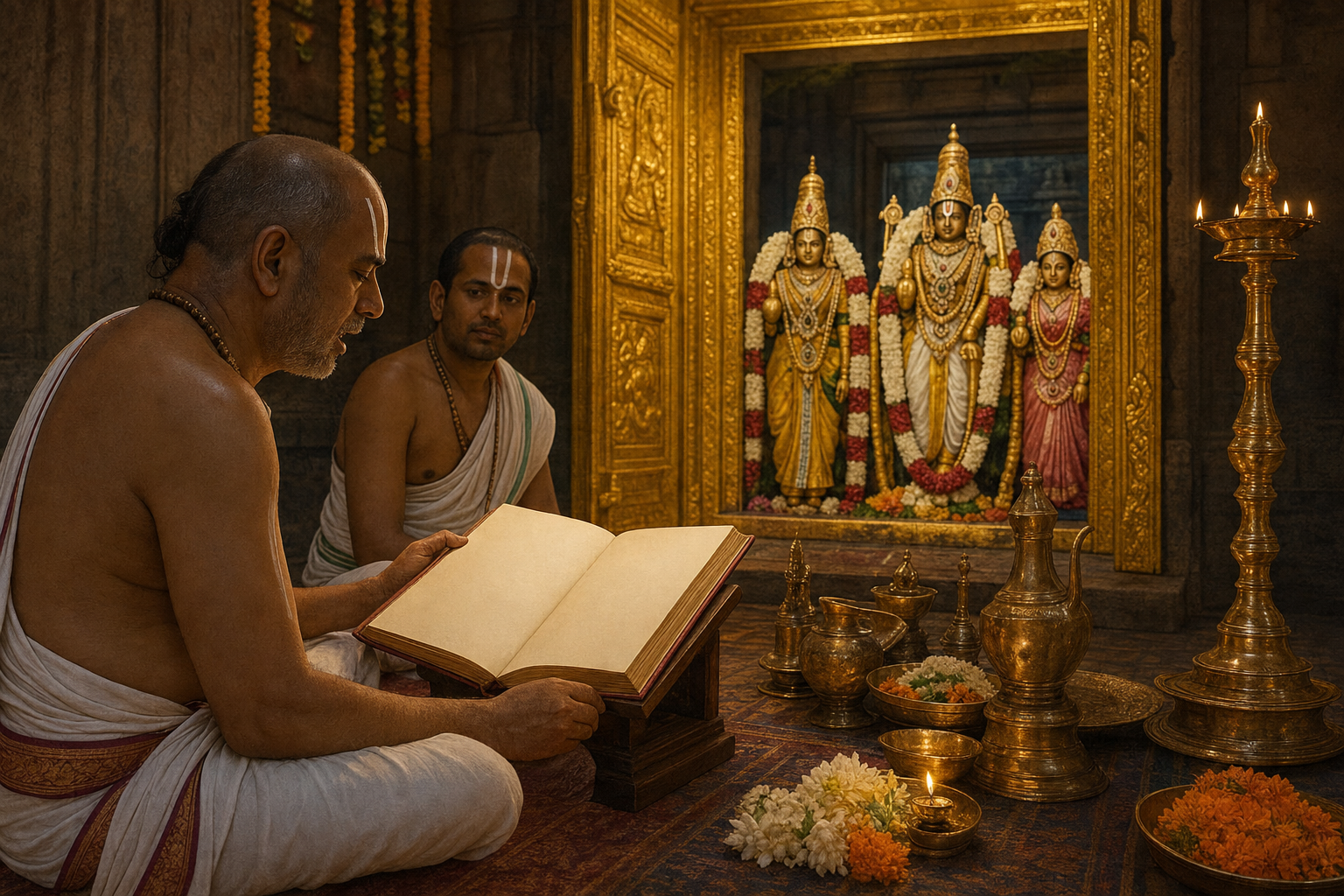
The observance brings the Coronation episode into the presence of Sri Rama, Sri Sita, and Lakshmana Swamy at the Bangaru Vakili. If you understand why the words, deities, threshold, and courtly form belong together, you can approach the rite as a participant in dharmic remembrance rather than as someone waiting for a visual climax.
What actually happens at the Bangaru Vakili
The name gives you the first key. Pattabhisheka means royal anointment and enthronement. Asthanam is a formal courtly assembly in which the deity is received and honoured as sovereign. Tirumala therefore does not merely recall that Rama once became king. The temple ritually establishes a royal court before the divine presence and allows the Coronation narrative to supply that court’s moral order.
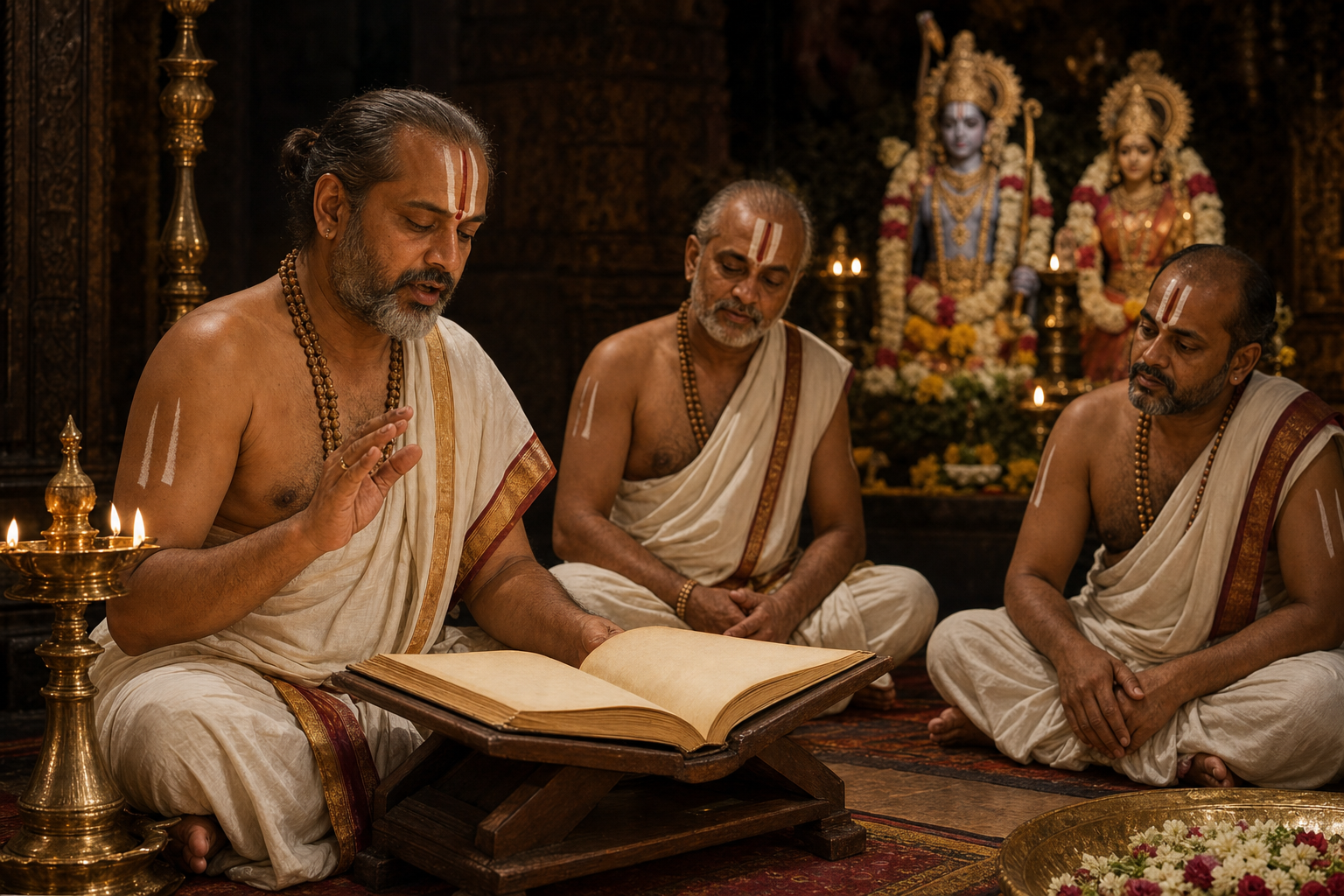
The ceremonial focus is the recitation of the Coronation portion of Srimad Ramayanam before the Utsava deities of Sri Rama, Sri Sita, and Lakshmana Swamy. This distinction matters. The recitation is not commentary accompanying a display; it is itself an offering. Scripture is voiced in ritual space before the divine figures whose deeds it proclaims.
The stable liturgical pattern includes three connected movements:
- A sankalpa establishes the sacred intention, including collective well-being.
- The Coronation passages from Srimad Ramayanam are recited before the deities.
- Auspicious verses and benedictions complete the movement from enthronement to shared welfare.
Specific local details can vary from one year’s observance to another while the canonical core remains intact. Tirumala follows the Vaikhanasa Agama, which governs the ritual order, mantras, and festival timing within the temple’s larger cycle of worship. You should therefore resist treating a remembered sequence, an old description, or a recording as an exact timetable for a future visit.
Notice what the sequence does. It begins with intention, enters the sacred narrative, and ends in blessing. The rite does not stop at Rama acquiring royal status. It directs kingship toward the welfare of the community. That is the first practical lesson to carry with you: in the dharmic understanding of authority, office is not a possession. It is a duty ordered toward others.
Why the return to Ayodhya becomes a lesson in government
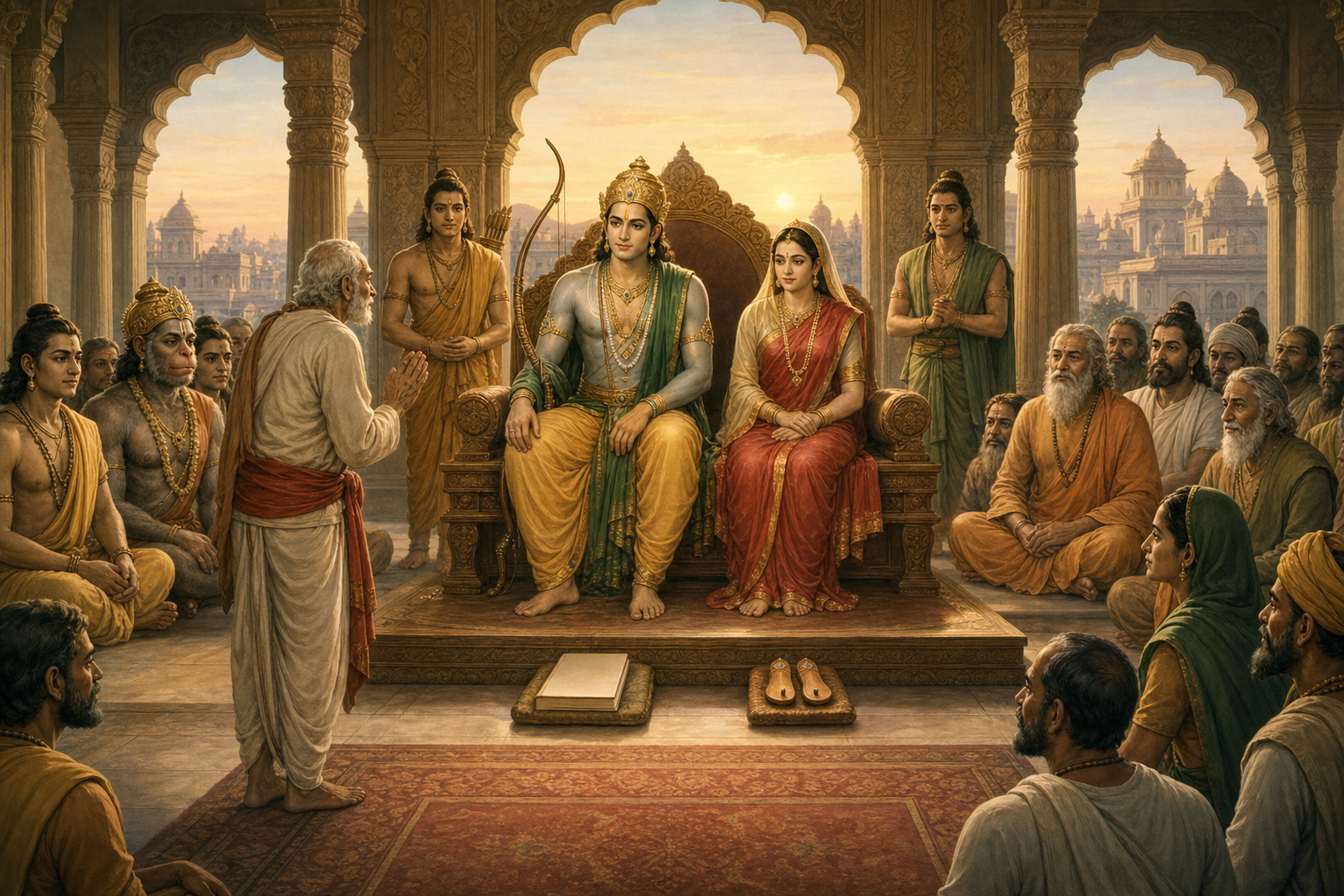
In the Valmiki Ramayana’s Yuddha Kanda, Rama’s enthronement follows exile, separation, war, and return. The Coronation passages describe consecratory waters placed in sanctified vessels, Vedic seers led by Vasistha, and Sri Rama installed upon the throne with Sri Sita. These elements make the coronation more than a transfer of power. They place royal authority under sacred discipline.
The narrative movement is crucial. Ayodhya is not restored merely because the rightful heir occupies a seat. Order returns because the ruler who accepts the seat has already demonstrated obedience to dharma when obedience was costly. The throne does not manufacture Rama’s righteousness. His fidelity to duty makes him fit to bear the throne.
This is the deeper meaning of Ram Rajya in the observance. It is not simply nostalgia for a prosperous kingdom, nor a decorative phrase for political speech. It represents rule constrained by justice, compassion, duty, and concern for social harmony. The coronation asks a hard question of anyone who invokes Rama in public life: does the desired authority serve the common good, or is Rama’s name being used to sanctify the desire for authority itself?
You do not need to hold public office for that question to apply. A parent allocates attention and sets rules. A manager evaluates work and controls opportunities. A teacher shapes confidence as well as knowledge. A community organiser decides whose concerns receive time. Wherever your decisions affect another person’s dignity or prospects, you exercise a small form of rule.
Use the Coronation episode to examine that authority through three tests. First, are your rules consistent when applying them costs you something? Second, can the people affected by your decisions expect fairness rather than favour? Third, does your use of authority leave the group more harmonious without demanding silence about injustice? These questions turn Ram Rajya from an admired civilisational ideal into a discipline of conduct.
The ideal also helps explain why righteous rulership resonates beyond a single Hindu ritual setting. Buddhist teachings on the duties of a ruler, Jain commitments to non-violence and just order, and the Sikh integration of spiritual and temporal responsibility each place moral limits on power. The doctrines are not interchangeable, but they converge on an important dharmic conviction: power must answer to a good higher than the ruler’s appetite.
Why the golden threshold is part of the teaching
Bangaru Vakili literally means the golden threshold. Its function in the observance is not merely to provide an impressive background. A threshold marks relation and passage: it stands between the sanctum and the gathered congregation. By placing the Asthanam there, the temple presents divine sovereignty at the meeting point between inward sanctity and public life.
The gilded doors frame the deities as a royal court of dharma. Their brilliance is appropriate to coronation, but the architecture also directs your attention. You are not looking through an ordinary doorway at a scene placed behind it. You are standing before a boundary where sacred authority becomes visible and where the congregation receives its ethical demand.
The three expressly featured deities make that demand legible. Sri Rama, traditionally shown with bow and arrow, represents the protection and enforcement of dharma. Sri Sita embodies auspiciousness, constancy, and the moral depth without which royal splendour would be hollow. Lakshmana Swamy embodies devoted service, reminding you that a righteous order depends not only on the one seated as sovereign but also on those who support dharma without making themselves its centre.
Hanuman often appears in South Indian representations of Rama’s divine court, and devotees naturally associate him with service to Sri Rama. In this Tirumala observance, however, the expressly identified ceremonial grouping at the Bangaru Vakili is Sri Rama, Sri Sita, and Lakshmana Swamy. Paying attention to the actual liturgical arrangement is better than mentally replacing it with a more familiar image. Temple tradition teaches through precise presence as well as through broad association.
The soundscape completes the setting. Vedic chanting, Ramayana recitation, and appropriate temple music do more than create solemnity. Their cadence orders attention. If you cannot follow every word, listen for the movement from intention to enthronement and from enthronement to blessing. You can participate through disciplined hearing without pretending to understand language that you do not understand.
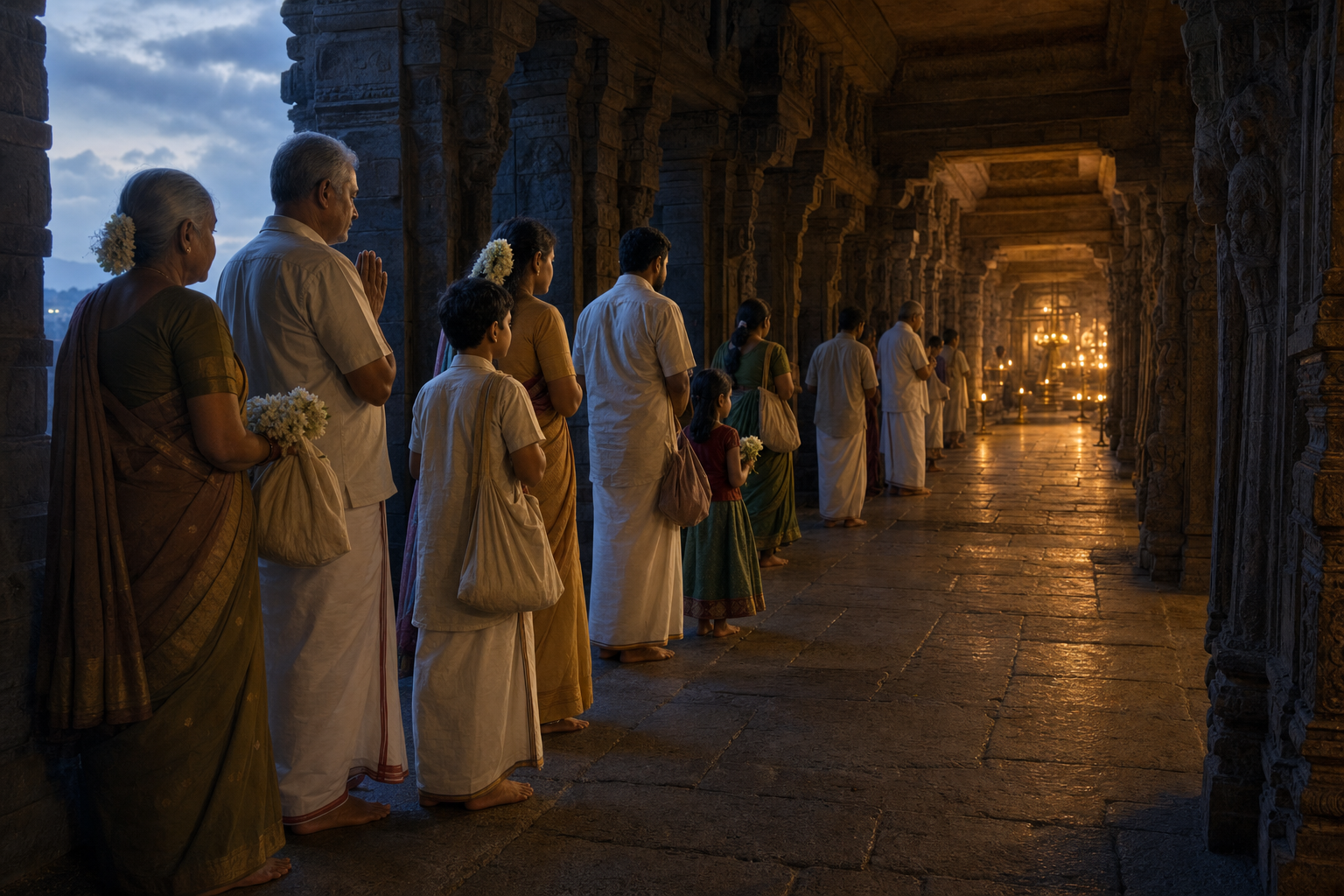
This is especially useful in a crowded pilgrimage environment, where the eye is easily pulled toward ornament, movement, and other people. Let the visual splendour locate you, then let the recitation govern you. The rite’s deepest content is carried by the union of spoken canon, divine presence, and consecrated place.
How to prepare without reducing the observance to sightseeing
Preparation begins by separating what is ritually stable from what must be confirmed for your visit. The festival belongs to Sri Rama Navami in Chaitra Shukla Paksha, and the Coronation recitation remains its core. Exact operational details belong to the temple’s current arrangements. Confirm the applicable schedule and visitor instructions with Tirumala Tirupati Devasthanam rather than inferring them from a previous year’s practice.
- Learn the narrative arc before you arrive. You do not need to memorise the Yuddha Kanda. Know the sequence of return, consecration, enthronement with Sri Sita, and restoration of just order. That map will help you recognise what the recitation is accomplishing.
- Follow temple dress and decorum. Appropriate clothing, restrained movement, and quiet attention are not external formalities. They protect the concentration on which a recitation-centred observance depends.
- Do not wait only for a visual high point. The sankalpa, Coronation verses, auspicious verses, and benedictions form one ritual argument. Treating only the royal tableau as important strips the coronation of its orientation toward collective welfare.
- Use the Bangaru Vakili as a cue. When you see the golden threshold, remember that dharma must cross from sacred conviction into public conduct. The purpose is not to admire righteousness at a distance.
- Choose one field of responsibility. Before the observance, identify where your decisions currently affect others: home, work, education, community, or public life. Carry that responsibility into the recitation instead of bringing only a vague wish for blessing.
- Leave with one measurable duty. Decide what just conduct requires next: applying the same rule to yourself, hearing someone before deciding, keeping a delayed promise, correcting favouritism, or using authority to protect someone with less influence.
You can also prepare a single inward sankalpa in plain language: “May the authority entrusted to me serve dharma and the welfare of others.” This is not a substitute for the temple’s liturgical sankalpa. It is a way to stop your mind from treating the ceremony as something that concerns kings but not you.
If the language of the recitation is unfamiliar, do not spend the entire observance anxiously trying to identify every verse. Hold the narrative map, attend to the divine grouping, and receive the benedictory movement. Study can continue afterward. During the rite, sustained attention is more honest than simulated comprehension.
Avoid another common reduction: treating Ram Rajya as a reward granted after victory. The Coronation occurs after victory, but its meaning lies in the disciplined use of what victory has made possible. Ask not only what Rama overcame, but what kind of order he is now obliged to establish. That question keeps devotion joined to ethics.
Key takeaways
- Pattabhisheka Asthanam is a formal divine court centred on royal anointment, enthronement, and the duties of righteous sovereignty.
- The principal offering is the Coronation recitation before Sri Rama, Sri Sita, and Lakshmana Swamy, not a dramatic reenactment staged for spectators.
- Bangaru Vakili matters because the golden threshold joins the sanctity of the inner temple to the ethical life of the gathered community.
- Ram Rajya means authority governed by justice, compassion, consistency, and collective welfare; it is not merely a slogan for power or prosperity.
- You will receive more from the observance if you learn the narrative arc, follow temple decorum, listen through the full ritual movement, and bring one real responsibility for examination.
- Festival placement and liturgical principles are stable, but you should confirm the current schedule and visitor arrangements with Tirumala Tirupati Devasthanam.
Before you go, review the return and enthronement at the close of the Yuddha Kanda and name one place where you already exercise authority. After the observance, act on one duty in that place. The most faithful response to Rama’s coronation is not prolonged admiration of righteous rule; it is making your own share of responsibility answerable to dharma.