

You want to honor Sita Thakurani, but a date on a calendar does not tell you what to do at home, what to expect at a temple, or which customs are actually required. The safest answer is also the most devotional: follow your established Gaudiya Vaishnava practice, verify local instructions, and make remembrance visible through service.
This approach keeps the observance centered on bhakti. It also prevents a common mistake: turning one community’s program into a universal ritual rule.
Let the day change more than your calendar
In Gaudiya Vaishnava usage, an appearance day commemorates the manifestation of a sacred personality. It is not merely a devotional version of a social birthday. The practical question is therefore not only, “How do we celebrate?” It is, “What quality of devotion should become clearer in our conduct?”
Sita Thakurani is remembered within the Gaudiya Vaishnava tradition as the consort of Advaita Acarya and as a revered Vaishnavi elder. You can honor that place without embellishing her biography. Hear from a trusted lineage teacher, remember her devotional position, and let the remembrance sharpen your respect for Vaishnavis whose worship, teaching, hospitality, and steady service sustain a community.
A useful observance should produce something you can notice afterward. Perhaps you become more attentive while hearing about a Vaishnava. Perhaps you stop overlooking the person who prepares, welcomes, cleans, teaches, or quietly maintains worship. Perhaps you offer practical help instead of general praise. If the day leaves your relationships unchanged, the external program may have displaced the inner purpose.
Treat the announced date as local information
The Naperville observance was listed for 15 September 2026. That date identifies a particular community observance. It should not be copied into another temple’s calendar, reused for a later year, or treated as sufficient evidence for an exact worship schedule.
If you are planning an observance, settle the calendar question before arranging food, travel, leave from work, or invitations. Use this sequence:
- Check the calendar published by the temple or Gaudiya Vaishnava community with which you actually practice.
- Confirm the civil date directly with the host, especially if you found an older announcement through a search engine or forwarded message.
- Ask whether the event is public and whether registration is required.
- Confirm the address, start time, expected end time, prasada arrangements, and any instructions about offerings.
- If you follow a guru or family tradition, give its established instructions priority over a generic online checklist.
This distinction matters because a local announcement tells you when that host is gathering; it does not establish a permanent annual date for every reader. If your community has not published a date, ask rather than infer.
Use a simple home observance when no temple program is available
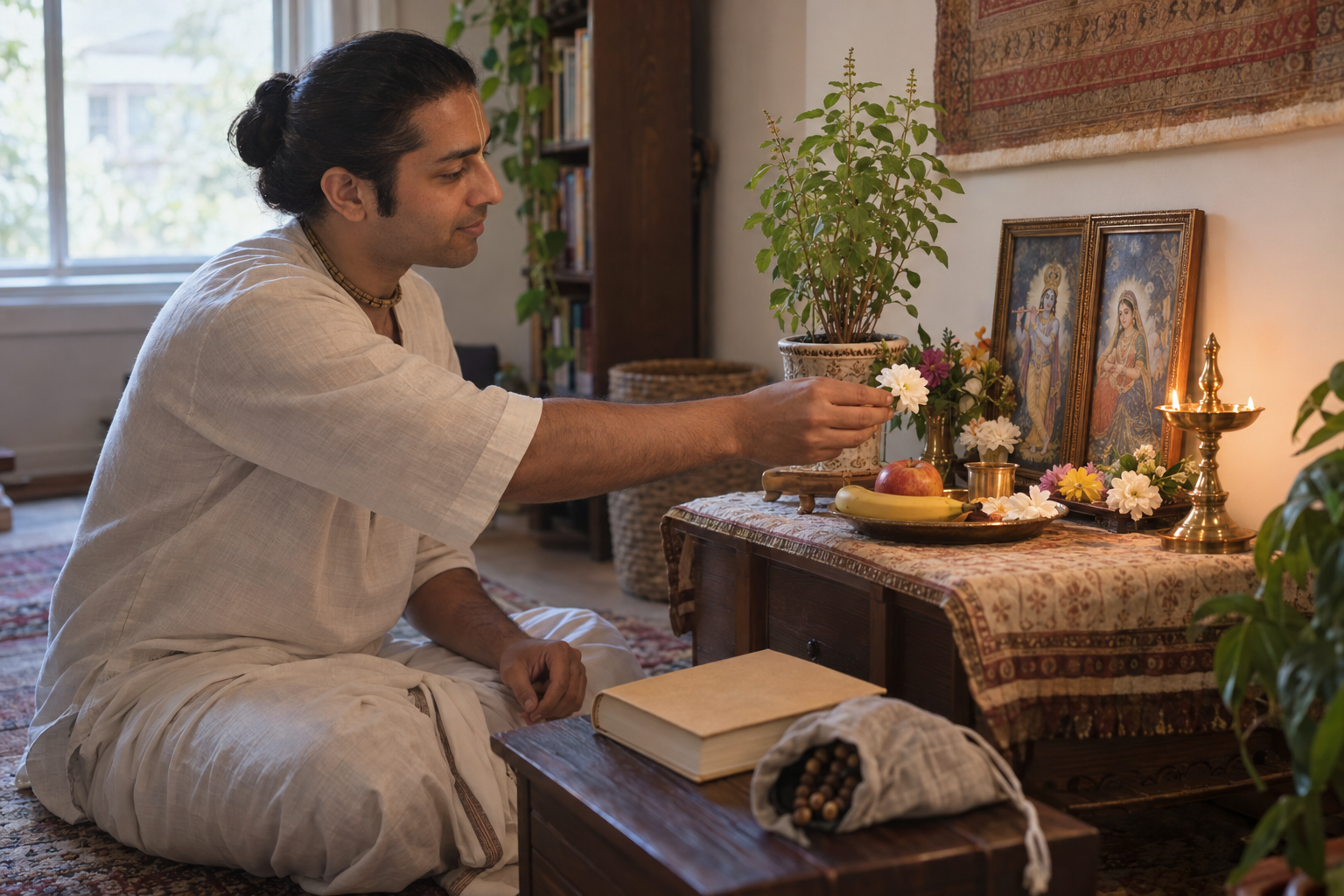
You do not need to construct an elaborate ceremony to make the day meaningful. A coherent home observance can fit around your existing sadhana and household responsibilities.
- Begin with your regular practice. Complete the worship, japa, prayer, or study that already forms part of your day. An appearance observance should deepen nitya-sadhana, not replace it with novelty.
- State a plain intention. In your own words, say that you are remembering Sita Thakurani and asking to grow in sincere service. Treat this as a personal intention, not as a traditional mantra.
- Hear before you explain. Read or listen to a biographical account approved by your temple or lineage. If you are guiding children or friends, repeat only what you can verify. It is better to share a modest, accurate account than a dramatic story detached from its context.
- Chant within your established practice. Sing kirtan or chant the names and mantras already received or commonly used in your community. The observance does not require you to invent a special formula.
- Make an appropriate offering. If food offering is part of your household worship, prepare something suitable under your family’s devotional rules, offer it through your normal procedure, and share the prasada respectfully.
- Turn remembrance into seva. Help with a temple meal, assist an elder devotee, relieve someone carrying an unnoticed community task, or contribute through an official temple channel. Choose service with a clear recipient and a real benefit.
- Carry one correction forward. Before closing, identify a habitual form of carelessness you can address: speaking dismissively about devotees, overlooking women’s devotional work, arriving only for the visible celebration, or leaving cleanup to others.
Do not manufacture mandatory rules
Do not declare a fast, a particular dish, a clothing color, a prescribed count, or a special vow compulsory unless your guru, family sampradaya, or temple has actually given that instruction. Personal austerity may be sincere, but it should not be turned into a test of another devotee’s faith.
If you do not know the formal procedure, keep the observance modest: normal sadhana, reliable hearing, a suitable offering, kirtan, and concrete seva. Restraint is preferable to presenting a newly assembled custom as inherited tradition.
Join a temple observance as a participant, not a spectator
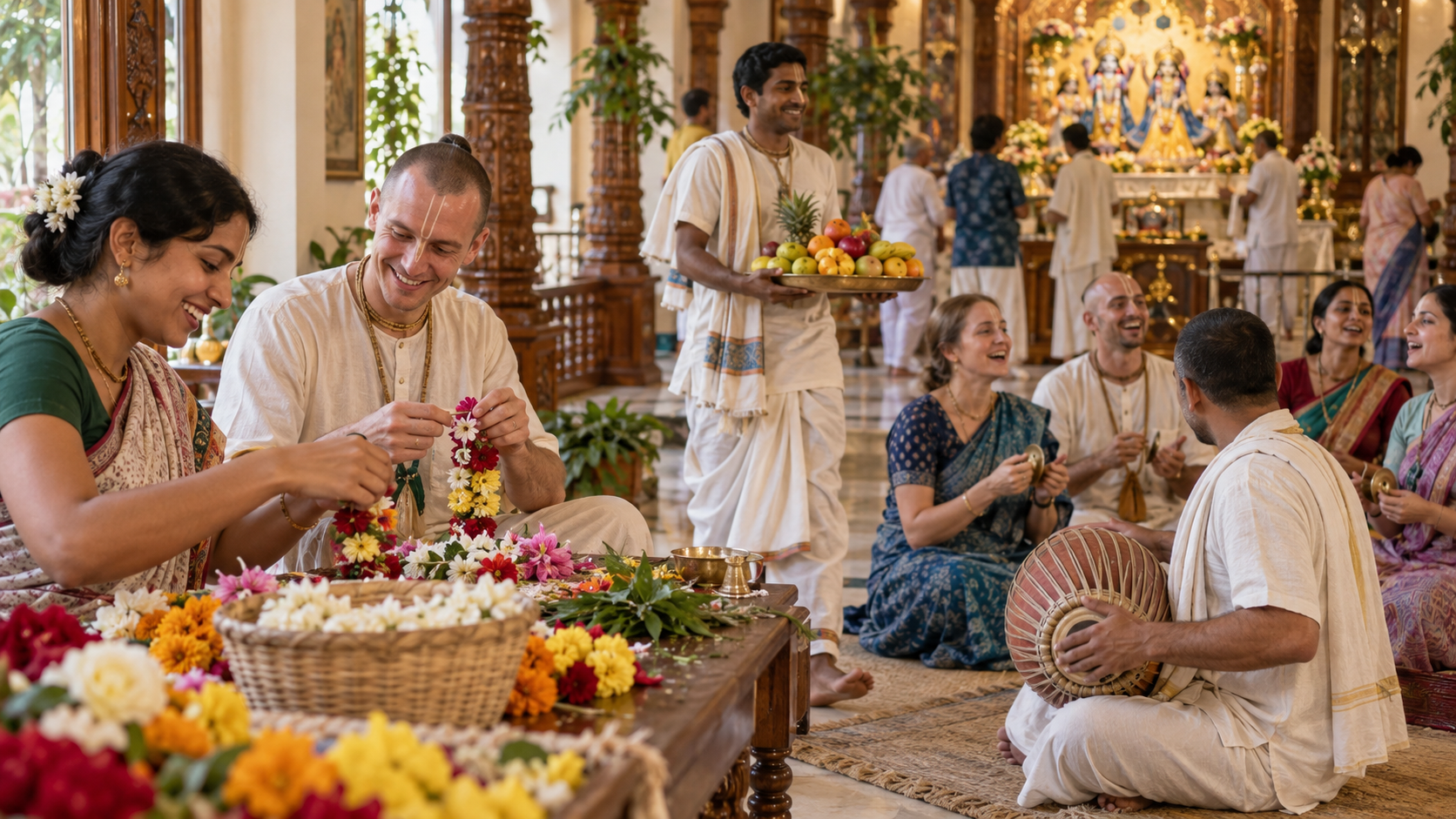
A temple gathering may include elements such as kirtan, discourse, worship, and prasada, but you should confirm the actual program with its organizer. Once the details are settled, prepare to contribute to the devotional atmosphere rather than merely consume it.
- Arrive early enough to settle in without interrupting worship or hearing.
- Bring flowers, food, or another offering only when the host has said it is appropriate.
- Ask where help is needed. Setting out shoes, welcoming newcomers, serving prasada, supervising children, or cleaning afterward may be more useful than adding another visible item to the altar.
- Keep conversations from competing with kirtan or discourse.
- Follow the host’s rules before photographing people, worship, or sacred spaces.
- If you bring children, tell them beforehand whom the community is honoring and give them a manageable act of service.
- Use official channels for donations, and ask what the contribution supports if that has not been made clear.
The most useful question you can ask an organizer is simple: “What work still needs hands?” It directs your energy toward the community’s actual need and away from assumptions about what a devotional event ought to look like.
If you missed the announced gathering, do not pretend that you attended or recreate an unverified program. Mark the remembrance quietly through your ordinary practice, obtain reliable teachings from your community, and record the correct contact or calendar for the next observance.
Key takeaways
- The Naperville observance was dated 15 September 2026; verify the current date and schedule with your own host community.
- Center the day on remembrance, hearing, established chanting, an appropriate offering, and practical seva.
- Honor Sita Thakurani as a revered Vaishnavi elder without filling gaps in her life story with unsupported details.
- Do not make fasting, special foods, clothing, counts, or vows compulsory without instruction from your lineage or temple.
- At a temple, participate through attention and useful service rather than treating the gathering as a performance.
- Let the observance correct one concrete habit in how you respect devotees and share community work.
Before the next observance, save the calendar and contact details of the community you trust. When the day arrives, come with fewer assumptions and a clearer offering: attentive hearing, disciplined practice, and service that genuinely lightens another person’s burden.
References

Leave a Reply
You must be logged in to post a comment.