
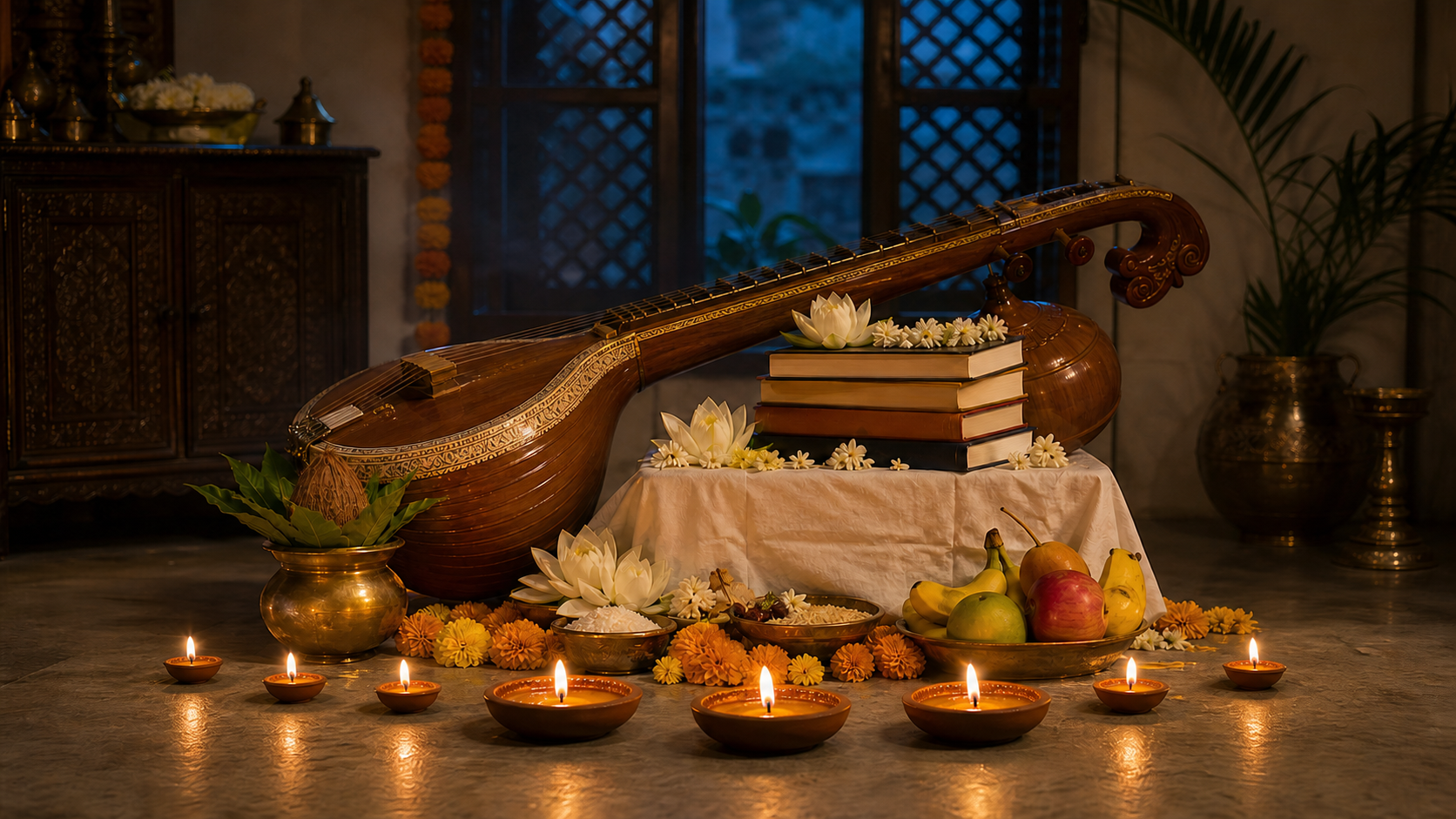
You are trying to coordinate a lunar festival, a household routine, and perhaps a school or arts schedule. The useful answer is not a single date copied into every calendar. Reserve the Saraswati observance window first, then use your local panchang to settle the ritual timings.
For 2026, keep October 16 through October 19 available for Saraswati Triratra Puja. That gives you enough structure to plan leave, classes, temple visits, and family participation without pretending that every region follows an identical timetable.
Put the dates in your calendar, but verify the local tithi

Shardiya Navratri is governed by the lunar tithis of Ashwin Shukla Paksha, called Ashwayuja in several southern calendars. Ghatasthapana, the daily Navratri observances, and the concluding rites therefore need to be read through a regional panchang rather than through civil dates alone. The applicable schedule and Kalash Puja muhurat can differ by place and tradition.
There is an apparent puzzle in the 2026 planning information: Triratra describes the final three-day phase, while the observance window touches four civil dates, October 16 to 19. Do not solve that puzzle by casually deleting one of the dates. A ritual phase and a civil-date planning span answer different questions. Let the panchang used by your family or temple identify when the relevant tithis operate in your location.
- Enter October 16-19 as the protected planning window now.
- Confirm the city and time zone for which your panchang was calculated, especially if you live outside Bharat.
- Ask your temple which regional calendar it follows instead of assuming that a schedule from another state applies locally.
- Record three separate details: the Ghatasthapana timing, the Saraswati worship period, and the Vijayadashami observance. One time copied without its ritual label is easy to misuse.
- If your household has an inherited sampradaya or established family vidhi, follow it. A generic calendar should help you organize that tradition, not displace it.
This distinction matters in a family group chat. Send the location, time zone, panchang name, tithi, and ritual together. A bare message such as October 17 morning leaves too much room for confusion.
Keep Saraswati worship inside the nine-night Navratri arc
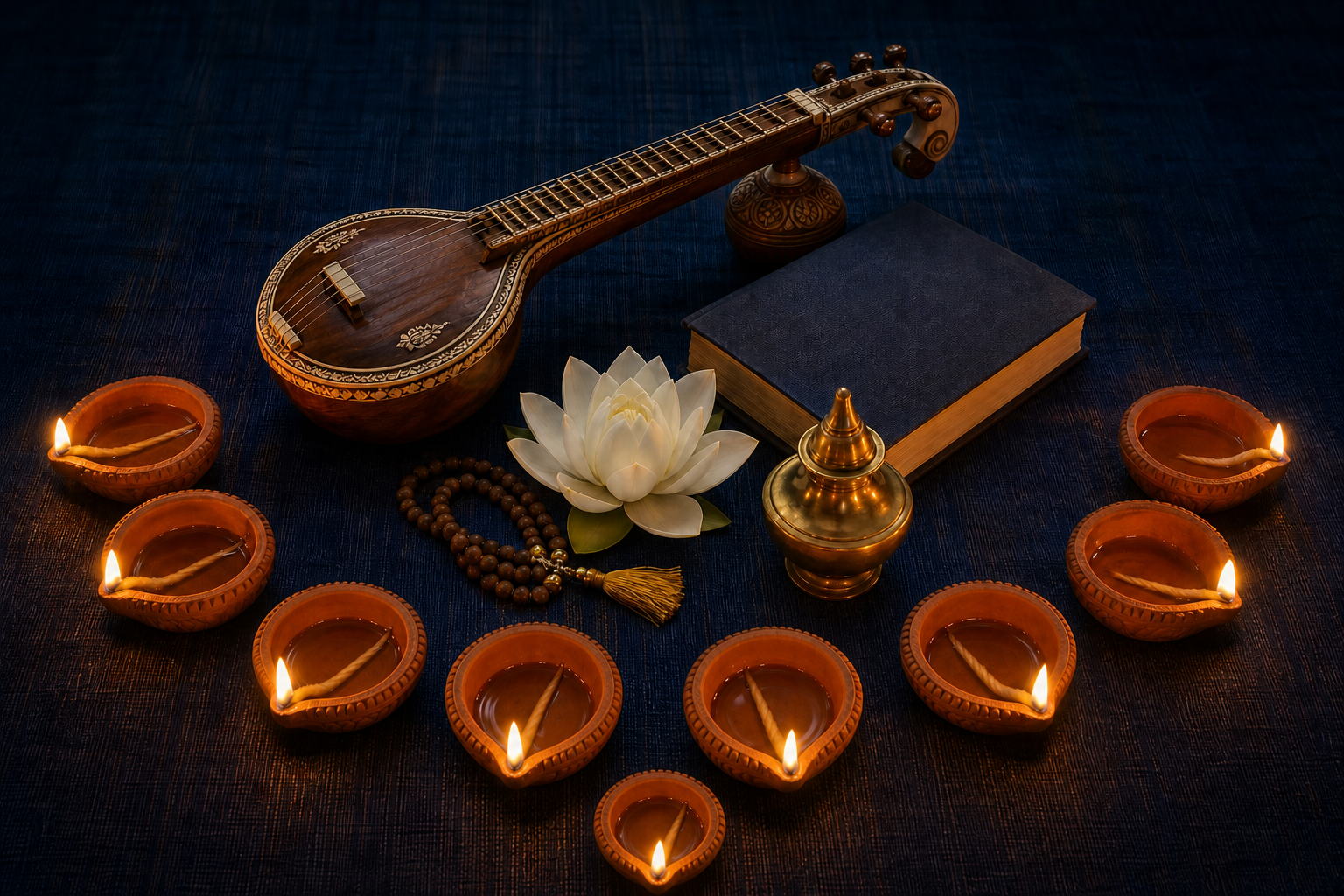
Saraswati Triratra is not a detached festival that happens to share Navratri’s calendar. It concentrates attention on knowledge, discernment, music, and the arts during the concluding phase of the nine nights. You can retain your family’s daily Devi worship while giving the final phase a more deliberate Saraswati focus.
The familiar Navadurga sequence moves through Shailaputri, Brahmacharini, Chandraghanta, Kushmanda, Skandamaatha, Katyayani, Kalaratri, Mahagauri, and Siddhidatri. Vijayadashami, or Dussehra, follows on the tenth day as an affirmation of victory over adharma and a renewal of dharmic resolve.
That sequence gives the Saraswati observance its practical force. Knowledge is not treated as a possession displayed at the end of a festival. It is approached after days of discipline, devotion, courage, and inward correction. The lesson for a student, scholar, musician, or professional is direct: learning bears fruit when reverence is joined to repeated effort.
You do not need to choose between Navadurga worship and Saraswati Puja. If your household already recites a Devi stotra or follows a daily Navratri practice, continue it. Add the books, manuscripts, notebooks, or instruments that make your dependence on learning visible. The layers belong together unless your own tradition instructs otherwise.
Build the puja around the learning you actually practise
In Andhra Pradesh, Telangana, Kerala, Karnataka, Tamil Nadu, Maharashtra, and Gujarat, books and musical instruments commonly become part of the worship space. The regional forms vary, but the underlying choice is concrete: place before Devi the means by which knowledge enters your life.
- For a student, select the textbook or subject that presently requires sincere effort. Do not stack every book in the house merely to make the arrangement look abundant.
- For a musician or dancer, include the instrument, notation book, or other object central to disciplined practice. If the object is fragile or cannot be moved safely, use a notebook bearing its name.
- For a writer, teacher, researcher, or professional, choose a working text, manuscript, notebook, or appropriate tool of learning rather than a decorative substitute.
- For a young child, prepare a simple first-letter activity or Aksharabhyasam practice consistent with the family’s custom. Keep the moment patient and uncluttered.
- For the household as a whole, choose one cherished text from which a few pages can be read with attention during the observance.
Set a clean, quiet place for a Saraswati murti or image and the selected learning objects. A lamp and simple flowers are sufficient for a modest home observance. If your family has a prescribed alankara, mantra, archana, or sequence, prepare those requirements in advance; otherwise, simplicity is better than an improvised claim of ritual precision.
The sankalpa should name an action, not merely an aspiration. Instead of resolving to become wiser, commit to a defined practice: return to a neglected text, protect a regular period of study, resume an instrument, improve one weak subject, or learn to form the first letters with care. Saraswati Puja becomes durable when the object on the altar points to the discipline that will continue afterward.
Use October 16-19 as a planning sequence, not a substitute liturgy
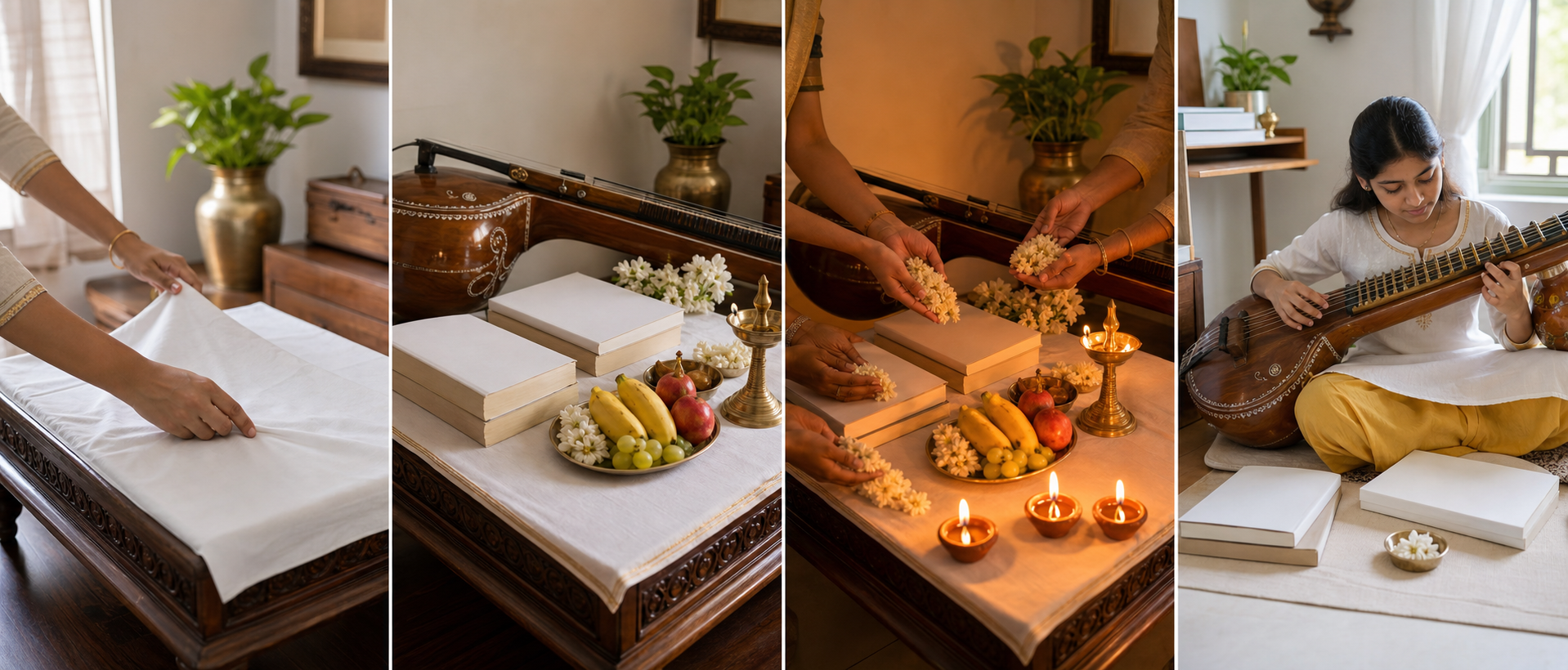
The following sequence is a household planning aid. It does not assign universal tithis to civil dates, and it should be adjusted after you receive the local temple or panchang timings.
- Before October 16, verify the local schedule, choose the books or instruments, clean the worship area, and agree on one shared period when the household can gather.
- On October 16, begin the protected observance window. Make the learning sankalpa and arrange the Saraswati image or murti with the selected objects according to your family custom.
- Across October 17 and 18, keep the practice steady. Offer flowers, light the lamp safely, recite the shlokas known to your household, read a few pages from the chosen text, or hold a quiet music or recitation session where custom permits.
- On October 19, complete the observance according to the locally confirmed timing. Mark the return to active learning with one real step: open the chosen book, write the first letters, resume a lesson, or schedule the next period of practice.
This sequence prevents a common failure: spending the entire sacred period arranging objects, coordinating photographs, and searching for instructions, then reaching Vijayadashami without deciding what will actually change. Preparation belongs before the window. The window itself belongs to worship, attention, and renewed learning.
If relatives follow different regional customs, do not force them into a false uniformity. Agree on the shared centre: reverence for Devi, respectful treatment of learning, and a definite return to study or art. Each branch of the family can retain its inherited timing and form.
Let the observance produce learning beyond the altar
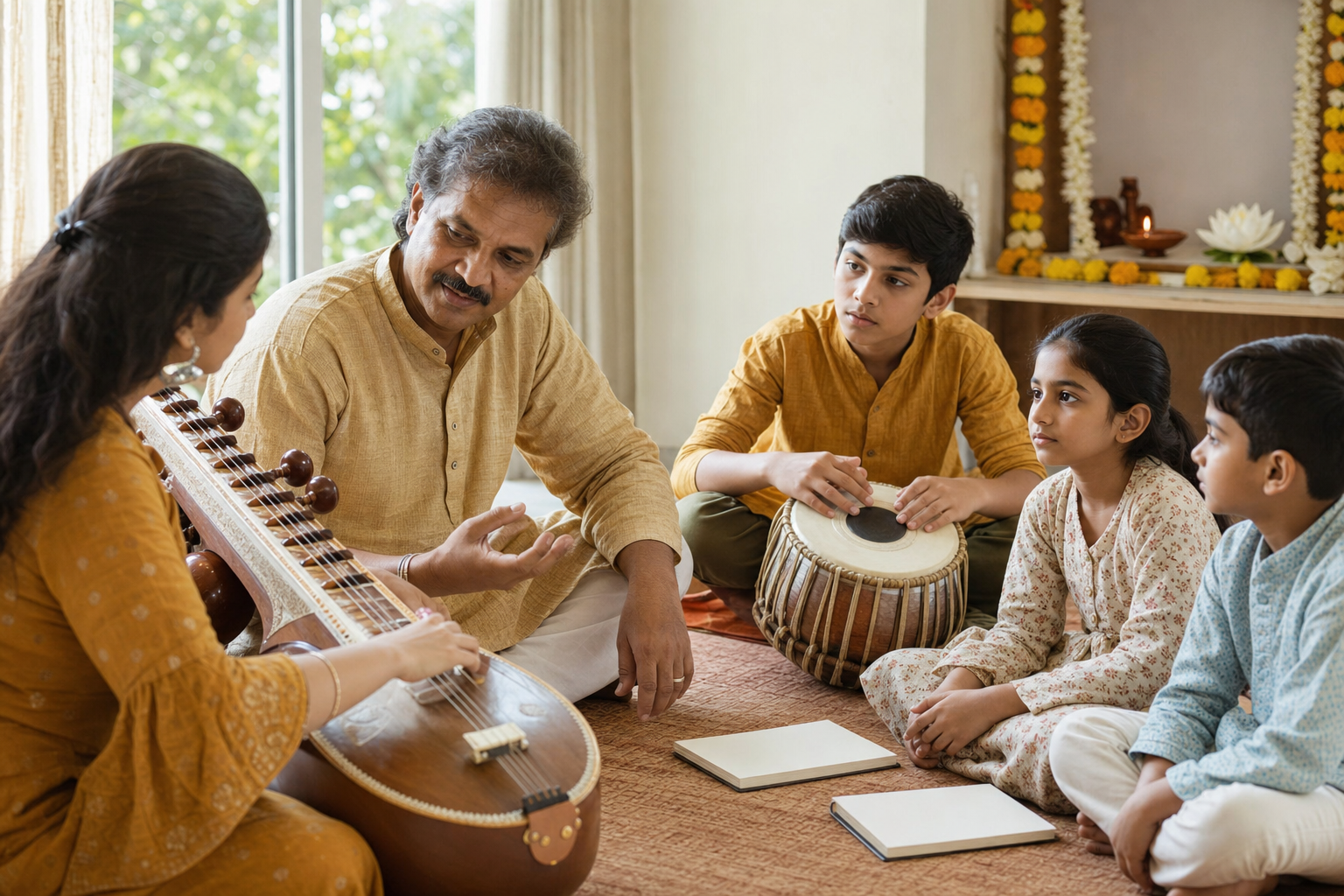
A household puja can remain intimate while still strengthening the larger community. Schools, temples, libraries, and arts groups can organize recitations, reading circles, music gatherings, cultural performances, or educational seva during the Saraswati period. Choose one form that serves learners instead of building a crowded program around every possible activity.
- A family can invite elders to explain one prayer, script, raga, story, or inherited learning practice to children.
- A library or community group can hold a multilingual reading circle that gives each participant a short, prepared role.
- An arts academy can present student work while keeping the emphasis on sadhana and the teacher-student relationship rather than spectacle.
- A temple group can pair Saraswati worship with an educational service effort, such as gathering useful learning materials for students who need them.
- A diaspora community can preserve regional practices while publishing the exact local time zone and panchang basis beside every announced timing.
Use natural decoration and responsible lighting where practical. More importantly, protect the atmosphere from avoidable distraction. A quiet reading, careful recitation, or well-prepared student performance expresses the purpose of the observance more clearly than an elaborate program with no space for attention.
Reverence for disciplined learning also creates a natural meeting point across the Dharmic family. Hindu, Buddhist, Jain, and Sikh traditions differ in theology and practice, yet each gives serious place to study, ethical inquiry, teachers, and the transformation of knowledge into conduct. A shared library event or educational seva can honor that affinity without pretending that the traditions are identical.
Key takeaways for Saraswati Triratra Puja 2026
- Protect October 16-19, 2026, as your Saraswati Puja planning window.
- Use a trusted local panchang or temple calendar to confirm the operative tithis and timings for your city and time zone.
- Do not mistake a four-date planning span for a claim that Triratra has become a four-night rite.
- Continue the Navratri practice inherited by your household while adding a focused reverence for Saraswati, knowledge, music, and the arts.
- Place a few genuinely used books, manuscripts, notebooks, or instruments in the worship space rather than assembling objects only for display.
- End with a defined learning action so that Vijayadashami renews study, practice, or teaching beyond the festival.
Put October 16-19 on your calendar now. Then save the contact for the temple or panchang you trust and choose the one book, skill, or instrument that will carry your sankalpa. When Shardiya Navratri arrives, you will be ready to spend these days in worship and abhyasa rather than last-minute logistics.
References
- DharmaRenaissance Blog – Saraswati Puja 2026: Dates, Traditions, and the Joy of Learning in Sharad Navratri
- DharmaRenaissance Blog – Navratri 2026 Dates & Schedule: Definitive Guide to Shardiya Navratri, Kalash Puja, Rituals
