
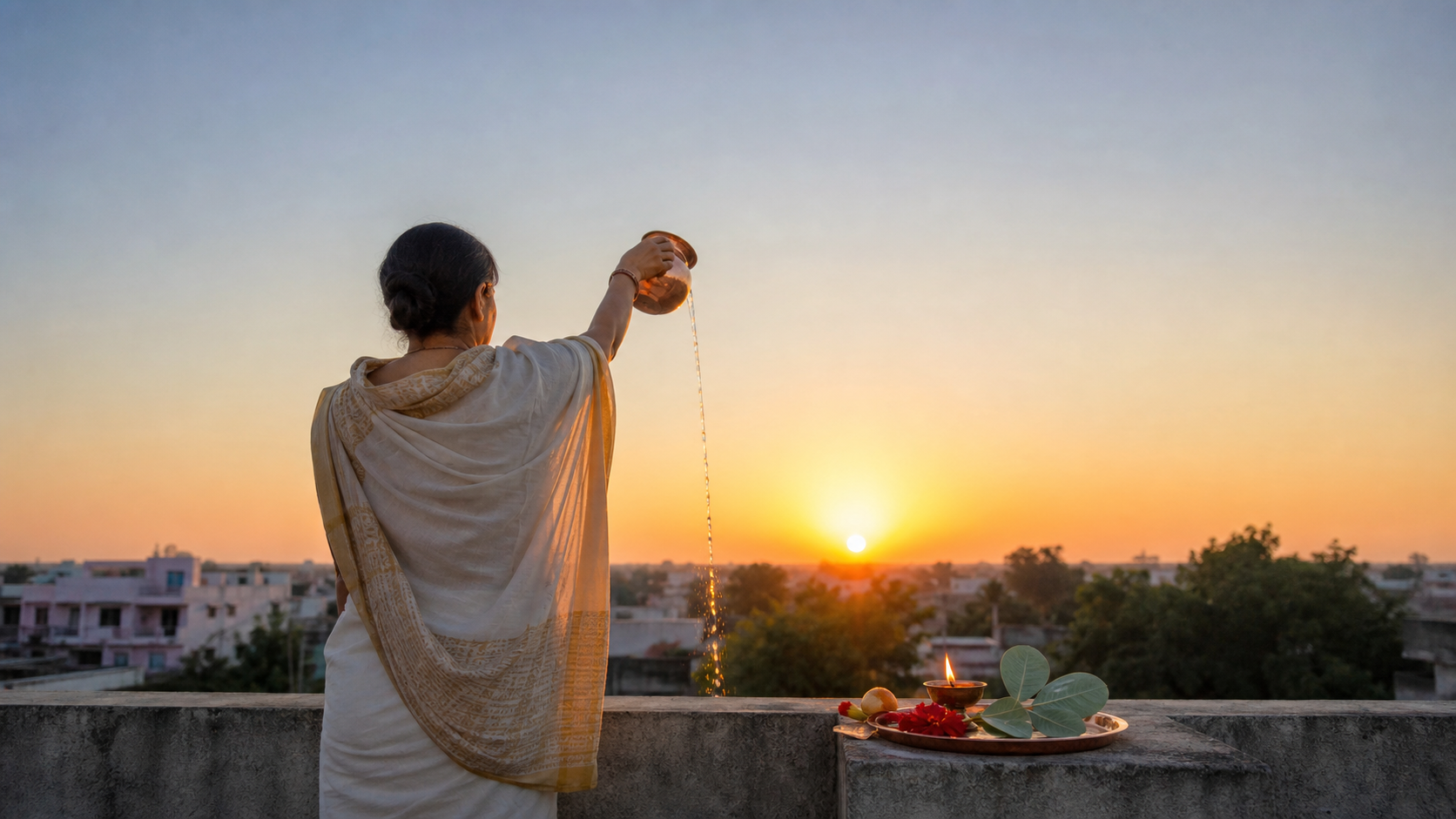
If you want to observe Ratha Saptami at home but are unsure which details are essential, begin with the ritual spine: bathe, greet Surya at sunrise, offer water, pray with attention, share food or wealth, and carry the discipline into your conduct. Arka leaves, an elaborate altar, a long recitation, and fasting can deepen the vrata, but their absence does not make sincere worship empty.
This distinction matters because Ratha Saptami is not a test of how many ritual materials you can obtain. It is a deliberate realignment with light, time, health, gratitude, and dharma. The outer observance should help you become more regular, clear, generous, and useful after the lamp has been extinguished.
Plan around the tithi and the first light
Ratha Saptami falls on Magha Shukla Saptami, the seventh lunar day of the bright fortnight of Magha. It is widely observed as Surya Jayanti. Because the festival follows a lunar tithi rather than a fixed recurring date on the civil calendar, confirm the observance and local sunrise in the panchanga followed by your family or temple. Do not simply reuse the previous year’s date.
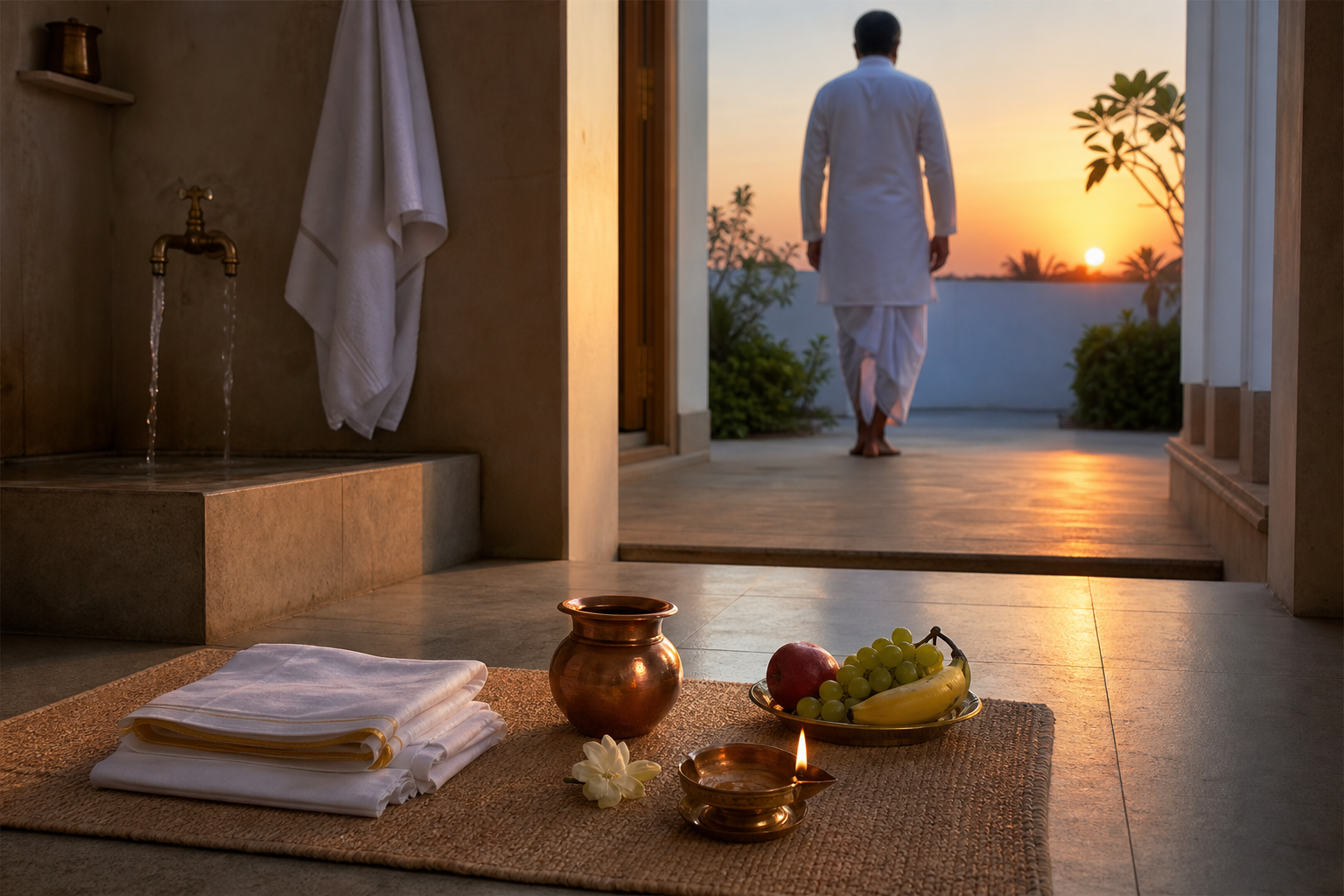
Prepare before sleeping so that the morning does not become a search for vessels and flowers. A modest home arrangement may include:
- A clean image, murti, or symbolic place for Surya
- A clean vessel of water for arghya
- A deepa, wick, and ghee or oil
- Red or yellow flowers, sandal paste, and akshata if available
- Fruit, jaggery, wheat, rice, sweet pongal, payasam, or another simple sattvic naivedya
- Arka leaves only if they are customary, correctly identified, safely handled, and responsibly obtained
- Grain, clothing, food, or another suitable gift for dana
A compact home puja vidhi
If you have limited time or do not know an elaborate procedure, use the following sequence. It preserves the central movement of the vrata without pretending that every household follows one identical form.
- Take snana near sunrise. Bathe cleanly and put on fresh clothing. Where it is your custom, use sesame in the bath and place seven Arka leaves on the head, shoulders, and torso. A regular bath with sincere remembrance is sufficient when Arka is unavailable.
- Make a sankalpa you can carry beyond the puja. You may pray for health, steadiness, family welfare, clarity of mind, or the flourishing of all beings. Add one practical resolve, such as greater regularity, restraint in speech, or consistent seva.
- Face east and offer arghya. As the first light appears, offer clean water to Surya. A common observance offers arghya three times at sunrise. Pour with attention and gratitude, but do not stare directly at the sun.
- Light the deepa and recite what you know. Aditya Hridayam, Surya Gayatri, another Surya stotra, or a lineage mantra may be used. If you do not know a text, a short prayer or silent contemplation is better than hurried recitation without attention.
- Use movement as prayer if it is appropriate for you. Some practitioners perform twelve Surya Namaskars in honor of the twelve Adityas. Move within your physical capacity. A devotional number is not a reason to aggravate pain or ignore medical restrictions.
- Offer naivedya. Fruit or a small sattvic preparation is enough. The purpose is grateful offering, not culinary display. Receive it later as prasada and avoid waste.
- Conclude with humility. Perform aarti and pradakshina where customary, then offer kshama prarthana for errors or omissions. This keeps precision from turning into pride.
- Complete the vrata through dana or seva. Give according to your means. Grain, jaggery, sesame, ghee, clothing, food, or direct service can extend the worship from the altar into another person’s life.
Fasting is an optional discipline governed by health and tradition, not a contest. Some devotees keep a full fast; others take a light sattvic meal. If fasting is medically unsuitable, interferes with medication, or makes you unwell, do not force it. Follow appropriate medical guidance and keep the vrata through prayer, restraint, food simplicity, and charity instead.
At its smallest, a home observance can consist of a clean bath, sunrise arghya, a brief stotra or silent prayer, and gratitude. That is a useful minimum when travel, work, health, or access to materials limits what you can do.
When your family follows Shodashopachara
If you already perform Shodashopachara Puja, retain the order taught in your lineage. A Ratha Saptami form may move from dhyana, avahana, asana, and padya into arghya, achamana, snana, and panchamrita snana; then to vastra, yajnopavita, gandha, and anga puja; and finally to deepa, naivedya, tamboola, prayers, aarti, and pradakshina. Lists and pronunciations vary, so a family paddhati or trusted purohita should take precedence over an improvised online sequence.
Use ceremonial bathing only for a murti designed to receive it. Do not pour water or panchamrita over a framed picture, painted object, electrical lamp, or material that can be damaged. You can offer the substance symbolically in a separate clean vessel.
Read the seven-horsed ratha as a discipline
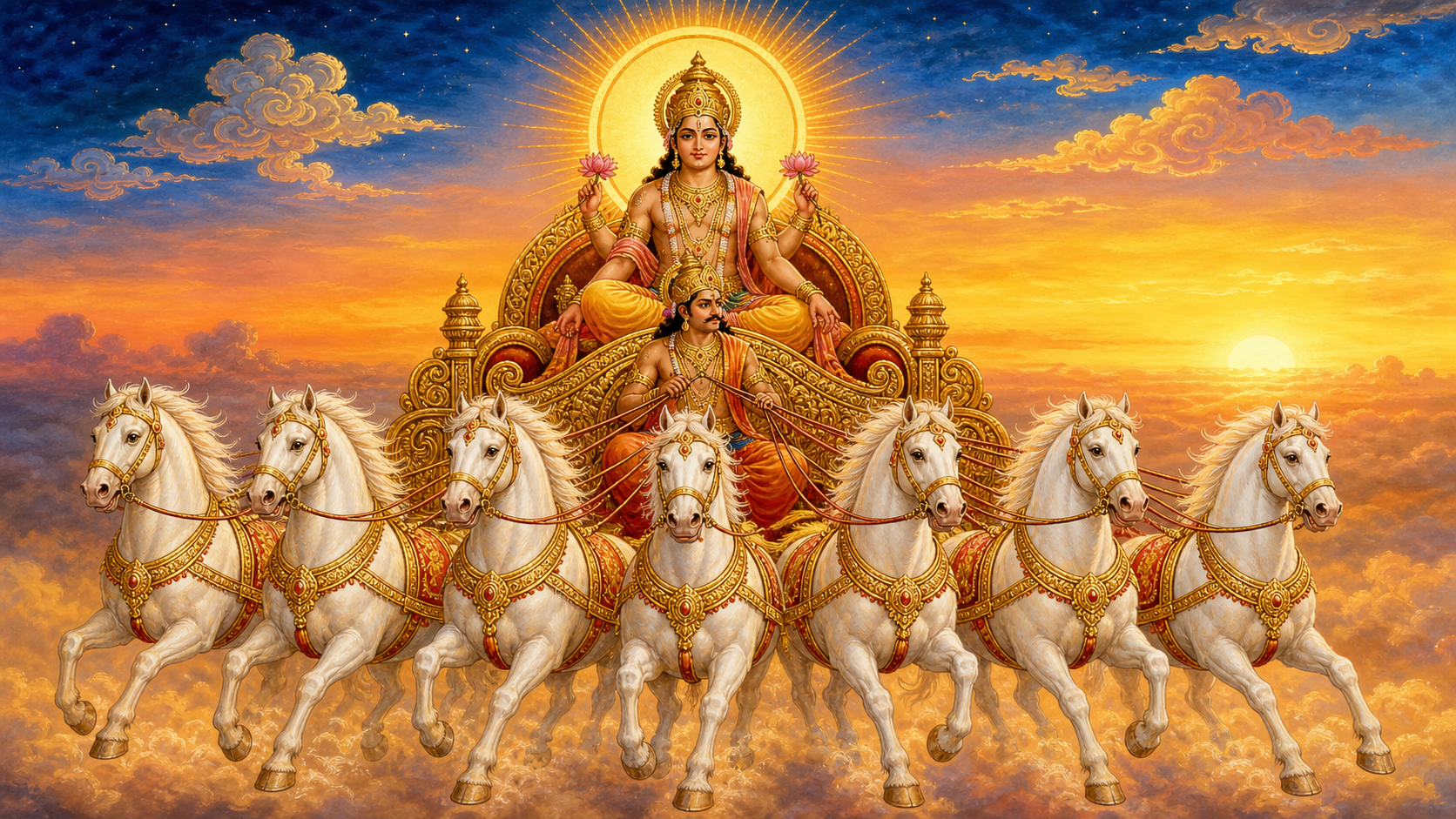
The image of Surya’s chariot is not merely festival decoration. A ratha moves in a direction, carries power under governance, and makes time visible through motion. For you, the immediate question is not only what the chariot represents, but whether your own energy has direction. Vitality without dharma can become restlessness; knowledge without regular practice remains unused.
The seven horses have received several contemplative interpretations. They are associated with the seven Vedic chandas, the colors of light, and the ordered movement of time and duty. Other traditional readings connect them with the seven days, the Sapta Rishis, or the seven principal chakras. These need not be forced into one exclusive historical code. They work as different lenses within distinct teaching contexts.
- Seven days: examine whether your spiritual practice survives the whole week or appears only on festival mornings.
- Seven chandas: notice the discipline of sound, language, and measured expression. Let the day’s worship refine how you speak.
- Seven colors: contemplate diversity as the expression of one light rather than as a threat to unity.
- Sapta Rishis: remember that wisdom is received, preserved, practiced, and transmitted. Choose something worth teaching the next generation.
- Seven chakras: if this symbolism belongs to your yoga tradition, coordinate posture, breath, attention, and ethical intention instead of reducing the image to an anatomy diagram.
Choose one of these lenses for your sankalpa. Trying to think about every interpretation at once often produces a crowded ritual and no changed habit. If you choose the seven days, for example, make regularity your practice. If you choose chandas, guard your speech. The symbol becomes useful when it gives direction to conduct.
Ratha Saptami also stands within the seasonal movement of Uttarayana and the agricultural expectation of renewal. It should not be reduced to a claim that a modern astronomical event occurs uniquely on this tithi. Its sacred-calendar role is devotional and seasonal: it asks you to notice increasing light, the rhythms sustaining food and life, and your dependence on an order you did not create.
The other ritual elements reinforce the same teaching. Snana marks a conscious reset. Arghya turns water and attention into gratitude. The deepa asks you to carry luminosity inward. Naivedya acknowledges that nourishment is received before it is possessed. Dana prevents a private request for blessings from becoming self-enclosed. Seen this way, the puja is a sequence that moves from purification to attention, from attention to gratitude, and from gratitude to responsibility.
Use Arka Patra reverently, not casually
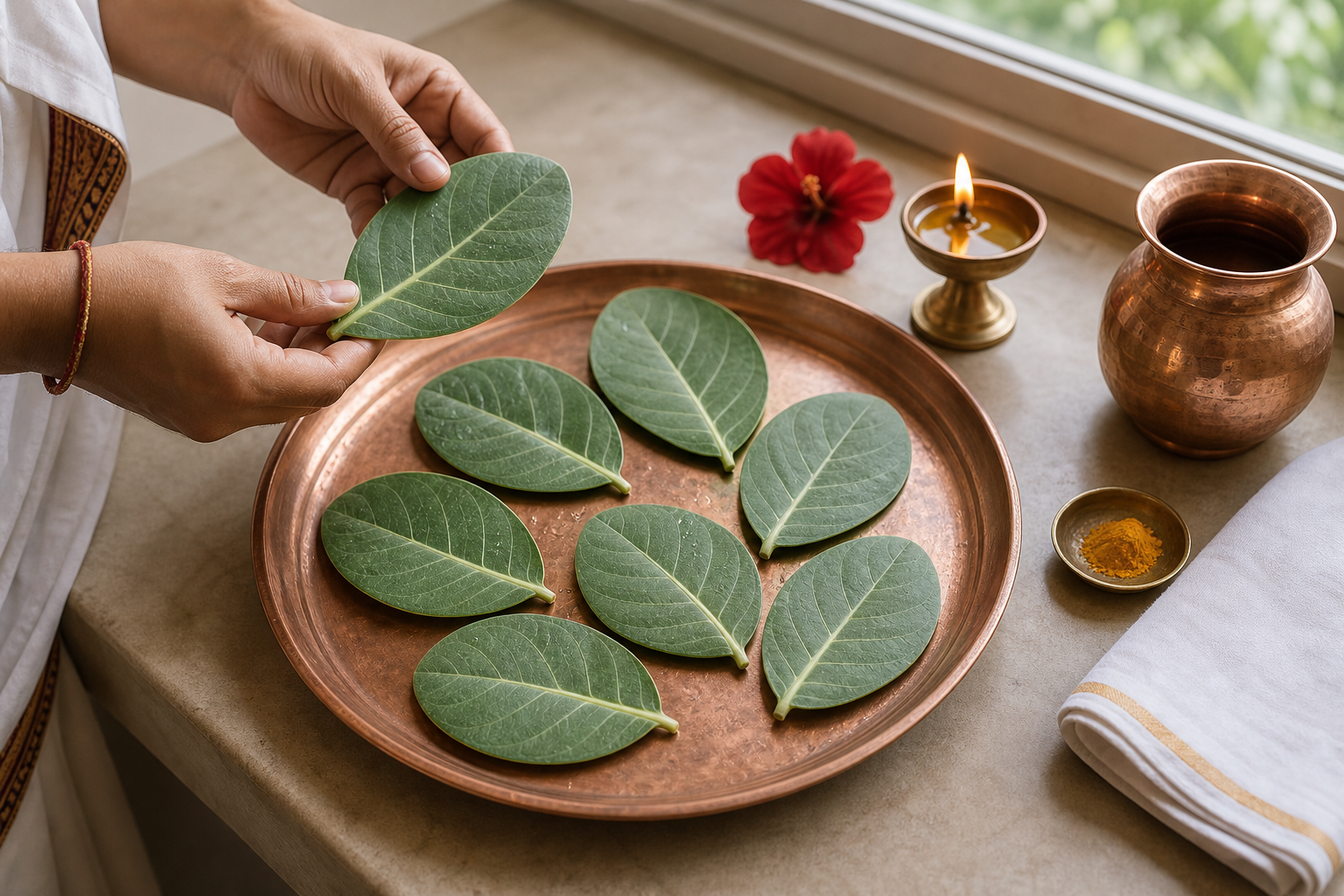
Arka Patra, the leaf of Calotropis, is closely associated with Ratha Saptami in many regional practices. Its ability to endure intense sunlight, along with its traditional association with heat and radiance, makes it a fitting emblem of Surya’s tejas. In the ritual imagination, Arka represents vigor, purification, tapas, and resilient energy.
During snana, seven leaves may be placed across the head, shoulders, and torso while Surya is invoked. The arrangement should help you remember that clarity must enter thought, action, and embodied life. The leaf is a carrier of intention, however, not a magical substitute for ethical conduct.
Calotropis contains potent latex, so ritual familiarity should not become casual handling. Use these boundaries:
- Use Arka only when you can identify it correctly and the practice belongs to your household or community tradition.
- Keep the latex away from the eyes and mouth, do not ingest the plant, and do not apply it as a home remedy merely because it has an Ayurvedic association.
- Wash your hands after handling it and supervise children who participate in the ritual.
- Take only what the observance requires and avoid damaging or uprooting the plant.
- If the leaves are unavailable or unsafe for you to handle, use a red-hued flower, perform a regular snana, or make a manasic offering.
Arka’s place in Ayurveda does not turn a ritual bath into medical treatment. Surya may be revered theologically as Arogya Devata, the divine source of health and vitality, while illness still requires appropriate professional care. Keep the levels distinct: the vrata can cultivate discipline, hope, movement, and gratitude, but it should not replace diagnosis, medication, or treatment.
This is also where ecological care becomes part of worship. Plastic decorations, abandoned offerings, excess water use, and careless harvesting contradict gratitude toward the natural world. Use modest quantities, biodegradable materials, and a clean method of returning water to the earth. Ritual restraint can express Surya’s order more faithfully than excess.
Carry Surya worship beyond one festival morning
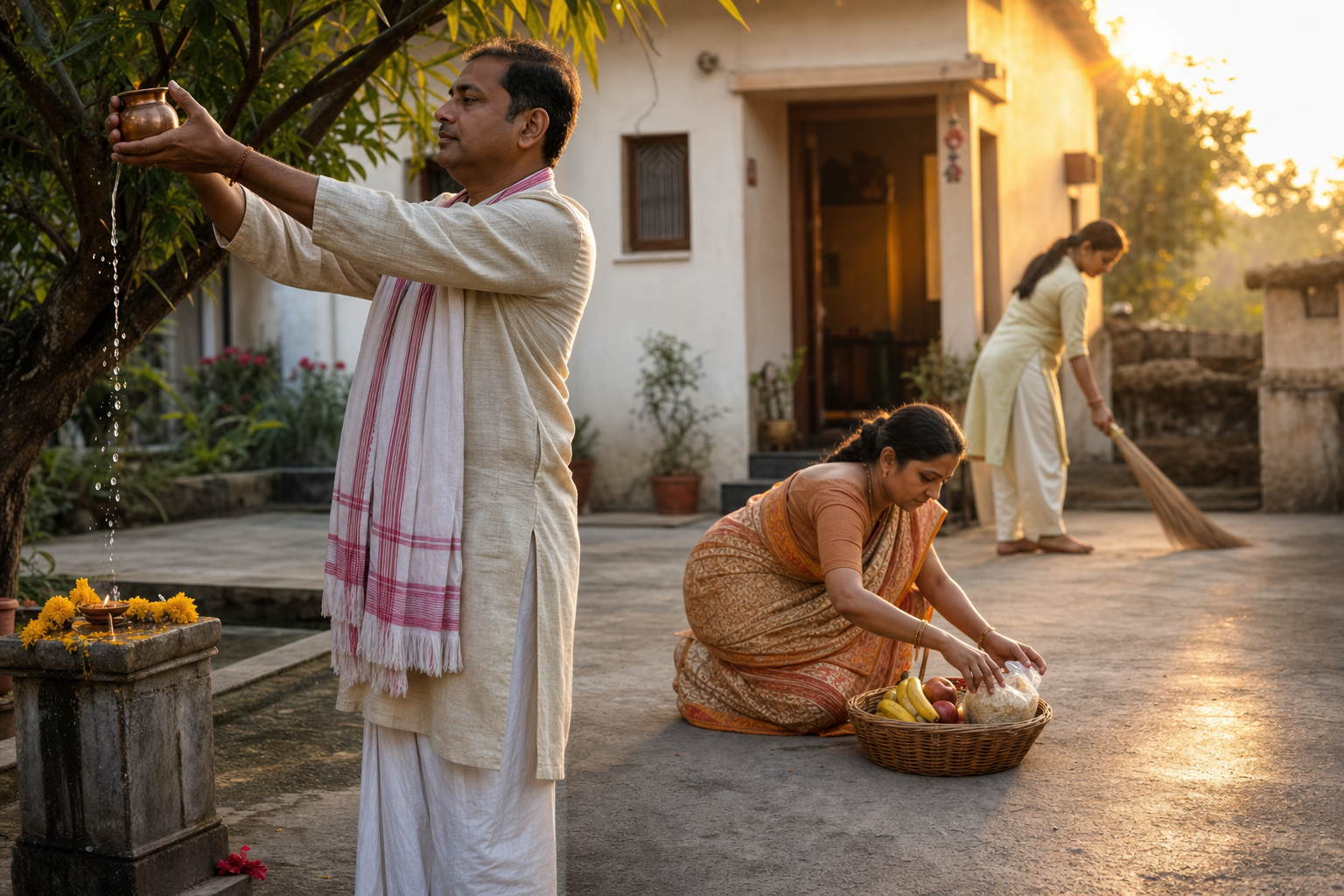
Ratha Saptami is specifically a Hindu vrata, even though its language of light has wider dharmic resonance. Hindu traditions approach Surya through arghya, mantra, stotra, puja, vrata, temple worship, and embodied practices such as Surya Namaskar. Ayurveda contributes a concern for seasonal routine, warmth, and the rekindling of vitality. These strands can support one another without being treated as identical disciplines.
Buddhism, Jainism, and Sikhism also use light as a powerful way of speaking about wisdom, truth, compassion, disciplined conduct, or remembrance. That shared vocabulary reveals kinship across the dharmic family; it does not mean every community performs Ratha Saptami or assigns the same theology to the sun. We honor unity more honestly when we preserve real differences in doctrine and ritual.
The traditional vrata katha associated with King Yashovarma of Kamboja gives the observance an ethical shape. Details vary across regional tellings, but the king’s misfortune leads him to seek counsel, undertake disciplined Surya worship, offer arghya, and practice charity; health and order are then restored. Read this as a pattern of transformation rather than a bargain in which one morning’s ritual mechanically cancels every consequence. Humility leads to discipline, discipline changes conduct, and changed conduct makes restoration possible.
You can continue that pattern through a small daily Surya discipline:
- Protect a quiet interval at dawn. Step into gentle morning light when circumstances allow, without staring at the sun. Morning light, regularity, bathing, and mindful prayer can support circadian balance and focused attention, but they are not cures for illness.
- Keep one repeatable practice. A brief arghya, Surya mantra, Gayatri recitation, or silent gratitude performed consistently is more formative than an elaborate routine you abandon.
- Move with awareness. If Surya Namaskar is suitable for your body, use it as coordinated prayer rather than a hurried count. Let posture, breath, and attention remain connected.
- Translate tejas into conduct. Use energy for work that sustains family, community, learning, or seva. Radiance in dharmic life is not mere intensity; it must illuminate and nourish.
- Keep dana visible. Set aside food, money, clothing, knowledge, or time for others according to your capacity. Charity is not an optional social appendix to worship; it is one way gratitude becomes action.
- Respect the systems that sustain life. Conserve water, avoid waste, care for plants, and recognize agricultural labor. Gratitude to Surya becomes credible when it changes how you treat the world receiving that light.
This daily continuation is the real test of the vrata. If sunrise worship leaves your schedule just as chaotic, your speech just as harsh, or your relationships just as neglected, the chariot has remained an image. Let one element of Surya’s order enter your ordinary day.
Key takeaways
- Confirm Magha Shukla Saptami and local sunrise through the panchanga followed by your family or temple.
- The essential home observance is snana, sankalpa, sunrise arghya, attentive prayer, a simple offering, and dana or seva.
- Arka leaves are meaningful but not mandatory. Handle Calotropis carefully, never ingest it, and use a flower or manasic offering when necessary.
- The seven horses support several traditional readings, including the seven days, Vedic chandas, colors, Sapta Rishis, and chakras. Choose the lens that helps you change a real habit.
- Fast and perform Surya Namaskar only within your health and physical capacity. Devotion does not require avoidable harm.
- Ratha Saptami becomes a vrata in the fullest sense when gratitude at sunrise produces regularity, ethical speech, generosity, and ecological care afterward.
Before your next Ratha Saptami, decide on one sankalpa rather than accumulating more ritual objects. Prepare the arghya vessel, choose the prayer you will actually recite, and identify the act of dana you will complete. Then greet Surya with enough simplicity that the meaning remains visible: receive light, order your energy, and use it in the service of dharma.
References
- DharmaRenaissance Blog — Ratha Saptami and Arka Patra: Timeless Symbolism, Vedic Health Wisdom, and Surya’s Grace
- DharmaRenaissance Blog — Ratha Saptami 2026 Vrat Katha: Surya Jayanti Blessings, Rituals, and King Yashovarma’s Legacy
- DharmaRenaissance Blog — Ratha Saptami Puja Vidhi: Time-Honored Surya Pooja Steps, Meanings, and Practical Tips
- DharmaRenaissance Blog — Ratha Saptami (Radha Saptami) Guide: Sacred Snan Mantra, Sunrise Rituals, and Surya Jayanti
