
If you found December 30 on one calendar and January 4 on another, the dates are not competing claims. The 146th Jayanti of Bhagavan Sri Ramana Maharshi was observed on January 4, 2026. December 30 is his historical solar birthdate; January 4 was the traditional Nakshatra-based Jayanti date for 2026.
That distinction tells you how to approach the observance. Start with the Punarvasu timing in your local Panchang, place the central practice within that window, and resist turning the day into an overloaded religious programme. A lamp, a carefully chosen recitation, sustained silence, and sincere Self-enquiry can form a complete observance.
Why the 2026 Jayanti fell on January 4
Ramana Maharshi was born on December 30, 1879, during Margazhi under Punarvasu Nakshatra. The annual Jayanti follows that lunar-star alignment in the traditional Hindu Tamil calendar rather than simply repeating December 30 on the Gregorian calendar.
This is why a biographical record and a religious calendar can display different dates without either being mistaken. Use December 30 when referring to the historical date of birth. Use January 4 when referring to Sri Ramana Maharshi Jayanti 2026.
Punarvasu, Punarpoosam, and Punartham are alternate names for the same Nakshatra. Your Panchang may use any of them. Do not interpret the different spellings as separate observances.
If you are preparing a family calendar, temple notice, or community invitation, label the occasion clearly: Bhagavan Sri Ramana Maharshi Jayanti – Punarvasu in Margazhi – January 4, 2026. That wording records both the civil date and the traditional basis for it.
Let your local Panchang determine the observance window
The date is shared, but the exact beginning and ending of Punarvasu can vary by location. A clock time copied from another city may not match the Nakshatra boundary where you live. Check a Panchang configured for your own location before assigning times to puja, parayana, meditation, or a community gathering.
- Set the Panchang to the city or region where you will actually observe the Jayanti.
- Look for Punarvasu, Punarpoosam, or Punartham on January 4, 2026.
- Confirm that the entry belongs to Margazhi Masam in the Tamil calendar.
- Write down the local start and end of the Nakshatra before arranging the rest of your programme.
- Place the principal act of observance – Self-enquiry, silent meditation, parayana, or puja – within the local Punarvasu window where possible.
If family duties or work prevent you from following the entire window, choose a portion you can protect from interruption. Calendrical care gives the observance its traditional setting; it does not require you to fill every available moment with activity.
For a community event, put the location and local timing on the invitation. Also include all three Nakshatra names if participants use calendars from different linguistic regions. That small clarification prevents avoidable confusion about whether everyone is observing the same sacred day.
Build a home observance around stillness, not scale
At Sri Ramanasramam in Tiruvannamalai, the traditional pattern includes Veda parayana, recitation of works such as Upadesa Saram and Aksharamanamalai, and collective silence. Devotees may also undertake girivalam, the circumambulation of Arunachala.
You do not need to reproduce the scale of an ashram programme at home. Translate its essential functions into a sequence that you can perform attentively:
- Prepare a quiet place. Clean the immediate area and remove devices or other distractions. You may light a lamp and place an image of Ramana Maharshi or Arunachala before you, but elaborate decoration is not necessary.
- Begin without hurry. If Vedic chanting is already part of your practice, open with a familiar parayana. If it is not, begin in silence instead of attempting an unfamiliar recitation merely for the occasion.
- Choose one teaching for close attention. Recite or read from Upadesa Saram or Aksharamanamalai. Read slowly enough for the words to direct the mind inward. Completing more material is not the purpose.
- Protect a period for atma-vichara. Put the text down, stop managing the ceremony, and turn to the question, “Who am I?” Let this be the centre of the observance rather than an item added at the end.
- Close through conduct. Carry the inward discipline into ahimsa in thought, speech, and action. A restrained reply, a repaired responsibility, or quiet help offered to another person makes the ethical intention concrete.
If you are observing with family, explain beforehand that silence is part of the programme, not an empty interval waiting to be filled. Decide who will lead the recitation, when the group will become silent, and whether there will be a brief reflection afterward. Avoid allowing speeches and organisational announcements to consume the time reserved for practice.
If you could not travel to Tiruvannamalai in 2026, the absence of girivalam did not make your observance incomplete. A householder could participate through the same inward orientation: remembrance of Arunachala, recitation, meditation, Self-enquiry, and compassionate conduct.
Keep “Who am I?” from becoming an intellectual exercise
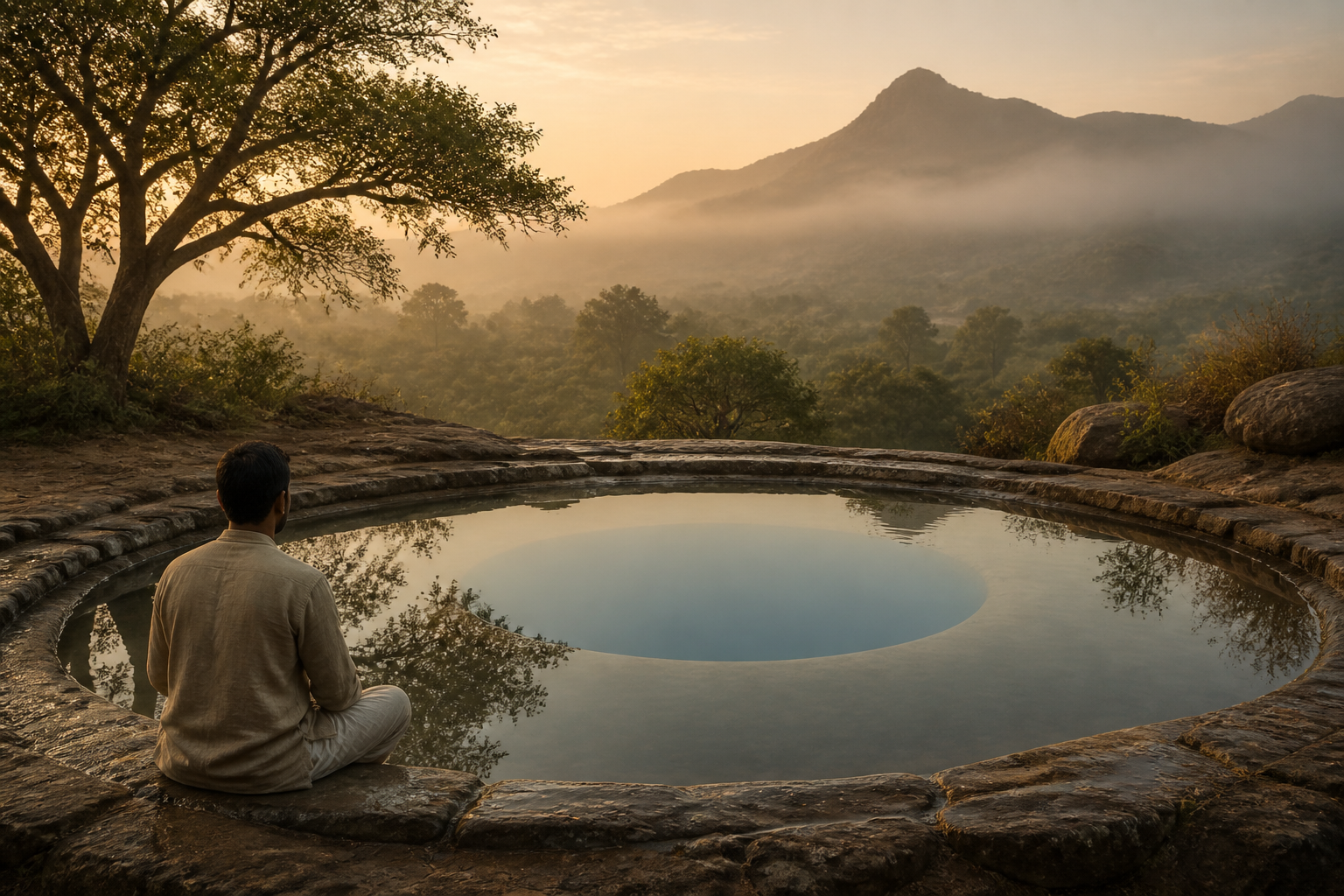
A commemorative programme can remain busy from beginning to end while leaving no room for the practice most closely associated with Ramana Maharshi. Atma-vichara changes that emphasis. The question “Who am I?” is not asking you to compose a better description of your personality, history, status, or relationships. Those are things you can observe and describe; the enquiry turns attention toward the one to whom they appear.
A simple way to enter the practice is to sit steadily, allow the breath to remain natural, and notice whatever is present. When a thought, memory, role, or bodily sensation claims your attention, recognise that it is known. Then return to the question of who knows it. Do not rush to manufacture a verbal answer. Let the question interrupt the usual movement toward explanations and bring attention back to its source.
Three mistakes commonly weaken an observance of this kind:
- Replacing enquiry with reading about enquiry. A text can point you inward, but there must be a point at which you close it and practise.
- Treating silence as forced blankness. The arrival of a thought does not end the enquiry. Notice that it has been seen and return attention to the knower.
- Judging the day by whether something dramatic happened. The workable measure is whether you turned inward honestly and carried greater restraint into your conduct afterward.
The Jayanti also offers a respectful meeting point among Dharmic paths. Meditative discipline, ethical living, ahimsa, and the search for direct insight resonate across Hindu, Buddhist, Jain, and Sikh traditions. That resonance should not be used to erase their doctrinal differences. In an inter-Dharmic gathering, identify atma-vichara accurately as a practice associated with Advaita Vedanta, while allowing shared silence and ethical reflection to remain genuinely shared.
Key takeaways for the 2026 observance
- Bhagavan Sri Ramana Maharshi’s 146th Jayanti was observed on January 4, 2026, although his historical birthdate was December 30, 1879.
- The traditional marker was Punarvasu Nakshatra in Margazhi Masam, not a simple repetition of the Gregorian birthdate.
- Punarvasu, Punarpoosam, and Punartham refer to the same Nakshatra.
- The exact Nakshatra window depends on location, so puja and parayana timings should come from a local Panchang.
- A focused home observance can combine a lamp, a Ramana text, silence, atma-vichara, and a practical commitment to ahimsa.
- Girivalam and the ashram programme have special significance, but physical presence at Arunachala is not required for sincere participation.
For any observance based on this pattern, make three decisions before the day begins: record the local Punarvasu window, choose the text you will recite, and protect the silence in which you will ask “Who am I?” Then carry one visible change into ordinary life. Pause before the next harsh response, perform the duty you have been avoiding, or help someone without seeking recognition. That is how Jayanti becomes a renewal of sadhana rather than another entry on the calendar.
References
