
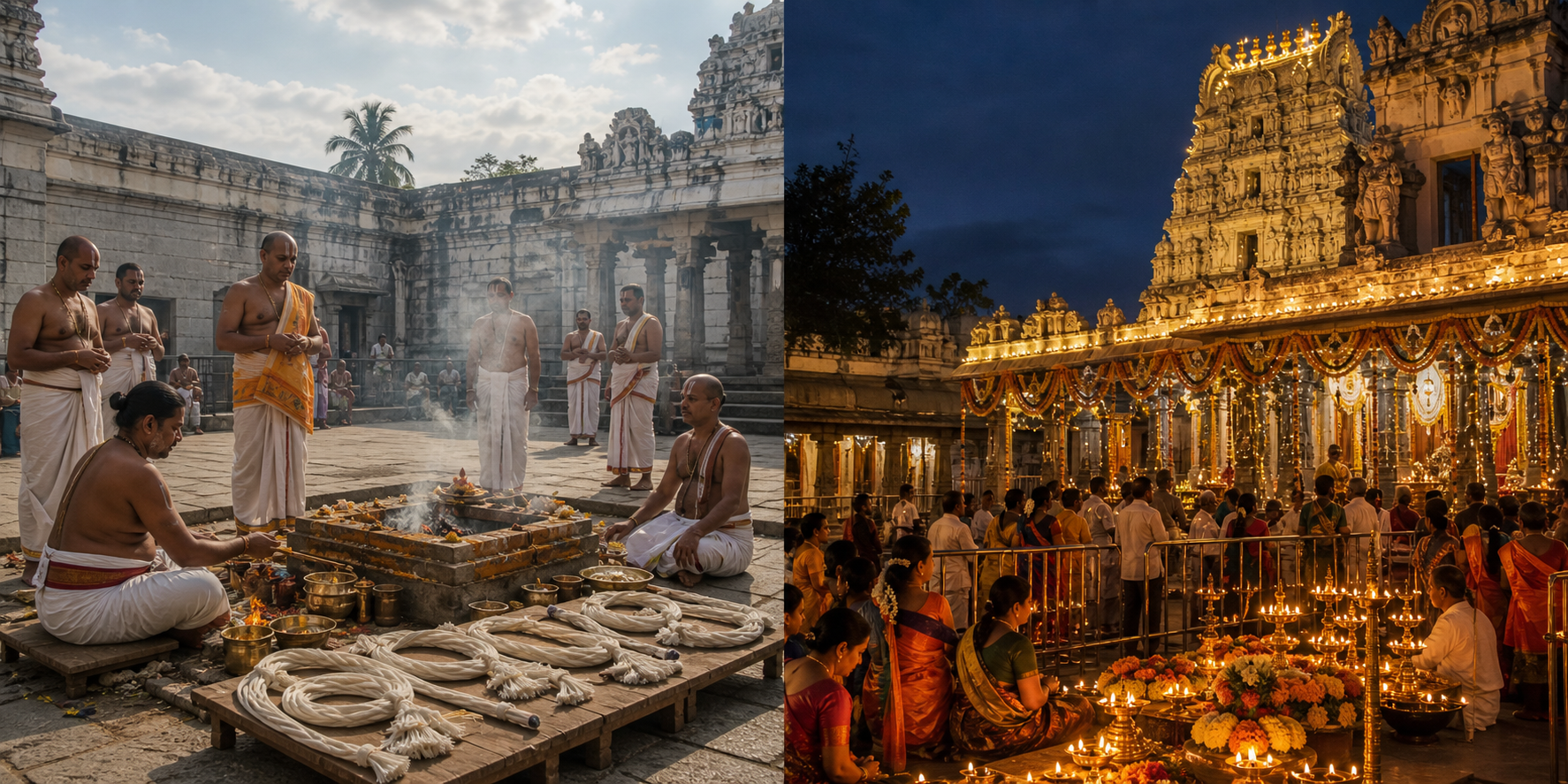
If you are arranging an October temple visit around Sri Rama, the first decision is not simply which date is free. Chandragiri’s Pavitrotsavam and Tirupati’s Deepavali Asthanam serve different ritual purposes, follow different schedules, and affect your day in different ways.
For 2025, the main dates were 11-14 October at Chandragiri and 20 October at Tirupati. Put the full temple location beside every date in your itinerary. The shared name, Sri Kodandarama Swamy Temple, should not lead you to treat these as one event or one destination.
Key takeaways for October 2025
- At Sri Kodandarama Swamy Temple, Chandragiri, the Pavitrotsavam cycle opened with Ankurarpanam at 6:00 PM on 11 October 2025.
- The main Chandragiri Pavitrotsavam observances ran from 12 to 14 October 2025. Daily ritual timings were to be announced by the temple administration, so the dates alone were not a complete schedule.
- At Sri Kodandarama Swamy Temple, Tirupati, Deepavali Asthanam began its principal ritual focus at 7:00 PM on 20 October 2025.
- Sahasra Kalasabhishekam Seva and Hanumantha Vahana Seva were cancelled at the Tirupati temple on the day of Deepavali Asthanam. Anyone building a visit around either seva needed to change plans.
Know what each observance is meant to accomplish
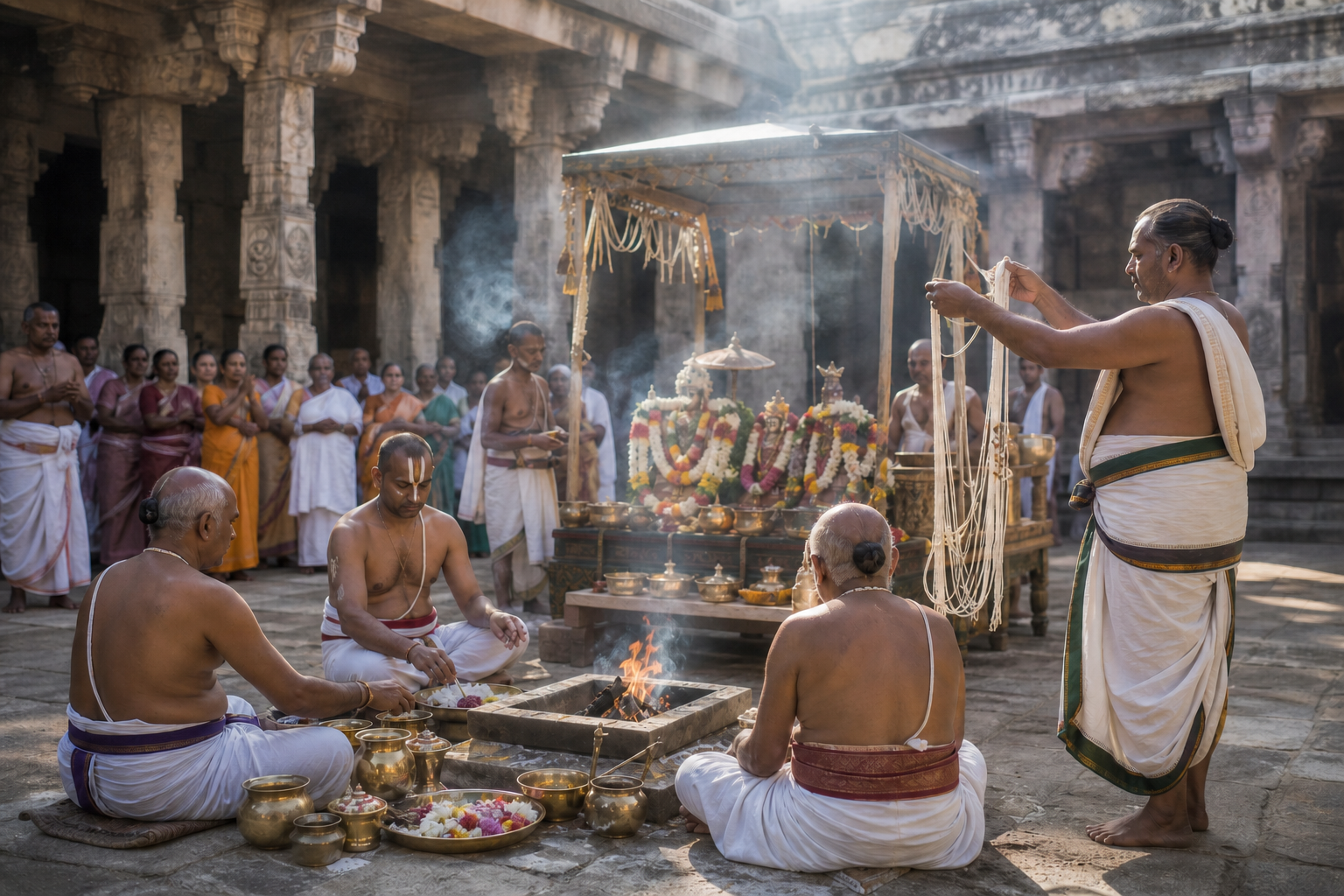
Pavitrotsavam is a rite of ritual correction. Its purpose is to purify the temple and address inadvertent doshas that may arise in the continuous performance of worship through human error or the pressure of serving many devotees. Here, dosha does not imply misconduct or a scandal. It acknowledges that sustained sacred service requires periodic restoration as well as daily discipline.
Ankurarpanam formally opens this cycle. The three principal days at Chandragiri then centre on Vedic homas, special pujas, and pavitra threads offered to the deities. Vedic chanting, the homa, and alankaram give the observance a measured, reflective character. If you are seeking a visit centred on purification, correction, and renewed sankalpa, this is the more relevant October window.
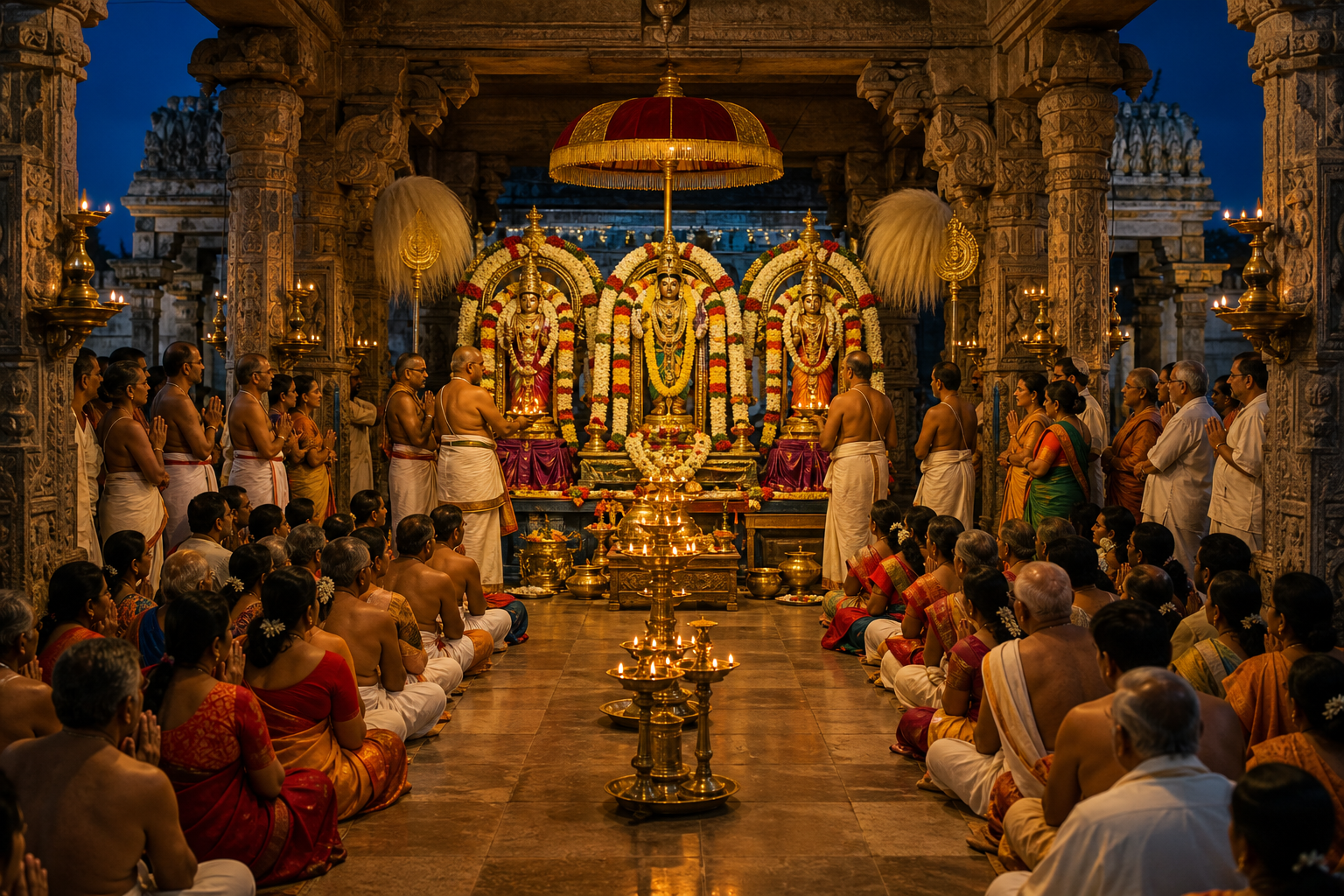
Deepavali Asthanam has a different emphasis. At 7:00 PM in Tirupati, new clothes, lamps, and offerings are ceremonially brought from Sri Govindaraja Swamy Temple and presented to Sri Kodandarama Swamy. This movement of auspicious offerings expresses the ritual relationship among Tirupati’s temples. It also places the familiar Deepavali themes of light, renewal, and harmony within a specific temple liturgy.
If you want to witness what distinguishes the Asthanam from an ordinary darshan day, plan around that evening exchange rather than treating any visit on 20 October as equivalent. Arrive before the 7:00 PM focus, allow temple staff to direct where devotees may stand, and do not assume that the procession or offering will be visible from every part of the queue.
Neither observance is a substitute for the other. Chandragiri invites you into ritual repair; Tirupati places Deepavali’s illumination within an interconnected sacred geography. Because the dates were separated in 2025, a pilgrim could plan for both without pretending that they formed one formally unified festival sequence.
Build your itinerary around fixed and unfixed details
The dates and the two announced evening times give you a framework. They do not settle daily access, the full order of worship, queue conditions, or the timing of every component. A devotional itinerary becomes fragile when transport, darshan, and a named seva all depend on one detail that has not been confirmed.
- Write down the complete destination. Use “Sri Kodandarama Swamy Temple, Chandragiri” or “Sri Kodandarama Swamy Temple, Tirupati” on tickets, family messages, and driver instructions. Do not leave the location implied.
- Separate the opening rite from the main festival days. At Chandragiri, 11 October at 6:00 PM was Ankurarpanam; Pavitrotsavam itself occupied 12-14 October. Decide whether you want the opening, a principal festival day, or both.
- Confirm the daily timetable close to the visit. The Chandragiri dates were fixed, but the individual ritual timings depended on temple announcements. Evening attendance was the practical emphasis, not a licence to assume that every rite began at 6:00 PM.
- Arrive early without inventing a universal buffer. Processions, crowd controls, and queue routing can change how long it takes to reach the relevant area. No single early-arrival interval was announced for every devotee, so consult the temple administration instead of relying on a guessed number.
- Audit your seva plan for 20 October. The cancellation of Sahasra Kalasabhishekam Seva and Hanumantha Vahana Seva was not a minor timetable adjustment. If either was your main purpose, you needed another date rather than a tighter schedule on the same day.
- Keep darshan separate from a guaranteed view of a ritual. Follow the route assigned by temple personnel. If crowd management limits your position, accept darshan from the permitted area rather than pressing through a queue to reproduce an imagined vantage point.
These dates belong to the 2025 calendar. Do not carry them forward into another October. For a later year, obtain a fresh temple announcement for the festival dates, seva availability, and entry arrangements.
Participate with intention, not just attendance
At Chandragiri, devotees may seek participation through sankalpa or annadanam as facilitated by the temple. Confirm the available arrangement before arriving; do not assume that bringing food independently or expressing a sankalpa at the entrance gives access to a formal programme. Temple facilitation preserves both ritual order and the shared character of seva.
During Pavitrotsavam, let the rite’s purpose shape your prayer. You might identify one inadvertent lapse in your own conduct: a duty repeatedly postponed, a promise left unfulfilled, or service performed carelessly. Choose a correction you can actually make. This does not equate a personal mistake with temple dosha; it allows the public rite of renewal to prompt honest personal discipline.
At the Tirupati Asthanam, notice the ritual action rather than reducing Deepavali to decoration. Clothes, lamps, and offerings move from Sri Govindaraja Swamy Temple to Sri Kodandarama Swamy, carrying mangala from one shrine to another. Your role is not to compete for proximity. Maintain queue discipline, leave the ceremonial path clear, and receive the moment as part of a larger temple community.
Follow the temple dress code and bring only offerings the administration permits. An eco-conscious lamp may suit the festival’s spirit, but ask whether reusable lamps are being accepted before carrying one into the queue. A sustainable intention does not override the temple’s rules for materials, placement, or fire safety.
After the visit, give the observance one concrete continuation at home. Pavitrotsavam can lead to correcting a neglected responsibility. Deepavali Asthanam can lead to an act that transmits goodwill beyond your own household. The useful question is not merely whether you attended, but what part of your conduct became more orderly, luminous, or generous because you did.
The wider dharmic meaning depends on preserving differences
These are Hindu temple observances centred on Sri Rama, with their own ritual vocabulary and liturgical structure. Their wider dharmic resonance should not be used to make distinct traditions sound interchangeable. A precise comparison is more respectful than a vague declaration that all practices are the same.
Pavitrotsavam’s concern with purification and ethical renewal can be placed beside Buddhist cultivation of purity of intention and Jain pratikraman. Its communal participation through seva can also be discussed alongside the Sikh commitment to seva and remembrance of the Divine. These are parallels in moral orientation, not claims that the ceremonies, doctrines, or histories are identical.
Deepavali’s language of light likewise gives families a way to speak about clarity, restraint, compassion, and communal goodwill across dharmic boundaries. The strongest civilizational connection is not a flattened ritual uniformity. It is the shared insistence that renewal must become visible in conduct.
For your next Kodandarama Swamy temple visit, write down four things before you leave: the full temple location, the date, the confirmed ritual time, and the one observance or seva that matters most to you. Reconfirm the schedule with the temple administration, then arrive prepared to follow the order of the shrine rather than forcing the shrine into your itinerary.
References
- DharmaRenaissance Blog – Deepavali Asthanam 2025 at Tirupati: Complete Guide to Timings, Rituals, and Seva Changes
- DharmaRenaissance Blog – Ultimate Guide to Chandragiri Kodandarama Swamy Pavitrotsavam 2025: Discover Dates and Rituals
