
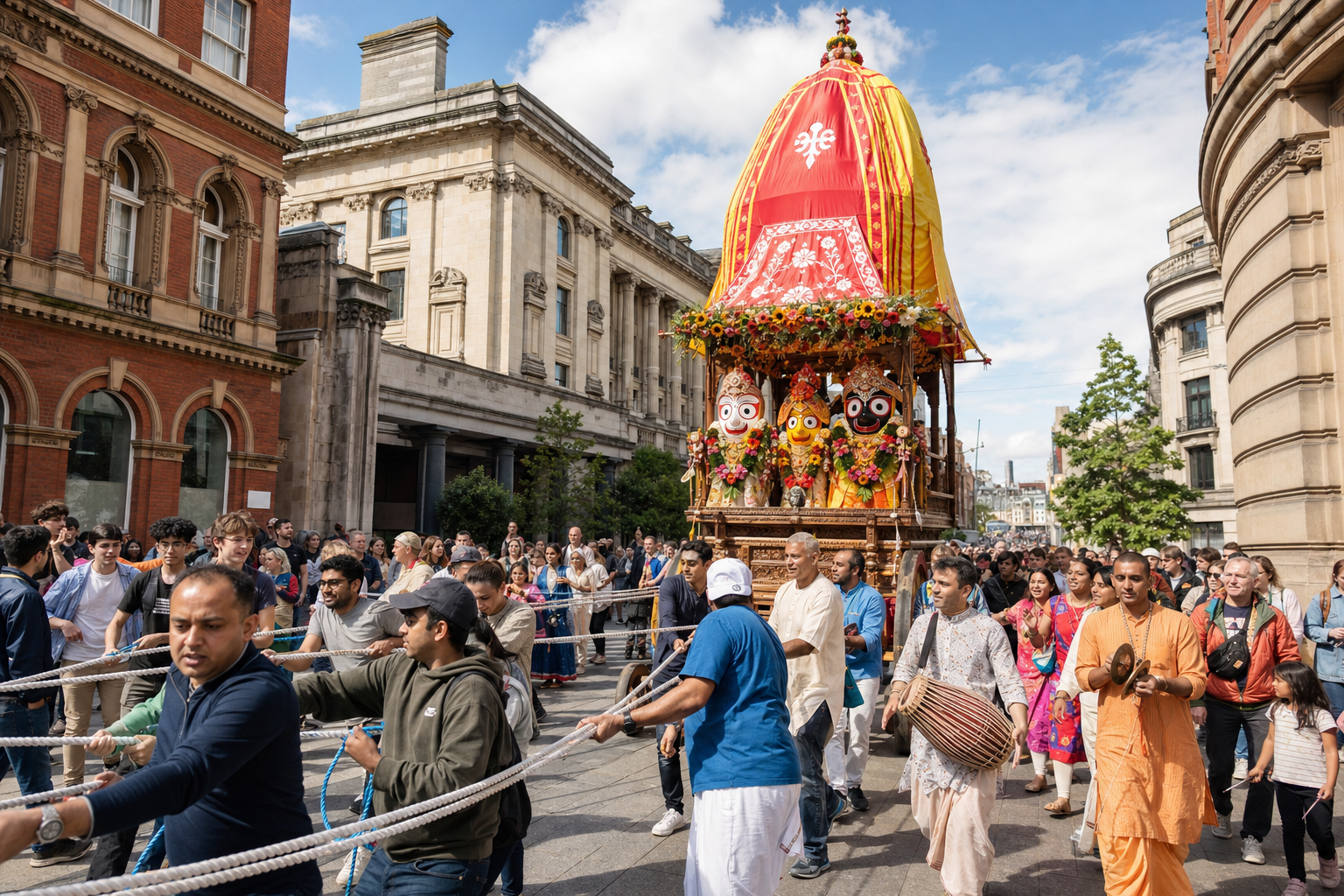
If Nottingham’s 2026 Festival of Chariots left you wondering what the procession meant, the essential question is not simply what people were celebrating. It is why Lord Jagannath was brought into public space, why devotees sang and pulled ropes, and how someone unfamiliar with the tradition could participate respectfully.
The clearest way to understand Rathayatra is as darshan in motion. Devotion usually encountered in a temple becomes accessible in the streets, allowing worshippers, neighbours, and curious passers-by to meet within a living sacred practice.
What happened in Nottingham on 7 June 2026
On 7 June 2026, local devotees organised a Rathayatra in Nottingham in honour of Lord Jagannath. The procession also received coverage from BBC Midlands, giving a distinctly Vaishnava celebration a place within mainstream regional public life.
- Date and form: The event took place on 7 June 2026 as a public chariot procession.
- Sacred focus: It honoured Lord Jagannath rather than presenting Indian culture as an undifferentiated theme.
- Local and civic character: Devotees carried the religious work, while media visibility allowed the wider community to encounter it.
Rathayatra literally means a chariot journey: ratha is a chariot, and yatra is a journey or pilgrimage. Festival of Chariots is therefore a useful English description, but it is incomplete by itself. The chariot is not merely a colourful vehicle, and the people around it are not simply participating in a parade. The movement of the deity, the congregational singing, the ropes, and the service performed around the procession all belong to the worship.
If you are explaining Nottingham Rathayatra to someone else, begin with that distinction. Call it a public Vaishnava festival honouring Lord Jagannath. Cultural celebration is part of what the city sees, but devotional encounter is what gives the event its internal meaning.
Why Lord Jagannath comes beyond the temple walls
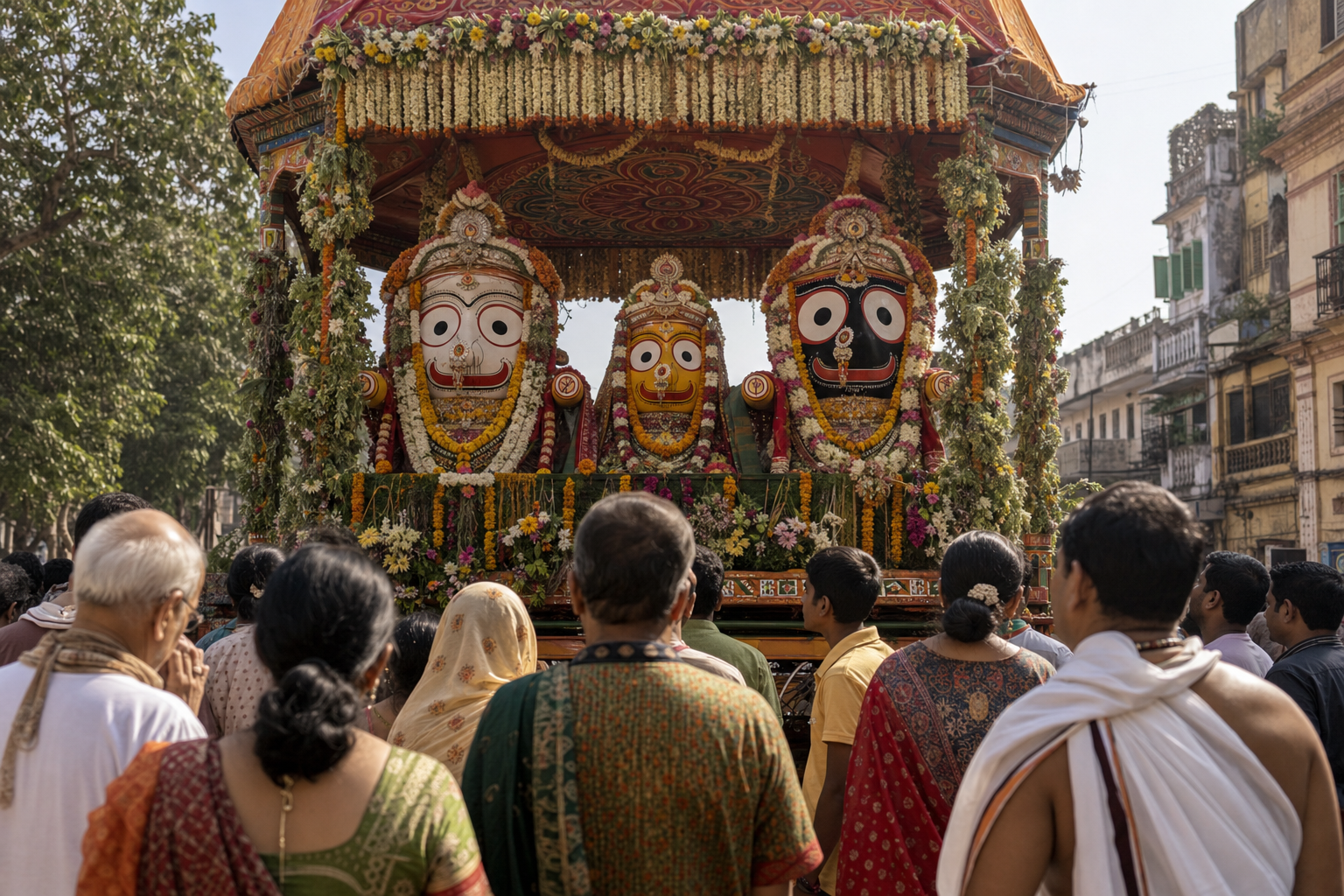
The best-known Rathayatra takes place at Jagannath Puri in Odisha. There, Jagannath, Balabhadra, and Subhadra are ceremonially placed on grand chariots. The Purushottama-kshetra-mahatmya of the Skanda Purana praises the sanctity of this pilgrimage and its sacred setting.
A diaspora Rathayatra does not reproduce Puri in every physical or liturgical detail. It carries the festival’s devotional grammar into a different setting. An urban route becomes a temporary sacred path, and the deity’s journey makes darshan available beyond a temple congregation. Nottingham should therefore be understood as a British expression rooted in a living tradition from Bharat, not as a detached imitation of an Indian spectacle.
In Vaishnava theology, Jagannath is worshipped as Purushottama, the supreme person. His movement into public space represents compassionate availability: the deity symbolically visits the city instead of waiting only for worshippers to enter a shrine. That is why openness to neighbours is not an optional public-relations layer. It reflects the theological direction of the festival itself.
Rathayatra has also become a signature public expression of the Hare Krishna Movement. Across diaspora communities, ISKCON frequently coordinates Festivals of Chariots with councils and interfaith partners. Civic cooperation makes a safe public procession possible, but it does not turn the occasion into a merely secular street event. Administration serves the devotional purpose.
The chariot also supports a contemplative reading. One classical interpretation treats the ratha as the body, its wheels as the restless mind, and its ropes as disciplined practice drawing consciousness toward the divine. This is not the chariot’s only meaning, but it explains why pulling a rope can be understood as sadhana rather than novelty.
If you take hold of the rope at a future Rathayatra, use that symbolism concretely. Bring one clear devotional intention to mind, follow the procession without competing for position, and let the physical act remind you to bring wandering attention back toward the divine. The outer movement becomes useful when it changes the quality of your inner attention.
How to participate and help responsibly
If you are attending
Sound will often be your first point of entry. Rathayatra kirtan uses a call-and-response form, commonly supported by the mridanga drum and karatala hand cymbals. Its purpose is collective remembrance, or smarana, expressed through bhakti. The form belongs to the sankirtana renaissance associated with Sri Chaitanya in the 16th century and remains central to Hare Krishna processions.
- Listen before joining the response. You do not need prior musical knowledge. Hear the leader’s line, notice what the group repeats, and enter with the congregation rather than singing over it.
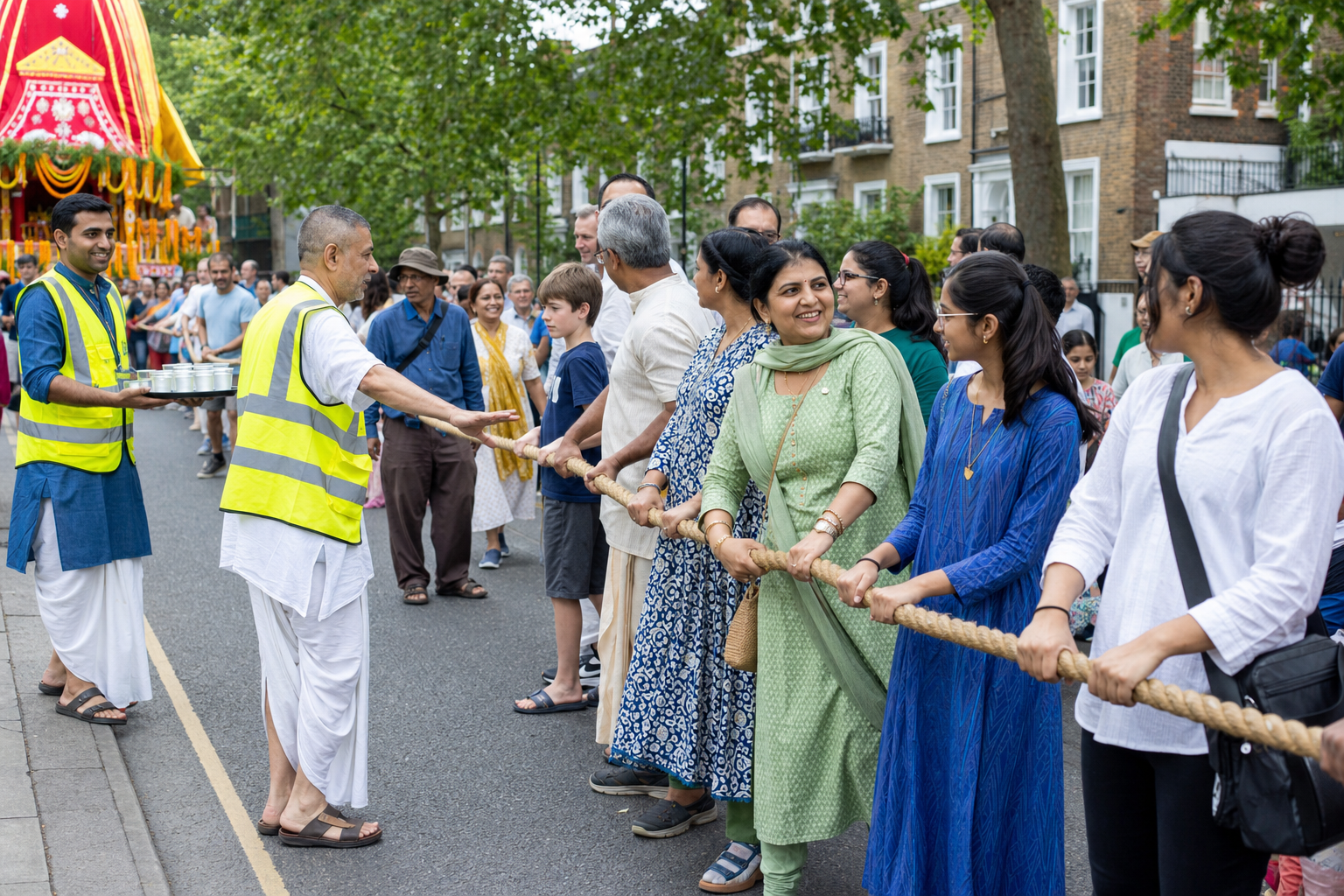
- Follow the stewards near the chariot. Wait for an invitation before approaching a rope, keep clear of the moving wheels, and do not push forward for a photograph or a better position.
- Treat rope-pulling as participation, not a prop. Holding the rope is meaningful because it joins bodily effort to devotion. If you are not ready to pull, walking respectfully or standing aside is also a valid way to witness the procession.
- Leave room for other bodies. Families, elders, and people with disabilities should not have to compete for safe access. Avoid blocking crossings, accessible viewing areas, or stewarded passages.
- Use your camera with restraint. A public setting does not remove ordinary courtesy. Do not obstruct worship, and seek permission before taking close photographs of individual devotees or children.
The most common misunderstanding is to treat kirtan as background entertainment while waiting for the chariot to pass. In this tradition, the sound is itself part of the sacred action. Even if you do not sing, attentive listening lets you encounter the festival on its own terms.
If you are volunteering or helping to organise
Public devotion depends on competent service. If you volunteer at a future UK Rathayatra, ask practical questions before accepting a role:
- Has the route been coordinated with the relevant city authorities, and will current route information be easy for visitors to find?
- Have stewards received training, including clear instructions for crowd movement and escalation?
- Where is first aid, and do volunteers know how to summon it without leaving their positions unmanaged?
- Can families, elders, wheelchair users, and other people with access needs participate without being placed at the edge of the event?
- Are waste-separation points visible, and can reusable containers replace avoidable single-use serving materials?
- Do public notices explain public-transport options so visitors are not forced to rely on cars?
These are established operational priorities for UK chariot festivals, not claims that every measure appeared in exactly the same form in Nottingham. Use them as a checklist for future seva. Risk assessment, first aid, accessibility, and environmental care are not distractions from spirituality. They are ways of protecting the people whom the festival is intended to welcome.
Why public visibility matters without defining the festival
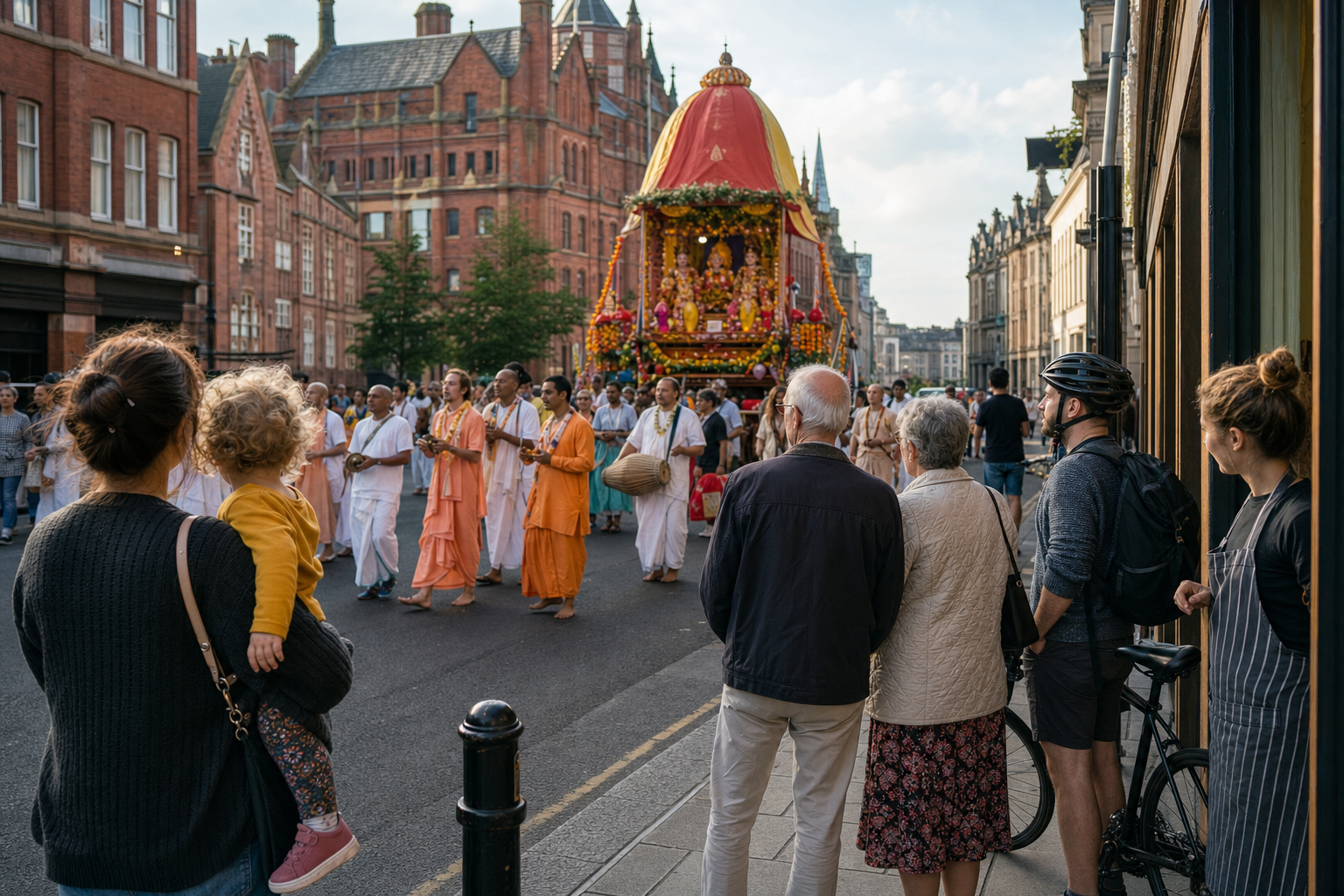
BBC Midlands coverage mattered because it placed Rathayatra alongside other recognisable forms of regional community life. That visibility can improve cultural literacy and make it harder to reduce Hindu festivals to stereotypes. A neighbour who sees a well-organised procession, hears kirtan, and encounters volunteers serving the public receives a more accurate picture of lived Hindu practice.
Media recognition does not confer sacred legitimacy. Rathayatra does not become religiously valid because a broadcaster notices it. The value of coverage lies elsewhere: it opens a civic doorway through which more people can understand the festival as both devotion and public contribution.
That contribution includes intergenerational continuity. Children see inherited practice carried confidently into British public space; elders see that belonging does not require hiding their tradition; and neighbours meet devotees through hospitality, music, and service rather than through arguments about identity. A carefully stewarded festival can therefore strengthen both religious continuity and local trust.
Rathayatra also offers a useful meeting point within the wider dharmic family. Hindu, Buddhist, Jain, and Sikh traditions have distinct teachings and forms of worship, yet they contain recognisable commitments to compassion, non-violence, remembrance, discipline, and community service. Those resonances create grounds for solidarity without making the traditions interchangeable.
If you introduce Rathayatra to a Buddhist, Jain, Sikh, or non-Hindu neighbour, preserve that order of explanation. First state the particular truth: this is a Vaishnava festival honouring Lord Jagannath. Then identify the shared ethical language that may help the listener approach it. Unity becomes credible when it does not erase difference.
Key takeaways
- Nottingham’s Rathayatra took place on 7 June 2026 and brought public devotion to Lord Jagannath into the life of the city.
- The festival is best understood as moving darshan, not simply as an Indian cultural parade.
- Puri supplies the sacred model; diaspora cities adapt the route and logistics while retaining the Vaishnava purpose.
- Kirtan is devotional practice. Listen for the call-and-response pattern before joining.
- Pull the chariot rope only under steward direction and treat the act as sadhana rather than a photographic opportunity.
- Safe routes, trained stewards, first aid, accessibility, waste separation, and transport information are concrete forms of seva.
- Public recognition can build cultural literacy, but it does not define the festival’s spiritual legitimacy.
If Nottingham 2026 awakened your interest, do not reuse its date as though it were a future schedule. Watch for a current announcement from the relevant local organisers, check the published route and access information, arrive before the procession begins, and ask a steward how you can participate or serve. Enter through attention rather than spectacle, and the festival will reveal far more than a passing chariot.
References
