
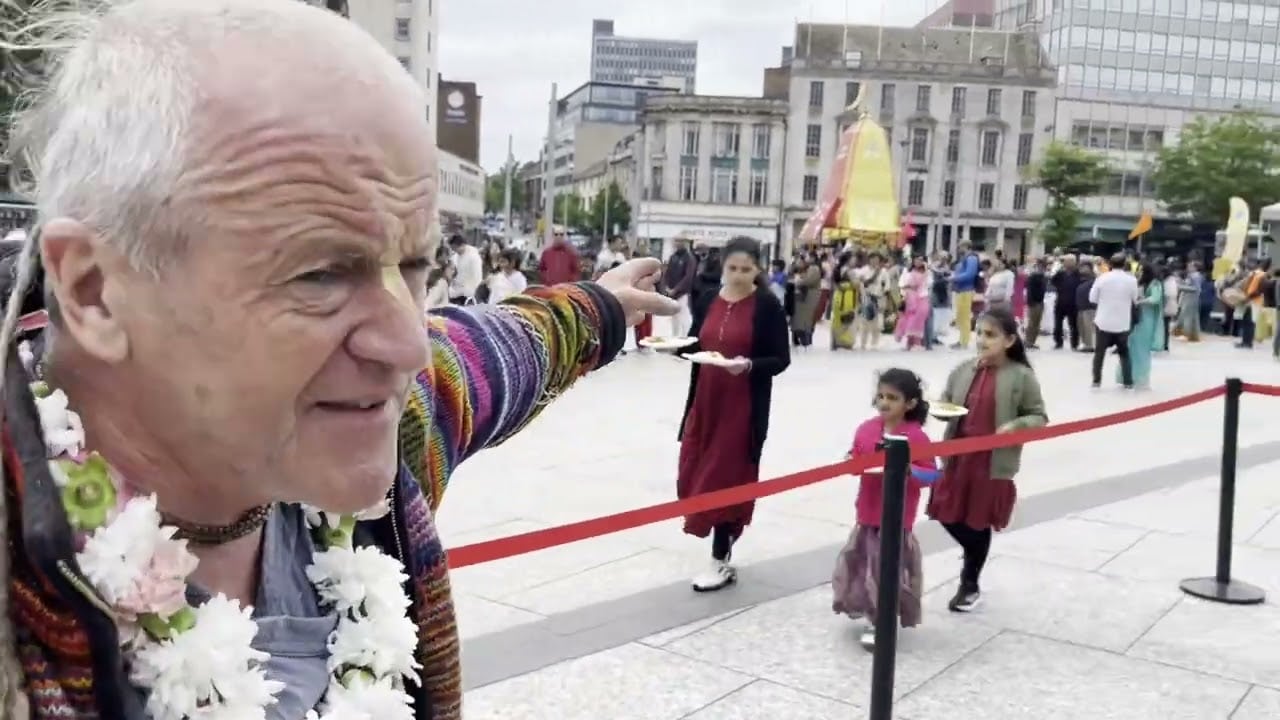
On 7 June 2026, Nottingham hosted a vibrant Rathayatra (Festival of Chariots) honoring Lord Jagannath. Covered by BBC Midlands, the procession reflected meticulous organisation by local devotees and the growing recognition of Hindu festivals in the UK.
Rathayatra, literally “chariot procession” (ratha = chariot; yatra = journey), traces its most celebrated form to Jagannath Puri in Odisha, where the deities Jagannath, Balabhadra, and Subhadra are ceremonially brought onto grand chariots. Puranic literaturemost notably the Skanda Purana’s Purushottama-kshetra-mahatmyaextols the sanctity of this pilgrimage, which diaspora communities respectfully adapt into accessible urban routes that bring darshan into public space.
In Vaishnava theology, Jagannath is venerated as Purushottama, the supreme person, and the festival is a signature public expression of the Hare Krishna Movement. Around the world, ISKCON (International Society for Krishna Consciousness) frequently coordinates diaspora Rathayatras, partnering with local councils and interfaith groups so that the deity’s chariot “visits” the citysymbolising compassionate outreach beyond temple walls to all communities.
Sound is central to the experience. Call-and-response kirtansupported by mridanga (drum) and karatala (hand cymbals)cultivates collective remembrance (smarana) and joyful devotion (bhakti). This musical form, refined through the 16th-century sankirtana renaissance associated with Sri Chaitanya, remains integral to modern Hare Krishna Festival of Chariots processions worldwide, including those in the UK.
The chariot operates as a layered symbol. Classical interpretations liken the ratha to the body, its wheels to the restless mind, and the ropes to disciplined practice that draws consciousness toward the divine. Publicly taking hold of the ropes becomes a participatory sadhanaan embodied commitment to inner transformation through devotion.
Beyond liturgy, Nottingham’s 2026 Rathayatra served as a locus of social cohesion. Festivals of this kind strengthen intergenerational bonds, invite dialogue with neighbours, and highlight shared civic valueshospitality, service (seva), and mutual respectwithin a multicultural setting where heritage and belonging are celebrated together.
These values resonate widely across the dharmic familyHinduism, Buddhism, Jainism, and Sikhismthrough overlapping emphases on compassion, non-violence, mindful remembrance, and community service. Public processions and sung devotion have analogues across these traditions, reinforcing unity-in-diversity without erasing the distinct paths each community follows.
Media visibility matters. Coverage by BBC Midlands situates Rathayatra alongside mainstream community events, encouraging informed engagement and countering reductive stereotypes. Within the broader “hindu festivals uk” landscape, such documentation enhances cultural literacy and fosters constructive conversations around belief, heritage, and shared public space.
Operationally, UK chariot festivals typically involve route planning with city authorities, steward training, risk assessment, first-aid stations, and accessible design for families, elders, and people with disabilities. Aligning devotional aims with public-safety standards ensures wide participation and models best practices for large-scale cultural processions.
Environmental stewardship increasingly informs festival logistics. Volunteer-led waste segregation, reusable offering containers, and clear public-transport wayfinding help reduce environmental footprint while expressing reverence for the natural worldan ethic consistent with Sanatana Dharma’s care for all living beings.
Nottingham Rathayatra 2026 exemplified a living, portable sacred spacerooted in Jagannath Puri yet dynamically expressed in the British context through the Hare Krishna Movement. As devotees and well-wishers offered their hearts in song and service, the unifying invocation echoed across the city: Jai Jagannath!
Inspired by this post on Dandavats.
