
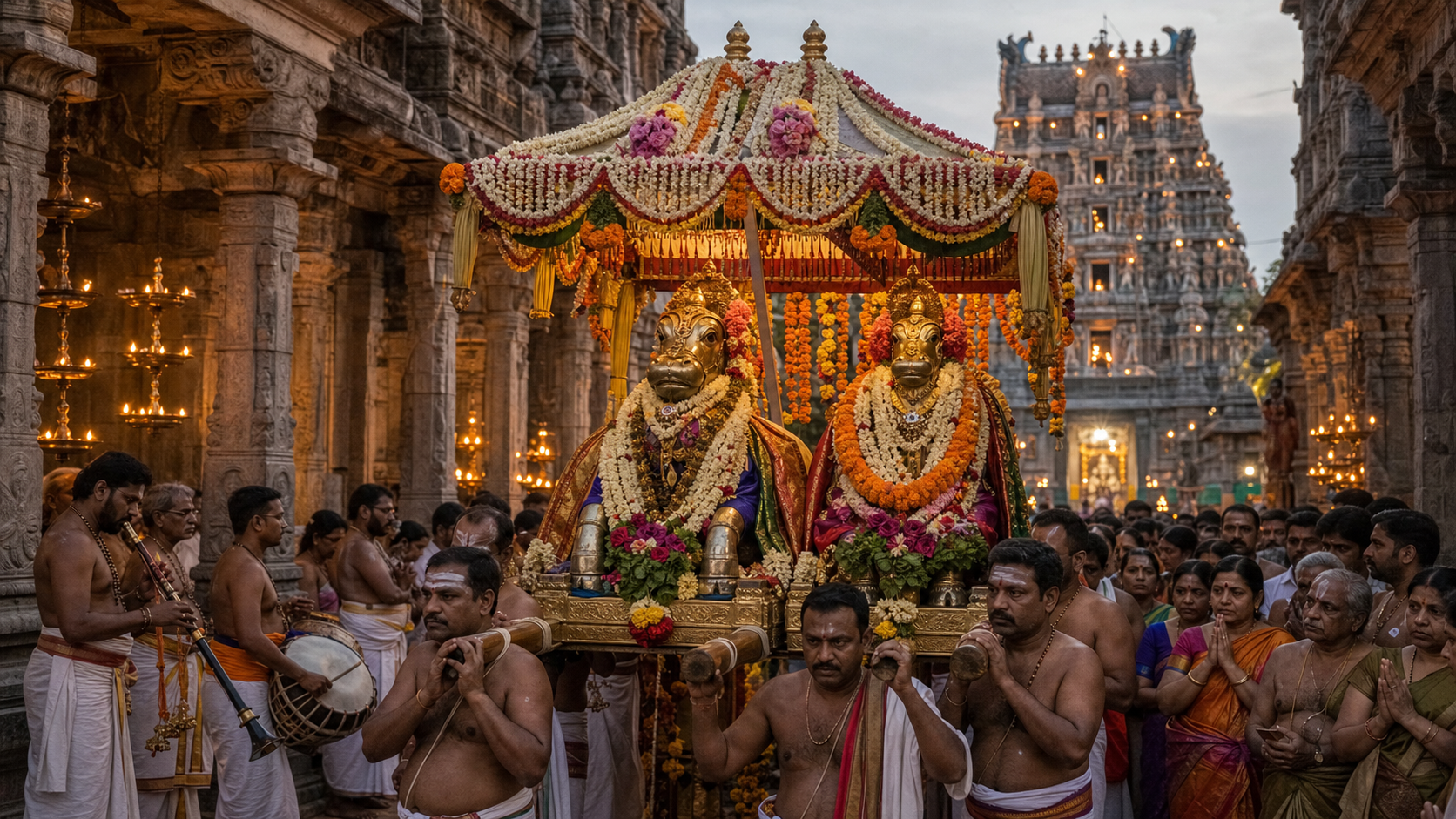
If you are considering a visit for Nandi Kalyanam, the important question is not only when to arrive. It is how to recognize what the celebration asks you to see: devotion expressed through duty, marriage lived within dharma, and a community carrying sacred memory together.
At Thirumazhapadi Vaidhyanathar Temple, Nandikeshwara’s wedding to Suyasha is remembered through worship, music, processional participation, and the shared presence of devotees. Understanding those elements will help you attend as a pilgrim rather than merely watch as a visitor.
The wedding carries a Shaiva teaching about daily duty
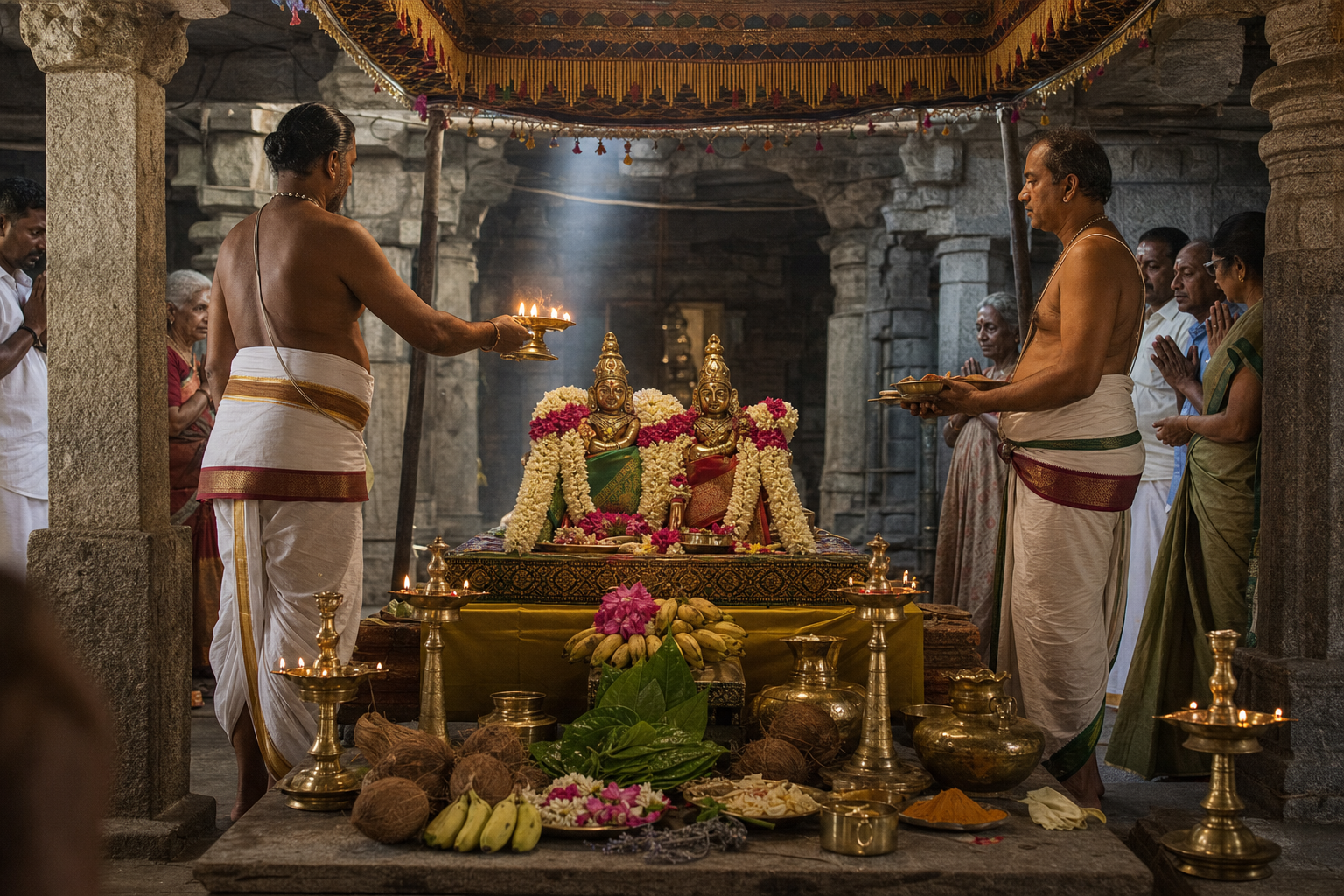
Nandi Devar is not simply a decorative figure associated with Shiva temples. Shaiva tradition knows him as Shiva’s vigilant gatekeeper and devoted attendant at Kailash. His defining qualities are constancy, service, loyalty, and the willingness to protect what is sacred.
The local sthala-purana places Nandikeshwara’s marriage to Suyasha at Thirumazhapadi. The event belongs to sacred time rather than to an ordinary historical chronology. You do not need to force it into a modern date-based account to understand its purpose. The temple community keeps the memory alive because the marriage still teaches people how devotion can shape conduct.
The union brings together Nandi’s unwavering duty and the auspicious grace represented by Suyasha. The bull is an enduring emblem of dharma, so the wedding presents marriage as more than personal companionship. It places fidelity, service, protection, and moral steadiness inside the life of a household.
This matters if you have unconsciously treated spiritual seriousness and household responsibility as competing paths. Nandi Kalyanam affirms the dignity of grihastha life: caring for a family, keeping promises, serving others, and maintaining sacred commitments can themselves become disciplined expressions of bhakti.
Before attending, identify one duty in your own life that needs greater constancy. Make it concrete: keeping a promise without reminders, speaking patiently during a recurring disagreement, caring for an elder, completing neglected seva, or protecting time for daily worship. That gives the celebration a point of contact with your life.
Read the observance in three distinct layers
The exact order and scale of temple observances can vary, so confirm current arrangements locally. The commemoration may include a symbolic kalyanam, processions, nadaswaram and tavil music, and the recitation of Shaiva stotras. Each element does different work.
- The symbolic wedding: This is the ritual center. Watch how the divine marriage is treated as a sacred union rather than as staged entertainment. Families may approach it while seeking blessings for harmony, courage, and collective well-being.
- The procession: If one forms part of the observance, it carries sacred memory into collective participation. Follow the directions of temple volunteers, allow ritual movement to take priority, and resist pushing forward merely to secure a better view.
- The music and recitation: Nadaswaram, tavil, mantras, and Shaiva stotras help create the wedding’s devotional atmosphere. You do not have to understand every word to listen attentively. Notice how rhythm, sound, and repetition gather many individual minds around one sacred event.
Temple bells, flowers, music, and mantra can make the occasion both joyful and solemn. Do not mistake joy for casualness. The best way to participate is to remain responsive to the ritual: become quiet when worship requires quiet, move when the community moves, and let darshan take precedence over photography or conversation.
Prepare for darshan, not just festival attendance
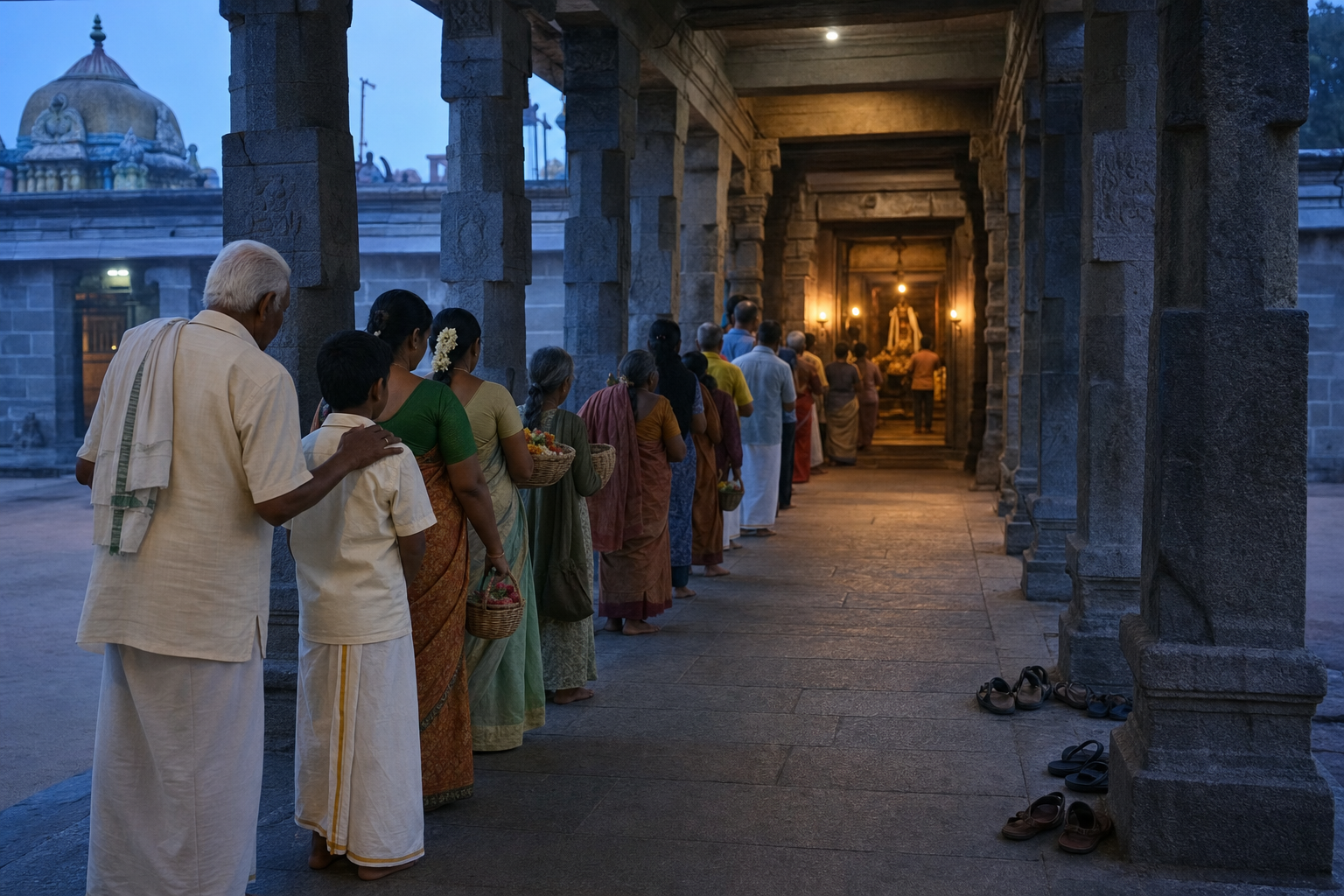
A little preparation prevents practical distractions from consuming the visit. Because the available tradition does not establish a fixed public schedule, do not rely on an assumed annual date, procession order, or offering procedure. Confirm the current timing and local rules with the temple or reliable local organizers before setting out.
- Check the day’s arrangements. Ask about the principal kalyanam observance, darshan access, procession timing, permitted offerings, and any photography restrictions. Follow the information supplied for that particular celebration.
- Dress for temple decorum. Choose modest clothing that lets you sit, stand, and move without constant adjustment. Observe posted instructions concerning footwear, queues, restricted areas, and entry.
- Carry one conduct-based sankalpa. Frame your intention around something you will do, not only something you hope to receive. Nandi’s example is strongest when devotion becomes reliable action.
- Protect your attention. Silence notifications before entering. If images are permitted, take them without blocking worshippers or turning the ritual into a continuous recording session.
- Do not improvise an offering. Ask what the temple accepts and where it should be given. Local practice, not personal assumption, should govern participation.
- Reduce the burden of your visit. Carry away your waste, avoid unnecessary disposable items, and support local artisans or community livelihoods where appropriate.
Families often come with hopes concerning marriage or harmony, but the celebration should not be reduced to a mechanical promise that attendance will produce a desired outcome. Its deeper challenge is ethical. Blessing and responsibility belong together: if you seek steadiness in a relationship, you should also be ready to practice patience, fidelity, truthfulness, and service.
Help children see a living tradition rather than a spectacle
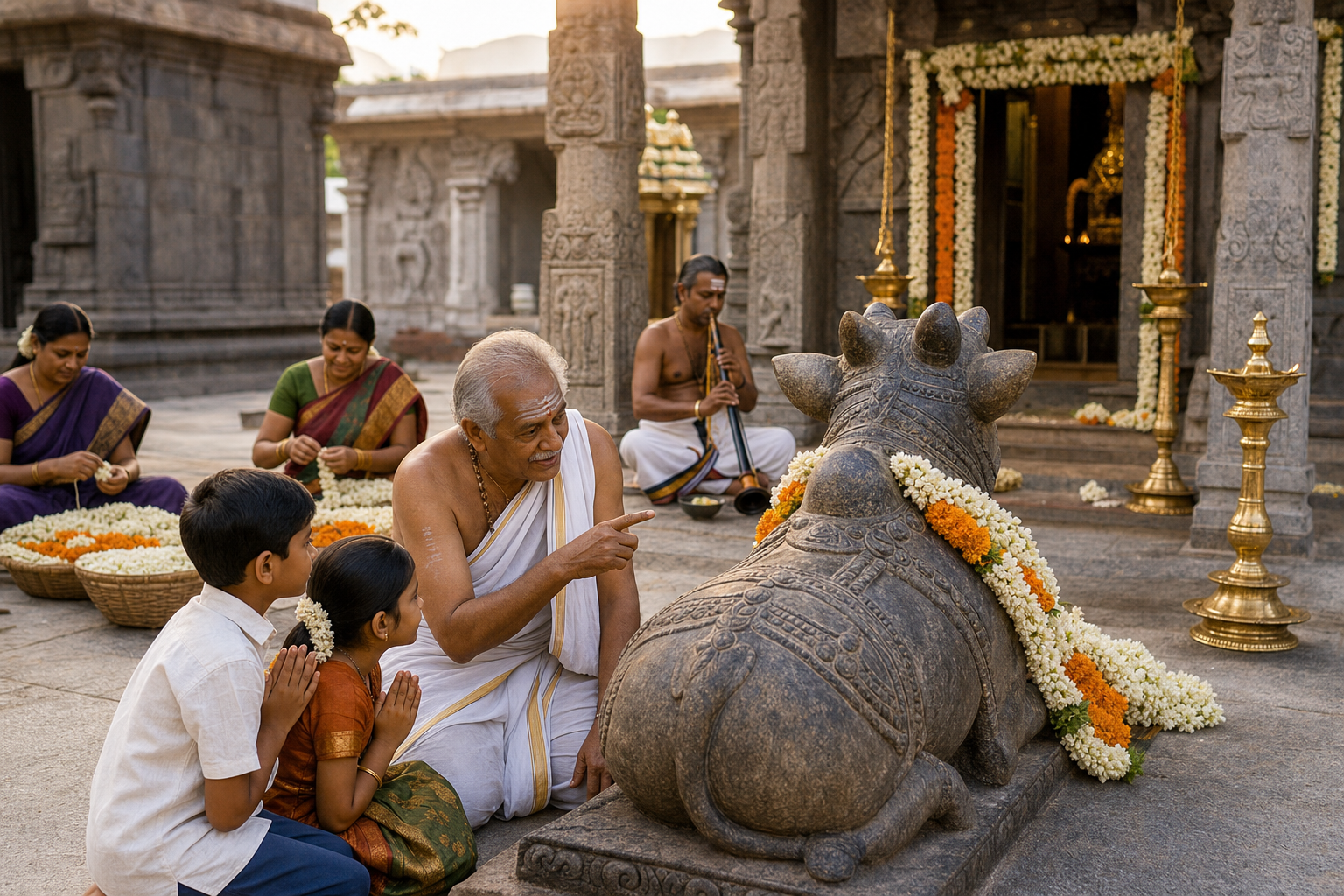
Nandi Kalyanam can become a practical lesson in dharma for children, but only if an adult gives them something meaningful to notice. A long explanation at the temple entrance rarely works. Prepare them with three short ideas: Nandi serves Shiva with unwavering loyalty; Suyasha’s union with him carries auspicious grace; and their wedding teaches that household life can be sacred when it is grounded in duty.
During the observance, invite each child to notice one form of service. It might be a musician sustaining the ritual atmosphere, a priest carrying out worship, a volunteer guiding devotees, or a family member helping an elder. This moves their attention away from noise and crowd movement toward the human effort that allows a tradition to continue.
After darshan, ask one precise question: What would steady service look like in our home this week? Let each person name a small action. A child might help without being asked; an adult might keep a neglected promise; the family might set aside time for worship or seva. That conversation turns temple memory into practice.
This is also how intergenerational continuity is built. Children do not inherit dharma only by hearing that a festival is ancient. They inherit it when they see elders behave with reverence, musicians sustain inherited arts, communities cooperate, and sacred ideals become visible in ordinary conduct.
Key takeaways for your Thirumazhapadi visit
- Nandi Kalyanam commemorates the sacred marriage of Nandikeshwara and Suyasha at Thirumazhapadi Vaidhyanathar Temple.
- The central teaching joins steadfast duty with auspicious grace and affirms the sanctity of responsible household life.
- The observance may include a symbolic wedding, processions, nadaswaram and tavil music, and Shaiva stotra recitation; confirm the current program locally.
- Attend with modest dress, respect for temple instructions, minimal waste, and one practical commitment inspired by Nandi’s constancy.
- For children, connect each ritual element to a visible act of service and discuss how that quality can enter family life.
Let the first act of your pilgrimage be checking the temple’s current instructions. Let the last be keeping the duty you named before entering. The sacred wedding becomes personally meaningful when admiration for Nandi’s devotion matures into constancy in your own conduct.
References
