
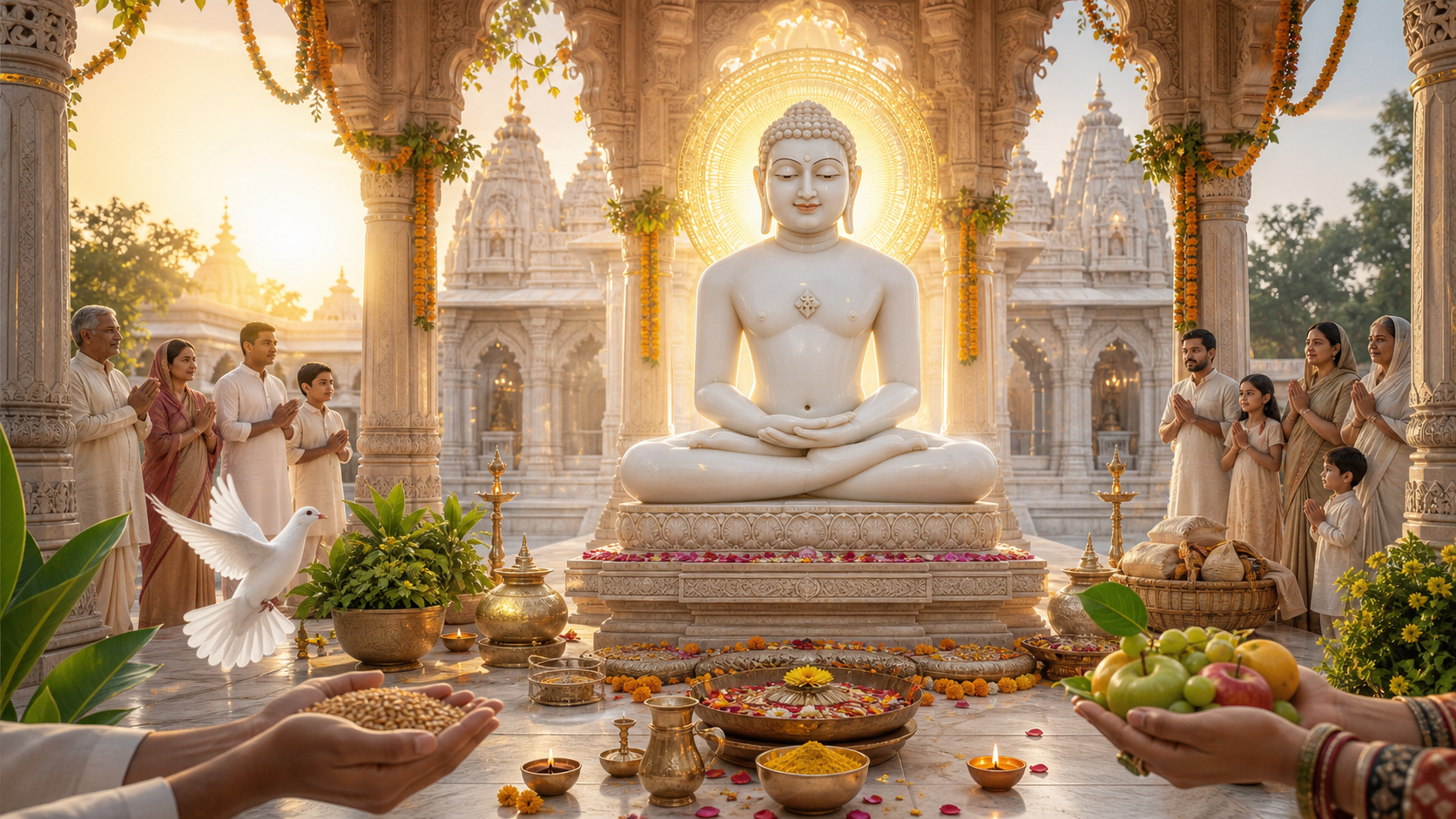
Mahavir Jayanti 2026, also known as Mahavir Janma Kalyanak, falls on Tuesday, March 31, 2026. The festival is observed on Shukla Trayodashi, the thirteenth lunar day of the bright fortnight in the Chaitra Month, and it marks the birth of Lord Mahavir, the twenty-fourth Tirthankara of Jainism. For Jain communities across India and the wider diaspora, this day is not merely a calendrical observance; it is a disciplined remembrance of a spiritual master whose life placed ahimsa, truth, restraint, compassion, and liberation at the center of ethical living.
The name Mahavir Janma Kalyanak is especially meaningful because Jain tradition understands a Tirthankara’s life through auspicious events called kalyanakas. A janma kalyanak refers to the sacred birth event, while the broader framework of Panch Kalyanaka includes conception, birth, renunciation, omniscience, and liberation. In this context, Mahavir Jayanti is not limited to biography. It becomes a study of spiritual possibility: how a human life, purified through discipline and insight, can become a ford-maker for others seeking to cross the ocean of karma and suffering.
Lord Mahavir is traditionally remembered as Vardhamana, born to King Siddhartha and Queen Trishala in the ancient region associated with Vaishali and Kundagrama in present-day Bihar. Jain accounts preserve his birth as a moment surrounded by auspicious signs, including the famous dreams seen by Queen Trishala. Shvetambara traditions commonly describe fourteen dreams, while Digambara traditions often speak of sixteen. These narrative differences are best understood as expressions of devotional memory within Jain diversity, not as divisions that weaken the shared reverence for Mahavir’s life and teachings.
The festival’s spiritual significance rests on Mahavir’s role as the twenty-fourth and last Tirthankara of the present avasarpiṇī, or descending half-cycle of time in Jain cosmology. A Tirthankara is not a creator deity but a perfected teacher who rediscovers and proclaims the path to liberation. This distinction is important in understanding Jain philosophy. Lord Mahavir did not ask humanity to rely on external rescue; he taught that the soul, or jiva, must be purified through knowledge, right perception, right conduct, and disciplined removal of karmic bondage.
In most Jain homes and temples, Mahavir Jayanti begins with reverent preparation. Temples are cleaned and decorated, images of Lord Mahavir are ceremonially bathed through abhishek, and devotees gather for puja, prayers, stavans, scriptural recitation, meditation, and discourses. Processions, often called rath yatras, carry an image of Mahavir with devotion and dignity. These public celebrations can be visually rich, but their central purpose remains inward: to bring the mind back to self-restraint, non-violence, and compassion toward all forms of life.
The abhishek ritual carries theological depth. The bathing of the image is not a simple act of decoration; it symbolically reminds devotees that the soul’s natural purity is obscured by karmic matter, passions, attachments, and careless conduct. Water, sandal paste, and other offerings become ritual languages through which the community contemplates purification. The image of the Tirthankara remains calm, still, and unattached, creating a disciplined visual lesson: serenity is not passivity, but mastery over impulse.
Charity is also a major part of Mahavir Jayanti. Food distribution, support for the poor, medical camps, animal welfare activities, and community service are often organized on or around the festival. In Jain thought, generosity is not merely social kindness; it is connected to aparigraha, the principle of non-possessiveness. When wealth, food, time, or labor is shared with humility, the grip of possessiveness loosens. This ethical practice aligns closely with broader dharmic ideals of dana, seva, daya, and lokasangraha, showing how Jainism contributes to the shared moral vocabulary of Indian civilization.
Mahavir’s teachings are commonly summarized through five great vows: ahimsa, satya, asteya, brahmacharya, and aparigraha. For monks and nuns, these vows are observed in rigorous form; for householders, they are practiced as anuvratas, or smaller vows adapted to domestic and social responsibilities. This graded structure is one of Jainism’s great practical insights. It does not reduce the ideal, but it recognizes that spiritual progress must be integrated into real human conditions, including family life, livelihood, community obligations, and moral decision-making.
Ahimsa is the most widely recognized Jain principle, but its full meaning is often underestimated. It is not only the refusal to harm through physical violence. It includes restraint in speech, carefulness in consumption, mindfulness toward insects and animals, avoidance of cruelty, and vigilance against mental hostility. The principle asks that human beings expand the circle of moral concern beyond convenience. On Mahavir Jayanti, this teaching becomes especially relevant in a world shaped by ecological pressure, social conflict, and casual harshness in public discourse.
Satya, or truthfulness, is inseparable from ahimsa. In Jain ethics, speech must be true, beneficial, measured, and non-injurious. This provides a sophisticated framework for modern communication. A statement may be factually accurate and still be ethically careless if it is delivered with cruelty, arrogance, or the intent to humiliate. Mahavir Jayanti therefore invites reflection on how truth can be practiced without aggression, and how public debate can recover intellectual honesty without abandoning compassion.
Asteya, usually translated as non-stealing, extends beyond the obvious act of taking what belongs to another. It includes fairness in trade, honesty in measurement, restraint from exploitation, and respect for time, labor, credit, and trust. In a contemporary setting, asteya can be applied to business ethics, environmental responsibility, intellectual honesty, and institutional integrity. The festival thus has practical relevance for professionals, students, merchants, administrators, and householders who seek a dharmic model of accountability.
Brahmacharya, in Jain discipline, refers to control over sensual impulses and the intelligent conservation of inner energy. For ascetics it involves celibacy; for householders it means fidelity, restraint, responsibility, and freedom from compulsive indulgence. Its deeper purpose is not denial for its own sake, but clarity. When desire governs the mind, judgment becomes unstable. When restraint matures, attention becomes available for study, service, meditation, and ethical refinement.
Aparigraha, or non-possessiveness, may be one of Mahavir’s most urgent teachings for the present age. It does not require every householder to abandon society; rather, it asks each person to examine the psychological weight of accumulation. Possessions become spiritually dangerous when they generate anxiety, pride, comparison, waste, and indifference to others. In practical terms, aparigraha encourages mindful consumption, simplicity, ecological sensitivity, generosity, and inner freedom from the endless expansion of wants.
Another essential Jain contribution is anekantavada, the doctrine of many-sided reality. It teaches that truth is complex and that finite human viewpoints are partial. This does not mean that all claims are equally valid or that moral clarity should be abandoned. Rather, it cultivates humility before complexity. Anekantavada trains the intellect to listen, qualify, examine, and avoid dogmatism. In an age of polarized debate, this principle offers a disciplined alternative to both relativism and fanaticism.
Mahavir Jayanti also highlights the relationship between Jainism and the wider dharmic family of traditions, including Hinduism, Buddhism, and Sikhism. These traditions differ in metaphysics, ritual, scripture, and community history, yet they share civilizational concerns: liberation, ethical conduct, restraint, compassion, self-knowledge, karma, disciplined practice, and reverence for realized beings. The festival is therefore an opportunity to strengthen dharmic unity without erasing legitimate differences. Respectful distinction and shared moral purpose can coexist.
This unity is especially visible in the shared vocabulary of moksha, karma, tapas, dhyana, dana, and ahimsa. Jainism gives these ideas a precise and rigorous formulation, particularly in its account of karmic bondage and liberation. Hindu darshanas, Buddhist traditions, and Sikh teachings articulate their own pathways, yet all acknowledge that ordinary life must be refined through discipline, wisdom, and compassion. Mahavir Jayanti can therefore function as a bridge of understanding, reminding dharmic communities that diversity need not become fragmentation.
The social atmosphere of Mahavir Jayanti often carries a quiet emotional force. Families dress simply or traditionally, elders narrate episodes from Mahavir’s life, children learn the meaning of ahimsa through stories, and communities gather in temples where silence and devotion stand beside public celebration. For many, the day creates a rare pause from competition and consumption. It allows the mind to ask practical questions: where has speech become harsh, where has desire become excessive, and where has compassion become selective?
From a historical perspective, Mahavir’s life belongs to the extraordinary intellectual and spiritual environment of ancient India, where questions of suffering, rebirth, liberation, ritual, renunciation, and ethical discipline were examined with great intensity. Jainism emerged not as a marginal curiosity but as one of the major śramaṇa traditions that helped shape the philosophical landscape of the subcontinent. Its ascetic discipline, logical sophistication, mercantile ethics, literary contributions, temple culture, and commitment to non-violence have deeply influenced Indian civilization.
The figure of Mahavir also demonstrates that spiritual authority in the dharmic world is not merely inherited through power or institutional status. It is earned through realization. Jain tradition remembers Mahavir as one who renounced comfort, practiced severe austerities, conquered passions, attained kevala jnana, and taught the path of liberation. His greatness lies not in domination, but in conquest of the self. The very title jina means conqueror, and it refers to victory over attachment, aversion, ignorance, and karmic bondage.
Mahavir Jayanti 2026 will also be a public holiday in many Indian contexts, though administrative observances such as bank holidays can vary by region and official notification. This public recognition reflects the importance of Jainism within India’s religious and cultural life. Yet the deeper value of the day cannot be measured by closures or processions alone. Its enduring importance lies in whether the festival renews ethical seriousness in daily life.
A technically informed reading of Jain practice shows that Mahavir Jayanti is not a stand-alone ritual event. It is connected to daily disciplines such as samayik, pratikraman, meditation, scriptural study, fasting, dietary care, and vows regulating conduct. Samayik cultivates equanimity. Pratikraman encourages repentance and correction. Fasting disciplines desire. Scriptural recitation trains memory and moral imagination. Together, these practices demonstrate that Jain spirituality is not built around occasional emotion but around repeated ethical refinement.
The festival’s message also speaks to environmental ethics. Jain dietary practices and concern for living beings have long encouraged careful consumption, vegetarianism, and sensitivity to the hidden consequences of human appetite. In contemporary terms, ahimsa can inform discussions of sustainability, animal welfare, resource use, and ecological humility. Mahavir Jayanti therefore offers more than religious remembrance; it offers a civilizational framework for reducing harm in personal, social, and planetary life.
At the level of personal character, Mahavir’s teachings ask for courageous introspection. It is easy to celebrate non-violence in ceremonial language and much harder to practice it in anger, disagreement, ambition, and fear. It is easy to praise aparigraha while remaining attached to status and accumulation. It is easy to speak of truth while using speech as a weapon. Mahavir Jayanti becomes meaningful when devotion is translated into self-observation and self-correction.
For students and young readers, the festival can be approached as a living ethical syllabus. Ahimsa teaches empathy; satya teaches intellectual honesty; asteya teaches fairness; brahmacharya teaches discipline; aparigraha teaches freedom from excess; anekantavada teaches humility in disagreement. These are not abstract virtues reserved for monks and philosophers. They are usable principles for classrooms, workplaces, families, online spaces, civic life, and friendships.
For families, Mahavir Jayanti can become a day of shared practice rather than passive observance. A household may visit a Jain temple, listen to a discourse, prepare simple sattvic food, support charity, read about the life of Mahavir, reduce waste, speak gently, or take a small vow for the year ahead. Even one sincere commitment, such as avoiding harsh speech or reducing unnecessary consumption, can carry the spirit of the festival beyond a single date.
For inter-dharmic dialogue, the day offers a graceful opportunity to learn from Jainism without appropriation or dilution. Hindus, Buddhists, Sikhs, and others can honor Mahavir by understanding the distinctiveness of Jain philosophy while recognizing shared ethical aspirations. Such learning strengthens mutual respect. It also protects the plural character of dharmic civilization, where multiple paths have historically explored liberation, self-mastery, and compassionate living through different but often complementary disciplines.
Mahavir Jayanti 2026 should therefore be understood as both a sacred anniversary and a practical ethical invitation. It commemorates the birth of Lord Mahavir on Chaitra Shukla Trayodashi, but it also calls society toward restraint in consumption, truth in speech, compassion in action, humility in thought, and unity among dharmic traditions. The power of the festival lies in its capacity to turn celebration into character, ritual into reflection, and remembrance into a disciplined path toward inner freedom.
Inspired by this post on Hindu Pad.
