

If you want to observe Lord Vamana’s appearance day with Vrindavan, keep two things distinct: the confirmed temple programme and the devotional practice you undertake around it. The anchor for this year’s observance is 23 September 2026 at ISKCON Vrindavan.
You do not need an elaborate private ceremony to participate meaningfully. Begin with darshan and hearing, contemplate what Vamana-lila asks of you, and turn that reflection into one concrete act of truthfulness, generosity, or surrender.
What is confirmed about the Vrindavan observance
Three confirmed details can guide your planning:
- The observance is identified as the appearance day of Lord Vamana Dev on 23 September 2026.
- It includes an appearance-day presentation by HH Bhakti Arjava Priti Vardhan Swami.
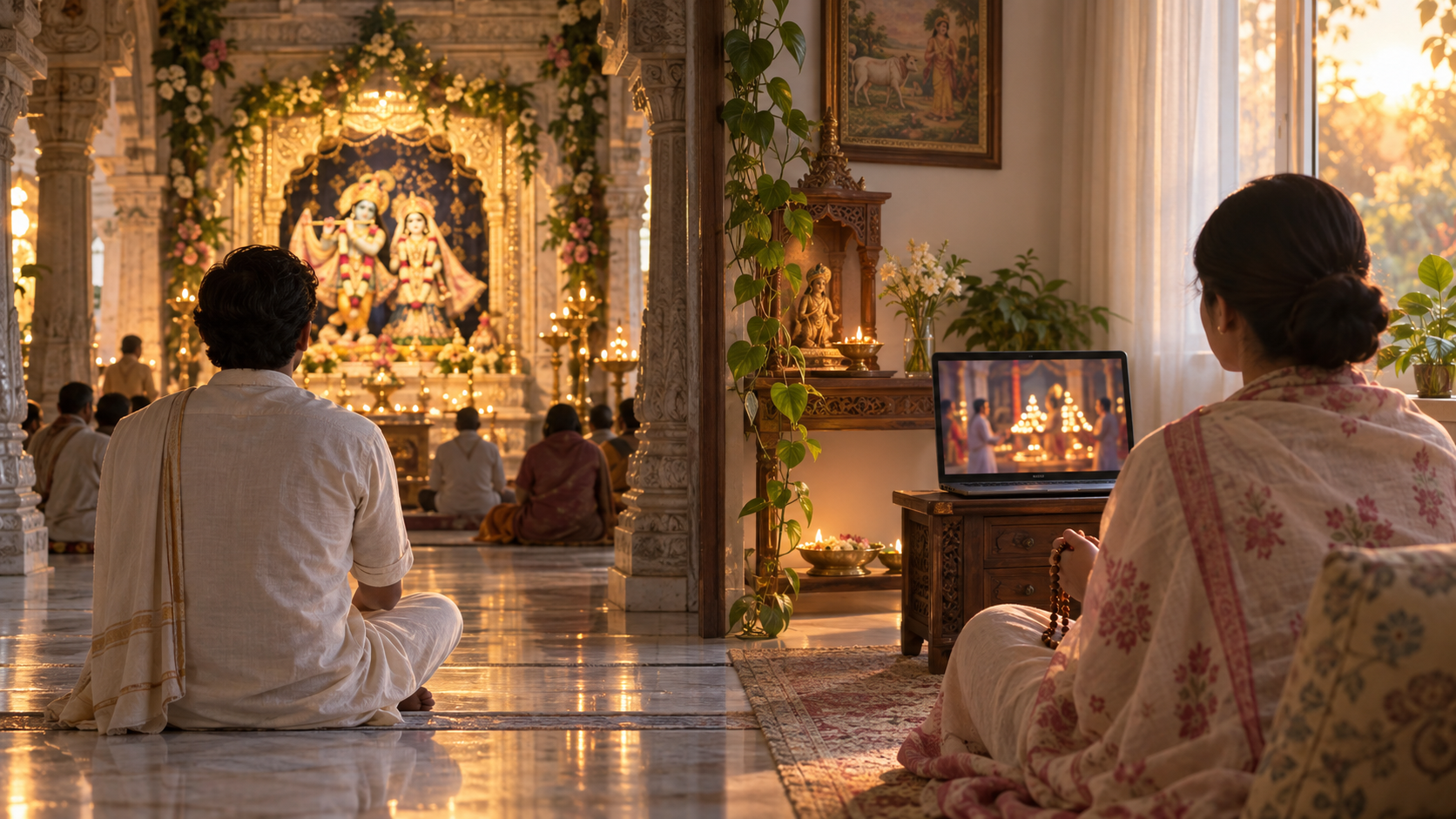
- Devotees can also connect with Mangal Arati darshan from Sri Sri Krishna Balaram Mandir in ISKCON Vrindavan.
These details identify the date, speaker, temple setting, and early-morning darshan. They do not amount to a complete timetable. Do not assume that Mangal Arati and the appearance-day discourse begin at the same time, or that every part of the programme will use the same stream. Confirm the current Vrindavan timing and access details before arranging your day.
If you are joining from outside Bharat, check the time-zone conversion yourself. Save the event link in advance and decide which part you intend to attend. That small step prevents the devotional day from becoming a last-minute search for a working broadcast.
Approach Vamana-lila through promise, possession, and surrender
The familiar Vaishnava account begins with a request that appears almost too modest to refuse. Lord Vamana approaches Bali Maharaja in the form of a young brahmana and asks for as much land as three steps can cover. Once the promise is given, the small request reveals its cosmic scale. Bali can no longer satisfy it with property alone; he must place himself before Bhagavan.
This is why the appearance day should not be reduced to a celebration of a divine victory over an asura. Bali Maharaja is remembered for what he does when generosity becomes costly. His stature lies in honouring his word and surrendering the false claim that anything is finally separate from the Lord.
Listen to the discourse with three questions in mind:
- What do you call yours? Consider the time, ability, influence, or possessions you guard as though they were independent of Bhagavan.
- Which promise becomes negotiable when it costs you something? Bali’s test begins after the commitment has been made, not while generosity is still comfortable.
- What would surrender look like in ordinary life? It may mean keeping a duty, admitting a fault, giving without display, or relinquishing control over an outcome.
These questions keep the lila from remaining a distant cosmic episode. They bring its moral demand into the decisions waiting for you after the festival ends.
Build a simple observance around darshan and hearing
The following sequence is a personal framework, not an official temple timetable. Use it whether you are in Vrindavan or participating from home.
- Set a clear sankalpa. Before opening a stream or entering the mandir, state why you are observing the day. One sentence is enough: you are seeking to hear Vamana-lila attentively and apply one lesson from it.
- Receive darshan as worship. If you join Mangal Arati, prepare before it begins. Wash, wear clean clothes, silence notifications, and keep the screen or worship space free from unrelated activity. A live transmission may arrive through a device, but your participation need not become casual viewing.
- Hear the appearance-day presentation actively. Keep a page divided into two headings: “What Vamana reveals” and “What I will change.” Record only the points that affect your understanding or conduct. This prevents note-taking from replacing reflection.
- Recount the lila accurately. After the discourse, explain the sequence in your own words or read it from a text accepted in your sampradaya. If observing as a family, ask children why three small steps became a test of Bali’s promise. Let them answer before supplying a moral.
- Make one offering of conduct. Choose a manageable act of dana, seva, restraint, or truthfulness. Do it quietly and within your means. The aim is not to imitate Bali’s external circumstances but to loosen one real claim of possessiveness.
- Close with a specific prayer. Ask Lord Vamana for the steadiness to keep your word when keeping it demands humility. Carry that prayer into the next duty of the day.
If you are physically present at Sri Sri Krishna Balaram Mandir, let the temple’s directions govern your movement and timing. Keep your phone silent, avoid obstructing another devotee’s darshan, and treat any photography or recording rules as part of temple etiquette rather than an inconvenience.
Verify fasting and programme details instead of guessing
An appearance-day announcement does not by itself establish a universal fast, permitted foods, a time for breaking the fast, or the exact order of worship. Those practices may depend on the calendar followed by the temple, instructions from your guru, and the discipline of your sampradaya.
Before the observance, verify these points directly with the temple or the spiritual authority whose discipline you follow:
- The local start time for Mangal Arati and the appearance-day discourse.
- Whether the discourse is live, recorded, or available through a separate link.
- Whether visitors need to follow any special entry or seating arrangements.
- Whether your lineage prescribes a vrata, and when that vrata begins and ends.
- Which observances are expected of householders, children, older devotees, or those unable to fast.
Do not improvise a severe fast merely because the day is sacred. If fasting is part of your established practice, follow the instructions of your sampradaya while taking any health condition and medical guidance seriously. Devotion is not strengthened by concealing a health risk or borrowing an austerity you have not been instructed to undertake.
Remote participants should make one further distinction: watching a recording later can still support hearing and remembrance, but it is not the same logistical act as joining a live arati. Decide beforehand whether your priority is real-time participation, careful hearing, or both. That decision will tell you what must be scheduled and what can be revisited.
Key takeaways
- ISKCON Vrindavan marks Lord Vamana Dev’s appearance day on 23 September 2026.
- The identified presentation is by HH Bhakti Arjava Priti Vardhan Swami.
- Mangal Arati darshan from Sri Sri Krishna Balaram Mandir provides an early devotional point of connection.
- Confirm exact times, links, entry arrangements, and vrata instructions rather than deriving them from the event title.
- Centre your observance on the decisive movement of Vamana-lila: a small request exposes attachment, a promise becomes costly, and Bali Maharaja answers with surrender.
- End the day with one concrete act that makes the teaching visible in your conduct.
Your next step is simple: confirm the Vrindavan timing, decide whether you will join darshan, the discourse, or both, and write down the one promise you intend to honour more faithfully. Let Lord Vamana’s three steps enter your life through that one honest beginning.


References

Leave a Reply
You must be logged in to post a comment.