
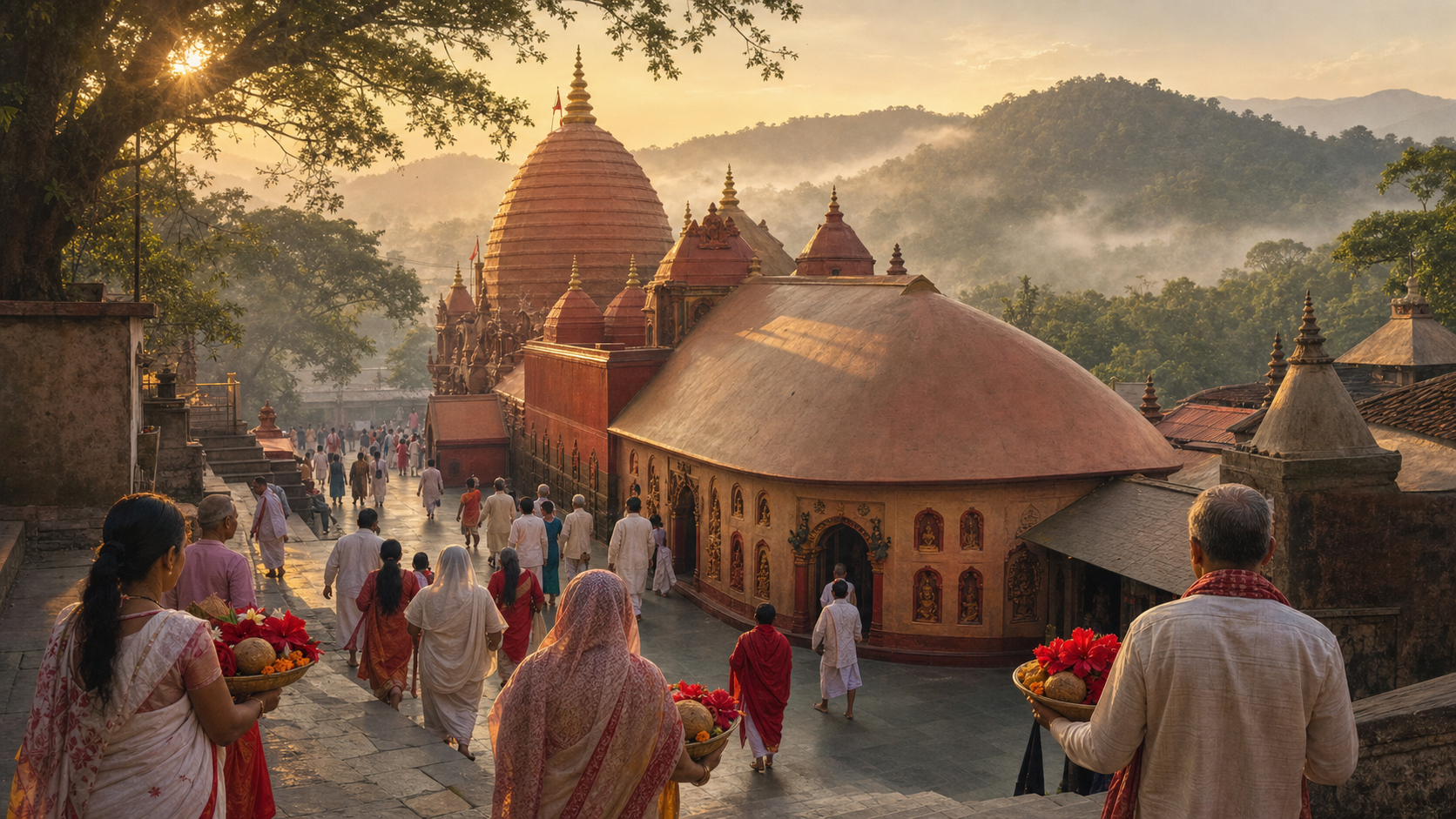
If you are trying to plan Kamakhya around the familiar nine-night calendar, pause before choosing your travel dates or home vrata. The temple’s Ashwin observance follows a sixteen-day Shakta cycle, and treating it as an ordinary Navratri with seven extra dates will obscure the logic of the festival.
You need to make two decisions. First, do you want to witness the whole ritual arc, attend its most concentrated days, or be present for its conclusion? Second, will you undertake a simple public devotional practice at home, or are you already following a guru-given lineage? Once those choices are clear, the calendar, darshan plan, and daily discipline become much easier to arrange.
Understand what the sixteen days are doing
Kamakhya is not simply another setting for a pan-Indian Navratri programme. The temple stands on the Nilachal Hills above the Brahmaputra in Guwahati, and its sanctum enshrines an aniconic yoni-pitha rather than a sculpted image of the Goddess. You therefore approach Devi here as the generative power from which forms arise, not only as one divine form among others.
That theology changes how you should look at the festival. The sacred feminine is not confined to an icon, a particular age, or a remote supernatural realm. Creation, the body, disciplined desire, protection, knowledge, and transformation all belong within the field of shakti. Kumari Puja, the sanctity of the yoni-pitha, and the worship of the Mahavidyas make sense within that larger vision.
The sixteen-day observance, sometimes described as Shodasha-dinatmaka Navaratri, draws together the regional panchanga, the Kalika Purana, the Yogini Tantra, and the temple’s own parampara. It does not replace the nine-night observance followed elsewhere. It is Kamakhya’s regionally rooted expression of the wider Shardiya Navratri and Durga Puja season.
The wider complex contains shrines associated with the ten Mahavidyas: Kali, Tara, Shodashi or Tripurasundari, Bhuvaneshvari, Bhairavi, Chinnamasta, Dhumavati, Bagalamukhi, Matangi, and Kamala. Their presence helps explain the layered Shakta character of the pilgrimage, but you should not force the festival into a made-up chart assigning one Mahavidya, one offering, or one spiritual result to each of the sixteen days. The dependable public map is the progression of rites.
Key takeaways
- Wait for the locally confirmed tithis before fixing a 2026 pilgrimage around a national Navratri calendar.
- Read the observance as an arc: establishment, daily worship, the Mahashtami-Sandhi-Mahanavami climax, and completion on Vijayadashami.
- Use Chandi Path, accessible hymns, and ordinary offerings for home worship; do not adopt lineage-bound tantric mantras without initiation.
- If you can attend only part of the festival, choose your dates by ritual purpose rather than by crowd size alone.
- Expect a temple-centred pilgrimage in which darshan and liturgy matter more than external spectacle.
Read the festival as a four-part ritual arc
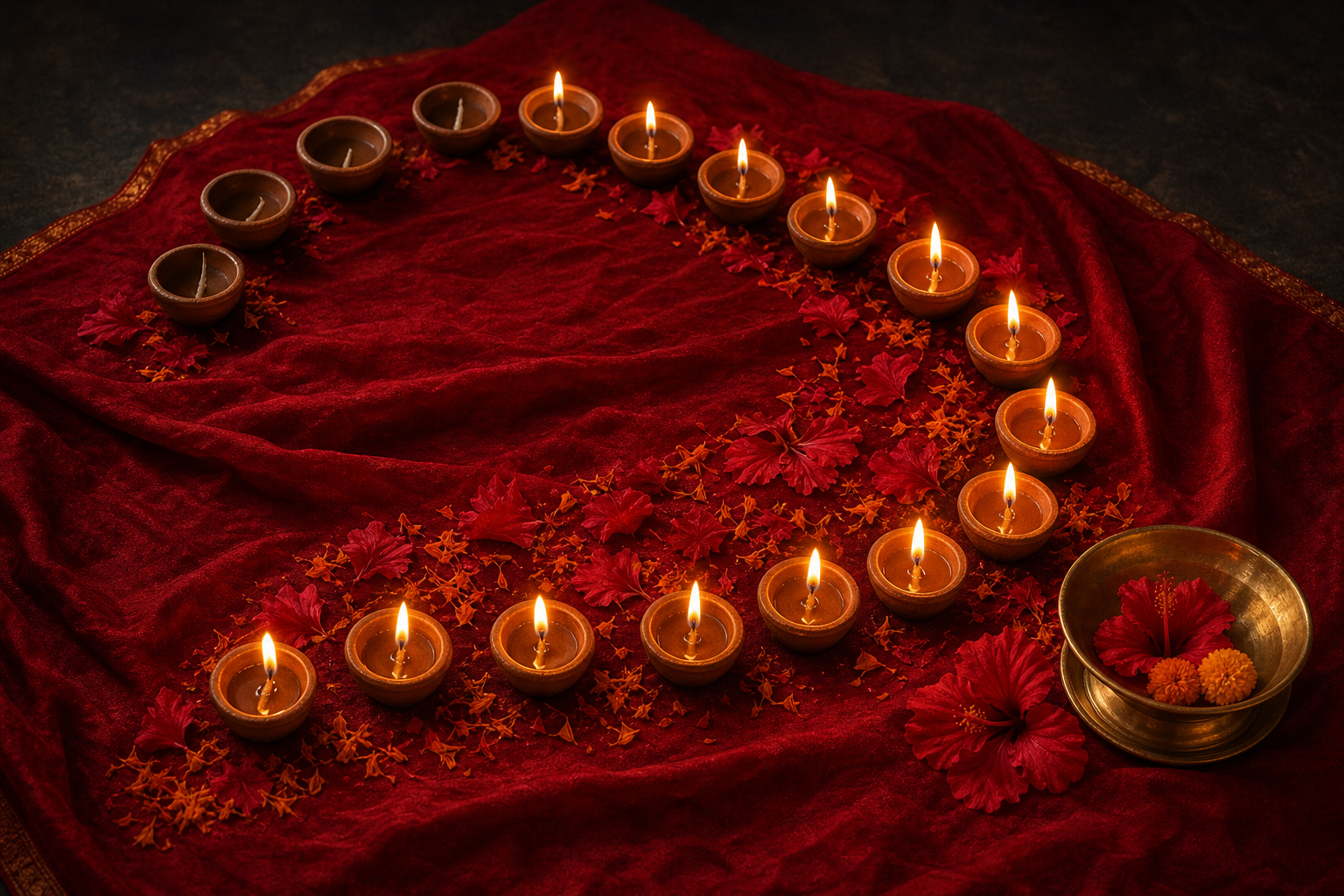
A precise sixteen-row schedule must come from the temple’s calendar for the year. What you can understand in advance is the ritual movement. That is enough to choose the part of the observance most meaningful to you.
- The sacred centre is established. Ghata Sthapana installs the kalasha with auspicious materials and invokes Durga under qualified priestly guidance. This is more than an opening formality: it fixes the intention and ritual centre of everything that follows.
- Daily worship develops steadiness. Puja, offerings, hymns, and recitation of the Devi Mahatmyam, also called Chandi Path, carry the observance forward. Its narratives of Mahakali, Mahalakshmi, and Mahasarasvati restoring dharma give the devotee a practical standard: restrain what is disorderly, cultivate clarity, and act compassionately.
- The rites concentrate at the Ashtami-Navami threshold. Kumari Puja on Mahashtami honours a prepubescent girl as a living presence of shakti. Sandhi Puja occupies the charged transition from Mahashtami to Mahanavami, concentrating offerings and mantra-japa into the relevant muhurta. Mahanavami commonly culminates in homa, with recitation and offerings into Agni completing the liturgical sequence.
- Victory becomes a commitment. Vijayadashami celebrates Devi’s victory over adharma, but the observance does not end with triumphal imagery. Aparajita Puja and the respectful exchange of shami or durva leaves direct the devotee back toward harmony, gratitude, and dharmic conduct in family, work, and society.
This gives you a practical attendance rule. Arrive near the beginning if your priority is sankalpa and the gradual development of the vrata. Centre your visit on Mahashtami, Sandhi Puja, and Mahanavami if you want to encounter the most concentrated ritual period. Choose Vijayadashami if completion, thanksgiving, and renewed resolve are the heart of your pilgrimage.
Shodasha Upachara, the sixteen classical services offered to the deity, threads through this ritual world: avahana, asana, padya, arghya, achamaniya, snana, vastra, gandha, pushpa, dhupa, dipa, naivedya, tambula, nirajana, stuti, and visarjana. These move from invocation and hospitality through sensory offerings, praise, and formal leave-taking. They are a grammar of worship, not a sixteen-day calendar in themselves.
Knowing that grammar helps you notice what is happening even when you cannot follow every recitation. A lamp is not decorative lighting, naivedya is not merely food placed near an altar, and visarjana is not an abrupt dismissal. Each act locates the devotee within a disciplined relationship of welcome, service, gratitude, and release.
Build a home observance without imitating restricted tantra
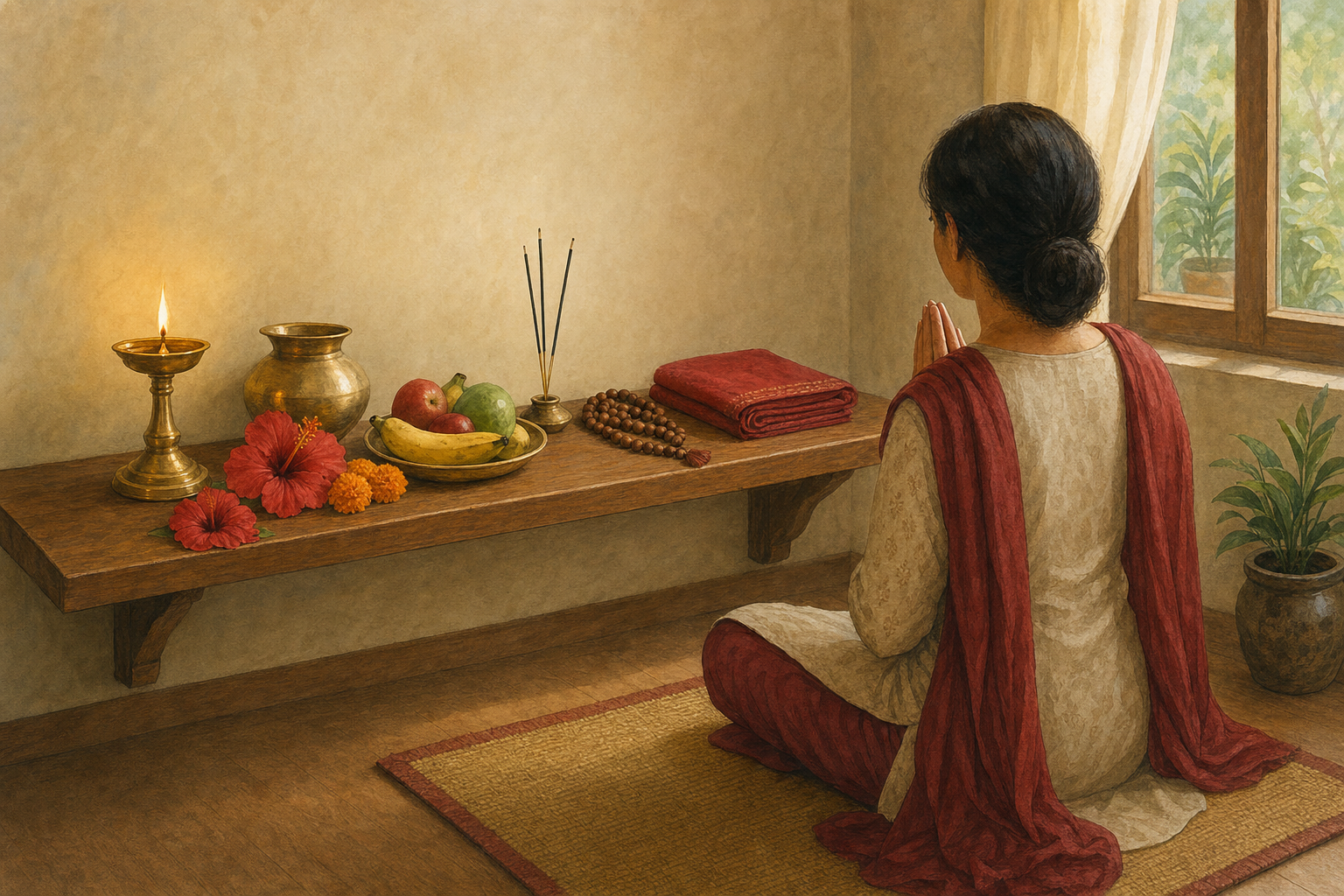
You do not need to reproduce the temple’s full liturgy to participate meaningfully. Kamakhya preserves both public devotion and esoteric practice, and respecting the boundary between them is itself part of proper practice. A mantra belonging to an initiated lineage does not become safer or more authentic because it is readily available online.
The Navarna mantra, in particular, belongs within guru-guided Shakta discipline. If you have not received the relevant initiation and instructions, do not improvise its nyasa, ritual applications, or intensive japa. Choose the strong public practices already available to every devotee.
- State a workable sankalpa. Name the conduct you intend to cultivate across the observance, such as restraint, clarity, compassion, or steadiness. Do not make the vow so elaborate that maintaining the performance displaces its purpose.
- Select one daily textual anchor. Use the Devi Mahatmyam or Chandi Path if you can recite it within your established practice. Sri Durga Saptashloki or Sri Durgashtottara offers a more accessible alternative when a full recitation is not practical.
- Keep the offerings intelligible. A clean place of worship, light, incense, flowers, naivedya, praise, and respectful completion can follow the public logic of upachara without pretending to reproduce temple procedure. Bilva-patra archana is another accessible practice where it belongs to your custom.
- Give the threshold days special attention. Mark Mahashtami, the Sandhi interval, Mahanavami, and Vijayadashami according to reliable local calendrical guidance. Sandhi Puja depends on a particular tithi transition, so a convenient clock time should not be substituted for the proper muhurta.
- End with a concrete dharmic promise. On Vijayadashami, identify one way the vrata will continue in ordinary life. Reconciliation, disciplined speech, dependable family duty, or service to the community gives the language of victory a real consequence.
If Kumari Puja belongs to your household or community tradition, remember what the rite claims: the girl is being honoured as a manifestation of shakti. Her dignity, comfort, and respectful treatment must therefore govern the occasion. It should never be reduced to costume, display, or intrusive photography.
Offerings require the same honesty. Parts of the Shakta world preserve histories of bali, while contemporary Kamakhya accommodates more than one devotional approach. If your vrata is grounded in ahimsa, vegetarian and symbolic offerings provide a coherent path. Do not improvise a sacrificial practice or pressure another devotee to violate a sincere discipline; follow the temple’s procedures and the guidance of qualified custodians.
Plan 2026 darshan from the local tithis outward
Shardiya Navratri falls in the Ashwin season, generally across September and October, but that broad window is not enough for booking a Kamakhya pilgrimage. The commencement, conclusion, and darshan arrangements are confirmed locally. Check the temple administration’s final schedule before committing to non-flexible travel, especially if Sandhi Puja or another time-bound rite is the reason for your visit.
Build the yatra in this order:
- Confirm the tithis and access arrangements. Do not rely only on a generic Navratri calendar, an old festival programme, or a forwarded message. Temple-specific dates and darshan windows are the controlling information.
- Choose the ritual moment. Mahashtami, Mahanavami, and Vijayadashami are peak days. If one of those rites is essential to you, prioritise it first and accept the heavier footfall that comes with it.
- Prefer early-morning darshan on peak days. An early start improves your chance of moving through the regulated approach before the day’s pressure increases. Keep the rest of that day flexible rather than placing another fixed appointment immediately after darshan.
- Add buffer days. The observance has a cadence that is difficult to experience through a rushed arrival and departure. A buffer also absorbs queues, traffic regulation, intermittent rain, and schedule adjustments without turning the pilgrimage into a race.
- Book accommodation in Guwahati early. Options range from dharmashalas and budget lodging to mid-scale city hotels. Decide whether proximity, simplicity, or easier city transport matters most to your household before rooms tighten around the major dates.
Guwahati is served by Lokpriya Gopinath Bordoloi International Airport and major rail connections around Paltan Bazar. The Nilachal Hills can be approached by road, but high-footfall days bring regulated parking and designated pedestrian movement near the temple. Treat the final hill approach as part of the pilgrimage rather than assuming a vehicle will deliver you directly to the point you prefer.
Assam at this time is commonly warm and humid, with intermittent showers as the monsoon recedes. Light cotton clothing, water, sun protection, and footwear suitable for walking and waiting are practical necessities. Pack for the queue you will actually stand in, not merely for the few minutes you hope to spend in the sanctum.
If you are travelling with elders or children, make their waiting tolerance the limiting factor in your plan. Keep food, rest, transport, and a return route flexible, and follow the priority arrangements communicated on site. A spiritually ambitious itinerary that exhausts a vulnerable family member has misunderstood seva.
Enter Kamakhya on its own terms
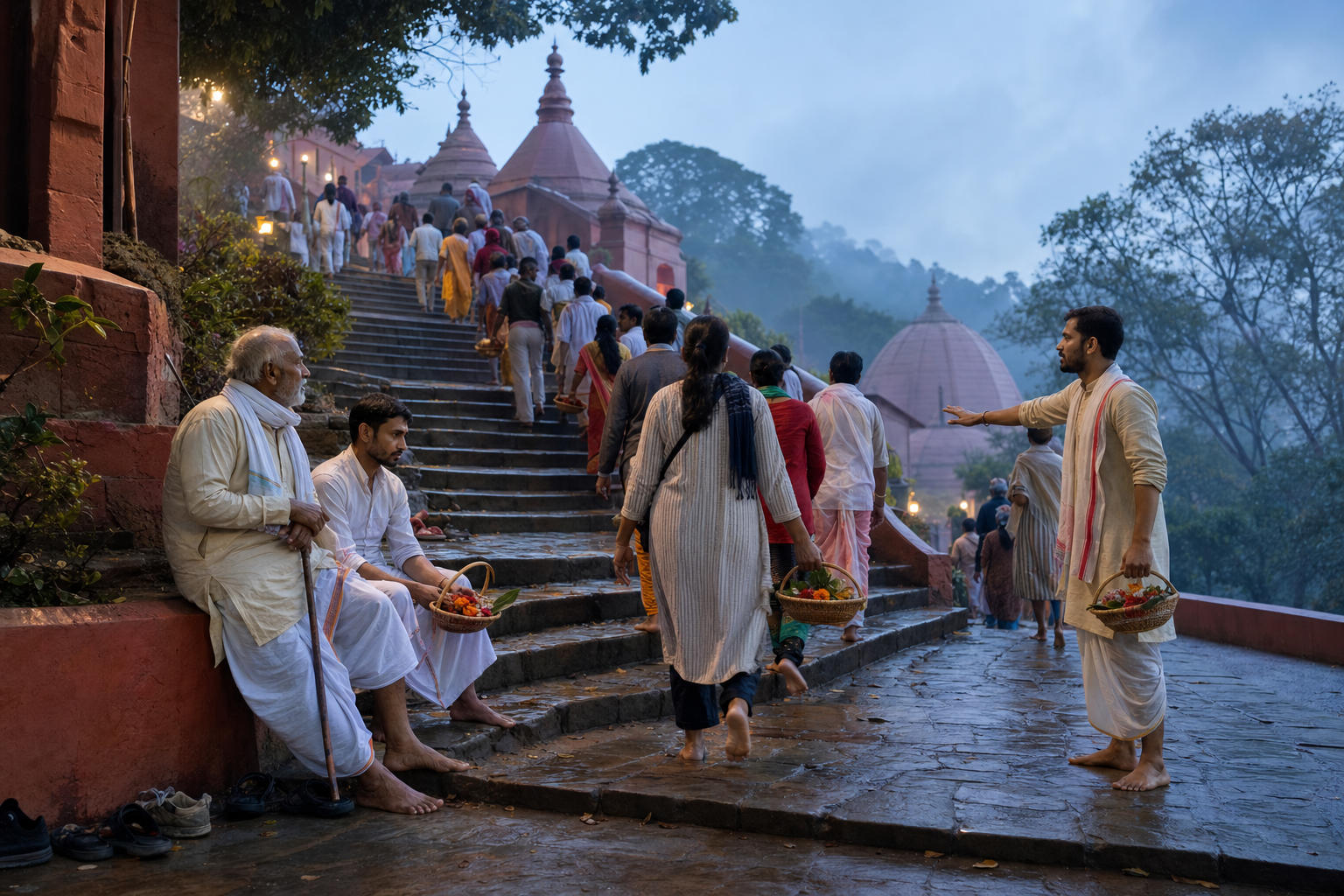
Someone accustomed to grand Durga Puja pandals may arrive expecting spectacle to carry the experience. Kamakhya is more fundamentally a temple-centred pilgrimage. Assamese devotional poetry, kirtana, ritual music, and regional arts enrich the setting, but the principal aesthetic act is worship itself.
Prepare for an aniconic sanctum. If you expect a sculpted image to provide the visual focus, the yoni-pitha may initially feel unfamiliar. Do not fill that unfamiliarity with hurried photography or disappointed comparison. Let the absence of an anthropomorphic image direct your attention toward water, stone, touch, sound, offering, and the generative presence the pitha signifies.
Within the temple precincts, practical etiquette protects both sanctity and people:
- Remain inside prescribed queues and follow current instructions for inner courtyards and the garbhagriha zone.
- Wear clothing appropriate to a Shakti Peeth and suited to walking in warm, humid conditions.
- Minimise mobile use around active ritual spaces. A darshan queue is not a filming position.
- Give elders, children, and those struggling in the wait the space and priority provided for them.
- Receive prasada through the organised distribution arrangements rather than obstructing the flow near ritual areas.
- Use the available waste-segregation arrangements and do not leave packaging, flowers, or food along the hill approach.
- Ask before carrying an offering into a restricted area; do not assume that every object accepted at a home altar belongs in the sanctum.
If time and access permit, allow the Mahavidya shrines to widen your understanding of Kamakhya beyond a single darshan queue. Do not rush through them as a collection to be completed. Kali, Tara, Tripurasundari, Bhuvaneshvari, Bhairavi, Chinnamasta, Dhumavati, Bagalamukhi, Matangi, and Kamala disclose very different aspects of the same vast Shakta horizon.
The most useful step now is simple: write down whether your priority is the full sixteen-day rhythm, the Ashtami-Navami threshold, or Vijayadashami. Wait for the temple-confirmed tithis, book with a buffer, and choose a daily public practice you can sustain. Then arrive ready to receive Kamakhya’s discipline, not to force the pilgrimage into a schedule or image formed elsewhere.
References
