
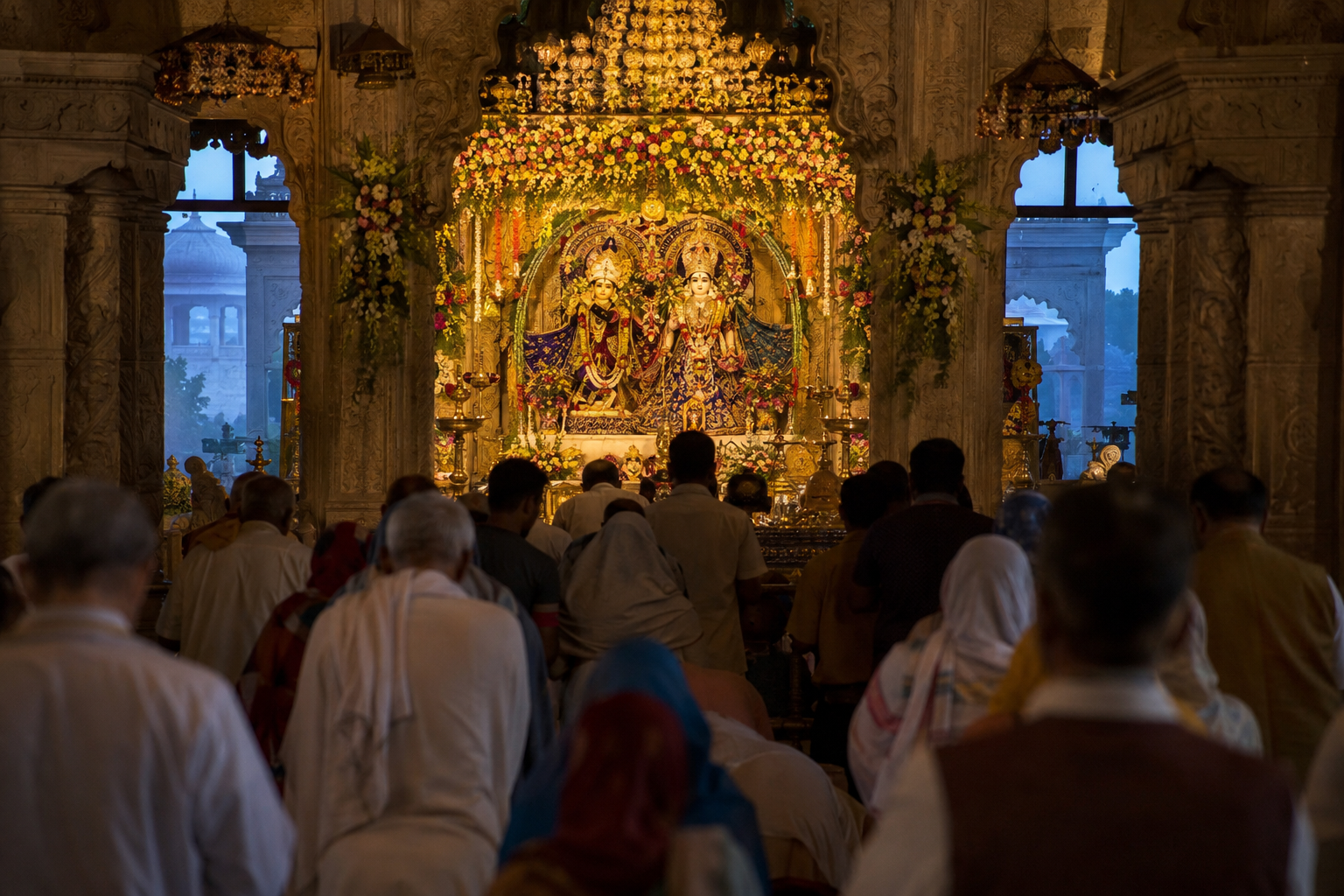
If you missed Janmastami 2026 in Vrindavan, you can still approach the celebration as a devotional encounter rather than a stream of festival media. The most useful path is simple: see with attention, hear about Krishna, and carry one response into your own sadhana.
ISKCON Vrindavan shared Mangala Arati darshan photographs for Janmastami 2026. His Grace Panca Gauda Prabhu is also named for Glorification of Lord Krishna, dated 04-09-2026. Together, these give you two complementary ways into the festival: darshan for the eyes and Krishna-katha for attentive hearing.
What is firmly established about the 2026 observance
The available festival trail confirms Mangala Arati darshan connected with ISKCON Vrindavan’s Janmastami observance. It also identifies a Krishna-glorification program by His Grace Panca Gauda Prabhu on 4 September 2026. Those are the details you can repeat confidently.
Do not turn those details into claims they cannot support. A photograph album does not establish the complete order of ceremonies, public-entry arrangements, crowd procedures, or the exact timing of every temple program. Likewise, the date attached to a discourse identifies that program; it should not be treated as a timetable for every part of the celebration.
This distinction matters if you are preserving the occasion, writing a caption, or planning a later pilgrimage. Label the photographs as Mangala Arati darshan and identify the discourse by its stated speaker and date. For a future visit, obtain that year’s current temple schedule instead of assuming that the 2026 pattern will be repeated unchanged.
Approach the Mangala Arati photographs as darshan
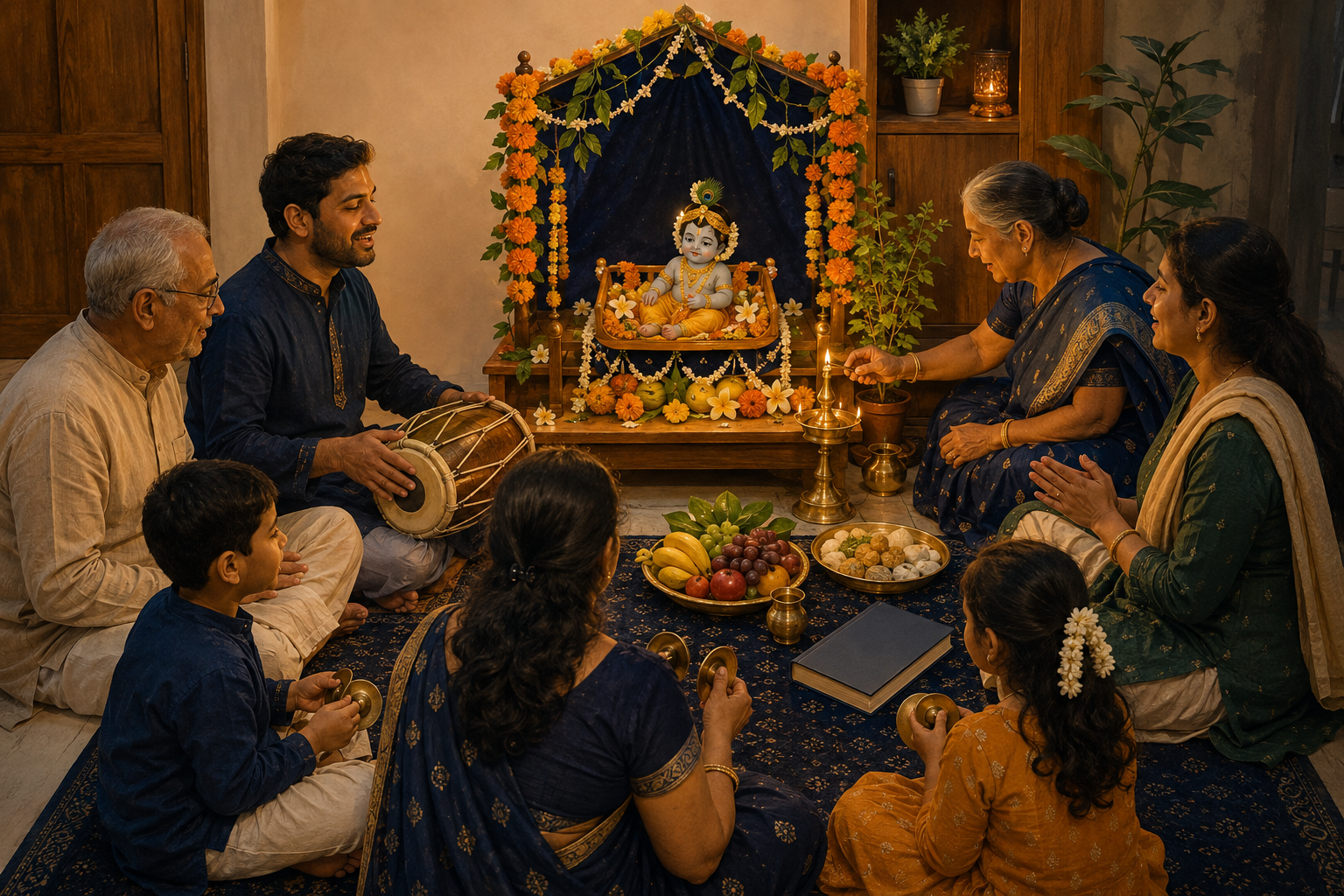
Mangala arati belongs to the auspicious opening of the devotional day. Darshan, in temple practice, is more than looking at a religious image. You bring your attention before the worshipped form of the Lord. That difference is easy to lose when sacred images appear in the same feed as news, messages, and entertainment.
Before opening the album, silence the distractions you can control. Offer pranam in the manner taught within your tradition. Then move through the photographs slowly enough to notice what is actually present rather than hunting for the most dramatic frame. Let one image hold your attention. You might notice the altar as a whole, the expression of worship, or a detail of the day’s presentation, but avoid claiming details that the image does not clearly establish.
When you have finished, pause before opening another app. Recall one feature of the darshan and offer a short prayer in your own words. This small boundary between sacred attention and ordinary scrolling changes the act: you are no longer merely consuming festival photographs.
Let Krishna-katha complete what the eyes begin
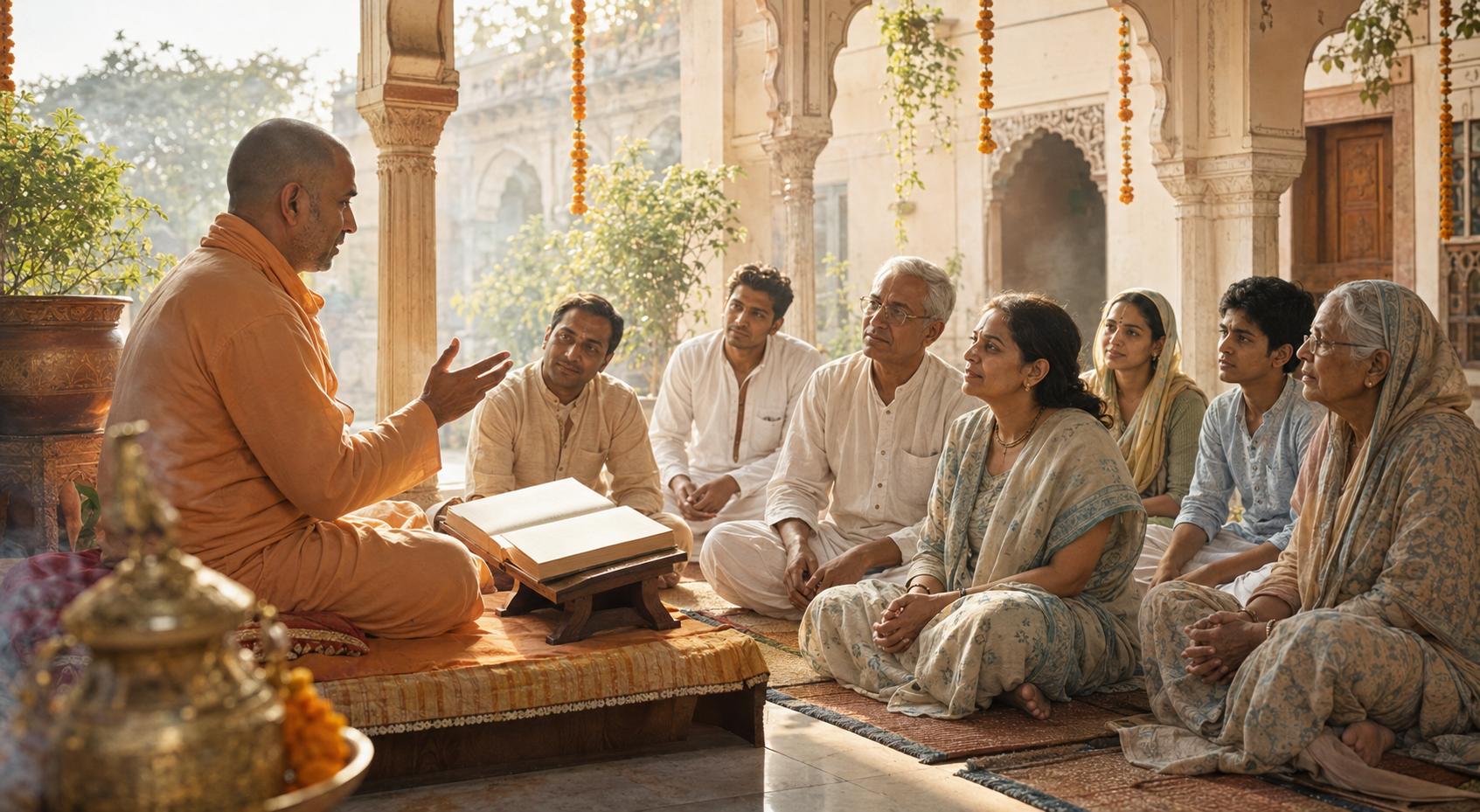
Visual splendour can draw the mind toward Krishna, but hearing gives that attention direction. Krishna-katha is devotional speech centered on Krishna: His names, qualities, activities, teachings, and relationships with His devotees. The program attributed to Panca Gauda Prabhu is explicitly framed as glorification of Lord Krishna, so that broad subject should remain the center of your listening.
Listen for three things. First, which name, quality, activity, or relationship of Krishna is being emphasized? Second, what response is being asked of the listener: remembrance, gratitude, surrender, service, or a correction in conduct? Third, what single teaching can you return to during your regular practice?
Take brief notes in your own words. If you later share a quotation or clip, preserve the speaker’s name and the date, and separate the speaker’s words from your interpretation. Do not attach an unverified verse, translation, or narrow doctrinal thesis to Panca Gauda Prabhu merely because it seems consistent with the program’s title.
This is also how the festival avoids becoming an isolated emotional peak. Darshan gathers the mind; hearing teaches the mind what to remember; practice gives that remembrance somewhere to live.
A simple way to observe from home
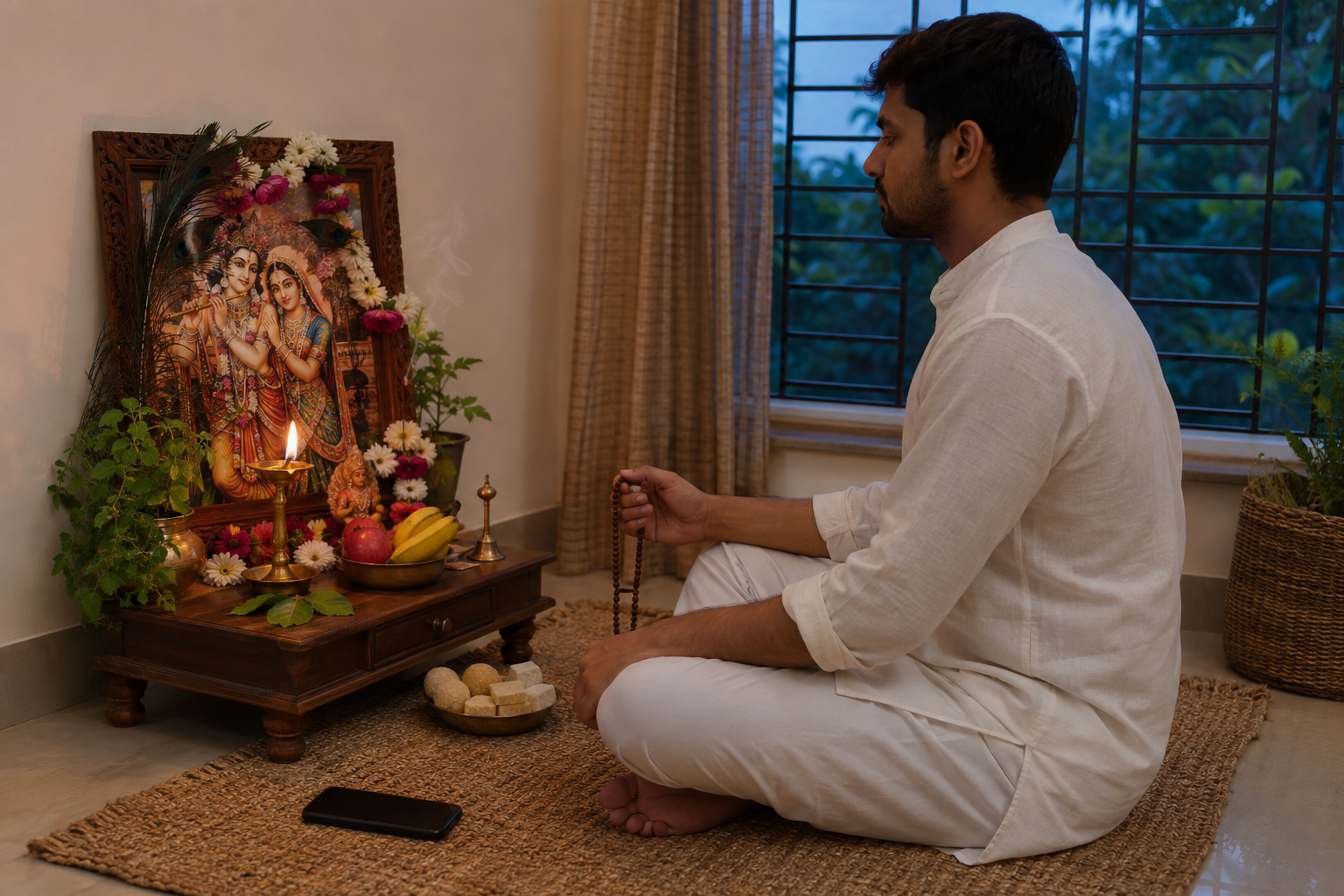
If you are engaging after the event or from outside Vrindavan, use the available material as a sequence rather than browsing it casually. The following is a personal devotional framework, not an official ISKCON Vrindavan ritual or festival schedule.
- Prepare. Open the darshan album and the Krishna-glorification program before beginning, then put away unrelated notifications.
- See. View the Mangala Arati photographs with undivided attention. Offer pranam and remain with one image instead of rushing through the entire album.
- Hear. Give the Krishna-glorification program the same attention you would give a speaker sitting before you. Do not multitask.
- Respond. Write one sentence naming what you understood about Krishna and one sentence naming the response it asks from you.
- Carry. Bring that response into a practice already familiar within your sampradaya, such as prayer, seva, remembrance, or chanting a name or mantra you have been taught.
If a photograph or recording does not load, resist filling the gap with confident guesses. Retain the verified title, speaker, date, and temple connection as an index, then look for a functioning upload through ISKCON Vrindavan’s current official channels.
Key takeaways
- ISKCON Vrindavan’s documented Janmastami 2026 material includes Mangala Arati darshan photographs.
- His Grace Panca Gauda Prabhu is identified with a Glorification of Lord Krishna program dated 4 September 2026.
- The photographs support devotional viewing, but they should not be used as proof of a complete schedule or visitor arrangements.
- Move through the occasion in a deliberate order: darshan, hearing, reflection, and a familiar personal practice.
- When sharing the material, preserve verified names and dates and distinguish your reflection from the speaker’s teaching.
Begin with the Mangala Arati darshan. Give it your full attention, then hear the glorification of Krishna and choose one response to carry into your next period of practice. That turns an archived celebration into a living devotional step.
References
- Dandavats – Janmastami 2026 – Mangal Aratik Darshan (Album of photos)
- Dandavats – Glorification of Lord Krishna || His Grace Panca Gauda Prabhu || 04-09-2026
