
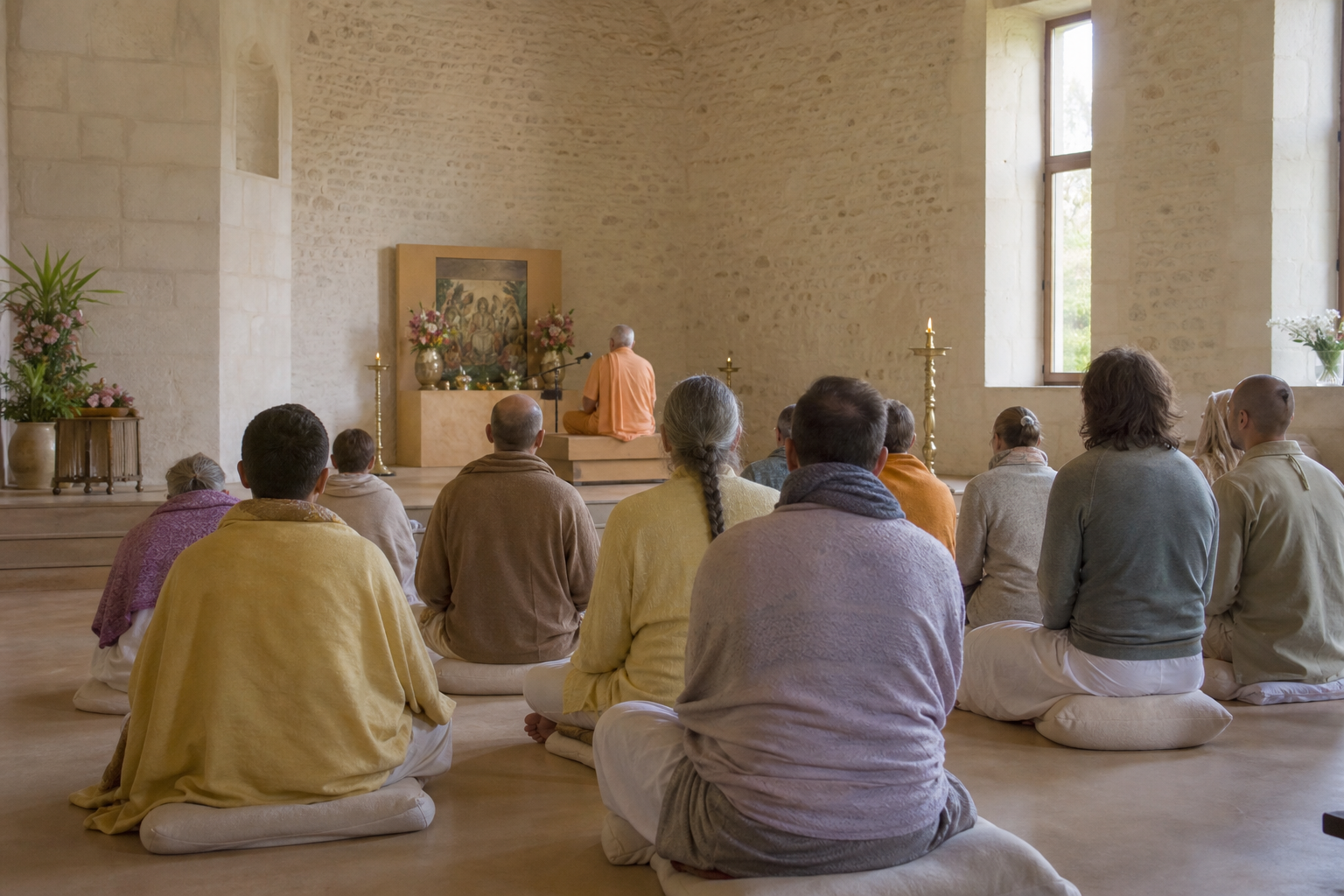
If you came looking for Janananda Swami’s Balaram Purnima lecture, begin with the direct lecture page. It is identified as a 27 Aug morning lecture by Janananda Swami, carried by the ISKCON New Mayapur, France channel.
The festival title tells you the occasion, but it does not tell you everything the speaker will say. The sound approach is to hear the lecture on its own terms, record its teachings accurately, and carry one clear point into your practice. That protects you from both passive listening and invented summaries.
Begin with the occasion, but do not pre-write the message
Balaram Purnima is the Vaishnava observance of the appearance of Balarama, revered as Krishna’s elder brother. That background gives you a devotional orientation before you listen. It should not become a substitute for listening.
A familiar festival name can create a subtle problem. You may arrive with remembered stories, earlier lectures, or a preferred theological theme and then hear those expectations instead of the speaker’s actual emphasis. Keep your prior understanding available, but provisional. Let Janananda Swami establish which aspect of the occasion matters for this particular discourse.
Before pressing play, write one question at the top of a page: What should become clearer in my understanding or conduct after hearing this lecture? The question is broad enough to keep you receptive, yet practical enough to prevent the lecture from becoming background audio.
Be equally careful with summaries shared by others. A festival title identifies the setting, not the argument. Do not attribute a teaching to Janananda Swami unless you can locate it in the lecture, and do not treat a familiar teaching about Balarama as something this speaker necessarily emphasized.
Listen in three passes, not as background audio

A festival lecture often rewards continuity first and close attention second. Pausing at every unfamiliar expression can break the movement of the discourse, while listening only once can leave you with a general mood but no dependable understanding. Use three distinct passes.
- Hear the full lecture for continuity. Do not try to transcribe it. When a point catches your attention, mark the moment with a short keyword and, if the player displays one, its time marker.
- Return to the marked moments. Write each main point in plain language. Check whether you have captured the speaker’s claim or merely recorded your emotional response to it.
- Choose one point that has a consequence for practice. Complete this sentence: Because I heard this teaching, I will now do this specific thing. Keep the action tied to what was actually taught.
The first pass preserves context. The second improves accuracy. The third stops hearing from ending at appreciation. If you have time for only one pass, resist the urge to take many notes. Write down the central point as you understand it, one supporting passage or example used by the speaker, and one question that remains unresolved.
When a Sanskrit term is unfamiliar, record it as carefully as you can rather than defining it from memory. Its meaning may depend on how it is being used in the discourse. Mark the term for later verification through a trusted edition, commentary, or teacher within the relevant tradition.
Keep the speaker’s words separate from your reflections
The most useful lecture notes distinguish four different things. Mixing them together is how a personal association gradually becomes a supposed quotation.
- Teaching: the point Janananda Swami makes, written as a faithful paraphrase unless you have recorded his exact words.
- Support: the scriptural passage, narrative, analogy, or line of reasoning used in the lecture, if one is given.
- Reflection: the connection that arose in your own mind while listening.
- Practice: the change in conduct, study, prayer, or service that follows from the teaching for you.
Label these lines on the page. That small separation gives you intellectual honesty without making the listening process academic. It also lets you revisit the lecture later and see whether your first interpretation remained sound.
If you share a passage, state whether it is a quotation or a paraphrase. A quotation needs the exact wording and, where the playback permits it, a time marker. A paraphrase should be introduced plainly as your understanding of the point. Do not place quotation marks around a sentence reconstructed from memory.
Context matters as much as wording. A sentence about discipline may answer a specific spiritual problem raised moments earlier. A statement about service may depend on a distinction explained immediately afterward. Before circulating a short clip or line, listen to what comes before and after it. If the surrounding reasoning changes the meaning, share the larger context or link to the full lecture instead.
For a group discussion, ask each listener to identify the passage that produced their conclusion. Different reflections are natural; conflicting factual claims about what was said can usually be checked. This allows a satsanga conversation to remain open without becoming careless.
Key takeaways
- The available item is a 27 Aug Balaram Purnima morning lecture by Janananda Swami, associated with the ISKCON New Mayapur, France channel.
- The festival gives you devotional context, but only the lecture can establish the speaker’s actual theme and argument.
- Hear for continuity first, return for accuracy, and then select one point for practice.
- Keep teachings, supporting material, personal reflections, and practical applications on separate lines in your notes.
- Use quotation marks only for exact words. Label remembered or condensed language as a paraphrase.
- Finish with one concrete commitment that follows from something you can locate in the discourse.
Carry one teaching beyond the festival day
A devotional lecture has not completed its work merely because you agreed with it. The decisive question is whether one heard truth survives contact with your ordinary conduct.
After listening, look at the question you wrote before the lecture. Answer it in a single sentence without consulting anyone else’s summary. Then identify the passage that supports your answer. If you cannot locate supporting words or reasoning, treat your answer as a personal reflection rather than the lecture’s conclusion.
Next, choose an application small enough to complete rather than admire. If the discourse directs attention toward service, identify a neglected act of service and do it. If it corrects a habit of speech or attitude, name the next situation in which the correction applies. If it recommends a prayer, text, or devotional observance, record the exact instruction before adding it to your routine. These are possible forms of application, not claims about what this particular lecture contains.
If you heard the lecture with family or a temple group, let each person state one teaching, one supporting moment, and one intended application without interruption. Compare interpretations only after everyone has spoken. The discussion will then reveal both shared understanding and places where the lecture deserves another hearing.
Open the lecture with a notebook beside you. Put one honest question at the top of the page and one verifiable commitment at the bottom. That is how a festival link becomes part of sadhana rather than another item consumed and forgotten.
References
