
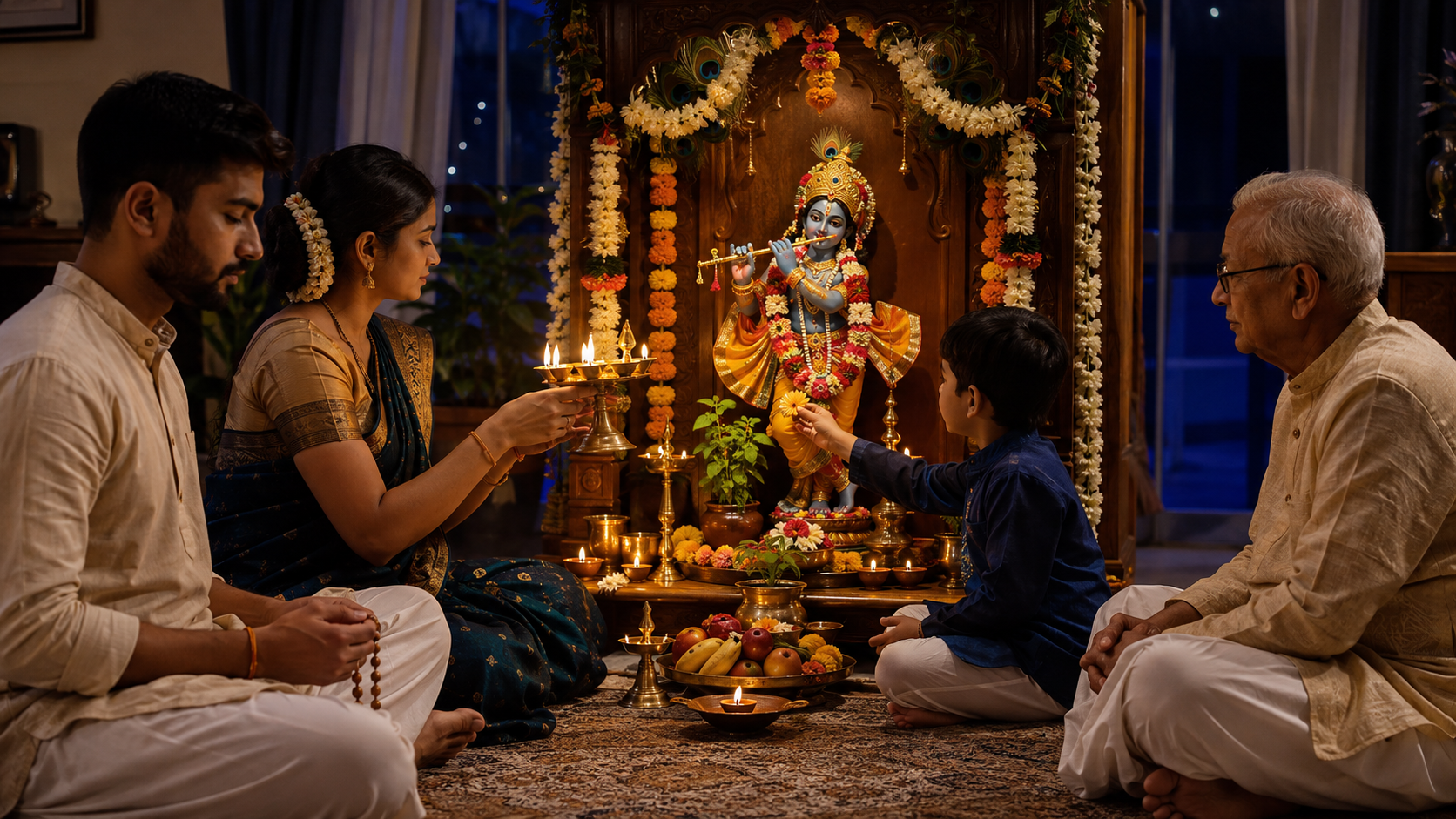
You may be deciding between a crowded temple programme, a quiet household puja, a fast, or simply making time to chant. The useful question is not how many observances you can fit into Janmashtami. It is whether the day actually turns your attention toward Krishna.
A meaningful observance can be elaborate or modest. Its center is remembrance expressed through the Holy Name, worship, service, restraint and gratitude. Once that center is clear, you can choose practices suited to your health, responsibilities, family and sampradaya without treating another devotee’s observance as a score to beat.
Decide what your Janmashtami observance is for
Begin with a sankalpa, a clear devotional intention. State it plainly: you are setting aside the day to remember Krishna, hear about him, chant his names and serve in a way that changes how you live after the festival. That intention gives the rituals a direction.
Without that direction, Janmashtami can become a demanding event-management exercise. The house is decorated, the offerings are arranged, everyone stays busy, and Krishna receives the least attention. Notice that danger early. Reduce the programme if the programme is displacing prayer, kirtan or kindness toward the people observing with you.
You do not need to resolve every theological question before participating. Krishna-centered bhakti begins relationally: you approach Krishna as someone to remember, love and serve, not as an abstract subject to master. If you are new to the tradition, choose a trusted temple, teacher or family practice and follow it carefully enough to learn why each action is performed.
Build the day around remembrance, the Holy Name and seva
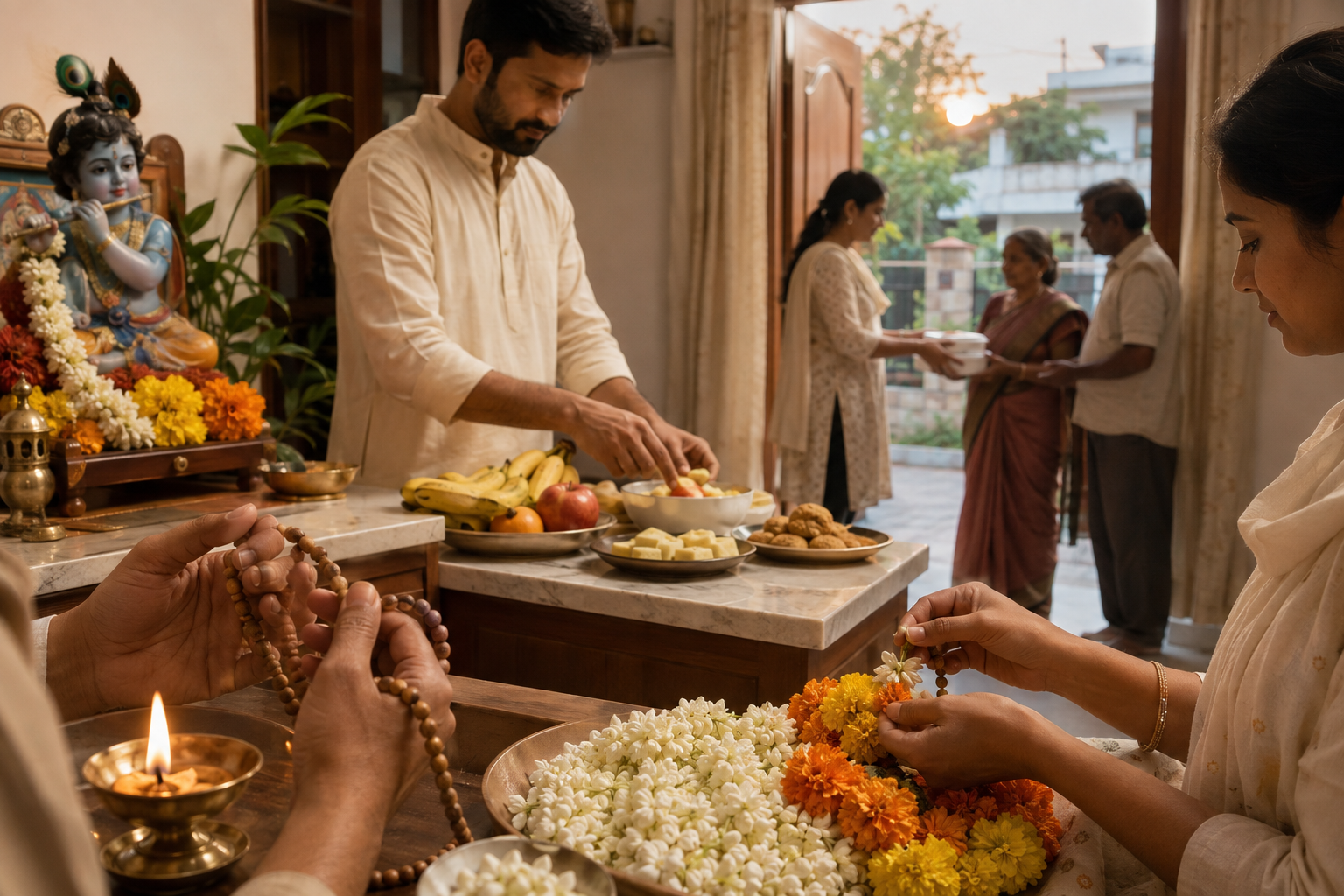
Customs differ among Vaishnava communities and Hindu households, so there is no universal checklist that every devotee must reproduce. A practical home observance can still follow a coherent devotional movement:
- Prepare the place before the observance begins. Clean the worship area, gather only the items your tradition uses, and remove avoidable distractions. Preparation should create attention, not display.
- Hear Krishna-katha. Read or listen to a trusted account of Krishna’s appearance and pastimes, or sing compositions received through your tradition. Pause long enough to consider what Krishna’s qualities ask of your own conduct.
- Chant with attention. You may undertake personal japa, join congregational kirtan, or chant with your household. If the Hare Krishna maha-mantra belongs to your practice, let its sound be the activity rather than background noise for other tasks.
- Perform puja, aarti or an offering according to the practice you have received. If you do not know the procedure, a simple and reverent observance is better than inventing ritual details.
- Make seva concrete. Help at a temple, prepare food for others, assist an older family member, welcome someone who would otherwise celebrate alone, or give within your means. Service prevents devotion from collapsing into private emotion.
- End by choosing what continues. Decide which act of remembrance will return the next morning, when the decorations no longer organize your attention for you.
Families can divide these responsibilities so that children and elders are participants rather than spectators. Someone can prepare the worship space, someone can lead a familiar bhajan, and someone can help distribute prasada. The purpose is not to manufacture an impressive programme. It is to give each person a real way to offer attention and service.
Treat fasting and temple attendance as supports, not scorecards
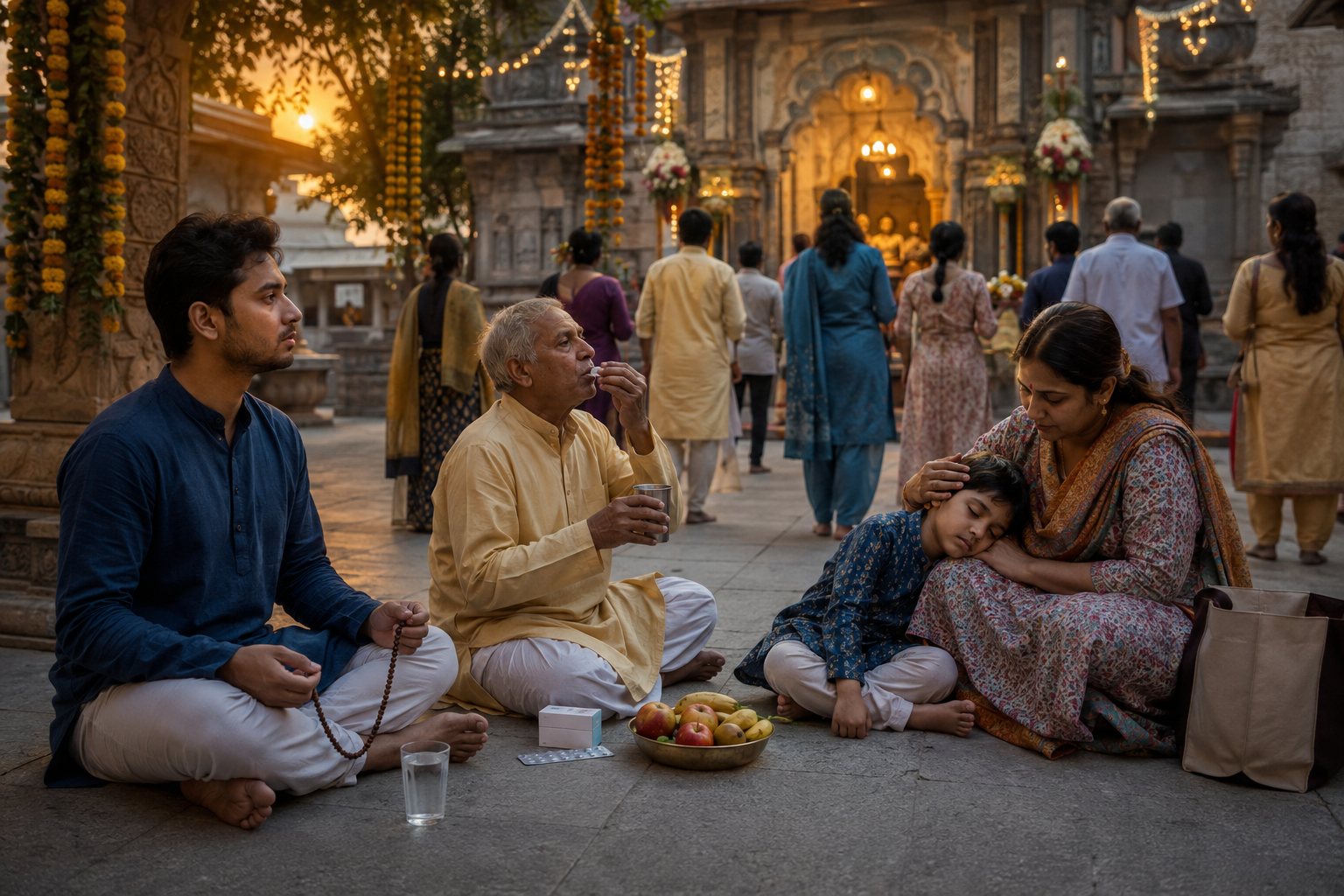
Fasting can discipline appetite and free attention for worship, but its form is not identical across every lineage or household. Follow the guidance of your sampradaya, family tradition or temple rather than combining rules collected from unrelated communities. If food restriction would be medically unsafe for you, do not improvise a severe fast. Seek appropriate medical guidance and adopt a suitable vrata of attention, speech, entertainment or service instead.
The same principle applies to staying awake, travelling to a temple or managing a large household celebration. Physical intensity is not a reliable measure of bhakti. A practice has missed its purpose when it predictably makes you careless toward dependants, hostile toward family members or unable to perform an essential duty.
Temple and home observances offer different strengths. A community gathering gives you congregational worship and the company of devotees; Bhaktivedanta Manor’s Sri Krishna Janmashtami programme is an example of the festival being organized around a temple community. A home observance can give you quiet, continuity with family customs and more time for reflection. Choose the setting in which you can participate responsibly and attentively.
If you plan to attend a public celebration, check the host temple’s instructions about timing, entry, accessibility and permitted offerings. Do not assume that a household custom or a schedule from another region applies to that temple. If crowds or travel would prevent an elder, child or disabled family member from participating safely, create a complete home observance rather than treating it as a lesser substitute.
What a rescue on Janmashtami can and cannot teach about faith
Krishna-centered faith becomes clearest when circumstances strip away ceremony. After a flash flood in Nepal on August 26, 2026, devotee Sanjay Sah was trapped inside the flooded Trishuli 3A hydropower tunnel. He survived there for nine days and was rescued alive on Janmashtami, September 4. Afterward, he said that he had continued chanting the Hare Krishna maha-mantra and believed that Krishna had protected and sustained him during the ordeal. Devotees received the timing of his rescue as a special sign of Krishna’s mercy.
That testimony deserves to be heard in the devotional terms in which it was offered. It should not be converted into a mechanical promise that anyone who chants will be physically rescued, spared loss or given the outcome they request. Calling the rescue miraculous expresses how devotees understood Krishna’s grace in this event; it does not establish a formula by which human beings can command grace.
The lesson you can act on is more demanding and more durable. When control disappears, the Holy Name gives devotion somewhere to stand. Chanting can become an act of surrender, remembrance and trust even when you do not know how events will end. In an actual emergency, it must accompany rather than replace practical action: alert rescuers, follow safety instructions, accept medical care, and help others where you can.
Gratitude for one rescue also must not erase the suffering around it. The Nepalese devotees continued praying for everyone affected by the floods. That matters. Mature gratitude does not imply that the rescued person was more worthy than those who were harmed. It receives mercy humbly while keeping the afflicted within the circle of prayer and service.
Key takeaways for a Krishna-centered Janmashtami
- Set a devotional intention before selecting rituals. Let every activity answer the question: how will this help you remember or serve Krishna?
- Give the Holy Name undivided attention through japa or kirtan instead of allowing chanting to become background sound.
- Learn fasting, puja and festival timing from the tradition you actually follow. Do not assemble a harsher observance from unrelated customs.
- Choose temple worship or a home celebration according to attention, duty, accessibility and safety, not social pressure.
- Understand divine shelter as relationship, not a guarantee of the outcome you want. Chant in danger, but also take every available practical safety measure.
- Carry a specific devotional practice into ordinary life after Janmashtami. The festival has done its work when remembrance begins to shape speech, duty, self-restraint and service.
Before Janmashtami begins, choose the practice you intend to continue when it ends. Keep it small enough to be honest and definite enough to appear in your daily routine. A festival centered on Krishna should leave you not merely with memories of a sacred night, but with a steadier way to meet the next morning.
References
- Dandavats — Bhaktivedanta Manor Presents: Sri Krishna Janmashtami
- Dandavats — Nine Days in Darkness, Nine Days with Krishna: ISKCON Nepal Gives Thanks for a Miraculous Janmashtami Rescue
