
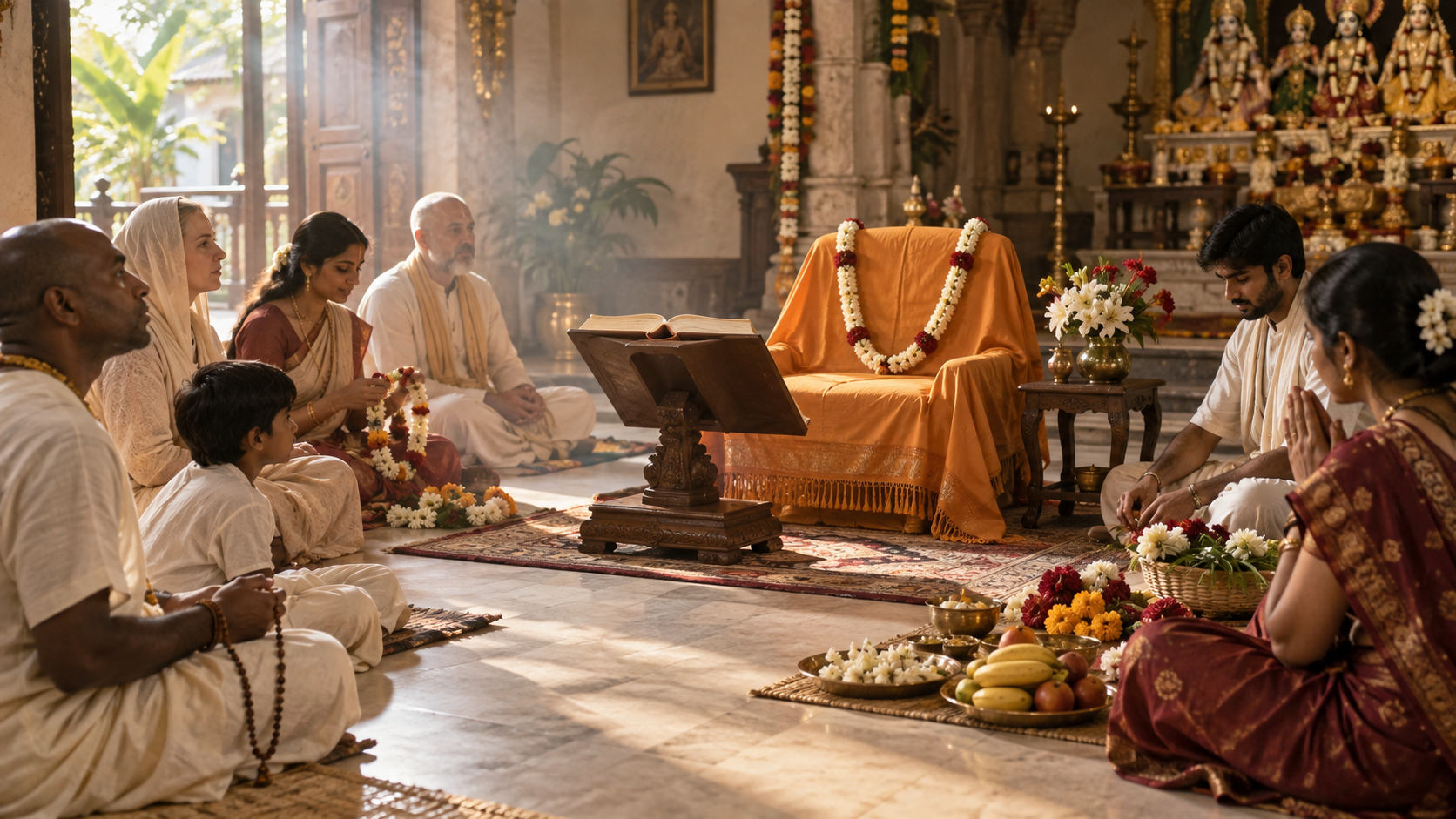
You may be preparing a temple program, a family observance, or a personal offering for Srila Prabhupada. The difficult question is not how to fill the schedule. It is how to honor him without letting remembrance become ceremony detached from practice.
A useful commemoration should help you understand what is being remembered, hear the teaching more carefully, make a credible commitment, and strengthen the community entrusted with carrying that teaching forward. If those things happen, the observance becomes part of Srila Prabhupada’s living legacy rather than an annual pause from ordinary life.
Start by naming the occasion correctly
Srila Prabhupada’s arrival in the United States and his Appearance Day or Vyasa-puja belong to the same sacred history, but they do not ask exactly the same question of you.
An arrival commemoration remembers the transmission of Dharma across distance, language, and culture. An ISKCON Thane program centered a special class by HH Mahadyuti Swami on Srila Prabhupada’s arrival in the United States. That format points to the proper emphasis: not travel as an isolated biographical fact, but the purpose for which the journey was undertaken and the responsibility it places on later generations.
The guiding question for an arrival observance is therefore practical: how will Krishna-bhakti reach someone who has not yet encountered it in an intelligible form? A class on the arrival should leave participants better able to welcome a newcomer, explain a teaching without insider language, or bring spiritual practice into a setting where it is not already established.
Appearance Day and Vyasa-puja turn the attention toward gratitude, discipleship, and renewed service. Vyasa-puja honors the spiritual teacher as a bearer of the disciplic teaching tradition. It is not merely a birthday tribute to a revered personality. The question becomes: what have you received through the acharya, and what will you now do with it?
- For an arrival commemoration, emphasize mission, translation across cultures, and responsibility to people beyond the existing congregation.
- For Appearance Day or Vyasa-puja, emphasize gratitude, careful hearing, honest self-examination, and service.
- At the beginning of the program, state which occasion is being observed and why it matters. Do not assume that every visitor already knows the distinction.
- Choose every reading, class, prayer, and offering by asking whether it serves that stated purpose.
This simple act of naming prevents a common failure: a generic festival in which several devotional activities occur, but no one can explain what the day was meant to awaken.
Build the program around hearing, prayer, and service
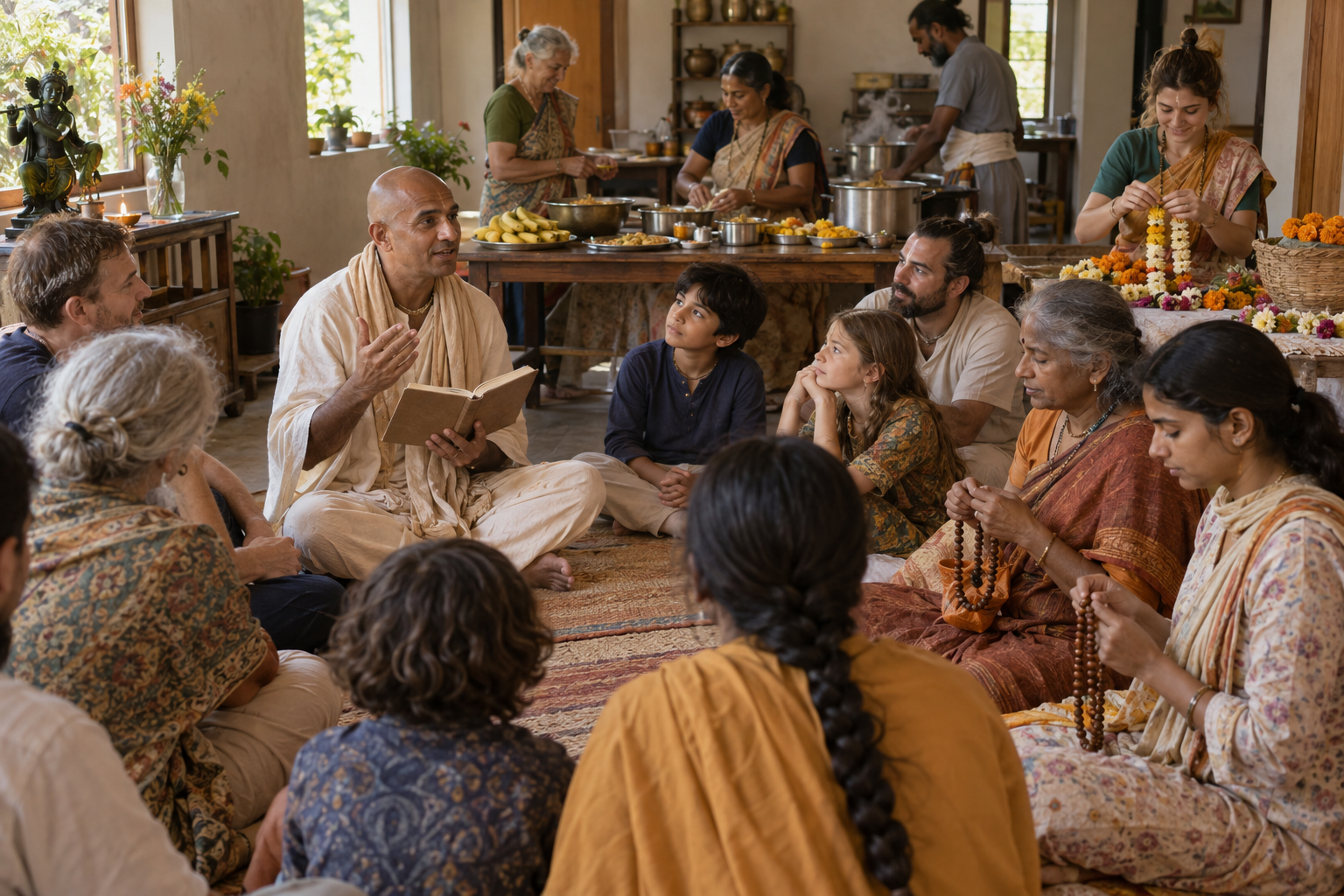
A commemoration needs more than affectionate memories. It needs a devotional movement from understanding to response. A Srila Prabhupada Vyasa-puja program dated 5 September 2026 joined an introduction with prayer to the lotus feet of Lord Krishna. That combination preserves an important orientation: the acharya is honored in relation to Krishna, not as the center of an independent personality cult.
You can give the observance a clear inner sequence without making it rigid:
- Orient the gathering. Explain the occasion in language that a first-time visitor can understand.
- Hear. Center the program on a coherent class, passage, or instruction rather than a succession of unrelated speeches.
- Reflect. Ask participants to identify what the teaching corrects, clarifies, or requires in their own lives.
- Pray. Keep Krishna at the center and ask for the steadiness needed to serve the teaching faithfully.
- Commit. End with a form of service that can continue after the decorations and formal program are gone.
The class deserves particular care. Give the speaker a guiding question, not merely a broad topic such as Srila Prabhupada’s greatness. For an arrival observance, the question might be: what does it demand of us when an acharya carries Dharma beyond familiar social boundaries? For Vyasa-puja, it might be: what is the difference between admiring an instruction and accepting it?
A useful class does not require listeners to remember a pile of biographical details. It helps them see a principle, recognize its claim on their conduct, and name an appropriate response. If the teaching cannot be connected to family life, temple service, personal sadhana, hospitality, or public communication, the program has stopped just before its most important step.
Turn a ceremonial offering into an accountable offering

Written and spoken offerings can easily become collections of honorifics. Reverence has its place, but an offering becomes more truthful when it reveals what the disciple or listener has actually heard.
Before writing, work through these elements:
- Name the grace received. Identify a teaching, practice, correction, or opportunity for service rather than praising in generalities.
- Name the change in understanding. Explain what you now see differently because of that gift.
- Name the resistance honestly. Acknowledge where convenience, pride, distraction, or inconsistency still interferes.
- Name a proportionate service. Choose something that belongs within your real duties and can survive after the emotion of the festival subsides.
- Ask for steadiness. A durable commitment is more meaningful than an impressive promise made for the occasion.
A workable form is: Srila Prabhupada, through your teaching I have understood ____. I see my weakness in ____. As service, I will begin, restore, or continue ____. I ask for steadiness to carry it forward.
The blank for service should contain an observable action. Read and discuss an assigned teaching with your family. Restore neglected japa discipline. Welcome unfamiliar visitors instead of remaining only with friends. Support an existing temple duty reliably. Learn how to explain a basic principle of bhakti in plain language. The right commitment depends on your responsibilities; the test is whether you will know when you have done it.
Do not make public disclosure a measure of devotion. A personal offering may remain private, and an organizer should never pressure participants to reveal matters of conscience. The purpose is accountability before guru and Krishna, not emotional performance before an audience.
Families can adapt the same practice. Younger participants can say what they understood in their own words. Experienced devotees can name a correction they still need to live, rather than offering only nostalgia. Everyone can leave with a suitable act of service. This allows different stages of spiritual life to share the observance without pretending that everyone has the same realization or duty.
Treat care for devotees as part of the legacy
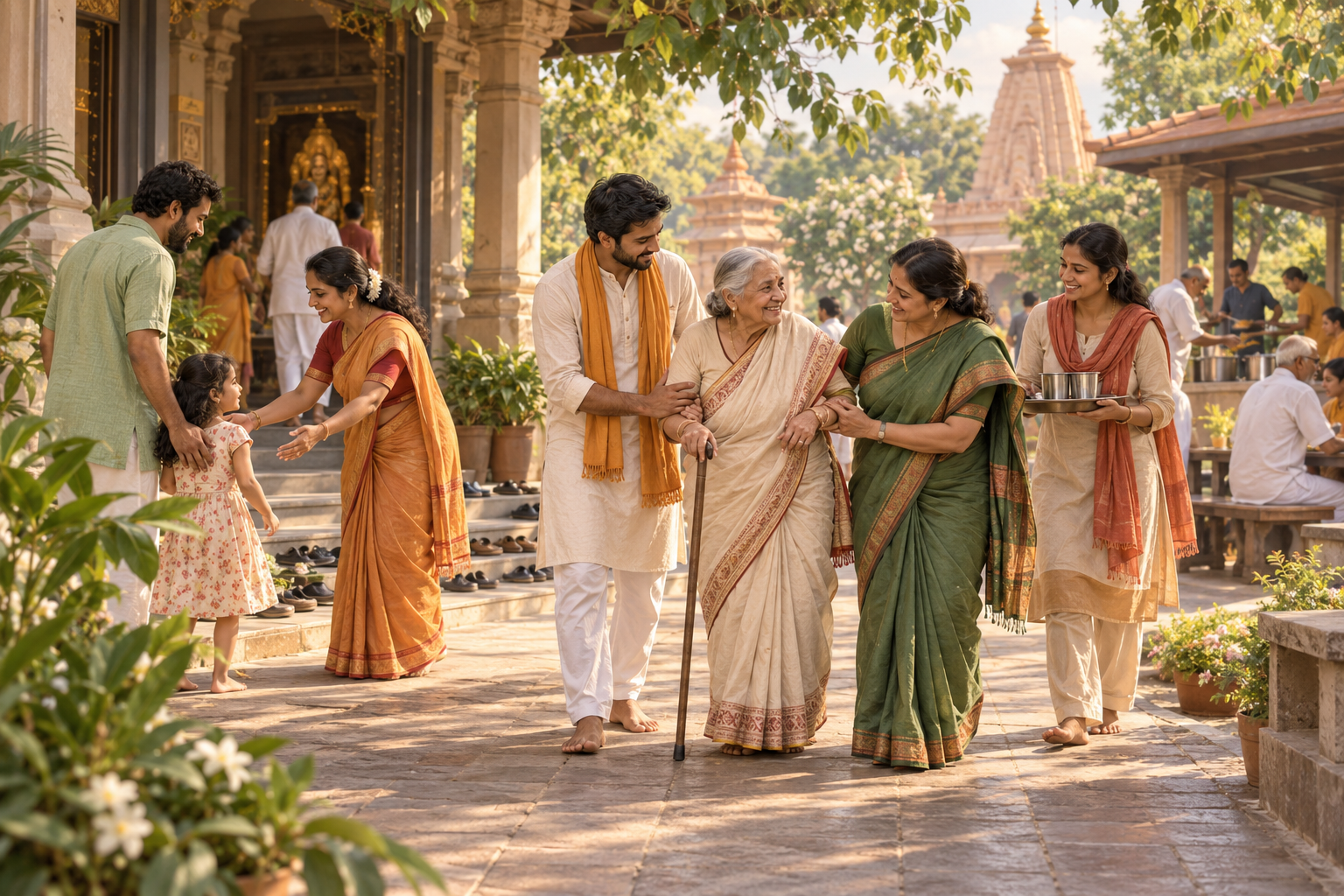
Commemorations often focus so heavily on the stage that the congregation becomes an audience. Srila Prabhupada’s legacy also lives in the quality of the community formed around hearing and service.
That point becomes visible when a familiar devotee has been absent. HH Mukunda Swami returned to the temple for Srila Prabhupada’s Appearance Day on Sunday, 6 September 2026, after months away during recovery, and his return brought evident happiness to the community. The significance was not another item on a program. It was the restoration of presence and relationship.
Before your next commemoration, look beyond the attendance list. Ask who has become disconnected because of illness, recovery, age, caregiving duties, transport difficulties, or another practical barrier. Then make participation possible without turning anyone’s circumstances into a spectacle.
- Contact absent community members personally instead of relying only on a general announcement.
- Offer a remote connection, a recording, or program notes when physical attendance is not possible.
- Invite a written or recorded offering from someone who cannot be present.
- Arrange suitable seating, access, or transport where the community can do so responsibly.
- Respect recovery needs. Do not pressure an honored guest to speak, stand, meet everyone, or remain longer than is comfortable.
- Let someone know that their absence was noticed without demanding a private explanation.
This is not separate from preserving an acharya’s work. A tradition capable of transmitting profound teachings but unable to notice an absent devotee has divided doctrine from character. Community care does not replace sadhana or instruction; it shows whether instruction has entered relationships.
Organizers should also prepare newcomers for meaningful participation. Explain devotional terms when they first appear. Tell visitors what will happen during prayers and offerings. Give them a way to listen without pretending prior knowledge. Srila Prabhupada’s arrival is poorly commemorated if the program itself remains inaccessible to the very people standing at its threshold.
Key takeaways for a Prabhupada commemoration
- Name the occasion precisely: an arrival commemoration asks about carrying Dharma outward, while Vyasa-puja asks how gratitude will become faithful service.
- Organize the program as a movement from orientation and hearing to reflection, prayer, and commitment.
- Ask speakers to answer a guiding question that connects history or doctrine with present conduct.
- Write offerings around grace received, weakness recognized, and a proportionate service that can actually continue.
- Include recovering, elderly, distant, and otherwise absent devotees without violating their privacy or placing demands on them.
- Judge the observance by what becomes clearer and more faithful afterward, not by how full the schedule appeared.
Before you finalize the next program, place the name of the occasion and its intended act of service side by side. If you can name the event but not what it should change, the plan is not finished. Resolve that gap, and the commemoration can become what it is meant to be: renewed participation in the work Srila Prabhupada entrusted to those who hear him.
References
- Dandavats – Special Class on Srila Prabhupada Arrival in USA | HH Mahadyuti Swami | ISKCON Thane
- Dandavats – HH Mukunda Swami visits the temple after months of recovery
- Dandavats – Introduction, Prayer to the Lotus Feet of Lord Krishna, Srila Prabhupada Vyasapuja, 9-5-26

Leave a Reply
You must be logged in to post a comment.