
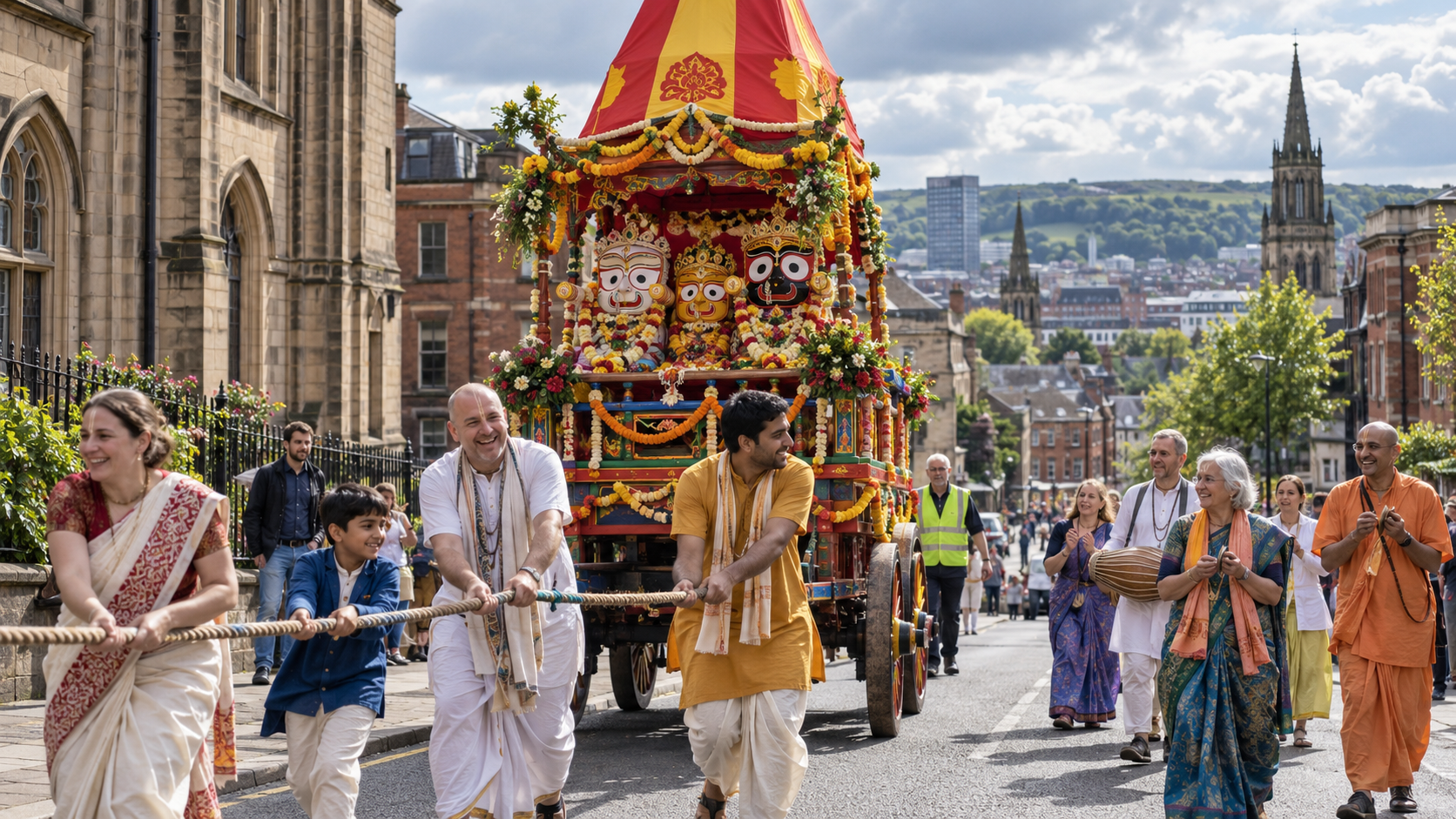
If you are wondering whether a small devotee community can bring Ratha Yatra back to its city, Sheffield offers a grounded answer. You do not need to wait until you have a large congregation, a complete budget and every role filled internally. You do need a clear devotional purpose, an honest list of what is missing and the humility to ask for help.
After an absence of roughly 10 to 15 years, Sheffield’s Ratha Yatra returned through the service of a handful of local devotees and a wider network willing to supply equipment, leadership, music and practical support. Its value for other Dharmic communities lies not only in the successful procession, but in the way a seemingly under-resourced group turned dependence into cooperation.
The revival began before the resources existed
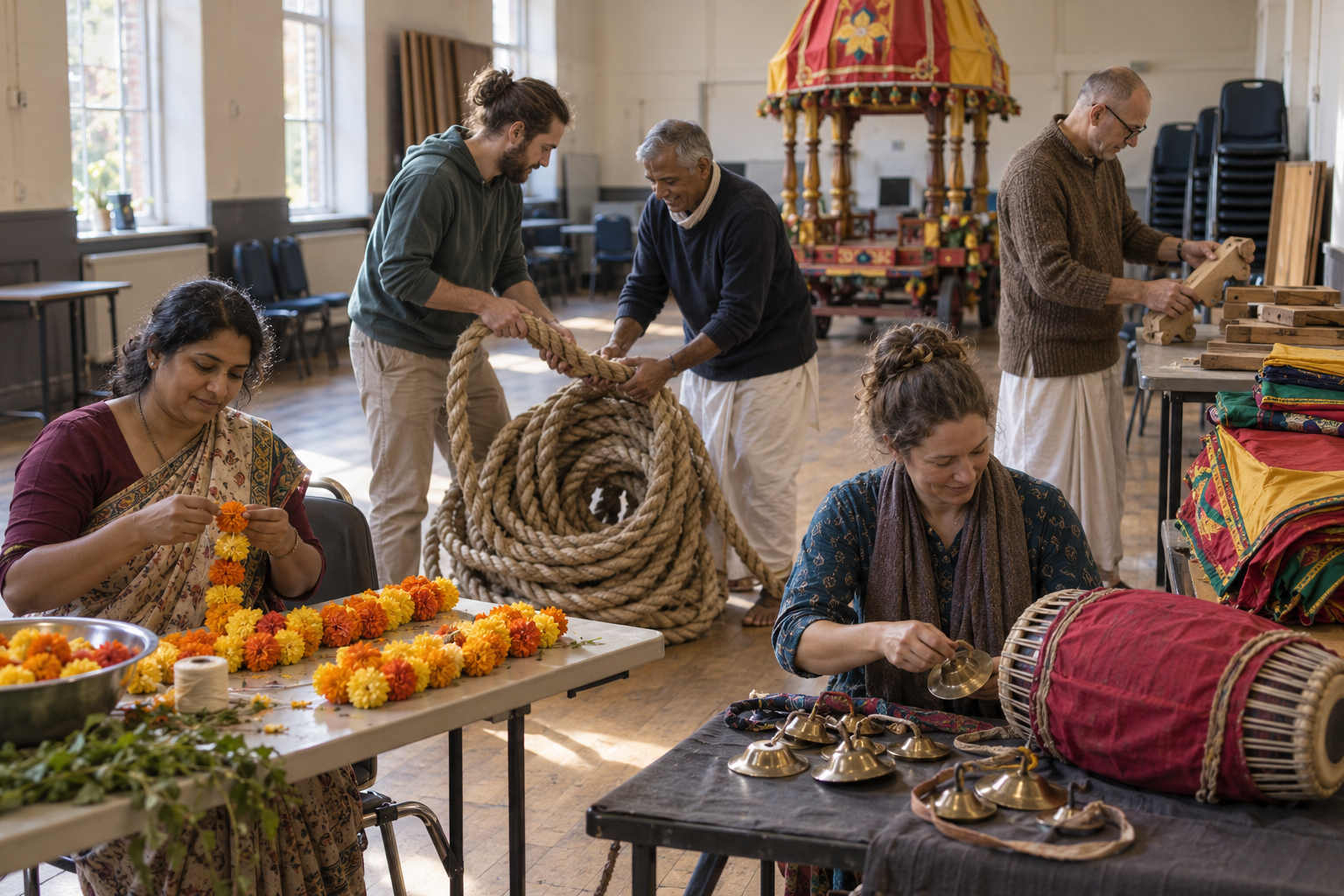
The initial commitment arose during a house programme on Radhastami 2025. Tribhangananda Prabhuji encouraged the Sheffield devotees to organise Ratha Yatra, and that conversation gave a small group enough confidence to begin. At the time, they did not have a large congregation, sufficient manpower or the finances expected for a festival of that scale.
This is an important distinction for anyone considering a revival. They did not pretend the shortages were unimportant. They allowed the decision to serve to come before the complete solution. Once the intention was real, each shortage became a defined problem that could be taken to someone capable of solving it.
If your city is in a similar position, begin by writing a one-sentence sankalpa: what are you trying to restore, for whom and in what form? Then define the smallest dignified festival that still preserves the devotional centre of Ratha Yatra. That means identifying the deities and chariot arrangement, authorised ritual leadership, kirtan, prasadam and the practical conditions for a safe public gathering. Decorations, an ambitious stage programme and other additions can remain flexible.
Do not use the phrase “we are too small” as if it were a complete assessment. Replace it with named gaps: no chariot, no sound system, no lead kirtaniya, no serving equipment, no cooks or no person coordinating volunteers. A vague lack feels immovable. A named need can be owned, borrowed, funded or simplified.
A service network did what one congregation could not
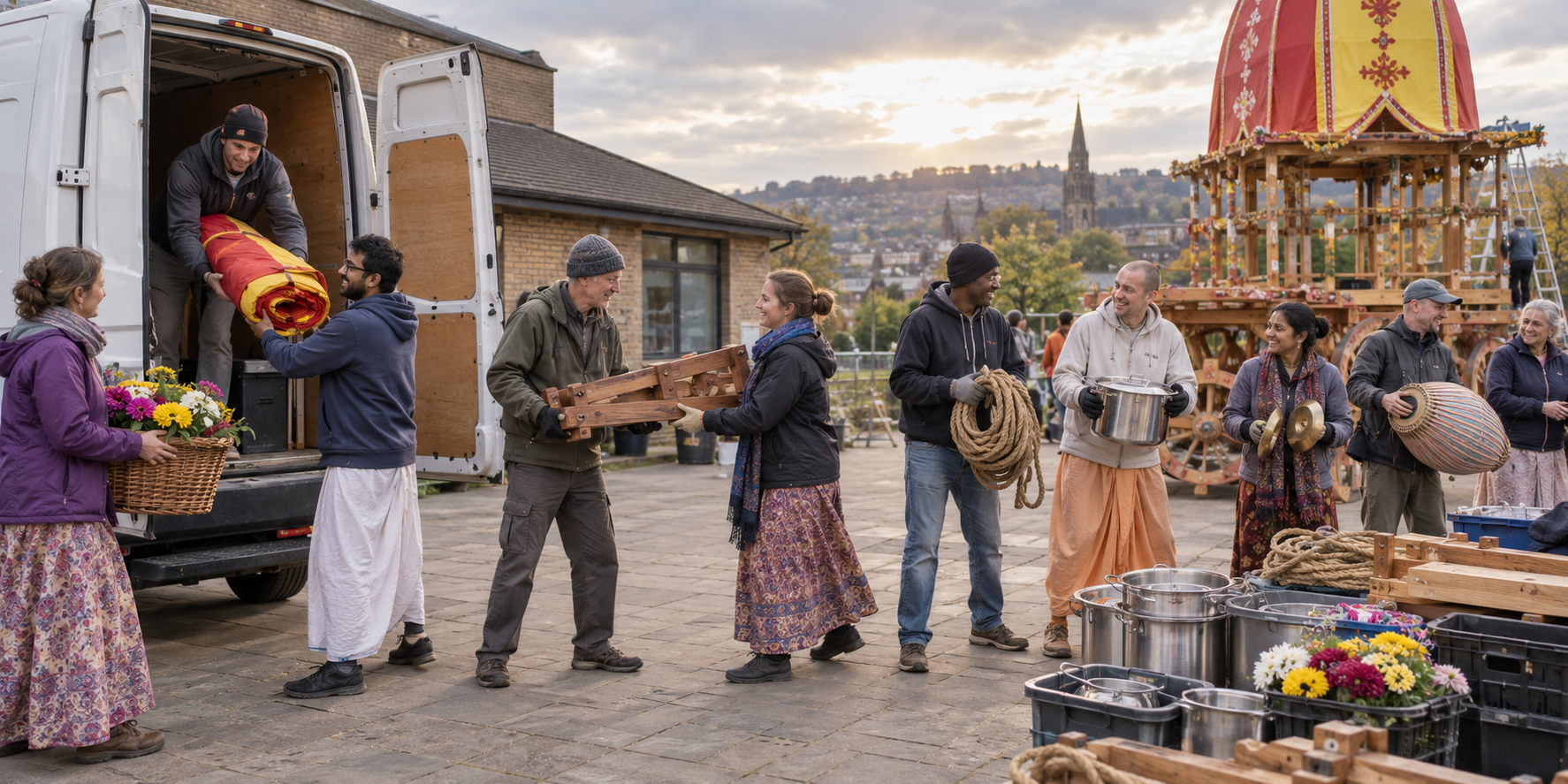
Sheffield’s organisers reached beyond their immediate group and connected with Parashuram Prabhuji and Moksha Lakshmi Mataji. When Parashuram Prabhuji received a long request covering the chariot deities, prasadam plates, spoons and other necessities, his reply was simply “Yes to all.” That response changed the practical horizon of the festival.
The pattern is worth studying because it was based on complementary capacity. One devotee did not have to finance or perform every part of the event. Different people supplied different parts of the service:
| Festival need | How the gap was met in Sheffield | Planning principle |
|---|---|---|
| Deities, chariot-related items and serving supplies | Parashuram Prabhuji responded to an extensive request for practical assistance | Ask experienced devotees with a complete, concrete inventory rather than a general appeal for help |
| Mobile and stage sound | Tribhangananda Prabhuji brought the children’s chariot and deities, his mobile Nama Chariot sound system and sound for the stage | Map reusable equipment across the wider devotee network before assuming that everything must be purchased |
| Rituals and kirtan after cancellations | Tribhangananda and Parashuram Prabhujis took responsibility for the aarti, rituals, procession kirtan and singing afterwards | Invite senior helpers as responsible partners, not merely as guests booked for one appearance |
For your own planning, build two inventories side by side. The first should list physical items: chariot components, deities, sound equipment, servingware and other essentials. The second should list capabilities: ritual leadership, kirtan, cooking, transport, coordination, setup and service. Put a person’s name beside every item or capability. Blank spaces reveal the real work still to be done.
This approach also changes fundraising. Money remains necessary, but it is not the only resource. A sound system already available for seva, equipment lent by another congregation or an experienced devotee willing to travel can remove a larger obstacle than an unfocused donation drive. Ask for the precise thing the festival lacks and make it easy for the prospective helper to understand the responsibility.
The final-week cancellation was a test of festival design
The most serious disruption came in the final week, when the kirtaniyas scheduled for the stage cancelled for different reasons. The festival continued because Tribhangananda and Parashuram Prabhujis were able to cross role boundaries and lead what was needed. They conducted the aarti and rituals, led kirtan during the procession and continued afterwards.
That flexibility was a blessing, but emergency generosity should not become the permanent operating model. If the same senior devotees must rescue every essential function each year, the festival remains fragile. Before your programme enters its final week, every critical role should have a primary owner, a named fallback and a reduced version that can still be delivered reverently if the preferred plan collapses.
For example, distinguish the devotional core from the advertised extras. A cancelled stage performance need not end the procession if competent kirtan leadership and the essential ritual responsibilities are already covered. A smaller programme can still be complete in purpose. By contrast, deity service and ritual responsibilities must never be treated as generic volunteer slots; confirm them with devotees who have the appropriate experience and authority.
Hold a readiness conversation before the final week begins. Ask each owner what could prevent delivery, who can substitute and what equipment or transport remains unconfirmed. Invite the backups into the preparation rather than keeping their names on paper. A person who has heard the plan, met the team and seen the equipment can step in far more effectively than someone contacted only after a cancellation.
Devotional readiness does not replace local compliance. Before publishing a route or inviting the public, confirm the current requirements that apply to your chosen format with the relevant council, venue and qualified advisers. Questions about public-space permission, traffic, insurance, food service, sound and safeguarding can have different answers depending on the route, venue and participants. Resolve them for the actual event rather than assuming that another city’s arrangements transfer to yours.
Key takeaways for a small Ratha Yatra team
- Start with a defined act of seva. Decide what must be present for a dignified Ratha Yatra, then let the scale follow the available capacity.
- Turn every shortage into a named request. “We need help” is difficult to answer. A request for deities, servingware, transport, sound equipment or a qualified kirtan leader gives another devotee a clear way to serve.
- Count the wider network as part of the team. Sheffield’s handful of local organisers succeeded because experienced devotees from beyond the immediate congregation accepted meaningful responsibility.
- Design for a cancellation. Give each critical role an owner, a fallback and a simpler form that preserves the devotional purpose.
- Plan prasadam as a flow, not just a quantity. Assign responsibility for cooking, transport, serving, the queue, the remaining supply and the final distribution. Sheffield served more than 350 plates, met a continuing queue and finished without a grain left over.
- Preserve what the team learns. Record contacts, borrowed items, missing resources, decisions and volunteer roles while memories are fresh, so the next festival begins with inherited knowledge rather than another blank page.
The prasadam result deserves particular attention. “Nothing wasted” does not mean organisers should guess the perfect quantity in advance. It means distribution must be actively managed. Keep the serving point in communication with those holding the remaining prasadam. Let one coordinator see both the queue and the supply. If attendance develops differently from expectations, the team can adjust the release and serving process while protecting cleanliness and respectful handling.
For the Sheffield devotees, the complete distribution of prasadam was experienced as Krishna’s arrangement. Good organisation does not compete with that understanding. In seva, disciplined preparation creates more opportunities for generosity to reach people without confusion or waste.
Make the revival the beginning, not the exception
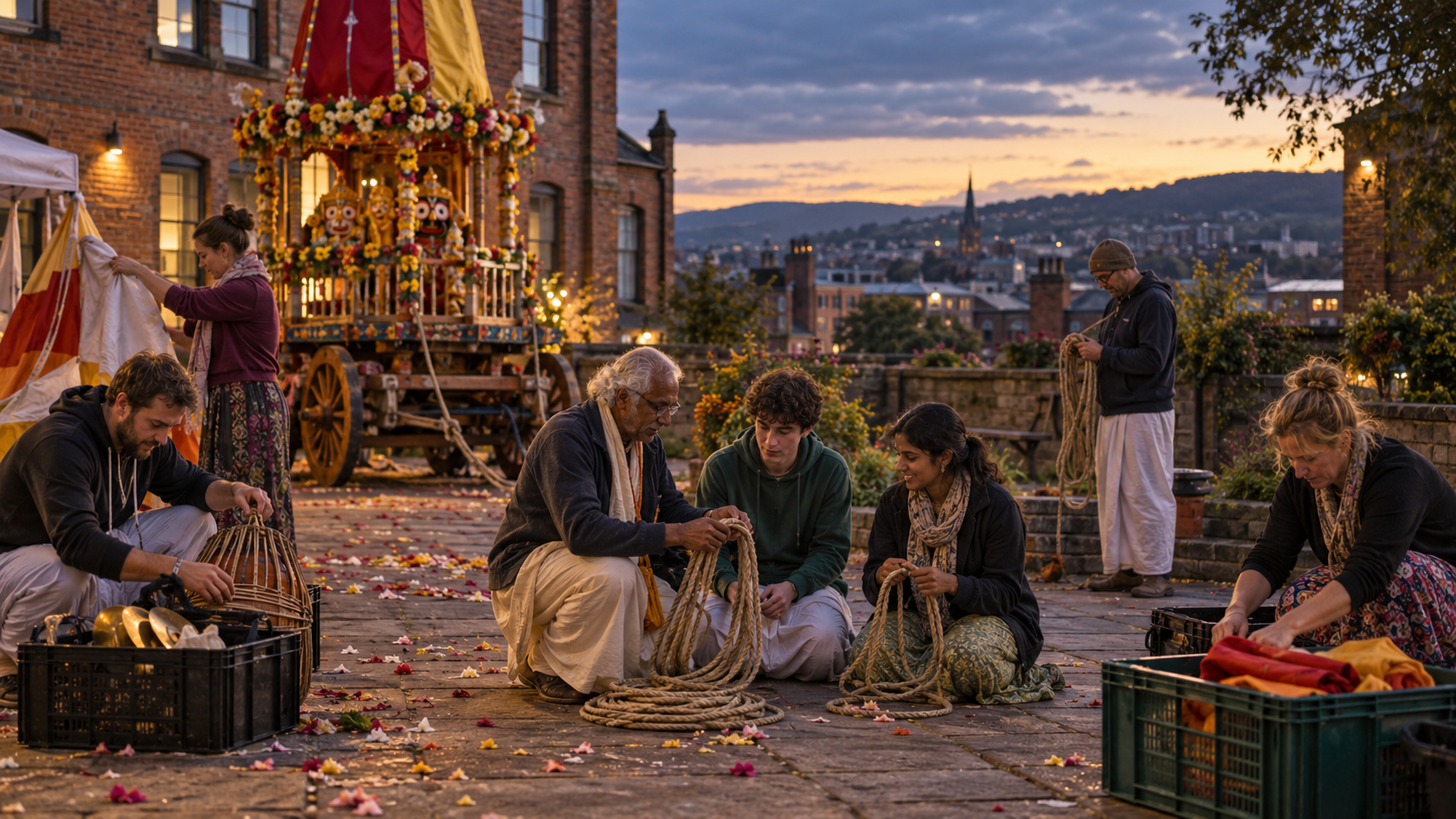
A festival can return once through extraordinary effort and then disappear again if its knowledge remains in a few people’s memories. The work immediately after Ratha Yatra therefore matters. Thank the people who travelled, cooked, lent equipment, led kirtan, served prasadam and covered unexpected gaps. Ask them what should be repeated, what should change and what they could responsibly own next time.
Then turn the emergency network into a continuing community. Keep the equipment inventory, supplier and volunteer contacts, devotional responsibilities and unresolved needs in one shared record. Train additional people beside the experienced leads. The aim is not to eliminate dependence on other devotees; mutual dependence is part of community. The aim is to prevent the entire festival from depending on an unspoken arrangement known only to one organiser.
Sheffield’s revival did more than place a chariot back on the city’s streets. It demonstrated what can happen when a small local sankalpa meets a wider culture of seva. If you are asking whether your own community is large enough, use a better test: can you name the devotional core, admit the gaps and invite trustworthy people to take real responsibility? If you can, the first practical step is already in front of you.
References

Leave a Reply
You must be logged in to post a comment.