
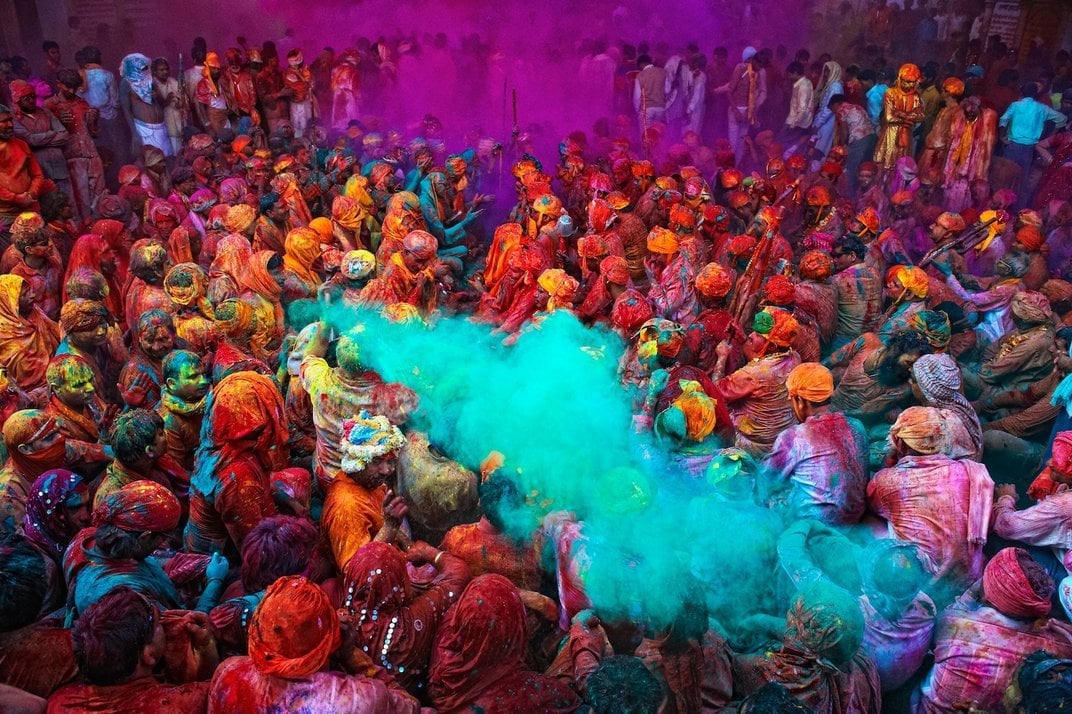
Have a happy Holi and reclaim the narrative.
ChatGPT, which is a good estimation of the content available online, seems to provide various concerns around holi.

Seriously?
Why is Holi celebrated

Holi is also known as the “festival of colors” or the “festival of love”. Holi is typically celebrated in the month of March, on the full moon day of the Hindu lunar month of Phalguna.
There are several mythological stories associated with the origin of Holi, but the most popular one is the story of Prahlad and Holika. According to the legend, there was a king named Hiranyakashipu who was blessed with a boon that made him invincible. He became arrogant and ordered everyone in his kingdom to worship him instead of the gods. However, his son Prahlad refused to do so and continued to worship Lord Vishnu, one of the Hindu deities. Hiranyakashipu tried to kill Prahlad several times, but Lord Vishnu saved him each time.
Finally, Hiranyakashipu’s sister Holika, who was immune to fire, tricked Prahlad into sitting on her lap while she sat in a bonfire. However, due to Lord Vishnu’s intervention, Holika was burned to ashes and Prahlad emerged unharmed. This event symbolizes the victory of good over evil and is celebrated as Holi.
Holi is also associated with the legend of Lord Krishna and his beloved Radha. According to the legend, Krishna, who had a dark complexion, was jealous of Radha’s fair complexion. His mother advised him to apply color on Radha’s face to make her look like him. This act of playfulness and love became a part of the Holi celebrations.
Today, Holi is celebrated as a joyous festival of colors and love, where people smear each other with colored powder and water, and indulge in feasting, music, and dance. It is a time to forget differences and come together in a spirit of unity and camaraderie.
Other similar festivals

There are several festivals celebrated around the world that share similarities with Holi in terms of their use of colors, joyous spirit, and celebratory atmosphere. Some of these festivals include:
- La Tomatina – This is a festival celebrated in Buñol, Spain, where people gather to throw tomatoes at each other.
- Songkran – This is a festival celebrated in Thailand, Laos, and Cambodia, where people celebrate the New Year by throwing water on each other.
- Carnival – This is a festival celebrated in several countries, including Brazil, Trinidad and Tobago, and Venice, where people wear colorful costumes, dance, and participate in parades.
- Jashn-e-Baharaan – This is a festival celebrated in Pakistan, where people throw colored powder on each other and participate in traditional dance performances.
- Rang Panchami – This is a festival celebrated in some parts of India, particularly in Maharashtra, where people play with colors and water, similar to Holi.
These festivals share common elements of celebration, community, and joy, and demonstrate the universal human desire to come together in a spirit of unity and happiness.
Hola Mohalla

Hola Mahalla and Holi are two different festivals celebrated in India, but they do share many similarities.
Firstly, both festivals are celebrated in the spring season, typically in the month of March. Additionally, both festivals have religious significance and are celebrated with great enthusiasm. Hola Mahalla is a Sikh festival that marks the beginning of the Sikh New Year, and Holi is a Hindu festival that celebrates the victory of good over evil and the arrival of spring which brings them together in a common Dharmic fold.
Furthermore, both Hola Mahalla and Holi involve the use of colors and are celebrated with social gatherings. During Hola Mahalla, Sikhs wear colorful clothes and perform martial arts, and during Holi, people play with colored powders and water. Both festivals are also occasions for people to come together with family and friends, socialize, and enjoy feasting and other cultural activities.
Despite their differences in terms of cultural and religious significance, Hola Mahalla and Holi share some similarities in terms of timing, colorful celebrations, social gatherings and Dharmic tones.
Unapologetic celebration

Holi is an ancient Sanatani festival that has been celebrated in Bharat for thousands of years. It is a time for people to come together, forget differences, and celebrate the arrival of spring. As part of the Sanatani civilization, Holi is seen as an important cultural and religious festival that represents the victory of good over evil, the triumph of light over darkness, and the power of love and unity.
Celebrating Holi unapologetically means embracing our cultural and religious identity without feeling the need to apologize or explain it to others. It means recognizing the value of our traditions and customs and sharing them with others as a way to promote understanding and respect.
Celebrating Holi unapologetically also means resisting the forces of cultural erasure and colonization that have historically attempted to suppress or erase our indigenous dharmic cultures and traditions. By embracing and celebrating their cultural identity, we can assert our right to exist as a civilization and thrive as members of a diverse society.
Overall, celebrating Holi unapologetically as part of the Sanatani civilization is a way to affirm and celebrate our cultural and religious heritage, promote understanding and respect among different communities, and resist cultural erasure and colonization.