

If you want to observe Bhadra Purnima but do not know what to do beyond attending a programme or acquiring a book, begin with one clear aim: let the Srimad Bhagavatam receive your attention, not merely your ceremonial respect.
A meaningful observance joins three acts that are easy to separate: hearing the Bhagavatam, reflecting on its teaching, and helping another person approach it. You do not need an elaborate event. You need a passage, a receptive hour, and a plan to continue after the festival.
Put the scripture at the centre of the observance
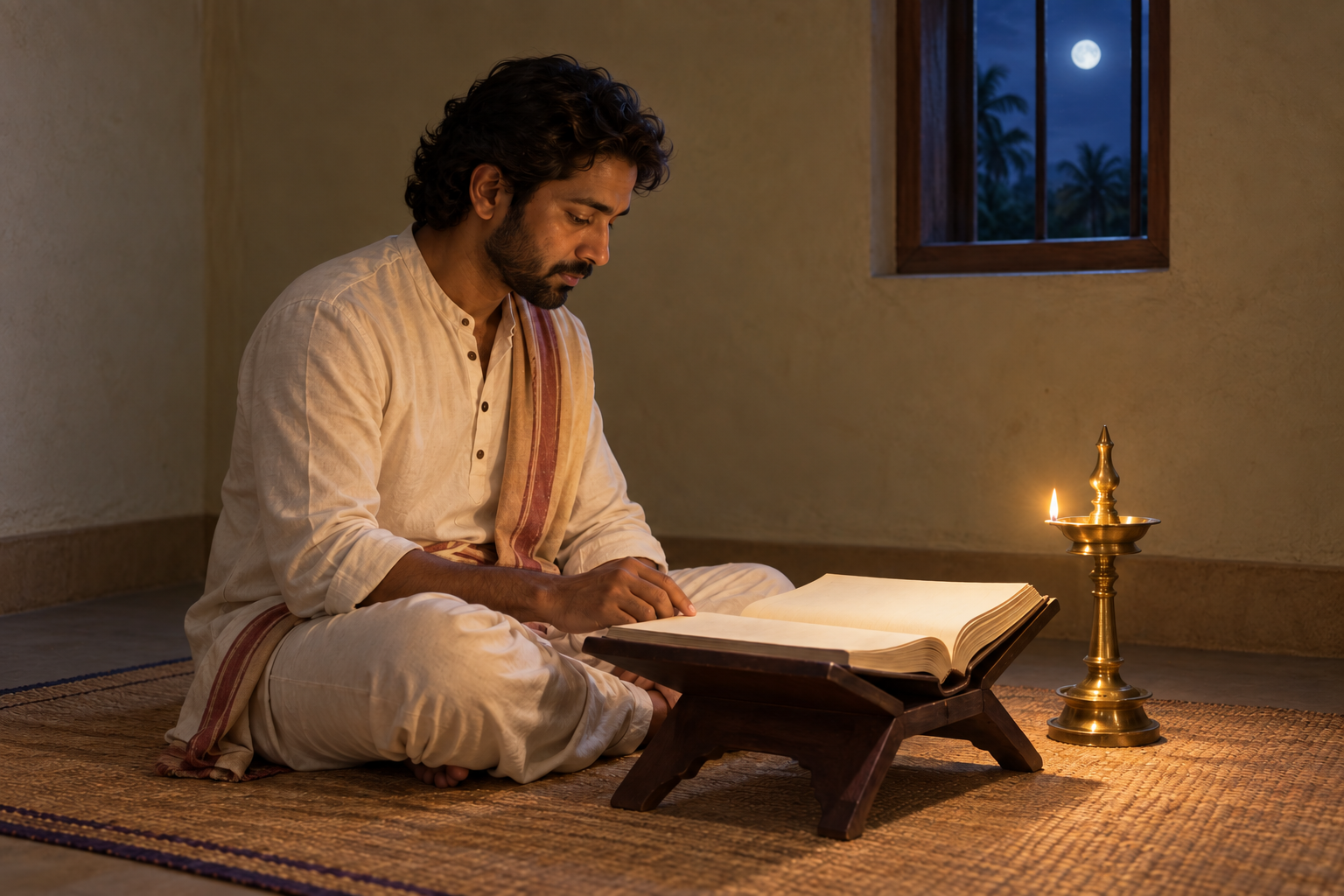
Bhadra Purnima is the full-moon observance in the month of Bhadra. In many Vaishnava communities, it is closely associated with honouring, hearing, and giving the Srimad Bhagavatam. In 2026, Bhaktivedanta Manor marked the occasion on 26 September with a dedicated Bhadra Purnima programme.
The important distinction is between honouring a sacred book and treating it as a sacred object that need never be opened. A clean cloth, elevated seat, flowers, lamps, and other signs of reverence can help orient the mind. They are beginnings, not substitutes for reading. If the Bhagavatam remains closed throughout the observance, the outer gesture has become detached from the teaching it is meant to serve.
Make the first decision before arranging anything else: which passage will you hear, and what question will you bring to it? A useful question is concrete. Ask, “What is this passage asking me to notice, relinquish, remember, or do?” That keeps your reading from dissolving into either hurried recitation or vague inspiration.
The Srimad Bhagavatam is also called the Bhagavata Purana. It is not simply a storehouse of stories or a manual of isolated rules. Its narratives, prayers, philosophical conversations, descriptions of devotion, and accounts of Bhagavan work together. Read a passage within that larger purpose: the cultivation of loving remembrance and devotion.
SB 3.28.28 teaches you how to direct attention

A focused entry point is Srimad Bhagavatam 3.28.28, taught publicly in Mayapur by Bhakti Caitanya Swami. The verse belongs to a sustained meditation on the personal form of the Lord and directs the meditator’s attention toward the beauty of the divine face.
The practical teaching lies in the precision of that attention. The mind is not merely told to stop wandering. It is given a worthy object of remembrance. In this Vaishnava approach, meditation is personal and relational: attention rests on Bhagavan with devotion rather than being reduced to an exercise in concentration for its own sake.
You can apply that method even if you are new to the text. Read the verse and its surrounding passage slowly. Notice the movement from general awareness to particular contemplation. Then use three questions:
- What does the passage direct me to contemplate?
- Which habit of attention pulls me away from that contemplation?
- What will loving remembrance change in my conduct today?
The third question matters. If meditation produces no change in speech, patience, service, restraint, or regard for others, it can remain sealed inside a devotional mood. The Bhagavatam repeatedly brings transcendental vision into the difficult territory of choice and character. After reading, name one action that will carry the contemplation into the rest of your day.
Hearing from a teacher can help you see what private reading misses. The continuing culture of Bhagavatam hearing is visible not only at major holy places but also in an ISKCON France morning class given by Prahladananda Swami on 26 September 2026. The lesson for your observance is simple: make room for both the text and responsible explanation of the text. Listen actively, with the passage open, and separate what the verse states from the applications a speaker draws from it.
Use a simple observance you can complete

An observance becomes harder to sustain when every desirable practice is crowded into one day. Choose a modest sequence and complete it attentively. The following plan works for an individual, a household, or a small satsanga:
- Prepare the place. Clean the reading area and place the Bhagavatam respectfully where everyone can see and hear the reading. Keep phones and unrelated conversation away from the space.
- State the intention. Say plainly that the purpose is to hear the Bhagavatam, remember Bhagavan, and carry one teaching into practice. This prevents ritual details from taking over the gathering.
- Read the passage aloud. Use a language the participants understand. If you recite Sanskrit, follow it with a translation rather than allowing sound alone to stand in for comprehension.
- Hear a trusted explanation. Attend a temple class or use a recorded teaching connected to the passage. Keep the text available so that you can follow the speaker’s reasoning.
- Allow quiet reflection. Ask each participant to identify one phrase, image, or teaching that held their attention. No one needs to manufacture an impressive insight.
- Choose one application. Write down a specific practice for the next day: return to the passage, restrain a recurring harsh response, offer a neglected service, or set aside a regular reading period.
- Share the Bhagavatam responsibly. Give a copy to someone who wants to read it, help a family obtain an accessible edition, or support a community effort that connects distribution with continued hearing.
- Fix the next reading before you finish. Leave the book marked at the next passage and place the return date in your calendar. Continuity is part of the observance, not an optional improvement added later.
If children are participating, give them a real but manageable role: carrying the book respectfully, reading a short paragraph, offering a flower, or answering one direct question about the passage. Do not measure their devotion by how long they can sit still. Help them connect reverence with meaning.
If you are observing alone, do not assume that the day has become lesser. Read aloud, listen carefully, write your response, and contact one person with whom you can discuss the teaching. A quiet observance can be complete when hearing, reflection, and follow-through remain joined.
Give the Bhagavatam as an invitation, not a transaction
Giving a copy of the Srimad Bhagavatam is one of the observance’s most recognisable expressions. Yet a book offered without regard for the recipient can become shelf decoration. The devotional aim is not merely to transfer an object. It is to open a path to hearing.
Before giving a copy, check four things:
- Interest: Does the person actually want to explore the text? A sacred gift should not be used to pressure someone into displaying agreement.
- Language: Can the recipient comfortably read the edition you have chosen? An accessible translation is more useful than an imposing volume they cannot enter.
- Orientation: Can you explain what the Bhagavatam is and suggest a manageable starting passage? Do not assume that a new reader understands its structure or vocabulary.
- Companionship: Can you offer a class, reading group, or later conversation? A willing companion often makes the difference between owning a scripture and beginning a relationship with it.
Avoid turning the gift into a bargain with the sacred: perform an act, expect an automatic result, and leave the mind unchanged. Traditional praise of giving the Bhagavatam points toward the spiritual dignity of transmitting wisdom. That dignity asks for reverence from the giver and freedom for the recipient.
If you already own a copy, you do not need to acquire another merely to make the day count. Open the one you have. Repair it if needed, clear the dust from its place, resume the reading you abandoned, or give a separate copy where it can genuinely be used. Respect is shown by relationship as much as by possession.
Key takeaways for Bhadra Purnima
- Place hearing before display: arrange the observance around a selected Bhagavatam passage.
- Read in a language you understand, and pair recitation with explanation and reflection.
- Use SB 3.28.28 to practise precise, personal attention to Bhagavan rather than vague concentration.
- Translate contemplation into one observable act of service, restraint, remembrance, or renewed reading.
- Give the Bhagavatam to a willing reader with enough orientation and companionship to help them begin.
- Schedule the next encounter with the text before the festival ends.
Before you put the book away, mark the passage you will read next and decide when you will return. That small appointment protects the heart of Bhadra Purnima: the Bhagavatam is not honoured for one full-moon day and forgotten, but welcomed as a continuing teacher.
References
- Dandavats – SB class by HH Prahladananda Swami – 26 September 2026 – ISKCON France
- Dandavats – ISKCON Bhaktivedanta Manor – Bhadra Purnima – 26 September 2026
- Dandavats – Srimad Bhagavatam Text 3.28.28, H.H. Bhakti Caitanya Swami – ISKCON Mayapur

Leave a Reply
You must be logged in to post a comment.