
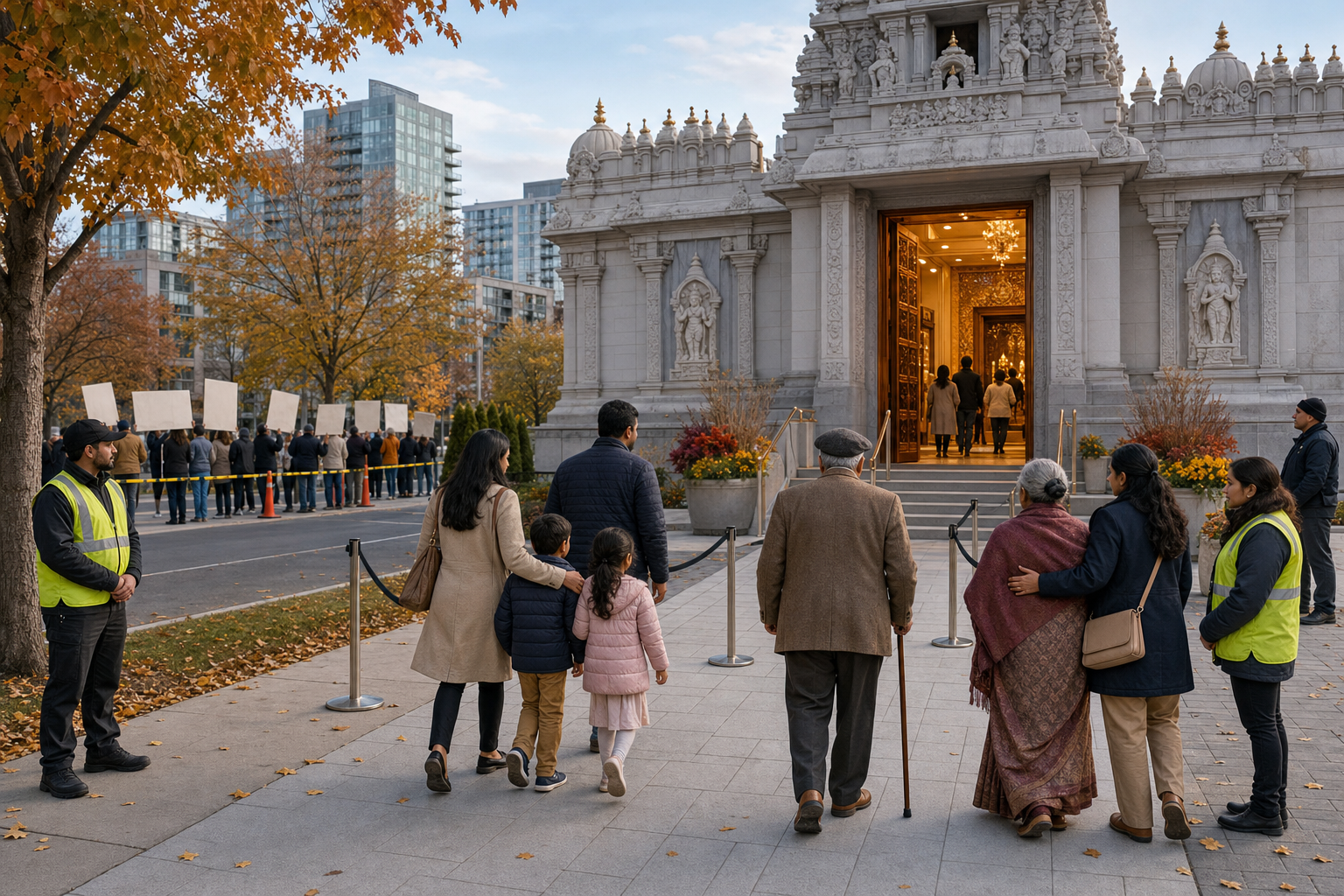
If you are deciding whether to bring children or an elderly parent to a mandir while a demonstration is expected outside, do not reduce the question to whether police will be present. Ask whether every devotee can reach the door without being blocked, surrounded, pursued or forced through targeted abuse.
A sound access plan protects political expression without making worshippers absorb the cost of someone else’s confrontation. Here is how devotees, temple leaders and public authorities can turn that principle into practical decisions.
Key takeaways
- Judge access at the temple entrance, not merely by whether violence or arrests occurred.
- A buffer zone can prevent direct confrontation while leaving graphic displays, amplified abuse and intimidation within the experience of families arriving to worship.
- If you encounter a hostile demonstration, prioritize leaving danger and helping children, elders or vulnerable devotees. Do not remain in harm’s way to collect evidence.
- Temple leaders should obtain a location-specific plan from police and local counsel. A Brampton bylaw, a Surrey injunction and a proposed provincial bill are not interchangeable legal protections.
- Defend Hindu institutions with precise language. Criticize identified conduct and separatist ideology without treating Sikhs collectively as responsible.
Use a three-part test for meaningful temple access
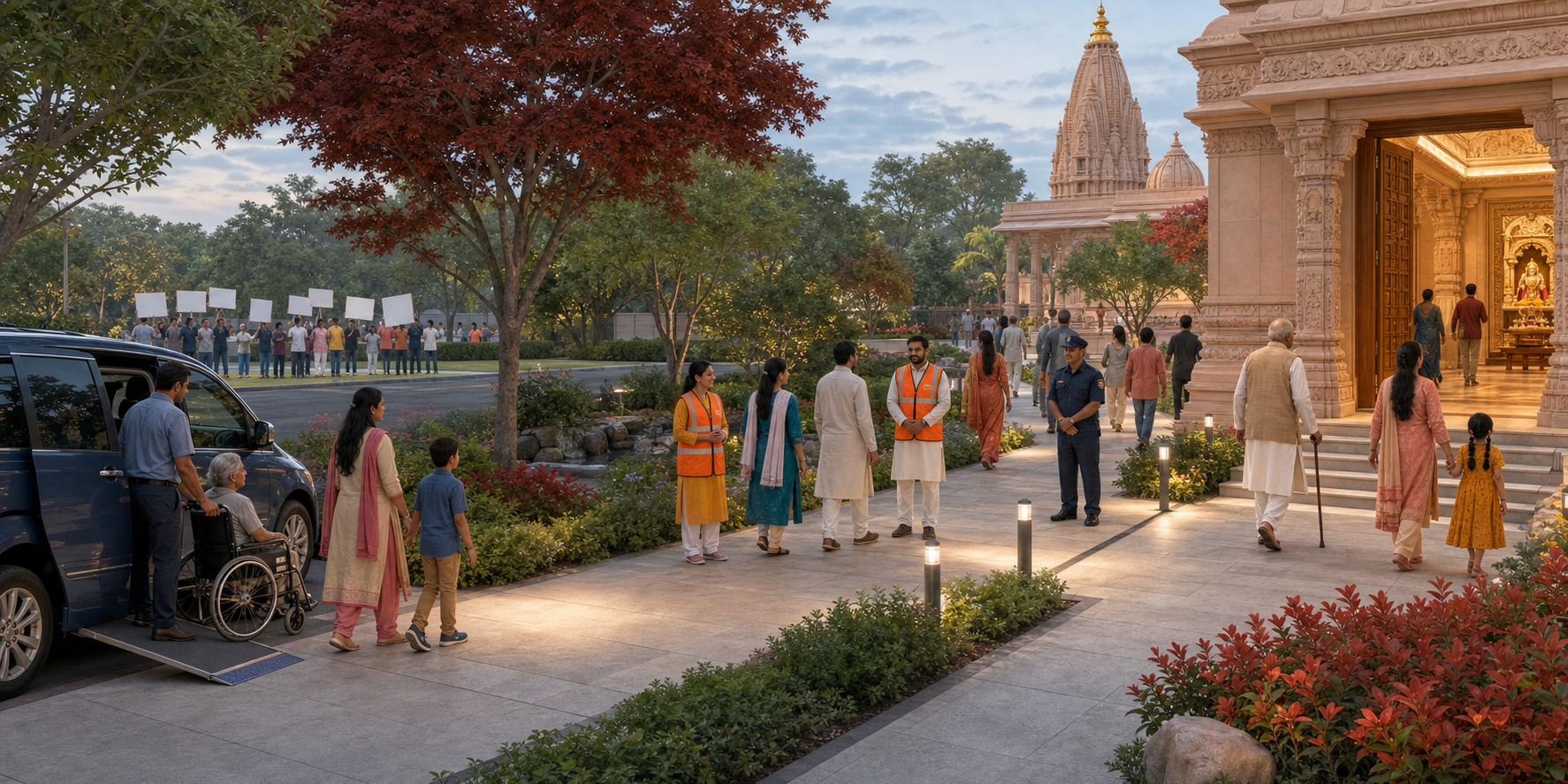
During Hanuman Jayanti gatherings, CoHNA, a Hindu advocacy organization, alleged that Canada-based Khalistani extremists staged targeted demonstrations outside Triveni Mandir in Brampton and Lakshmi Narayan Mandir in Surrey. Treat that description as an advocacy allegation, not as an independent judicial finding, and do not infer that every person present shared an identical motive.
The civil-rights question does not depend entirely on what label is applied to the demonstrators. It can be evaluated through three observable features: proximity, conduct and practical effect. This framework keeps attention on what worshippers actually face while avoiding an argument over political identity at the temple gate.
Proximity: where does the encounter begin?
Map the full arrival route, not just the property line. A clear doorway is of little use if devotees must pass a hostile gathering between a parking area, transit stop or drop-off point and that doorway. Ask where signs, loudspeakers and demonstrators will be positioned relative to the route used by families, seniors and people with disabilities.
A protest can remain visible to its intended public without occupying the narrow approach to a sacred space. The relevant question is whether adequate separation preserves both communication and unpressured entry.
Conduct: what are people doing?
Distinguish peaceful political criticism from conduct directed at individual worshippers. Blocking, following, surrounding, threatening or aiming degrading abuse at people entering a mandir creates a different problem from displaying a political message at a safe distance.
Use concrete descriptions when documenting an incident. Record where a person stood, what route was affected, what was said or displayed, and what the devotee had to do in response. Statements such as “the north entrance could not be reached without passing within the demonstration area” are more useful than broad conclusions about how everyone involved must have felt.
Practical effect: could an ordinary devotee still worship?
The absence of a physical clash does not answer whether access was meaningful. Despite legal separation at the two temples, devotees were reportedly still exposed to graphic imagery and loud, abusive slogans, with children among those affected.
Test the arrangement from the position of a parent carrying a child, a senior walking slowly or a first-time visitor who does not know another entrance. Could that person find the door, understand police instructions and enter without being singled out? Did anyone delay arrival, use a less accessible route or turn back? Those effects belong in the assessment even if no offence was charged.
Make an access plan before the festival begins
If you are attending the mandir
- Check the mandir’s own notice before leaving. Look for the designated entrance, parking changes, drop-off location and instructions for families or seniors. Treat forwarded social-media messages as unconfirmed unless temple leadership has adopted them.
- Agree on a simple family plan. Choose a meeting point away from the demonstration, keep children and dependent adults beside you, and make sure each capable adult knows whom to call if the group becomes separated.
- Follow the designated route and lawful police directions. Do not stop at the entrance to debate demonstrators, answer provocation or defend Bharat’s policies. Your purpose at that moment is to enter safely and avoid turning a congested doorway into a confrontation.
- Leave immediately if you see a weapon, a fight, an attempt to surround people or another sign of imminent danger. Contact emergency services from a safe location. Do not go back for a photograph or ask a family member to remain behind as a witness.
- If it is safe to document what happened, write down the time, location, entrance, conduct observed, words or images directed at worshippers, witnesses, police contact and effect on access. Note whether anyone was delayed, redirected or prevented from entering.
- Send the record to the temple’s designated contact or police, as appropriate. Avoid publishing unverified identities and accusations in real time; public misidentification can inflame tensions and create legal exposure.
If you want to support other devotees, volunteer through the temple’s plan rather than improvising security at the curb. A self-appointed counter-line can obstruct the same entrance it is meant to defend and may make police separation harder.
If you help lead or volunteer at the mandir
- Nominate one police liaison and one internal access coordinator. Volunteers should know who can change an entrance plan and who communicates that change to devotees.
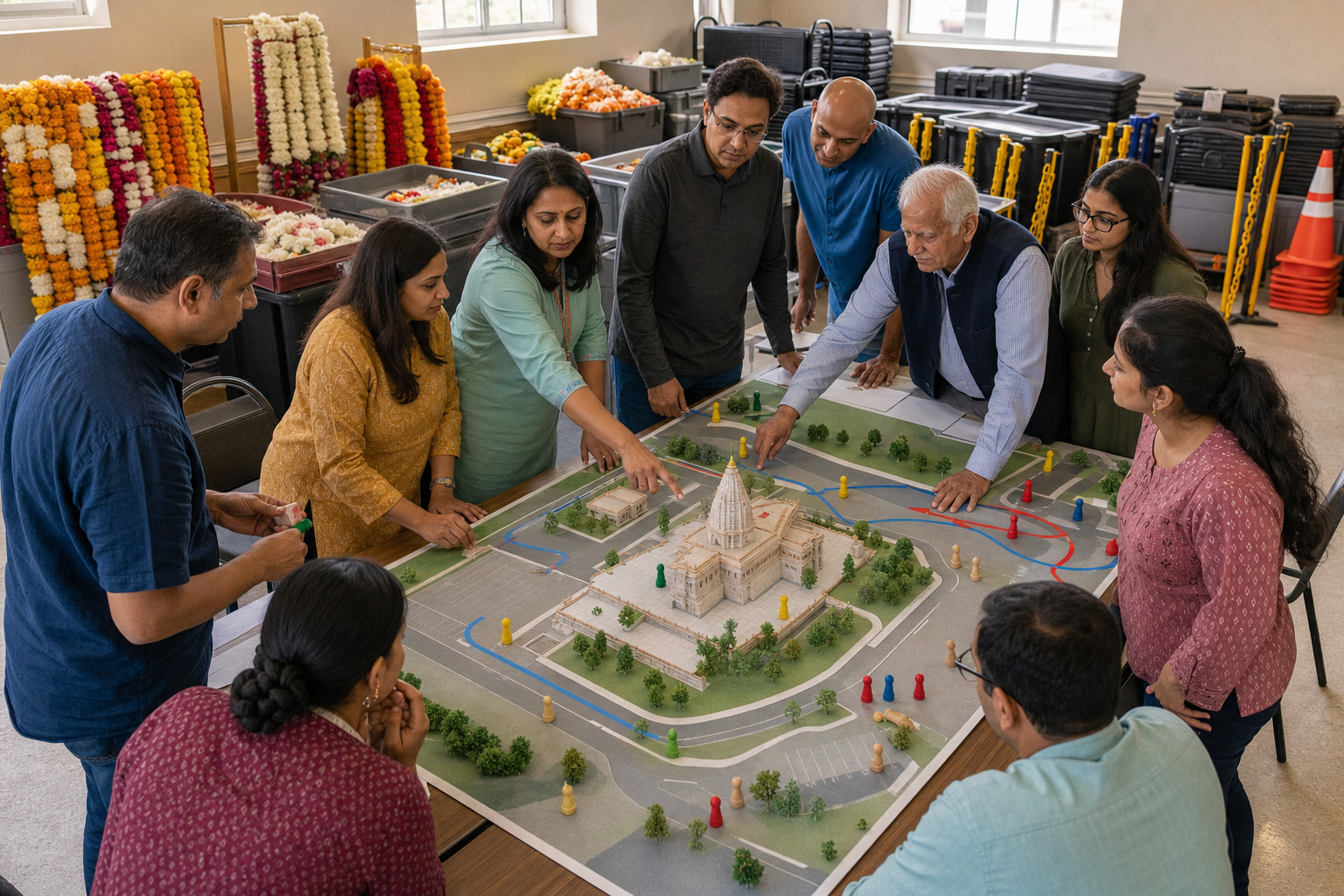
- Draw the arrival route from parking areas, transit stops and accessible drop-off points to each usable door. Mark the property boundary, narrow points and places where opposing groups could converge.
- Ask authorities to define the separation arrangement in operational terms: where demonstrators may stand, which route remains open, who responds to a breach and how temple leadership reaches the officer in charge.
- Publish a short access notice before the event. Include the entrance, arrival window, accessibility arrangements, family instructions and a temple contact. Do not publish security details that would make the plan easier to disrupt.
- Keep trained greeters inside the protected approach. Their role is to direct and reassure arriving devotees, not argue with protesters or act as an unofficial enforcement unit.
- Use one incident log. Separate direct observations from second-hand reports, preserve original files, and record the effect on worship rather than collecting slogans without context.
An alternate entrance can be useful, but it should not quietly transfer the burden to devotees with limited mobility or concede that a hostile group controls the main gate. Ask first how the ordinary entrance can remain usable; use another route when safety genuinely requires it.
Ask authorities for an access outcome, not a symbolic presence
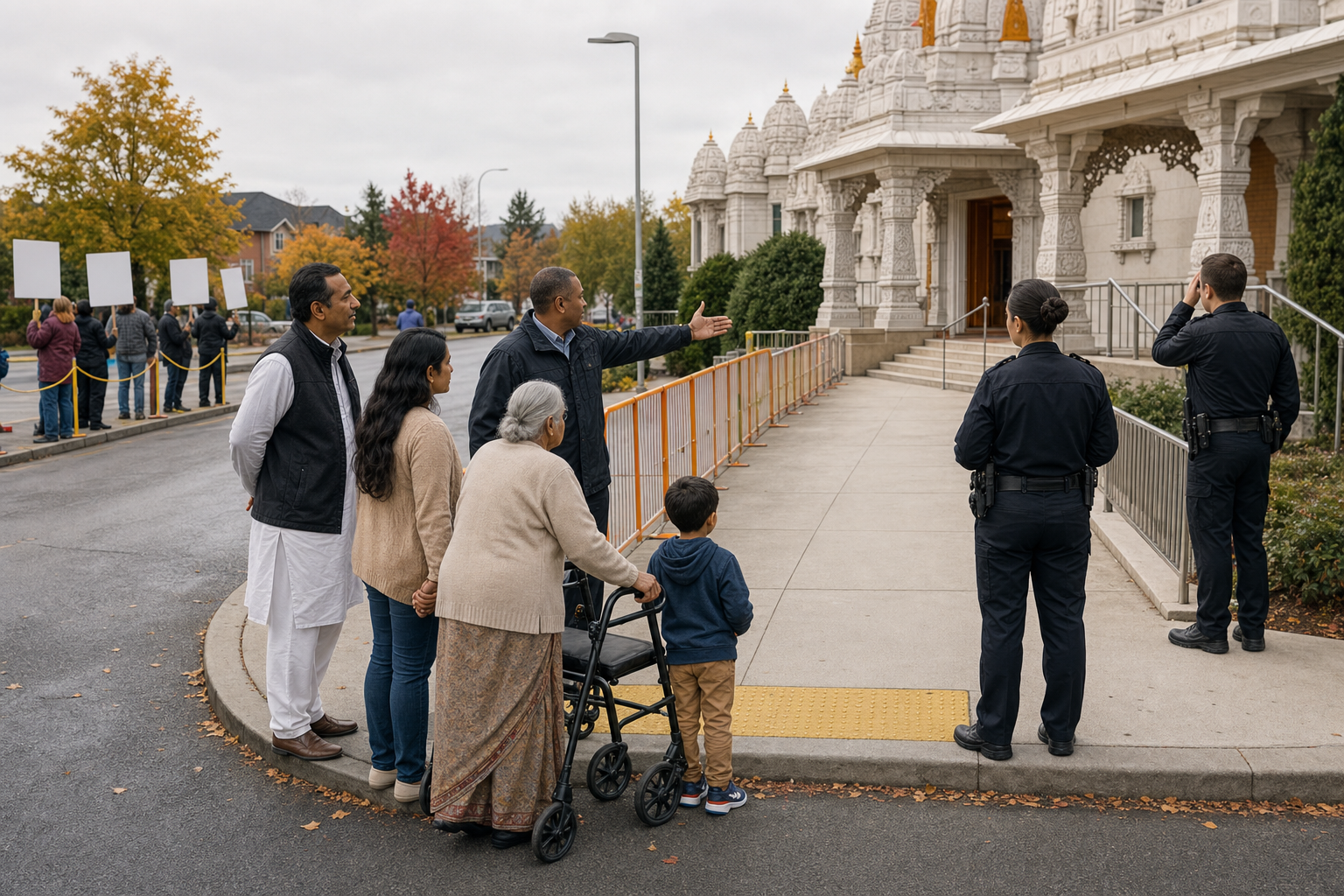
Different legal mechanisms were used in the two cities. Peel Regional Police reportedly enforced Brampton’s Protecting Places of Worship from Nuisance Demonstrations By-law 173-2024 around Triveni Mandir. Lakshmi Narayan Mandir in Surrey had obtained an injunction from the Supreme Court of British Columbia that reportedly enabled a similar buffer.
These examples tell temple leaders what questions to ask, not what powers they automatically possess. A municipal bylaw must be checked in the relevant municipality, while an injunction is a court order tied to its actual terms. Bill 13-2026, the proposed Safe Access to Places of Public Worship Act, was being advanced as a provincial measure; the word “proposed” matters, and its title alone is not evidence that it subsequently took effect. Have local counsel verify the current law before announcing that a buffer is legally guaranteed.
When requesting police or municipal assistance, be exact about the desired result: “We are not asking authorities to suppress a political position. We are asking for a viewpoint-neutral plan that keeps worship entrances practically usable and prevents targeted intimidation of people arriving to pray.” Then ask how the plan will answer these questions:
- Will every designated entrance and accessible route remain reachable?
- Can devotees arrive without walking through the demonstration or being surrounded?
- Who responds if people cross the agreed boundary, obstruct a route or direct threats at entrants?
- Will amplified sound and graphic displays remain far enough away that the buffer works in practice, not only on a map?
- How will authorities record delays, diverted families and people who turn back?
- Will the same conduct-based safeguards be available to a gurdwara, church, synagogue, mosque or other place of worship in equivalent circumstances?
After the event, do not accept “no arrests” as the complete evaluation. Record whether doors remained usable, vulnerable devotees received assistance, worship proceeded on schedule and anyone abandoned the visit because of the conditions outside. That information shows whether the arrangement protected access rather than merely preventing a fight.
Keep the defence of Hindu rights precise
Those involved reportedly presented the demonstrations as opposition to alleged Indian state activity rather than hostility toward Hindus. Political purpose, however, does not erase religious impact. Selecting a mandir places the immediate burden on Canadian worshippers, many of whom have no role in the dispute being protested.
A temple is not interchangeable with a foreign government. Mandirs may independently provide space for practical services, including consular assistance used by older Indian-origin residents for pension documents or life certificates. Hosting such a service does not, by itself, convert the sacred institution or its congregation into an arm of the Indian state. The assumption is especially crude in the case of Triveni Mandir, which was founded and is administered by Caribbean Hindus.
Precision is also a Dharmic obligation. Khalistani separatism and the conduct of identified demonstrators can be criticized firmly without assigning collective guilt to Sikhs. Sikhism belongs within the wider Dharmic civilizational family, and Sikh neighbours are not answerable for every activist who invokes Sikh identity.
Use three rules in temple statements, community meetings and conversations with officials:
- Name the organization, individuals or conduct for which evidence exists. Do not use “Sikhs” as shorthand for separatists or demonstrators.
- Distinguish allegations, direct observations, police actions and court orders. They carry different evidentiary weight and should not be blended into one sweeping claim.
- Request a neutral remedy: safe distance, an open route, prompt enforcement and the same protection for every faith community.
This discipline does not weaken Hindu advocacy. It makes the demand harder to dismiss, preserves relations among Dharmic communities and keeps attention on the conduct that must change.
If a demonstration is expected at your next observance, act before the crowd arrives. As a devotee, obtain the approved route and make a family plan. As a temple volunteer, put the access map, police liaison, legal verification and incident log in place. The practical standard is simple: political disagreement may remain public, but no family should have to run a hostile gauntlet to offer darshan.