

You may want two things at once: a footpath you can walk on and an Indian city where a small trader can earn lawfully. Municipal debates often force you to choose between them. You do not have to accept that choice.
If you are deciding whether a hawker-clearance drive, licensing reform, or deregulation proposal deserves your support, use one practical test: will the lawful route become easier and more predictable than an unofficial arrangement with officials, while genuine safety and access rules remain enforceable? If not, the proposal will probably move the problem rather than solve it.
The footpath is an incentive map

A crowded pavement in front of underused shops looks like a simple enforcement failure. Look more closely and it reveals how the city has priced lawful participation. The stall occupies contested public space, but it may also face a smaller, more predictable administrative burden than the legitimate business paying for premises behind it.
A Mumbai restaurant-sector example makes the imbalance unusually clear. Operating lawfully can involve more than 40 licences, contact with around 12 inspectors or officers, and upward of 450 official interactions over a year. Renewals may fall on monthly, semiannual, annual, and ad hoc cycles. The burden is not merely the number of forms. It is the repetition, mismatched calendars, uncertain waiting time, and discretion at every handoff.
In the same setting, a nearby informal food stall may keep operating through one recurring daily bribe. That payment is illegal and should never be romanticized. Its significance is economic: one predictable unofficial demand can feel less risky than dozens of lawful processes whose cost, timing, and outcome are unclear. A system reaches a perverse equilibrium when it penalizes the business trying to comply more heavily than the business avoiding compliance.
This also helps explain why some formal shops avoid fast-moving, low-margin goods. When the margin on each sale must carry a large compliance burden, the shelf can remain empty even though customers are plainly buying the same goods outside. The entrepreneur has not disappeared. The transaction has migrated to the part of the market where the administrative cost is lower.
To diagnose that pattern in your own city, keep four separate ledgers:
- Money: What official fees must a lawful business pay, and how many separate payments are required?
- Time: How many applications, renewals, inspections, visits, and follow-ups stand between the trader and permission to operate?
- Uncertainty: Which decisions depend on an officer’s discretion, an unpublished expectation, or a deadline the administration is not required to meet?
- Value: What usable protection, stability, or market access does the trader receive in exchange for complying?
Do not collapse these into a single claim that licences are expensive. A low official fee can still conceal a severe burden if the applicant must make repeated visits or wait without a reliable decision date. Likewise, moving a form online is not simplification if the same documents, approvals, and discretionary checkpoints remain underneath it.
Formalization is not another word for eviction

Eviction removes a trader from a location. Formalization gives that trader a workable lawful status. Confusing the two is why a city can conduct repeated clearance drives without creating a durable improvement in pedestrian access, hygiene, or public trust.
A serious formalization plan must answer two questions at the same time: which public harm must be prevented, and where can legitimate low-cost commerce occur? If the city answers only the first, it may displace livelihoods without creating a legal alternative. If it answers only the second, it may tolerate blocked paths or unsafe food handling in the name of compassion.
Use the following test on every proposed rule:
- Name the harm. Does the rule address food safety, hygiene, fire risk, waste, pedestrian passage, or another identifiable public concern?
- Match the burden to the risk. A low-risk trader should not pass through the same process as a business with substantially greater safety hazards.
- Ask for evidence once. If several departments need the same identity, location, or ownership information, the administration should reuse it rather than repeatedly demand it from the applicant.
- Put a clock on the decision. The applicant should know when an acknowledgement, inspection, approval, renewal, or reasoned refusal is due.
- Limit discretion. The checklist, grounds for refusal, corrective steps, and appeal route should be visible before an inspector arrives.
- Provide a lawful destination. Before clearing a trading area, identify the permitted location, permit route, operating conditions, and boundary that affected traders can actually use.
This is the disciplined meaning of deregulation: remove duplicated, arbitrary, and rent-seeking controls while preserving rules that protect real public goods. Abolishing food safety or fire compliance would not liberate commerce; it would transfer preventable risks to customers, workers, neighbours, and emergency services.
If you operate a business, use this framework to evaluate the system, not to infer your current legal obligations. Municipal and sectoral requirements must be checked locally before you stop, consolidate, or change any licence process. Ignoring a rule that remains enforceable can expose the business to official action. When a demand appears undocumented or irregular, retain the paperwork and receipts and use an authorized grievance channel, a trade body, or qualified local counsel rather than relying on an unofficial payment or a confrontation at the premises.
A dharmic city assigns duties before it exercises power
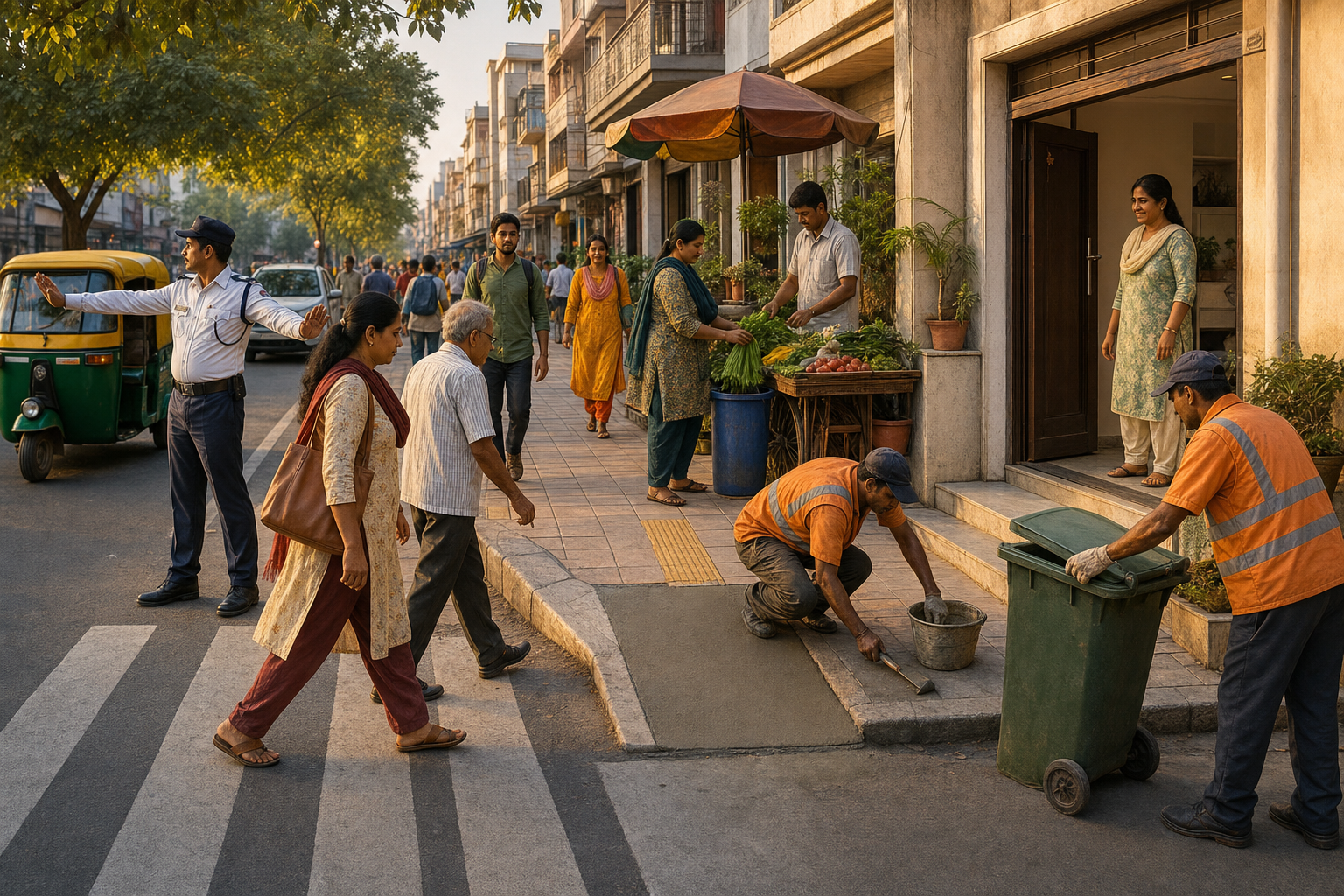
The deeper problem is not simply that some municipal rules are old. It is the operating assumption behind them. A control-first administrative culture can treat the citizen as a presumed violator, leaving lawful enterprise to prove its innocence again and again. That posture invites extraction because every permission becomes a point at which normal activity may be delayed.
A dharmic approach starts elsewhere. Dharma is not an excuse for having no rules. It is an insistence that authority and liberty both carry duties. Hindu, Buddhist, Jain, and Sikh ethical vocabularies are not identical, but trust, fairness, restraint, honest livelihood, and mutual responsibility give us a shared civic direction.
Applied to an urban market, that direction produces a reciprocal compact:
- The city must publish a comprehensible route to legality, decide applications predictably, discipline predatory enforcement, and keep public space usable.
- The vendor must remain within the permitted area, handle food and waste responsibly, respect pedestrian passage, and deal honestly with customers.
- The formal shop must meet the safety standards appropriate to its risks, but should not have to survive redundant approvals merely to preserve its lawful status.
- The inspector must identify the rule, record the evidence, distinguish a correctable lapse from an immediate danger, and avoid treating uncertainty as an opportunity for extraction.
- The resident or customer should challenge obstruction, danger, fraud, and unhygienic practice without treating poverty or informality itself as proof of bad character.
Trust in this model does not mean blind faith. It means clear expectations, proportionate verification, and consequences tied to actual misconduct. The trader should not be harassed for routine compliance, and the official should not be powerless when there is a genuine risk to the public.
This distinction matters politically. A city that tolerates everything eventually loses public space. A city that criminalizes ordinary livelihood pushes more people toward brokers, bribes, and concealment. Dharmic order lies in making each duty visible and applying it without humiliation or favour.
What smart deregulation should change on the ground
Create one administrative doorway
A single-window system should be a genuine front door, not a website containing links to the same fragmented offices. Specialist departments may still need to assess fire, food, building, or sanitation risks. The applicant, however, should submit common information once and see one consolidated status.
The minimum useful design includes:
- one business identity and profile used across participating departments;
- one visible list of required permissions, documents, fees, and renewal dates;
- one submission receipt that proves what was filed and when;
- one dashboard showing pending decisions, requests for correction, and reasons for refusal;
- renewal reminders on a predictable calendar rather than scattered surprise deadlines; and
- a recorded escalation route when an authority misses its stated timeline.
The practical goal is fewer occasions on which an applicant must ask an individual officer to move an ordinary file. Digitization helps only when it also reduces repetition and discretion.
Inspect risk rather than ritual
Not every enterprise creates the same potential harm. Inspection frequency and depth should follow the nature of the activity, its compliance history, credible data signals, and the seriousness of any complaint. A complaint should trigger assessment, not function as automatic proof of guilt.
Before a field visit, the business should be able to see the applicable checklist. Afterward, it should receive the findings, the rule involved, any corrective action, and the time allowed. Immediate hazards may require immediate intervention; a correctable paperwork defect should not be treated as though it were an imminent threat to life.
The administration must also inspect its inspectors. Repeated visits to the same low-risk business, unexplained differences between officers, missing receipts, and unusual patterns of penalties should be reviewable. Penalties for bribery and predatory enforcement are part of regulatory reform, not an unrelated anti-corruption exercise.
Protect footpaths without outlawing low-cost trade
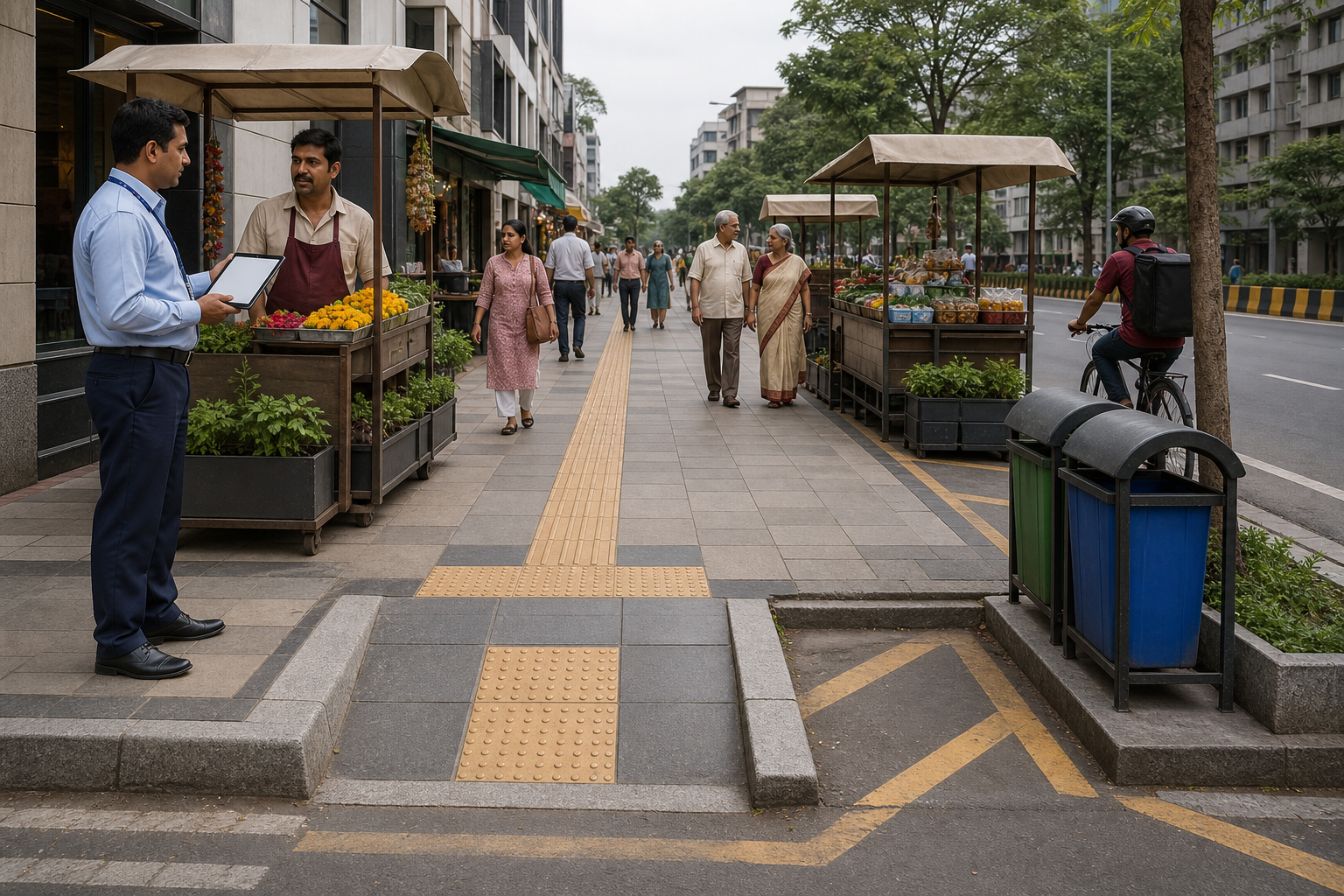
Pedestrian access is a real public good. The answer is to define it clearly and enforce it consistently. A city can identify where vending is compatible with movement, mark boundaries, specify operating conditions, arrange waste responsibilities, and prohibit trading at locations where safe passage cannot be maintained.
The sequence matters. Map the conflict, designate the lawful option, explain the conditions, make the permit usable, and then enforce the boundary. Clearing first and designing legality later leaves the trader with no practical route except displacement or another unofficial arrangement.
Enforcement should distinguish among conduct. A trader who crosses a marked boundary, a food operator creating an immediate hygiene danger, and a person missing a correctable document do not present the same problem. Published consequences make that distinction legible to the public and harder to manipulate in private.
Demand a before-and-after scorecard
If a reform proposal promises ease of doing business, do not settle for the launch of a portal or the repeal of an isolated licence. Ask officials to publish the old and new compliance journeys for a specific trade. The comparison should answer:
- How many licences or permissions were required before, and how many remain?
- How many renewal cycles and in-person interactions were removed?
- Which documents are now submitted only once?
- Which inspections are triggered by risk, and which routine visits were discontinued?
- How long is each administrative decision supposed to take?
- What happens when the administration misses that deadline?
- Which food-safety, hygiene, fire, and pedestrian protections remain non-negotiable?
- Where can a small trader operate lawfully after a footpath is cleared?
- How can a business report an undocumented demand without returning to the same opaque chain of command?
This scorecard prevents cosmetic reform. It also makes trade-offs visible. Residents can see that public protections remain; businesses can see whether compliance has actually become usable; and administrators can identify the checkpoints that generate delay without reducing risk.
Key takeaways
- Persistent informality is not explained by entrepreneurial failure alone. It can be a rational response when lawful participation costs more, takes longer, and produces less certainty than an unofficial arrangement.
- A clearance drive is not a formalization policy unless affected traders receive a realistic lawful route to continue legitimate commerce.
- Smart deregulation removes duplication and discretion while retaining food safety, hygiene, fire protection, and pedestrian access.
- A dharmic regulatory order binds every participant: the city, trader, shopkeeper, inspector, resident, and customer all carry enforceable duties.
- The best test of reform is operational: fewer permissions, fewer repeated submissions, predictable decisions, risk-based inspections, accountable officers, and a visible legal place for low-cost trade.
Start with one trade in one ward and draw its entire compliance path on a single page. Count every permission, renewal, visit, repeated document, waiting point, and discretionary decision. Then ask which step prevents a defined public harm. Keep those protections, combine what can be combined, and remove what exists only because another office has always demanded it. That is how a city makes lawful commerce the sensible choice while reclaiming public space through rules people can understand and respect.
References
