

Religious-property controversies are often framed as either threats to sacred institutions or scandals within them. Read together, the three source reports suggest a more useful principle: protecting an institution from external loss and holding its administrators accountable are complementary duties.
Both duties depend on the same foundations: reliable ownership records, clearly defined authority, traceable decisions, financial controls and remedies that respect due process. This framework helps distinguish legitimate defence of an endowment from attempts to shield its management from scrutiny.
Three cases reveal two directions of institutional risk

The Achalpur case represents the outward-facing risk: the possible loss of religious land through an acquisition or administrative proceeding. Hindu Janajagruti Samiti reported that a revenue court dismissed an attempted acquisition involving approximately 3.5 acres belonging to Shri Ram Mandir Sansthan, property the report valued at nearly ₹10 crore. It credited the Maharashtra Mandir Mahasangh with intervening in the matter. As presented by that source, documentary preparation and participation in the appropriate legal forum helped the institution retain control of the land.
The report concerning the Western Maharashtra Devasthan Management Committee illustrates the opposite risk: possible weakness or misconduct within an administrative structure entrusted with sacred assets. Hindu Janajagruti Samiti reported allegations of multi-crore irregularities involving a committee said to manage 3,067 temples, including Kolhapur’s Shri Mahalaxmi Temple. It also reported that Maharashtra Revenue Minister Chandrashekhar Bawankule directed officials to convene an immediate meeting after receiving the organisation’s memorandum. That direction signifies administrative attention, not a finding that the allegations have been proved.
A third report broadens the comparison beyond temple administration. HinduPost described allegations and legal proceedings involving Church of South India-linked property and bodies, including a dispute concerning 31.10 acres at Tallakulam in Madurai. According to that article, the Madurai Bench of the Madras High Court directed the Central Bureau of Investigation in November 2024 to register a case and examine allegations relating to an illegal sale of government land. A court-directed investigation is a serious form of scrutiny, but it does not itself establish criminal guilt.
These matters differ in institution, posture and alleged problem. Achalpur concerns a reported acquisition attempt that was dismissed; the Devasthan committee matter concerns allegations followed by a ministerial direction; and the CSI account describes disputes that had entered judicial or investigative channels. Their common lesson is therefore not that the cases are equivalent, but that religious property becomes vulnerable whenever records, authority or accountability cannot be demonstrated promptly.
A defensible endowment needs an unbroken governance chain

Sacred land is more than a marketable parcel. The Achalpur report emphasises its relationship to worship, festivals, maintenance and community continuity. Yet sacred purpose alone does not settle a revenue dispute or prevent an unauthorised transaction. Institutional memory must be translated into legally usable records.
The chain begins with an authoritative asset register. Each parcel should be connected to title documents, survey details, maps, revenue entries, historical grants where relevant, current possession and any lease, encumbrance or pending proceeding. Periodic reconciliation matters because a register that is accurate only when created can gradually diverge from revenue records and conditions on the ground.
The next link is authority. Trust deeds, statutory rules or institutional constitutions should identify who may sell, lease, mortgage, develop or litigate over property. Major decisions require recorded resolutions, confirmation that the meeting was properly constituted, disclosure of personal interests and any approval mandated by the applicable legal framework. A signature proves that someone acted; it does not by itself prove that the person was empowered to act.
Decision quality must then be documented. Independent valuation, legal review, comparison of alternatives and a written explanation of how the proposal serves the endowed purpose can expose an undervalued transfer or an unnecessary disposal before it becomes difficult to reverse. The same file should preserve notices, objections and responses so that later reviewers can reconstruct the decision without relying on competing recollections.
Financial traceability completes the chain. The Devasthan committee report points to the complexity of overseeing donations, leases, procurement, development expenditure and temple valuables across a large network. At that scale, annual totals alone are inadequate. Receipts must reconcile with deposits; contracts with approvals and completed work; leases with rent registers and collections; and inventories with controlled physical verification. Independent audits should track unresolved objections as well as certify completed accounts.
Oversight must investigate evidence without prejudging outcomes
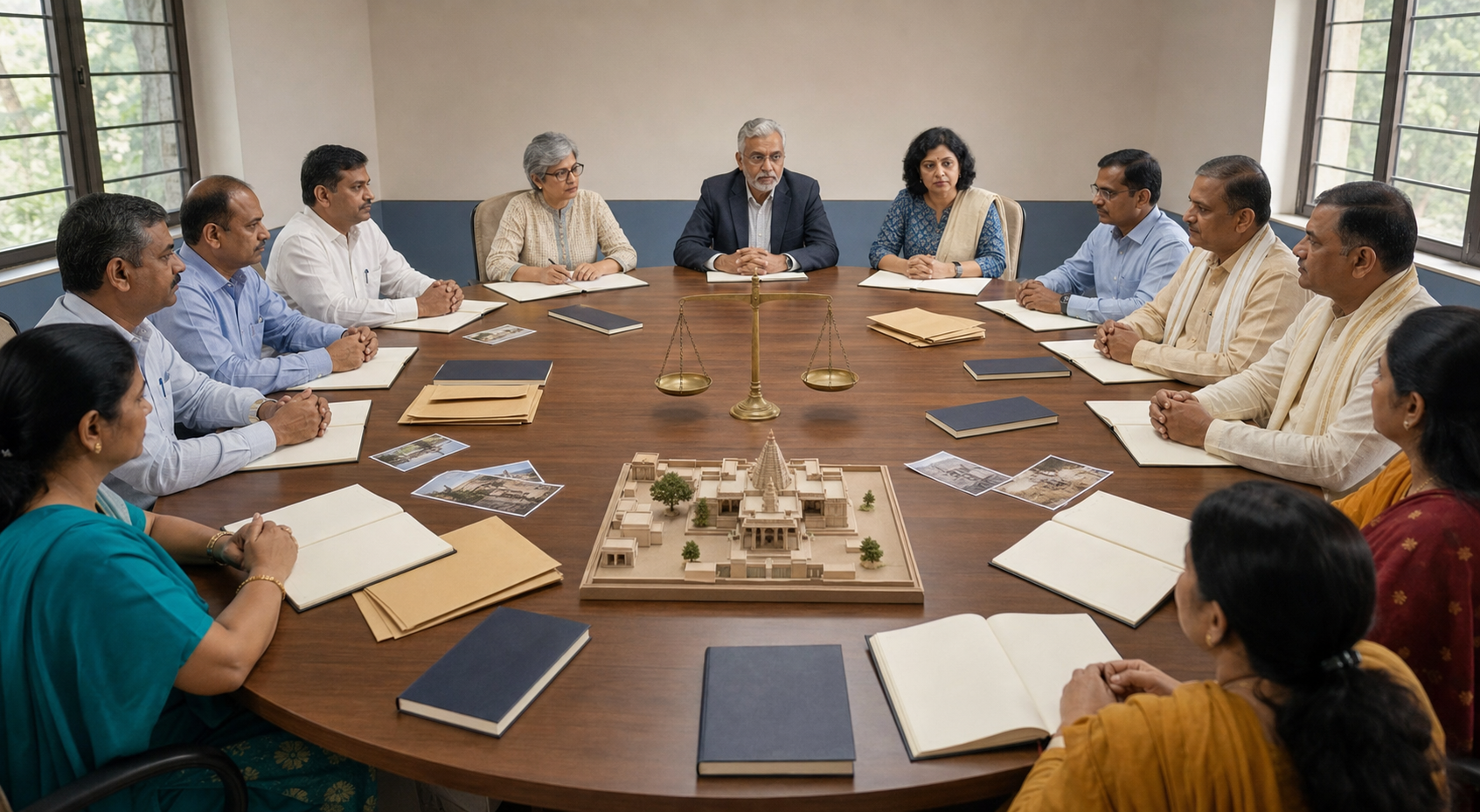
The three reports sit at different points in the accountability process, making precise language essential. An allegation is a claim requiring examination. An administrative meeting can define the scope of a review. An investigation can gather evidence. A court order may resolve a procedural or substantive issue placed before that court. None of these stages should automatically be described as a final determination of every disputed fact.
The Western Maharashtra report itself offers a useful distinction among suspected misappropriation, procedural non-compliance, conflicts of interest, poor records and administrative inefficiency. Those categories should not be collapsed into a single accusation. Proven diversion of funds may require recovery and prosecution; an unauthorised but otherwise documented decision may require invalidation or institutional correction; weak record-keeping calls for reconciliation, digitisation and stronger controls. Matching the remedy to the evidence protects devotees while also protecting honest employees and trustees from indiscriminate suspicion.
Civil-society organisations can play an important early-warning role. The Achalpur and Devasthan reports both describe interventions by Hindu organisations, one in a revenue proceeding and the other through a memorandum to government. Such participation is most credible when it identifies the affected asset, produces supporting records, uses the proper forum and remains open to an adverse finding. Public mobilisation can bring attention to a problem, but documentary evidence must determine the institutional response.
State oversight likewise requires discipline. It should be timely enough to prevent an irreversible transfer, bounded enough to avoid unnecessary control over religious life, and consistent across traditions. The CSI comparison is important here: property entrusted to a church, temple or other religious body should not become the private estate of its office-bearers. At the same time, allegations against any community should be assessed transaction by transaction rather than used to stigmatise the faith itself.
Key takeaways
- Property protection and managerial accountability rely on the same evidence: accurate asset records, lawful authority and a reconstructable decision trail.
- A favourable ruling in one land dispute does not remove the need for continuing audits, record updates and monitoring of vulnerable parcels.
- An allegation, ministerial direction, investigation and final finding are different stages and should be reported as such.
- Large temple networks need controls that connect each donation, lease, contract and asset to an approval, record and audit outcome.
- Civil-society vigilance is strongest when it combines community knowledge with documentary evidence and lawful procedure.
From reactive litigation to durable institutional trust

Digitisation can make governance more reliable, but scanning old files is only a beginning. Records should be searchable, access-controlled, backed up and reconciled with the relevant financial and land systems. Public summaries can disclose audited accounts, major contracts, property changes, committee resolutions and the status of audit objections without exposing personal data or security-sensitive information.
Governance also needs human separation of duties. The person proposing a transaction should not be its sole approver, valuer, record-keeper and beneficiary. Fixed review points for high-value or irreversible decisions, documented conflict disclosures and independent verification reduce dependence on the integrity of any one office-holder. Accessible complaint channels can surface missing rent, encroachment or unexplained expenditure before it grows into a crisis.
The forward path is to make verification routine rather than exceptional. When every sacred asset has a current record, every material decision has an identified authority, and every allegation enters a fair evidentiary process, institutions are better equipped to resist both wrongful dispossession and internal misuse. That is the administrative foundation on which religious autonomy and public confidence can reinforce one another.
References
- HinduPost — Explosive CSI Land Scandal: Court Battles Raising Hard Questions in South Bharat
- Hindu Janajagruti Samiti — Decisive Achalpur Victory Saves ₹10 Crore Shri Ram Mandir Land from Acquisition
- Hindu Janajagruti Samiti — Maharashtra Temple Funds Under Scrutiny: Bawankule Orders Urgent Meeting