
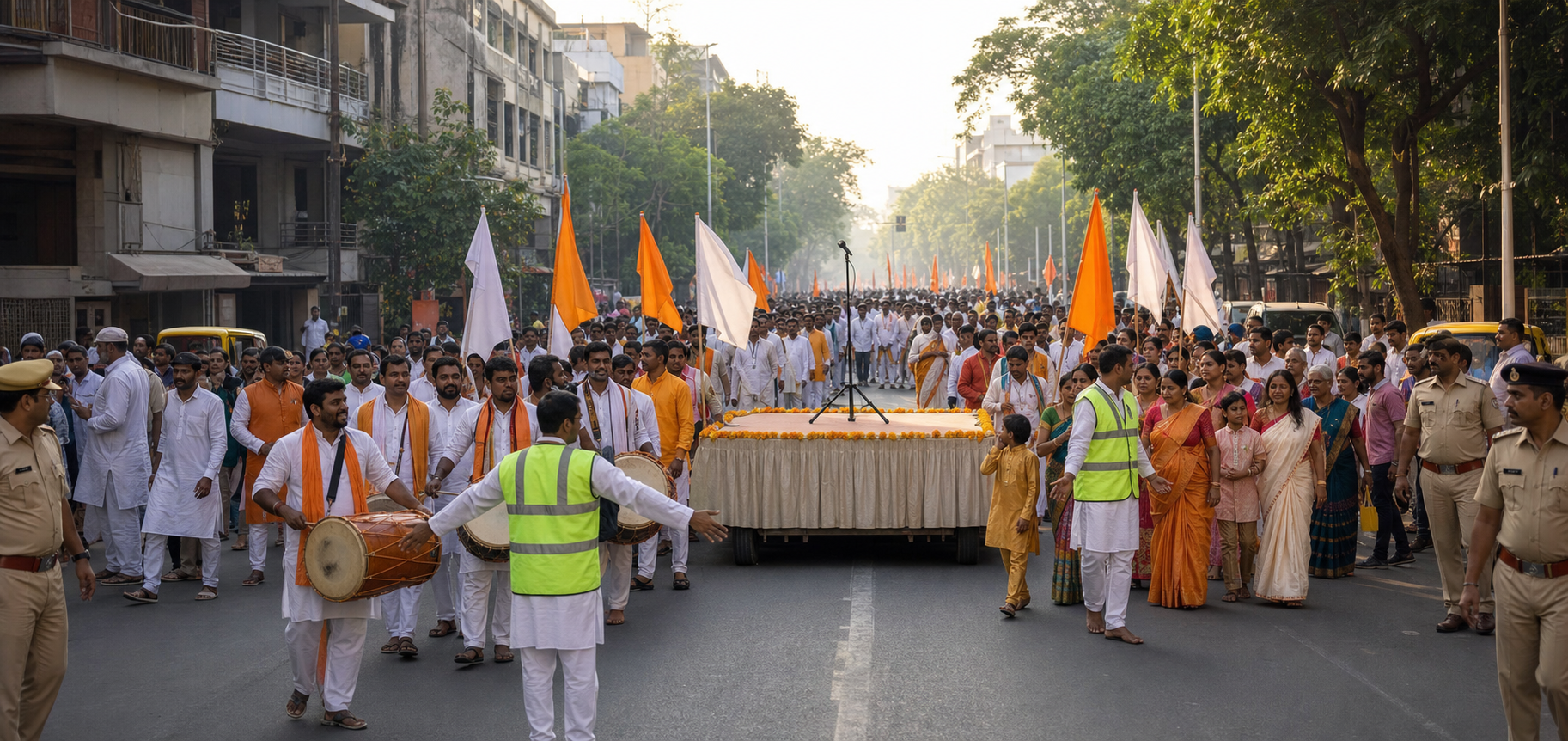
If you are organizing a yatra, speaking from its stage, or responding to a provocative clip, your hardest decision comes before any police notice: do you turn a grievance into a lawful demand, or let the crowd turn it into a verdict?
The practical rule is simple. Name the suspected conduct, preserve the evidence, and ask the competent authority to act. Do not threaten a person, blame an entire community, disclose private information, or invite a crowd to enforce the law. That discipline protects the procession, the cause, and the people around it.
The legal line depends on words, setting, and likely effect

Articles 19(1)(a) and 19(1)(b) of the Constitution protect expression and peaceful assembly. Those freedoms are substantial, but they are not permissions to intimidate, incite disorder, or disregard lawful conditions imposed on a public procession. Article 19(2) permits reasonable restrictions on speech on grounds that include public order, decency, and morality.
A festival permission also is not blanket approval for every sentence spoken from its stage. Processions commonly operate under route approvals, police directions, municipal requirements, and sound-amplification limits. The applicable conditions can differ by city, event, route, and current public-order situation, so organizers should obtain them in writing rather than rely on what happened in a previous year.
A disputed viral clip associated with a Hanuman Jayanti rally in Bhopal illustrates why neither anger nor a short recording settles the legal question. Officials examining a speech look beyond whether it sounded offensive. Relevant considerations include the exact words, the person or group targeted, the audience, local sensitivities, the surrounding events, and whether disorder or intimidation was a foreseeable result.
That produces several distinctions you can use before speaking:
- Allegation versus verdict: “We have submitted evidence of a possible licensing violation” leaves the finding to the authority. Declaring someone guilty before inspection turns an unverified claim into a public judgment.
- Enforcement demand versus crowd command: Asking the municipal corporation or police to investigate is different from asking listeners to surround, punish, expel, or confront somebody.
- Conduct versus identity: Criticize an alleged act, policy, permit failure, or enforcement lapse. Do not transfer blame to every member of a religion, caste, occupation, or neighbourhood.
- Moral condemnation versus threat: You may express firm opposition to cruelty or illegality. Predicting or promising harm to an identifiable person creates a different and much more serious risk.
- Complete record versus viral fragment: A clipped sentence can conceal a qualification, but it can also conceal escalation outside the selected segment. Preserve and assess the full recording.
Possible criminal scrutiny can involve legal categories such as promoting enmity between groups, deliberately and maliciously outraging religious feelings, statements contributing to public mischief, and criminal intimidation. The applicable statute, section number, and evidentiary threshold must be confirmed for the date and facts of the case. If you receive a complaint, summons, or restriction order, preserve the original media and consult a lawyer familiar with current criminal and local public-order law before issuing an improvised public rebuttal.
Two errors are especially common. The first is assuming that a worthy purpose immunizes dangerous methods. It does not. The second is assuming that questionable speech disproves the grievance behind it. It does not do that either. The speech and the alleged underlying violation require separate evidence and separate decisions.
Build restraint into the procession before the microphone opens
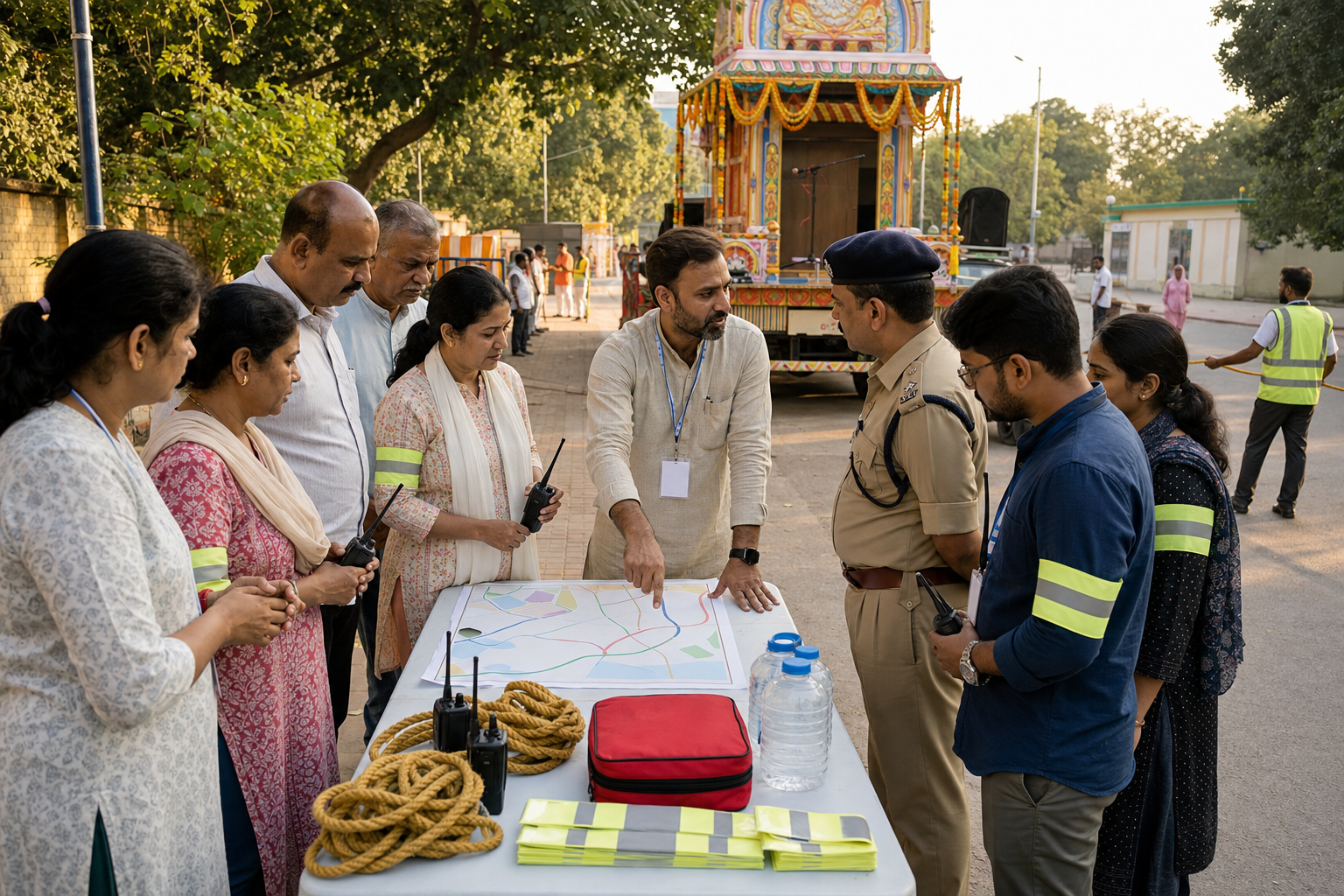
Most stage crises are operational failures before they become legal disputes. The speaker has not seen the conditions attached to the permission, nobody has authority to interrupt a speech, marshals do not know whom to call, and an allegation reaches the microphone before anyone checks it. Fix those points while the event is still being planned.
- Create one permission file. Keep the approved route, assembly and dispersal arrangements, sound permission, police directions, organizer contacts, and emergency instructions together. Give copies to the procession lead, stage manager, marshal lead, and police liaison.
- Appoint a speech steward. One named organizer should approve the speaker list, brief every speaker, and have authority to stop the audio feed. If everyone is responsible, nobody will act during the few seconds that matter.
- Issue a short written speaker code. Prohibit threats, collective blame, unverified accusations presented as facts, disclosure of private addresses or phone numbers, and calls for crowd enforcement. Require speakers to direct complaints to named lawful channels.
- Put allegations through an evidence gate. Before a person or business is named, ask what was directly observed, what remains hearsay, whether the media is original, and whether a complaint has already been filed. If those answers are missing, discuss the general issue without identifying the accused.
- Assign marshals to functions, not merely to the crowd. Designate people for route discipline, stage access, emergency passage, police communication, and rumor reporting. De-escalation training matters more than matching shirts.
- Record the complete event. Retain continuous stage audio and video when lawfully possible, along with the schedule and speaker names. A full record helps distinguish an accurate complaint from an edited clip and protects evidence integrity.
- Prepare a correction channel. Decide in advance who can publish an official clarification, in which languages, and on which accounts. A correction issued only after a rumor has spread through dozens of groups will struggle to catch it.
If a speaker breaches the code, the response should be immediate and procedural. The stage manager stops the microphone, makes a neutral announcement that the remarks were unauthorized, alerts the police liaison where necessary, and preserves the complete recording. Organizers should not start an argument from the stage; that merely gives the disputed claim a second audience.
Route discipline matters as much as speech discipline. Keep emergency access clear, prevent unscheduled diversions, and give marshals a direct way to report a blockage or confrontation. When a grievance arises, move it to the liaison desk instead of allowing a cluster to form around the person being accused.
Report suspected slaughterhouse violations on a separate track
If the grievance concerns a slaughterhouse, animal transport, prohibited slaughter, sanitation, or pollution, public anger is not evidence and a procession is not an inspection team. The lawful route is more exacting, but it is also more capable of producing an enforceable result.
In Madhya Pradesh, different rules address different parts of the activity. The Madhya Pradesh Govansh Vadh Pratishedh Adhiniyam, 2004, as amended, prohibits the slaughter of cow progeny. The Food Safety and Standards Act, 2006, and the Food Safety and Standards (Licensing and Registration of Food Businesses) Regulations, 2011, govern matters including licensing, hygiene, and traceability. The Prevention of Cruelty to Animals Act, 1960, and the Prevention of Cruelty to Animals (Slaughter House) Rules, 2001, address animal handling and slaughter conditions. The Water Act, 1974, Air Act, 1981, and Environment (Protection) Act, 1986, govern pollution, emissions, effluent, and waste-management obligations.
A facility can therefore face a problem in one regulatory area while complying in another. A food-business license does not by itself answer a cattle-protection question, and municipal permission does not prove compliant effluent disposal. Keep each allegation tied to the rule and regulator capable of examining it.
Potential warning signs include a missing or expired license, failure to follow veterinary inspection requirements, suspected handling of animals covered by a statutory prohibition, unsafe transport or treatment, absent or non-functional effluent treatment, and improper waste disposal. These are reasons to request an inspection, not proof that a crime has occurred.
Build a complaint packet that an officer can use:
- Record the date, time, and precise location of what you directly observed.
- Preserve the original photograph or video file. Do not replace it with a compressed forward or a screen recording if the original is available.
- Separate observation from inference. “Liquid was entering this marked drain at this time” is an observation; “the facility has no treatment plant” requires additional evidence.
- Include visible permit details, vehicle identifiers, signage, landmarks, and geolocation cues when they were obtained lawfully.
- State whether the concern appears ongoing, repeated, or an immediate danger. Do not manufacture urgency.
- Keep a copy of the complaint, attachments, submission receipt, and any reference number.
Send the concern to the authority that controls the relevant issue:
- Municipal corporation or nagar nigam: municipal licensing, local sanitation, and related civic compliance.
- State Food Safety Department or FSSAI’s Food Safety Connect channel: food-business licensing, hygiene, and food-safety concerns.
- State Animal Husbandry Department: veterinary inspection and animal-health compliance questions.
- State Pollution Control Board: effluent, emissions, waste treatment, and environmental violations.
- Local police: an immediate threat to safety or public order, or suspected criminal conduct requiring urgent intervention.
Do not trespass, block a gate, chase a vehicle, seize property, confront workers, or publish somebody’s home address. Those acts can endanger people, contaminate evidence, and shift attention from the original complaint to your own conduct. If access is needed, let the authorized inspector obtain it.
Verify viral media, then apply the Dharmic test

A clip can be authentic yet miscaptioned, accurate yet incomplete, or edited in a way that changes its meaning. Virality proves that a file is circulating; it does not prove when it was recorded, where it was recorded, or whether the caption identifies the right people.
Use this sequence before forwarding a charged video:
- Find the fullest available version. Locate the earliest upload you can identify and ask for the original file rather than another forwarded copy.
- Compare timestamps across platforms. A later upload may have borrowed an old clip. Record when each version appeared and which caption accompanied it.
- Search distinctive keyframes. A reverse-image or keyframe search may reveal an earlier event, another location, or a longer recording.
- Test the claimed location. Compare signs, road layout, buildings, banners, vehicle plates, and landmarks. Do not treat one familiar-looking feature as conclusive.
- Examine time and continuity. Weather, shadows, lighting, abrupt audio changes, repeated frames, and mismatched crowd noise can expose a false time claim or an edit. They are clues, not automatic proof of fabrication.
- Seek local confirmation. Look for a police clarification and independent local reporting. The absence of an official statement is not confirmation of the caption.
If verification remains incomplete, do not convert uncertainty into certainty with an emotional caption. You can send the file privately to the relevant authority with the label “unverified,” explain where you received it, and identify exactly what you want checked. Avoid naming a private individual unless identification is necessary for the complaint and supported by evidence.
Organizers confronted by a misleading clip should publish the complete segment, identify the event and approximate place in the program, state what can be verified, and correct only what is demonstrably wrong. Issue the correction through the same accounts and community groups that carried the disputed claim. A vague denial without the underlying record will rarely settle the matter.
Dharmic ethics sharpen this discipline. Satya requires accuracy before accusation. Ahimsa restrains the means used to pursue even a legitimate end. Daya and karuna keep an alleged wrongdoer’s human dignity within view. Buddhist samma vaca asks whether speech is truthful and conducive to freedom from harm. Jain restraint refuses the certainty and possessiveness that turn a partial view into absolute judgment. Sikh commitments to sarbat da bhala and seva direct public energy toward the welfare of all.
None of this requires passivity toward illegal slaughter, cruelty, pollution, or official negligence. It requires two duties at once: protect animals and uphold the law, while refusing intimidation and collective punishment. Dropping either duty weakens the Dharmic case.
Key takeaways
- A procession’s religious purpose does not remove legal limits on threats, incitement, intimidation, sound use, or route conduct.
- Judge a disputed speech by its exact words, target, audience, context, and foreseeable effect, not by a short caption or partisan paraphrase.
- Direct the audience toward a regulator, complaint number, or inspection request. Never direct it toward a person or premises for confrontation.
- Keep the legality of the speech separate from the legality of the alleged underlying activity. Either, both, or neither may warrant action.
- Prepare the speaker code, speech steward, trained marshals, police liaison, complete recording, and correction channel before the procession starts.
- Treat satya and ahimsa as operating rules: verify the claim, use lawful means, and correct misinformation with the same reach used to spread it.
Before your next procession, place the speaker code and escalation contacts beside the route permission, not in a file nobody opens. If a dispute is already live, stop forwarding, preserve the original media, separate each allegation, and send it to the authority empowered to decide it. Conviction becomes credible when it is disciplined enough to survive verification and due process.