

If the Ahmedabad flashpoint has left you wondering whether to defend the film, join a protest, protect an interfaith couple, or raise an alarm about coercion, begin by separating those questions. A certified screening, a peaceful demonstration, an adult relationship, and an alleged crime are four different matters. Treating them as one communal contest makes every one of them harder to handle lawfully.
You do not have to suppress concern in order to respect liberty. You do have to identify the conduct you object to, test claims against evidence, and choose a remedy the law permits. That is the practical line between vigilance and vigilantism.
Key takeaways
- A film certified by the Central Board of Film Certification may be criticised, reviewed, boycotted, debated, or peacefully protested. Threats and anticipated disorder are not, by themselves, a lawful substitute for maintaining public order around its exhibition.
- Peaceful assembly is protected under Article 19(1)(b), subject to reasonable restrictions. Obstruction, intimidation, incitement, violence, and property damage cross from dissent into conduct that can attract legal action.
- An adult’s choice of partner and faith is protected by personal liberty and freedom of conscience. A family or organisation may disagree, but disagreement is not evidence of a crime.
- Fraud, coercion, allurement, trafficking, threats, and exploitation should be investigated as specific acts. A communal label cannot replace a complainant, facts, evidence, and due process.
- The safest screening-day plan is made before crowds gather: separate entrances and protest areas, named police and organiser liaisons, trained marshals, clear advisories, and a rapid response to rumours.
Do not collapse the film, the protest, and the relationship

The Ahmedabad demonstrations associated with VHP and Bajrang Dal brought several emotionally charged issues into the same public space: a screening of The Kerala Story 2 – Goes Beyond, arguments about conversion and women’s safety, and concern about an interfaith relationship. The issues may influence one another politically, but their legal tests remain distinct.
A certified film is an expression question
Certification under the Cinematograph Act, 1952 does not make a film historically infallible or morally beyond criticism. It means the exhibition has passed through the statutory certification process. Citizens remain free to challenge its claims, decline to watch it, organise a boycott, hold a discussion, or demonstrate outside the venue within lawful conditions.
What opponents cannot properly demand is that threatened disorder become the mechanism of censorship. In S. Rangarajan v. P. Jagjivan Ram (1989), the Supreme Court established the central principle: authorities are expected to control those who threaten disorder rather than suppress protected expression because someone may react badly. The same reasoning has been applied in disputes surrounding politically sensitive screenings, including litigation over the earlier film in this franchise.
This principle protects Hindu voices too. If officials can silence one certified film whenever an organised group threatens disruption, the same method can later be used against a film about a temple, a historical atrocity, religious conversion, or Hindu persecution. Defending the lawful screening process is therefore not an endorsement of every frame. It is a defence of the civic space in which difficult Hindu concerns can also be expressed.
A protest is an assembly question
Article 19(1)(b) protects peaceful assembly, subject to reasonable restrictions. The decisive test is conduct, not whether officials, producers, or viewers like the message. Placards, speeches, leaflets, chants, and calls for a voluntary boycott belong to a different category from blocking access, surrounding viewers, threatening cinema workers, damaging property, or trying to force compliance through fear.
If you are organising a protest, decide its boundaries in writing before participants arrive. State that nobody will obstruct entry, touch a viewer, damage property, issue a threat, or pursue an individual after the event. Coordinate any required notice or conditions with local authorities, appoint marshals who can de-escalate their own side, and name one liaison who can speak to police. Local procedures can vary, so do not assume a social-media announcement completes the legal preparation.
An adult relationship is a liberty question
In Shafin Jahan v. Asokan K.M. (2018), the Supreme Court reaffirmed that an adult’s choice of partner falls within personal liberty. Freedom of conscience and faith also engages Articles 21 and 25. The Special Marriage Act, 1954 provides a civil route for an interfaith union; conversion is not the legal precondition for using that route.
That protection does not give anyone immunity for fraud, coercion, trafficking, threats, or exploitation. It does require investigators, families, and activists to prove the alleged wrongdoing instead of treating the religious identities of a couple as proof by themselves.
For an interfaith concern, move from labels to evidence

The expression “love jihad” has no independent standing as an offence in Indian criminal law. That does not mean grooming, fraudulent identity, forced conversion, trafficking, or intimidation are imaginary or unpunishable. It means a complaint must identify an act recognised by law and support it with evidence. The slogan cannot do that work.
Gujarat’s Freedom of Religion Act, 2003, as amended in 2021, addresses conversion alleged to involve fraud, coercion, or allurement. Parts of the 2021 framework that could operate as presumptions around conversion and marriage have faced judicial scrutiny, including interim restraint from the Gujarat High Court. You should therefore be wary of anyone claiming that an interfaith marriage automatically proves unlawful conversion. The legal position is more exacting and continues to depend on the facts and operative court orders.
If you are a parent, relative, temple volunteer, or community worker approached about a relationship, use this sequence:
- Establish age and identity. The autonomy principle discussed here concerns adults. Do not circulate unverified names, photographs, addresses, or religious claims while you are still establishing basic facts.
- Let the person speak privately. Ask what they want without the partner, relatives, or a crowd answering for them. Pressure can come from a partner, but it can also come from a family or community.
- Name the alleged act. Ask whether there was a false identity, a threat, confinement, pressure to convert, an inducement tied to conversion, trafficking, or another specific form of coercion. “We distrust the community” is not an allegation that police can investigate fairly.
- Separate proof from inference. Preserve relevant messages, documents, dates, and witness details. Do not edit clips, coach a statement, or publish intimate material online. Give relevant material to a qualified lawyer or investigating authority.
- Assess immediate danger. If there is a credible threat, forced confinement, or fear of violence, move the matter to police and legal counsel rather than staging a confrontation. Publicly surrounding a couple can increase danger and may itself become intimidation.
- Protect the right to independent advice. The adult should be able to consult a lawyer or counsellor without either side controlling the conversation. Advice is not independent when consent to a predetermined answer is the price of receiving it.
A useful family conversation begins with four plain questions: “What do you want?” “Are you free to say no?” “Has anyone deceived or threatened you?” and “Do you want independent legal or counselling support?” These questions can reveal a real safeguarding problem without presuming that the adult is incapable of choosing.
If you are the couple, do not rely on slogans from either side as legal guidance. Obtain advice on the Special Marriage Act procedure, any conversion-related issue, documentation, and protection options from a lawyer familiar with the current law in Gujarat. If either family or any organisation is making a credible threat, keep a factual record and seek prompt protection through lawful channels. This framework cannot determine the rights or risks in an individual case, especially where a complaint, police action, or court order already exists.
A practical public-order plan for screening day
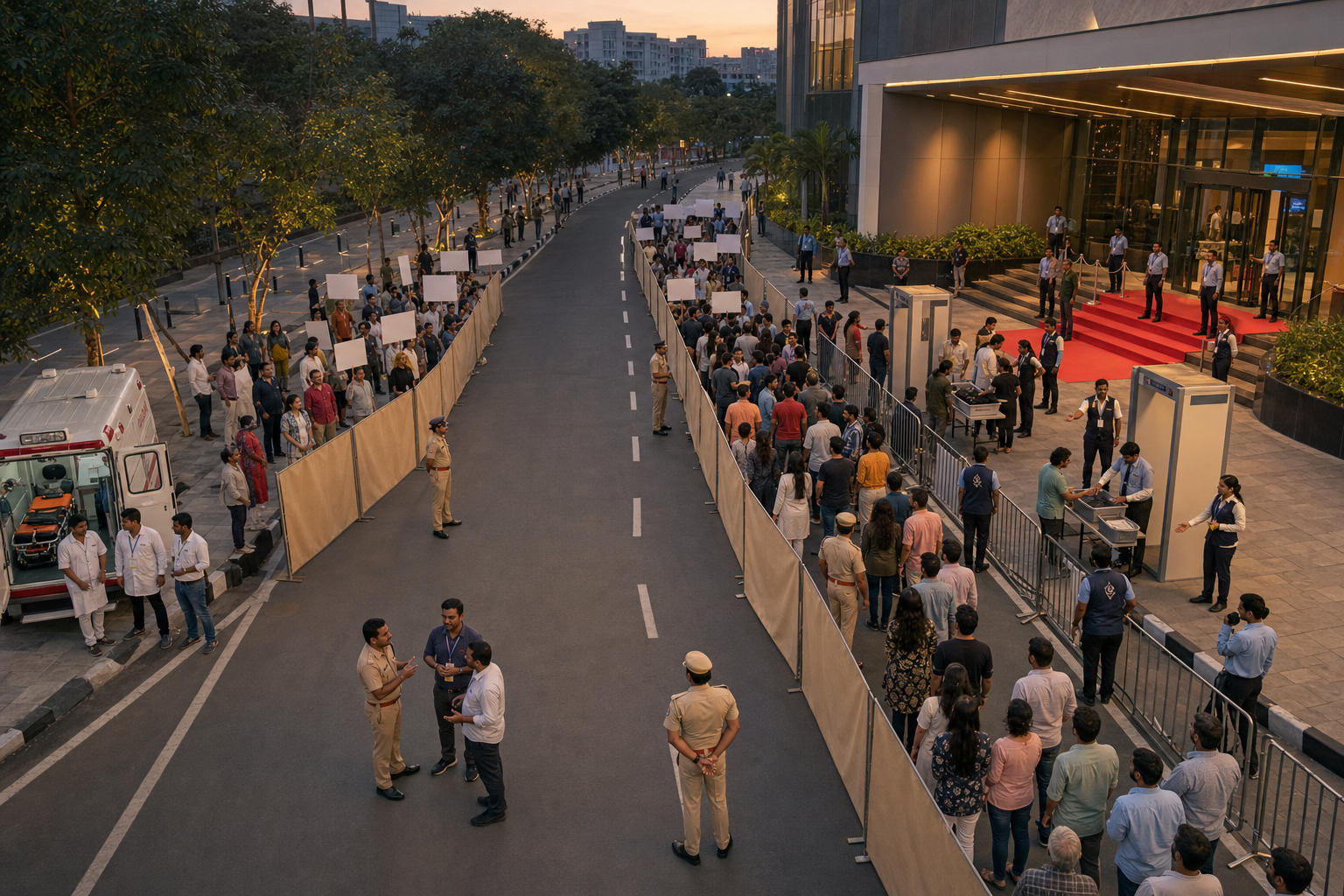
High-tension events usually become dangerous at points of contact: the entrance where viewers and demonstrators converge, a rumour that outruns verification, or a small act of intimidation that draws a crowd. Public-order planning should reduce those contacts without hiding either the screening or the protest.
Before people arrive
- Exhibitors: confirm the certification and applicable conditions, use appropriate content advisories and age controls, keep entrances and exits clear, and share expected timings with law enforcement when a credible disruption risk exists.
- Police and district officials: plan separate ingress, egress, and protest spaces; identify liaison officers; protect access without suppressing peaceful dissent; and communicate beforehand that both lawful viewing and lawful protest will be protected.
- Protest organisers: complete applicable notification or permission requirements, publish a nonviolence charter, brief marshals, and establish a clear endpoint and dispersal plan.
- Community institutions: prepare a small verification channel involving trusted representatives who can check fast-moving claims before rumours are repeated through neighbourhood groups.
While the screening and protest are under way
- Viewers: use the designated route and do not turn an entrance dispute into a personal argument. If movement becomes unsafe, create distance and follow official directions. A ticket does not require you to remain in a dangerous crowd.
- Marshals: keep participants inside the agreed area, stop attempts to surround individuals, and alert the police liaison when someone rejects the nonviolence rules. A marshal is there to restrain the organiser’s own crowd, not to police the public.
- Police: distinguish unpopular speech from unlawful conduct. Act against obstruction, intimidation, incitement, violence, and damage based on what a person does, not on which religious or political camp the person represents.
- Exhibitors: prevent crowding at doors, preserve emergency access, give short factual instructions, and avoid argumentative public messaging while an incident is still unfolding.
After an incident
Record the time, place, conduct, damage, threats, and available witnesses. Describe an individual act rather than accusing an entire religious community. Preserve original material for lawful reporting instead of posting identifying details in a way that invites retaliation. Officials should correct consequential rumours quickly and state what has been verified, what remains unverified, and what conduct is under investigation.
Producers and exhibitors also have a role after the show. A moderated discussion with people competent to address law, conversion, women’s safety, and communal relations can move disagreement from the pavement into a setting where claims can be questioned. Such a discussion is a voluntary act of responsibility, not an admission that intimidation earns editorial control.
What a dharmic response asks of Hindu public life

A pro-Hindu response need not choose between naivety and collective suspicion. Hindu, Buddhist, Jain, and Sikh ethical traditions place weight on ahimsa, truthful speech, compassion, dignity, and conscience. Applied to a controversy like this, those values demand disciplined distinctions.
Ahimsa does not mean passivity toward grooming, trafficking, coercive conversion, or threats. It means pursuing the wrongdoer through proportionate, lawful means without making unrelated people bear collective punishment. Satya does not mean repeating a claim because it confirms a fear. It means checking identity, conduct, evidence, and context before placing another person in danger. Respect for conscience does not require approval of every choice. It requires recognising that an adult remains a moral agent even when family and community strongly disagree.
This gives Hindu civic action a demanding but coherent standard:
- Defend the right to criticise the film without granting anyone a right to intimidate its viewers.
- Defend a certified screening without pretending certification settles every factual or moral argument raised by the film.
- Take a Hindu family’s fear seriously without treating the religious identity of a partner as proof of criminal intent.
- Protect an adult’s choice while investigating credible evidence of fraud, coercion, exploitation, or threats, whatever the religions of the people involved.
- Judge police, protesters, producers, and community organisations by consistent rules rather than by whether their immediate message is politically convenient.
Before you forward a clip, join a demonstration, confront a couple, or demand that officials stop a screening, write down four things: the right at stake, the exact alleged wrong, the evidence for it, and the lawful remedy you want. If you cannot identify the wrong and the evidence, pause and verify. If credible evidence points to a crime, report the conduct and protect the person at risk. If the dispute is about ideas or taste, answer it with speech, criticism, peaceful protest, voluntary boycott, or dialogue.
That discipline lets Gujarat defend Hindu concerns without surrendering either constitutional liberty or public order. It also ensures that the memory of this controversy is not who shouted loudest, but whether citizens and institutions kept courage, restraint, and truth together when doing so was difficult.
References
