
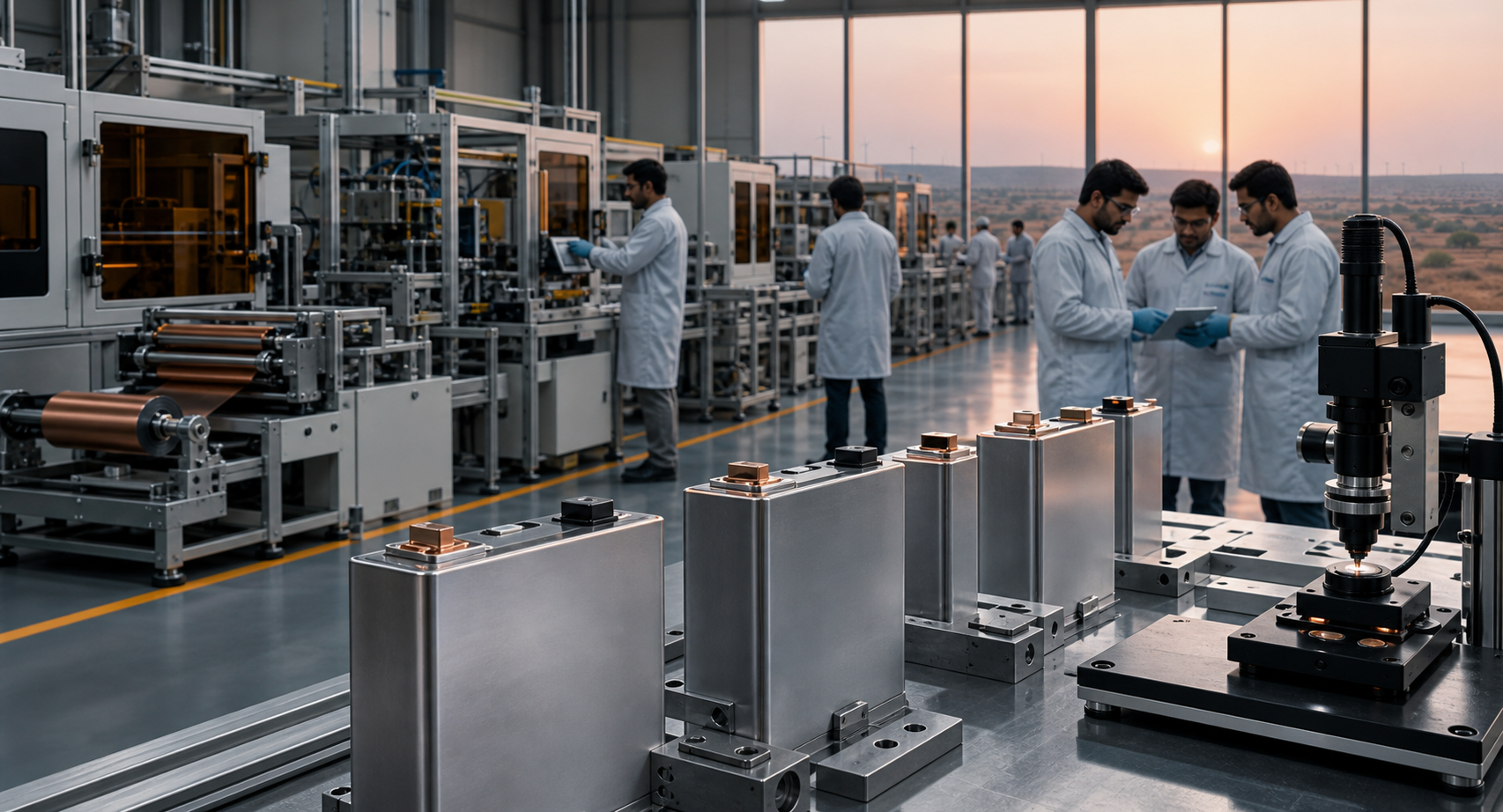
If you saw headlines declaring that Tata had already created an indigenous lithium cell, you were given the conclusion before the engineering. The significant development is narrower: Agratas, Tata Sons’ battery business, is reportedly trying to establish its own manufacturing process for lithium iron phosphate cells at Sanand, rather than receiving a ready-made process from a Chinese company.
That distinction determines how you should evaluate the project. A pilot line can be strategically important without proving commercial success. The useful question is not whether to celebrate or dismiss Tata today. It is which capability has moved from intention to repeatable production, and what evidence must come next.
A pilot line is where uncertainty gets exposed
On August 4, 2026, Agratas was reported to be building a pilot production line for LFP cells at its Sanand plant in Gujarat. A pilot line is a small-scale manufacturing line used to discover whether a proposed process works reliably before a company commits the full production line.
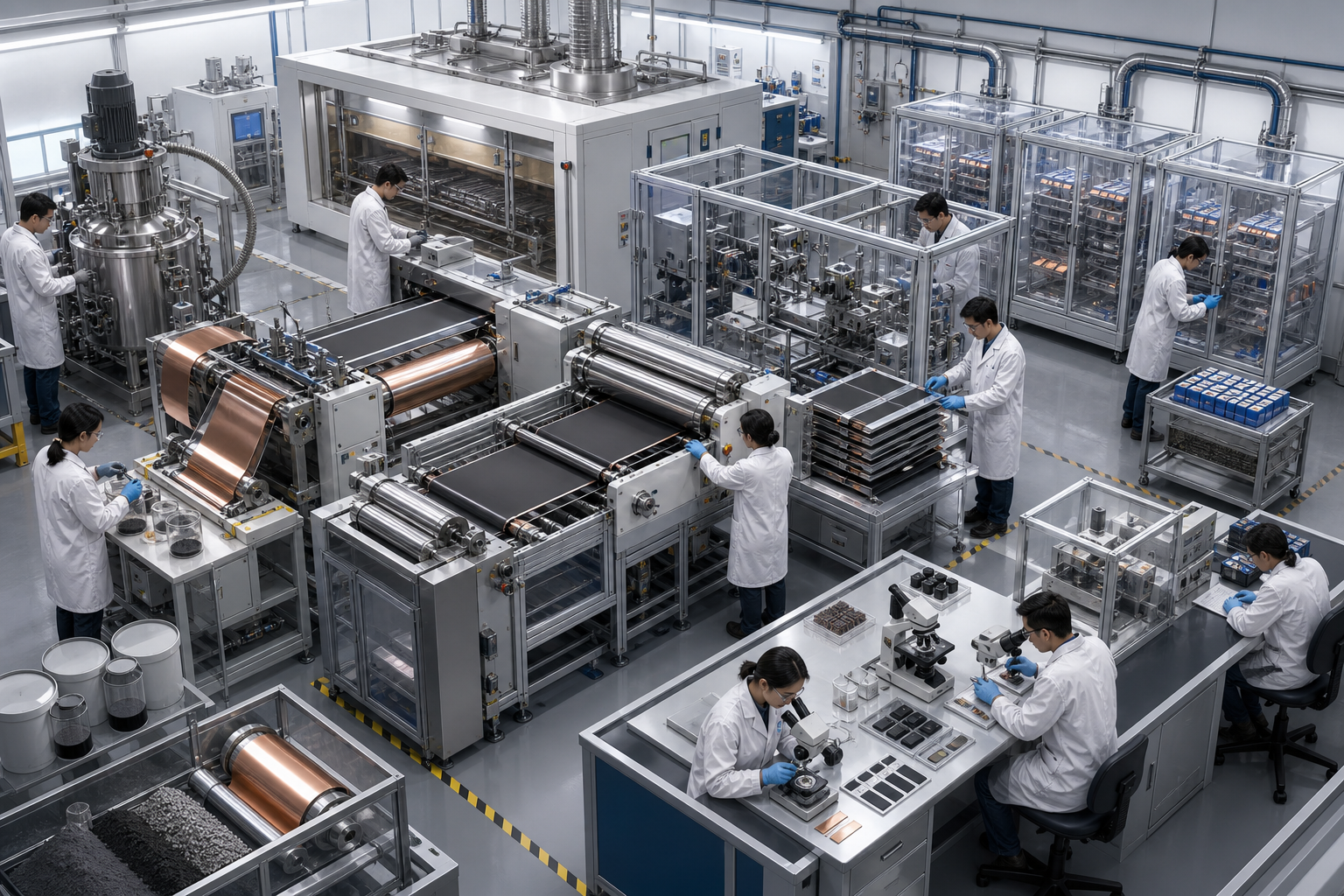
This is much more demanding than making a promising cell in a laboratory. Cell manufacturing typically involves preparing electrode material, coating and drying electrodes, compressing and cutting them, assembling the cell, adding electrolyte, sealing, formation cycling, ageing and grading. A fault or small variation at one stage can appear later as inconsistent capacity, shortened life, excessive resistance or an unacceptable failure rate.
The Sanand team is expected to include Indian, South Korean and Chinese engineers who will run the line, refine the process and assess the first cells. The full factory is meant to follow only after that work demonstrates that the process and its output are good enough.
The crucial restraint is that Agratas did not comment on the pilot-line plan or on the LFP technology said to be under development. No disclosed figures establish production yield, batch consistency, cycle life, safety performance, cost or customer qualification. That does not show that the cells are poor. It means their quality and commercial readiness cannot yet be judged from public evidence.
For you as a reader, this creates a simple rule: treat the pilot line as evidence of serious engineering work, not as evidence that the engineering has already succeeded.
What China-independent should mean in practice
The phrase “without Chinese help” is easy to overread. Agratas reportedly chose to work out the production process because its executives concluded that a Chinese company would not teach it the required manufacturing method. That is a claim about institutional control of process knowledge. It is not a claim that no Chinese engineer, machine, material or component will participate.
The multinational composition of the proposed engineering team is therefore not a contradiction. Industrial self-reliance does not require ethnic or professional isolation. It requires the Indian enterprise to understand, control, reproduce and improve the process without remaining dependent on a foreign company that can withhold the production recipe or the ability to troubleshoot it.
Five different ideas are often compressed into the single word “indigenous.” Keep them separate:
- Chemistry choice: The company has selected LFP as the type of cell it wants to make. Selecting a known chemistry is not the same as owning a manufacturing process.
- Process ownership: The company possesses the operating recipes, quality limits, failure analysis and engineering knowledge needed to make consistent cells.
- Production capability: The process works not only on a pilot line but also at the speed, volume and yield required by a commercial factory.
- Supply-chain resilience: Critical materials, components, equipment, software and maintenance are available without a single vulnerable dependency.
- Product competitiveness: Finished cells satisfy customer requirements for performance, safety, durability, price and delivery.
The disclosed plan directly concerns the second item and uses a pilot line to test the route toward the third. It does not yet establish all five. In particular, control of a cell-making process would not by itself prove a China-free supply chain.
There is another distinction worth preserving: a cell is the electrochemical unit, while a vehicle battery combines many cells with structural, thermal, electrical and control systems. Success on a cell pilot line would be a necessary industrial milestone, but it would not automatically prove that a complete vehicle battery is ready for customers.
Use an evidence ladder instead of an “indigenous” label
Future announcements will be easier to assess if you place each one on an evidence ladder. A ceremony, a first cell, a qualified product and a stable commercial line are not interchangeable achievements.
- Pilot line installed and operating: Look for confirmation that equipment has been commissioned and cells are physically coming off the line. A plan to build a line has not reached this stage.
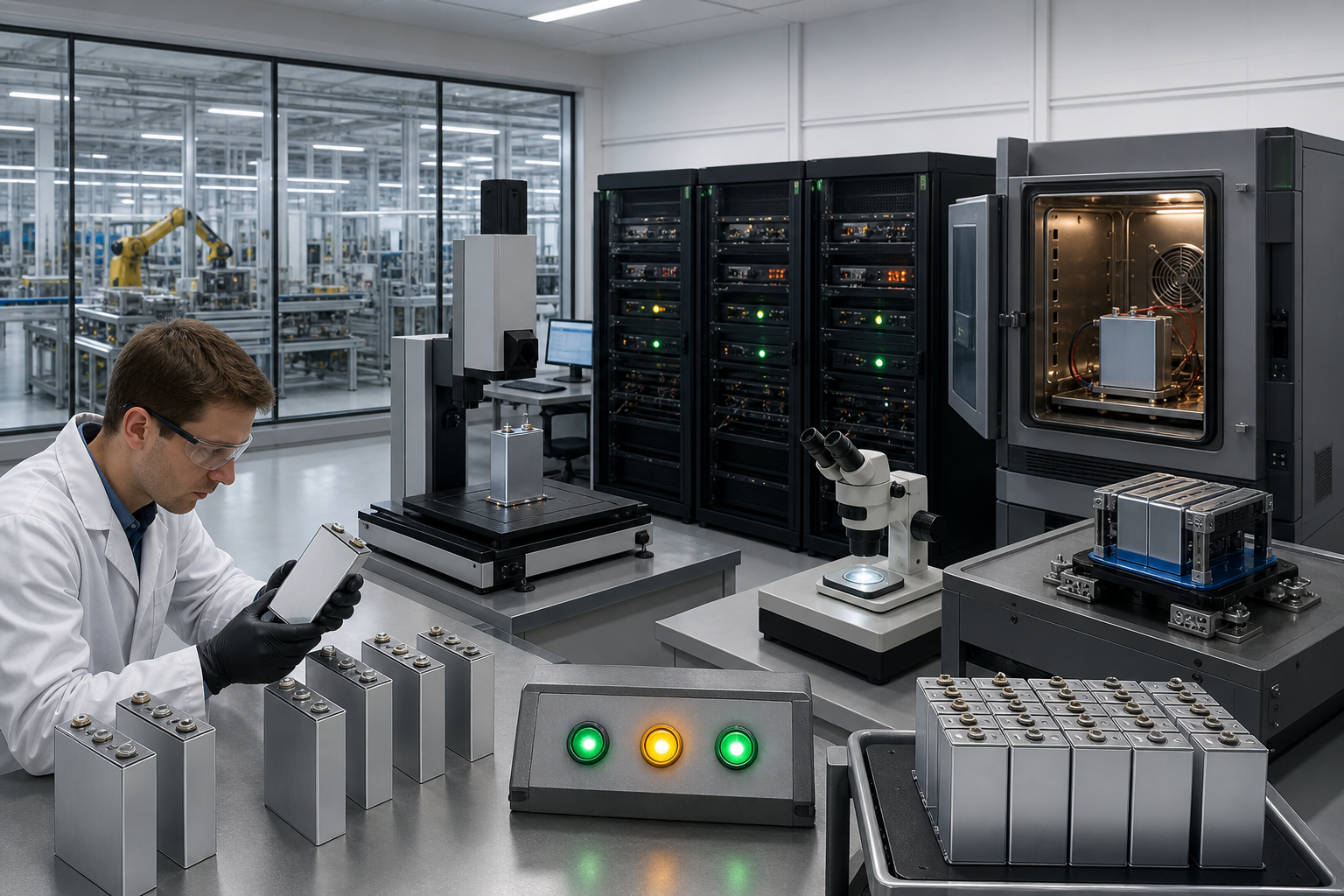
- Cells meet defined internal targets: Useful disclosure would attach numbers to capacity, energy density, internal resistance, cycle life and safety testing. A phrase such as “advanced technology” cannot substitute for measured results.
- The process is repeatable: One strong cell proves little about manufacturing. Look for batch consistency and production yield, meaning the proportion of cells that meet specification rather than being rejected or downgraded.
- Samples pass customer qualification: A prospective buyer must determine whether the cells satisfy its product, safety, durability and integration requirements. Internal confidence is not the same as customer approval.
- The full line ramps successfully: Commercial equipment must reproduce pilot quality at higher throughput. This is where process variation, equipment stability and quality control become decisive.
- Supply dependencies are disclosed: Ask where active materials, separators, electrolyte, production equipment and essential technical support originate. Local process ownership and supply-chain independence should be measured separately.
This ladder also helps you decode corporate language. “Developing” describes work in progress. “Pilot production” describes a validation stage. “Proprietary” is an ownership claim that still requires performance evidence. “Commercial production” describes output at scale, but does not by itself establish that the underlying process or every input is indigenous.
Claims that Tata has already developed a finished indigenous technology, holds a proven proprietary process or is preparing cells that outperform Chinese products go beyond the disclosed evidence. Those stronger assertions did not come from Agratas and were not accompanied by performance figures. Until numbers and qualification milestones appear, do not convert aspiration into accomplishment.
Why the attempt still matters for Bharat
Resisting premature celebration does not make the project unimportant. The most valuable industrial knowledge is often not the basic chemical formula but the accumulated ability to make millions of units behave consistently. That capability lives in process settings, inspection limits, maintenance routines, failure records and the judgement of engineers and operators.
A pilot line can turn imported fragments of expertise into institutional knowledge held within an Indian company. Engineers can identify which step causes a defect, change a parameter, observe the result and record the correction. Repeated often enough, that loop produces the know-how required to operate without waiting for an external technology owner to diagnose every problem.
For Bharat, this is the strategic prize: not a national flag attached to a factory, but the ability to understand and improve a critical manufacturing process. A genuinely durable capability would leave Agratas with its own process recipes, quality-control boundaries, equipment specifications, failure database, trained workforce and rights to use the resulting intellectual property.
The distinction also protects sound policy. If cell quality is the current bottleneck, engineering and validation deserve attention. If critical materials or equipment remain concentrated abroad, supply diversification becomes the next task. If pilot cells perform well but commercial yield is poor, factory ramp-up is the problem. Calling every stage “self-reliance” hides the exact weakness that must be fixed.
A multinational engineering team can strengthen this effort if the learning is absorbed and retained inside the Indian organisation. Bharat has historically grown by receiving knowledge, adapting it and building institutions around it. The relevant test is not the passport of every contributor. It is whether control of the resulting capability remains accessible to Bharat when foreign commercial cooperation becomes difficult.
Key takeaways
- Agratas is reportedly attempting to develop an LFP manufacturing process at a pilot line in Sanand; this is not yet proof of a completed indigenous cell technology.
- The China-independent element concerns avoiding dependence on a Chinese company for process transfer. Chinese engineers are still expected to participate in the multinational team.
- A pilot line matters because it tests whether cell quality can be made repeatable before the full factory is committed.
- No disclosed production, performance, cost or qualification figures currently support claims of commercial readiness or superiority over Chinese cells.
- Process ownership, mass-production capability, supply-chain resilience and product competitiveness are separate milestones and should be reported separately.
- The next credible advance will contain a measurable result: commissioned output, repeatable yield, specified performance, customer qualification or sustained commercial production.
If you care about Bharat’s battery sovereignty, the disciplined position is patient support combined with a demand for evidence. When the next Tata battery announcement arrives, look past the word “indigenous.” Find the measured result, the scale at which it was achieved, who validated it and which dependencies still remain. That is how a promising pilot becomes a capability the country can actually rely on.

References
