

You have chosen a Goa nightclub, your group is ready to go, and the venue’s page looks polished. What you still cannot tell from photographs, ratings or a crowded dance floor is whether the business has the permissions and safety controls needed to operate responsibly.
You do not need to conduct a legal inspection at the door. You need a quick way to separate credible signs from marketing, recognise conditions that justify leaving, and report a concern without putting yourself at risk.
Treat licensing as a chain of controls, not one badge
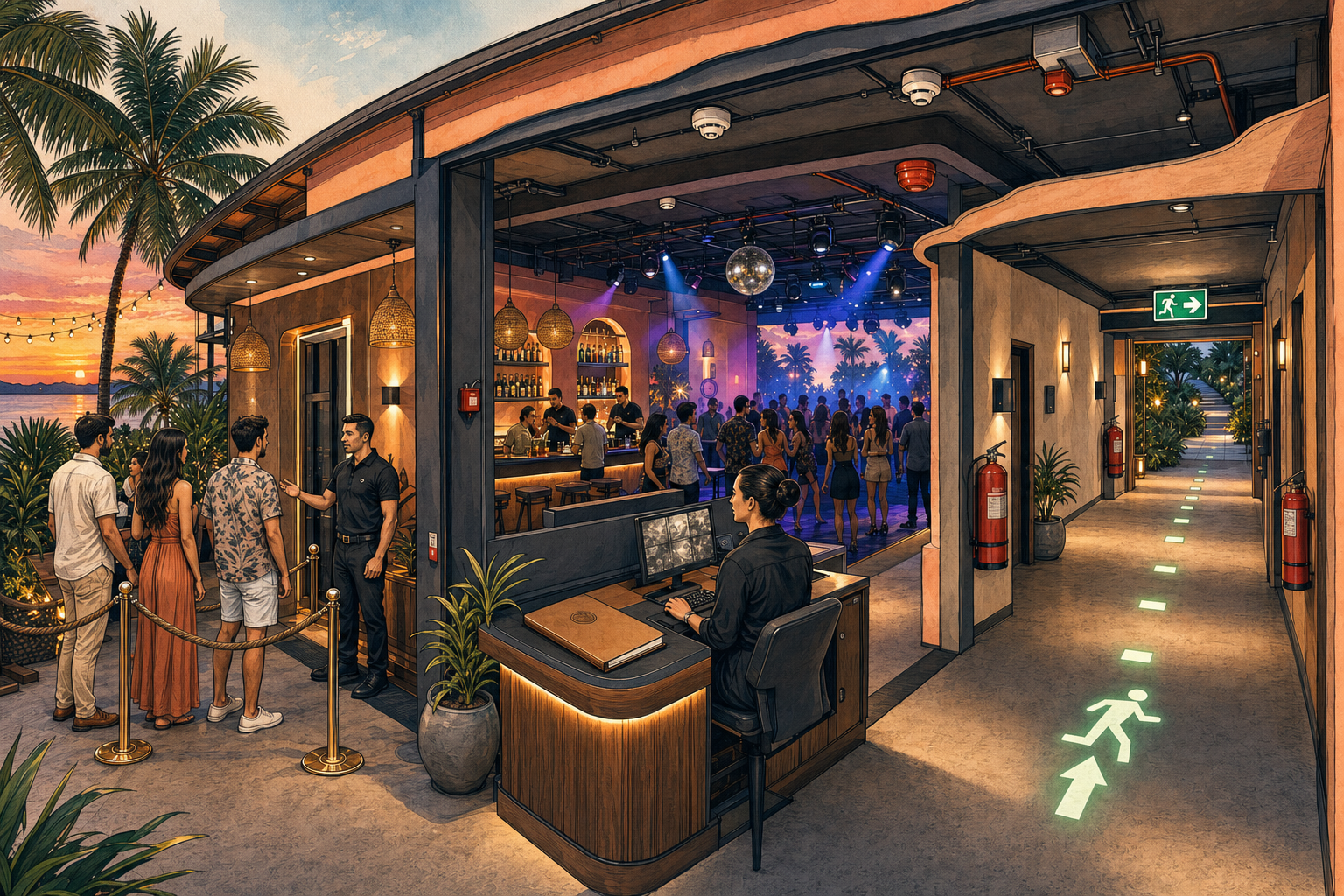
A venue may casually describe itself as “licensed” without telling you which permission it means. Nightclub oversight can cover the right to operate, valid safety certification, alcohol service, crowd control, operating hours and sound limits. These controls address different risks. One certificate on a wall does not answer every question.
The Arpora nightclub incident sharpened concern about venues operating without mandatory permissions. When required approvals are missing, important protections such as fire compliance, controlled admission, lawful alcohol service and noise limits can also be bypassed.
Think through five questions when you assess a venue:
- Operation: Is this establishment authorised to operate as a nightclub at the stated location?
- Safety: Does it hold a valid safety certification, and do the conditions inside appear consistent with basic fire and evacuation safety?
- Capacity: Is admission controlled, or are people still being admitted after movement and exit routes become difficult?
- Alcohol: Is alcohol service authorised and visibly managed rather than treated as an activity beyond supervision?
- Time and noise: Is the venue following its permitted operating hours and applicable sound limits?
This is a consumer screening test, not a claim that Goa issues one separate document for every question. The legal form of a permission can vary, and only the relevant authority can confirm a venue’s status. Your practical task is to avoid mistaking one narrow approval for complete compliance.
Licensing and physical safety must also agree. Valid paperwork does not guarantee that an exit remains clear during a particular event. Conversely, a tidy room is not proof that alcohol, hours or use of the property has been authorised. Check both the official claim and the condition in front of you.
Check the venue before you travel or pay
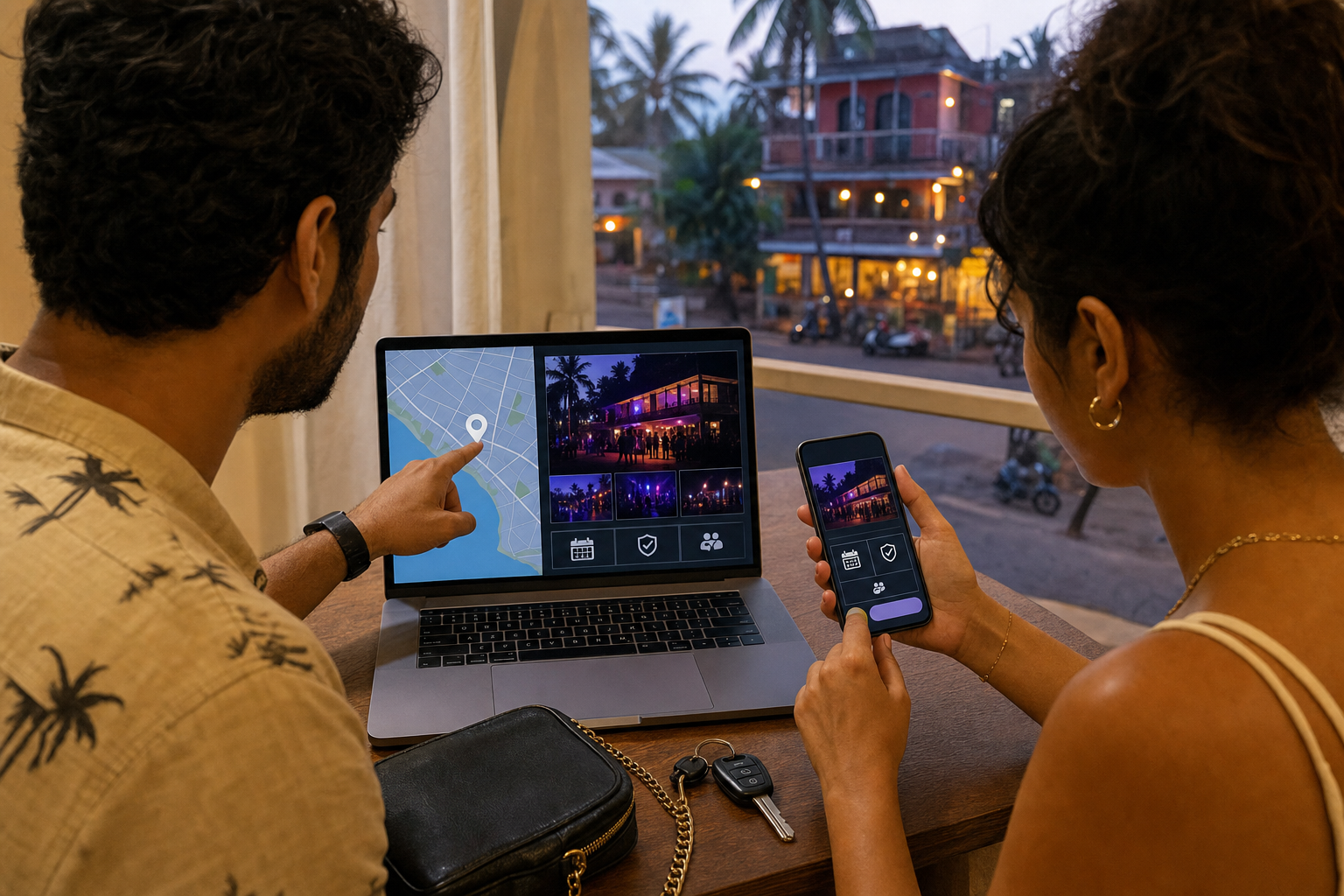
The best time to resolve uncertainty is before your group is standing in a queue and feeling pressure to enter. Use this short sequence:
- Confirm the exact identity. Record the venue’s full trading name and location. Similar names, event brands and temporary promotions can make a vague claim difficult to verify later.
- Ask a precise question. Instead of asking, “Are you licensed?” ask whether the venue is currently authorised to operate as a nightclub at that location. Ask where that status can be verified.
- Ask about safety certification. Request the name of the current certification or approving authority and its validity period, where applicable. A clear answer is more useful than a general assurance that everything is “approved.”
- Confirm the event hours. Ask when the event is scheduled to end and whether that time falls within the venue’s authorised operating hours. A late advertisement is not, by itself, proof that late operation is permitted.
- Clarify alcohol service. If alcohol is central to the event, ask whether the establishment is authorised to serve it. Do not assume an entry ticket or a visible bar answers that question.
- Keep an alternative. Choose another nearby venue before leaving your accommodation. Walking away is easier when it does not end the evening for everyone.
A credible answer should identify the relevant permission or authority rather than repeat a slogan. A current, authority-backed public listing is stronger than an advertisement, influencer video or event poster. Public-facing transparency about licensed venues would make this decision easier for visitors and protect businesses that follow the rules.
Do not turn uncertainty into an accusation. A door attendant may not know where documents are kept, and an inability to produce paperwork immediately does not prove an offence. It is still a reasonable consumer signal. If the venue cannot give you a clear route to verification, you can decline entry and choose somewhere else without making a legal claim.
Read the room before you settle in
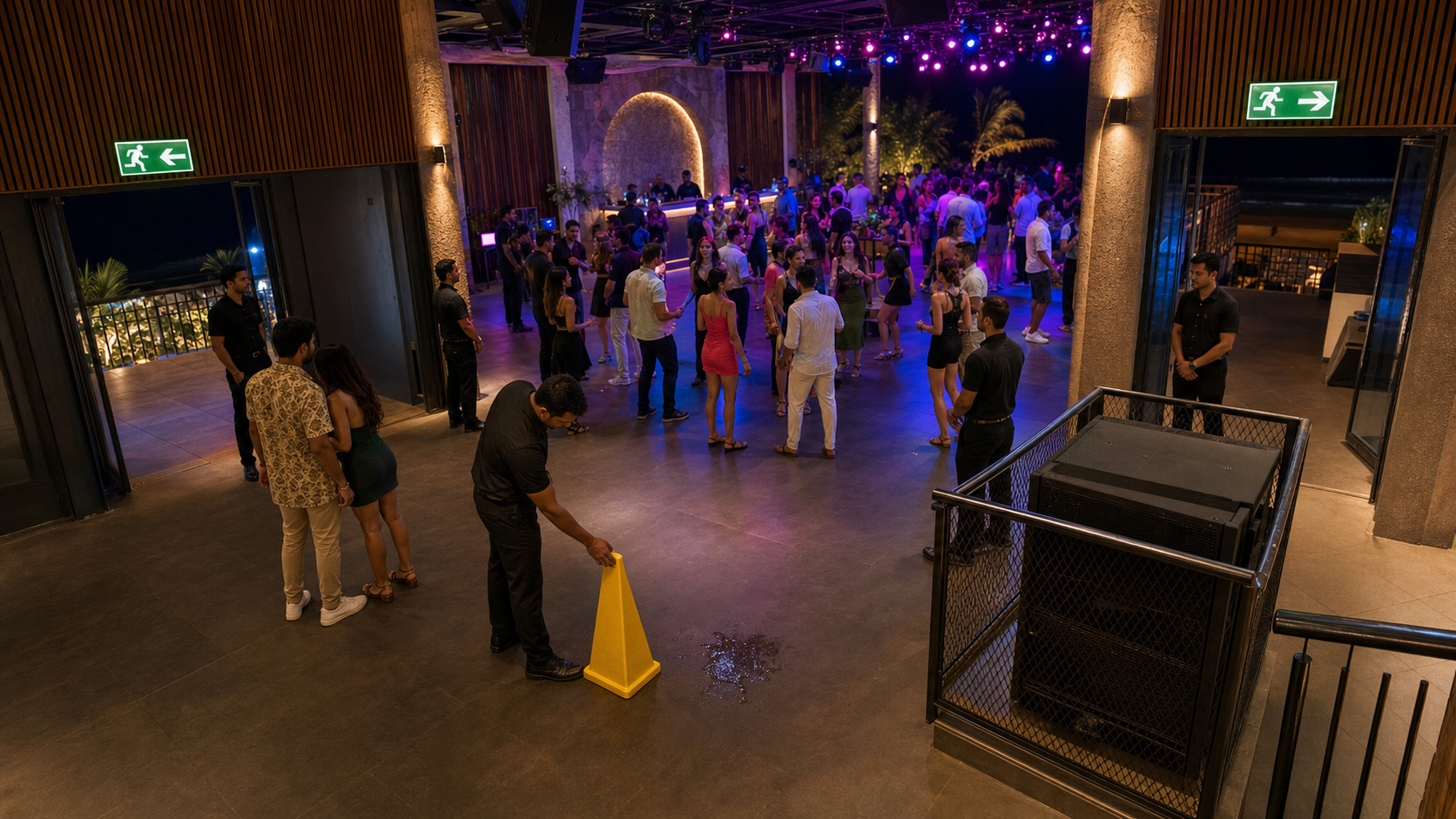
Your first minute inside is the right time for a safety scan. Once the floor becomes crowded, poor circulation and blocked routes become harder to judge. Before ordering or moving deep into the venue, notice the following:
- Your exit route: Identify the nearest usable exit and the path to it. If the only visible route is blocked, locked, hidden by equipment or already jammed, leave.
- Movement: You should be able to move without being trapped by a dense crowd. Continued admission while people cannot circulate is a warning that crowd control is failing.
- Aisles and doors: Furniture, decorations, queues and equipment should not obstruct routes people may need in an emergency.
- Staff control: Look for staff who are present, identifiable and able to manage admission or respond when a problem develops. Security that exists only at the ticket desk does not resolve unsafe conditions inside.
- Escalating disorder: Aggression, uncontrolled intoxication or staff indifference can turn a manageable problem into a dangerous one. Do not wait for certainty if the situation is deteriorating.
- Noise beyond the premises: Sound affecting neighbouring homes is not just a matter of taste. Compliance with sound limits is part of whether nightlife can coexist with the surrounding community.
You are not expected to test alarms, inspect wiring or challenge staff about technical standards. Those tasks belong to trained inspectors and responsible authorities. Your threshold is simpler: if an exit is unusable, the crowd feels uncontrolled, or staff cannot manage an obvious hazard, leave while leaving is still straightforward.
Do not let money already spent change that decision. An entry fee, prepaid table or unfinished order is less important than avoiding a room you cannot exit safely. Raise a refund issue later through a calm, documented channel rather than remaining in unsafe conditions to argue about it.
Leave and report a concern without creating another risk
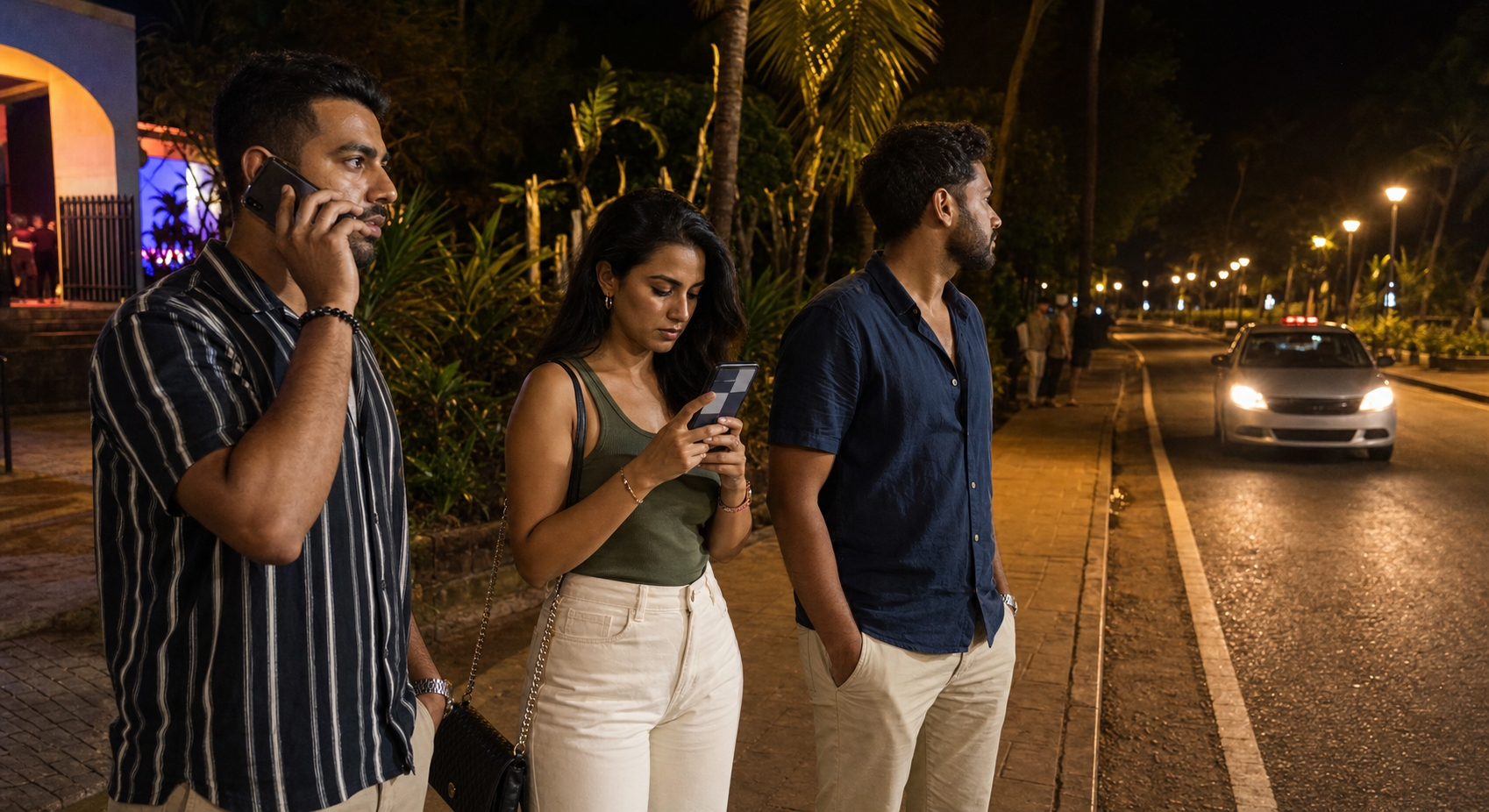
If a condition appears dangerous, your first job is to get yourself and your companions out. Do not delay an urgent call while trying to collect perfect evidence, and do not confront a crowd or physically interfere with the venue’s operation.
- Move to a safe place. Keep your group together and step away from entrances that emergency personnel or other guests may need.
- Escalate immediate danger immediately. Contact the police or emergency services when there is a fire, violence, crushing crowd, blocked evacuation or another active threat. A routine complaint process is not a substitute for an emergency response.
- Record facts, not conclusions. Note the venue name, exact location, date, time and what you directly observed. “The rear door was blocked by furniture” is useful. “The entire business is illegal” is an inference unless an authority has verified it.
- Preserve safe evidence. Keep tickets, booking confirmations or messages connected to the event. Take photographs only when it is lawful and safe, without obstructing an exit, provoking staff or invading another guest’s privacy.
- Send the concern to the relevant body. Police may need to handle public order or an immediate threat; excise officials may need to examine alcohol-service concerns; district administration or the local body may need to examine operating permission, hours, noise or local compliance.
- Ask for acknowledgement. If the matter is not urgent, keep a copy of the complaint and request a reference or acknowledgement that permits a factual follow-up.
The responsibility cannot rest on guests alone. Effective oversight requires coordination among district administration, police, excise authorities and local bodies, supported by licence checks, operating-hours audits, sound enforcement and verification of safety certification. Consistent, proportionate action matters because occasional attention after an incident does not create a dependable safety system.
If your concern is recurring noise rather than an immediate emergency, document the times and duration from a place where you are lawfully present. Avoid entering private property or provoking a confrontation to obtain evidence. A precise record gives the responsible authority something concrete to examine.
Key takeaways
- “Licensed” is too vague. Ask whether the establishment is currently authorised to operate as a nightclub at its stated location.
- Check safety certification, admission control, alcohol service, operating hours and sound compliance as distinct issues.
- Official, current verification carries more weight than social media, event promotion or a general assurance from staff.
- Once inside, locate a usable exit before the room becomes crowded and leave if routes are blocked or crowd movement is failing.
- A staff member’s uncertainty does not prove illegality, but you do not need proof of an offence to choose another venue.
- Report direct observations with the venue, location and time; use emergency services for active danger and the relevant administrative channel for non-urgent compliance concerns.
Goa does not have to choose between a vibrant night economy and the safety of residents and visitors. A dharmic public culture places duties on everyone: operators must obey the rules, officials must enforce them consistently, and guests must refuse conditions that put life or community well-being at risk. Before your next night out, save the venue’s exact details, ask the five licensing questions, and agree with your group that anyone can call for an early exit.
References
