
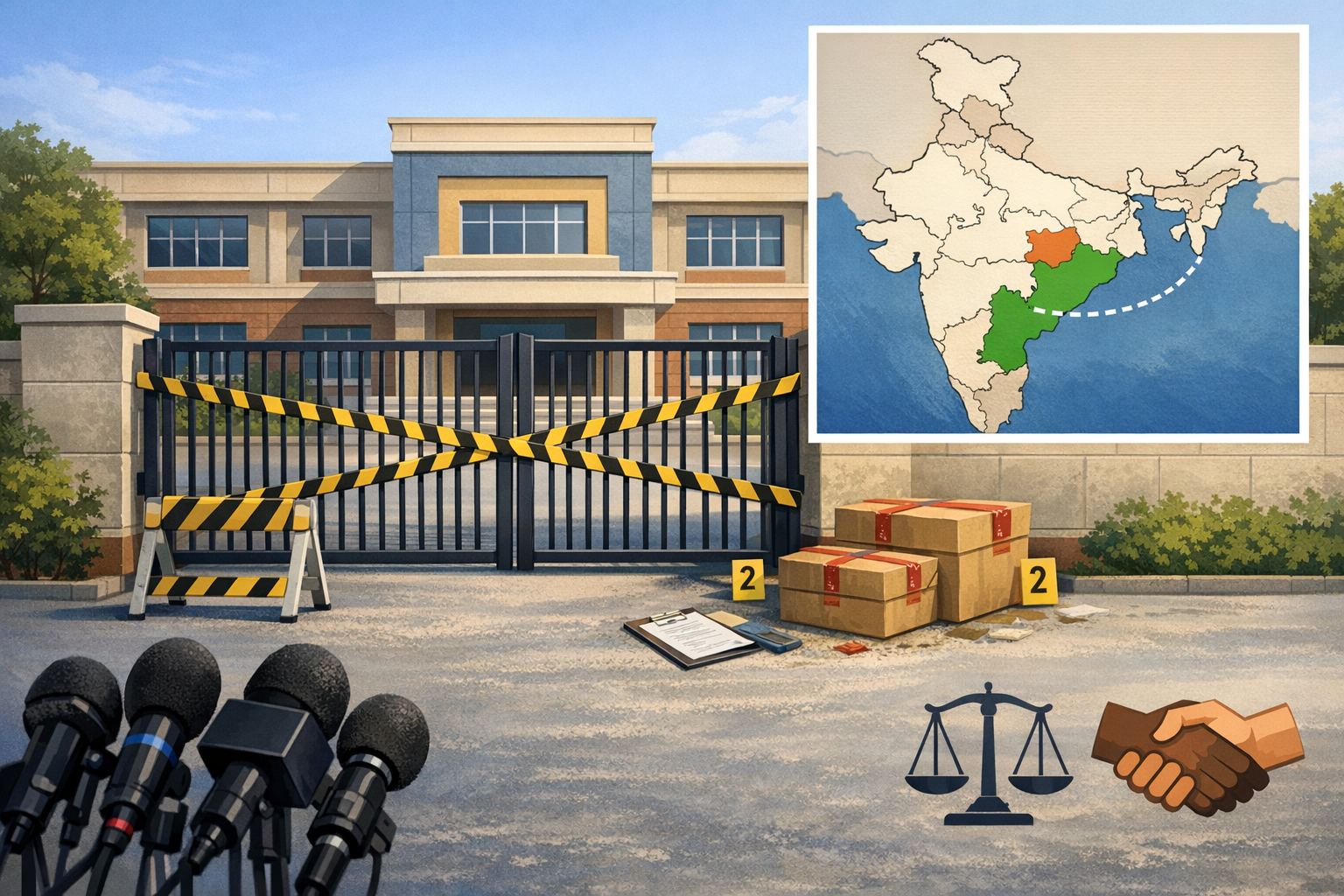
On April 6, 2026, Bihar Police sealed a madrassa in the West Champaran region after officers reportedly recovered a cache of arms during a search operation. Three individuals were detained for questioning, and an interstate anglepotentially involving Andhra Pradeshentered the scope of inquiry according to initial police briefings shared with local media.
This report synthesizes publicly available information to provide context on how such cases are handled within India’s counterterrorism and public safety architecture. It explains relevant law (Arms Act, Unlawful Activities (Prevention) Act), the National Investigation Agency (NIA) mandate, forensic protocols, and best practices that protect community harmony. It emphasizes the presumption of innocence, reliance on verified evidence, and the need to avoid stigmatizing any institution or faith.
Sealing a premises following an arms recovery is a preservation-of-evidence step often used to secure a crime scene. Under the Code of Criminal Procedure (CrPC), police may search and seize (for instance, Sections 102 and 165), after which a Magistrate typically exercises supervisory jurisdiction over custody and disposal of property (Sections 451 and 457). In practice, sealing prevents contamination, theft, or tampering while forensic teams document, catalogue, and remove exhibits under chain-of-custody.
When firearms or ammunition are found, the Arms Act, 1959 (notably Sections 3 and 25), and allied rules come into play to examine licensing status and potential violations. If investigators identify elements of a broader conspiracy intended to threaten public safety, provisions of the Unlawful Activities (Prevention) Act (UAPA) may be considered; this threshold is high and must be grounded in evidence, legal scrutiny, and prosecutorial review.
India’s counterterrorism ecosystem allocates specific roles across agencies. State police and specialized units such as Anti-Terrorist Squads (ATS) lead early-stage action. The National Investigation Agency (NIA), operating under the NIA Act, 2008, can assume investigation when Scheduled Offences (including UAPA) are invoked or when the Union Ministry of Home Affairs directs a transfer owing to interstate or national security implications. Such transfers prioritize coherence, evidence integrity, and resource optimization.
Forensic examination is central to due process. Ballistic experts test-fire recovered weapons to match striation patterns and determine functionality; serial numbers and microscopic impressions assist in tracing origin and trafficking routes. Fingerprints, DNA traces, and gunshot residue analysis may link objects to individuals. Digital forensicsexamining phones, storage devices, and cloud accountshelps reconstruct communications, finance trails, and logistics. Each exhibit is documented through a chain-of-custody to safeguard admissibility.
An interstate dimension, including a possible Andhra Pradesh link, is assessed through coordinated intelligence work. Investigative teams analyze call detail records, travel logs, financial transactions (including potential hawala channels), supplier networks, and meeting patterns. Joint working groups and inter-state police liaison cells share leads, while mutual legal assistance requests are raised when data or assets lie beyond a single jurisdiction.
At this preliminary stage, it is essential to distinguish allegations from findings. The presence of weapons at or near an educational institution, including a madrassa, requires strict inquiry; however, misuse by specific individuals does not implicate an entire institution or community. Law, evidence, and judicial oversight must determine culpability. Upholding this standard strengthens both counterterrorism outcomes and constitutional guarantees.
Public communication is a critical variable in preventing communal polarization. Responsible media coverage, verified police statements, and transparent briefings help curb rumor-mongering. Authorities typically combine neighborhood outreach with cyber monitoring for incitement, using lawful measures against content that promotes enmity (e.g., Indian Penal Code Section 153A) while protecting legitimate speech. Platforms and users share a civic duty to avoid amplifying unverified claims that can harm social cohesion.
Community safety improves when civil society, educators, and faith leaders move in step with security agencies. Across India, peace committees and interfaith forums convene during sensitive incidents to reduce tensions, clarify facts, and affirm shared values. Dharmic traditionsHinduism, Buddhism, Jainism, and Sikhismhave longstanding practices of non-violence, self-restraint, and dialogue; mobilizing those resources is vital in resisting attempts by any extremist fringe to divide society.
Children’s rights and educational continuity deserve explicit attention whenever a school or madrassa campus is sealed for investigation. District administrations can rapidly provide alternate venues or schedules so that examinations and classes proceed with minimal disruption, in line with the spirit of the Right of Children to Free and Compulsory Education Act, 2009. Such arrangements balance evidentiary needs with the welfare of students and families.
Risk management for educational institutions is as much about prevention as it is about response. Neutral, non-discriminatory campus security protocolsvisitor logs, secure storage policies, staff training on escalation pathways, and periodic coordination with local policehelp deter the illicit use of facilities. Compliance audits must be content-neutral and community-blind, aimed solely at safety and legality rather than profiling.
From an analytical standpoint, investigators often test several hypotheses in parallel: isolated criminality, contraband storage unrelated to the institution, attempts to incite communal violence, or nodes within a wider trafficking network. Hypothesis disciplineaccepting, revising, or discarding theories strictly on the basis of accruing evidenceis a hallmark of professional counterterrorism practice and reduces the risk of confirmation bias.
Key developments to track include: official forensic laboratory findings; specific sections invoked in the FIR and charge-sheets (Arms Act, IPC, or UAPA, if warranted); any application to transfer the case to the NIA; bail and remand orders; and coordinated statements from Bihar and Andhra Pradesh police. Verified, document-backed updates are preferable to social media conjecture.
The broader public interest lies in achieving both security and solidarity. Effective counterterrorism protects lives and deters future violence; equally, unwavering commitment to constitutional rights, interfaith respect, and dharmic principles of ahimsa and compassion preserves the social fabric. By privileging facts over fear, and due process over rumor, communities in Bihar, Andhra Pradesh, and beyond can navigate this investigation with calm and unity.
Inspired by this post on Struggle for Hindu Existence.
