
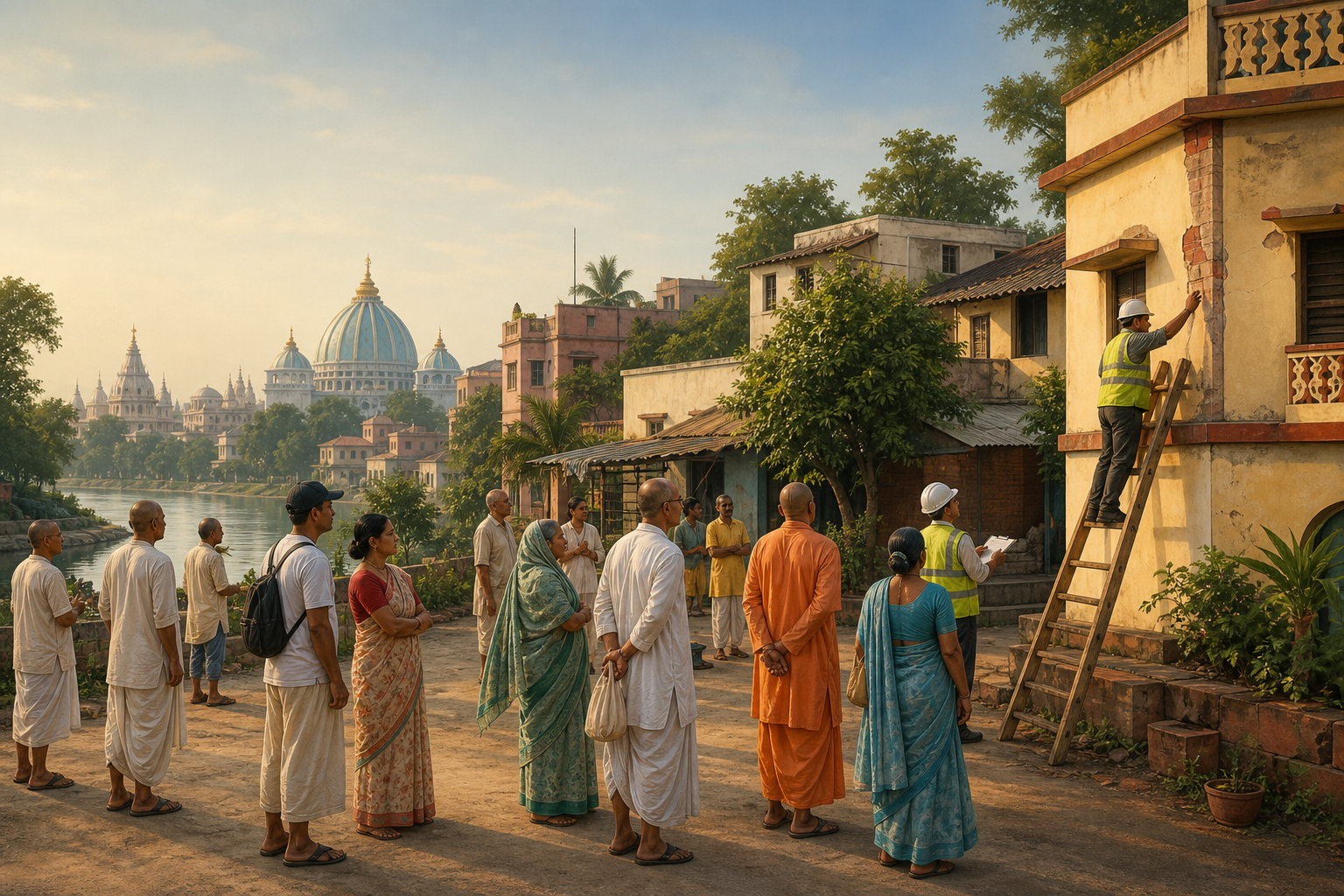
If you felt the brief sway in Mayapur, you probably want two answers: how serious was the earthquake here, and what should you do if the ground moves again? The early picture from Mayapur is reassuring, but it is not a reason to skip a careful check of your home, temple, ashram, school, or guesthouse.
No significant damage was reported in Mayapur during the initial assessment. That describes the community-wide picture available at the time; it does not certify every building or rule out aftershocks. Use the calm interval to check people, premises, supplies, and the reliability of the information reaching your community.
What the shaking in Mayapur does and does not mean
At approximately 10:08-10:10 am IST, a magnitude 5.5 earthquake centred near Narsingdi, Bangladesh, was felt in Mayapur and across several parts of West Bengal. The epicentre was roughly 300 kilometres from Mayapur. Shaking in the town lasted only a few seconds and was generally experienced as mild swaying or rattling rather than a violent jolt.
The tremor was also noticed in Kolkata, Malda, Nadia, Cooch Behar, and other districts. That wide felt area is not surprising in the Ganga-Brahmaputra basin. Its soft alluvial soils can allow the motion from a moderate earthquake to be noticed far from the epicentre, even where the local effect is limited.
This distinction matters. Feeling an earthquake strongly enough to notice windows rattling does not, by itself, prove that a building has been damaged. The reverse is also true: mild shaking and a reassuring regional assessment do not amount to an inspection of the particular structure you occupy. Look at the condition of the premises rather than judging safety only by how frightened, or unf frightened, people felt.
The consequences were more serious closer to the affected area in Bangladesh. Preliminary information indicated at least three fatalities and multiple injuries. Those figures may change as official assessments develop, so do not repeat them as a final toll. Mayapur’s relatively mild experience should not be used to minimise what communities nearer Narsingdi may have faced.
If the ground moves again, use this sequence
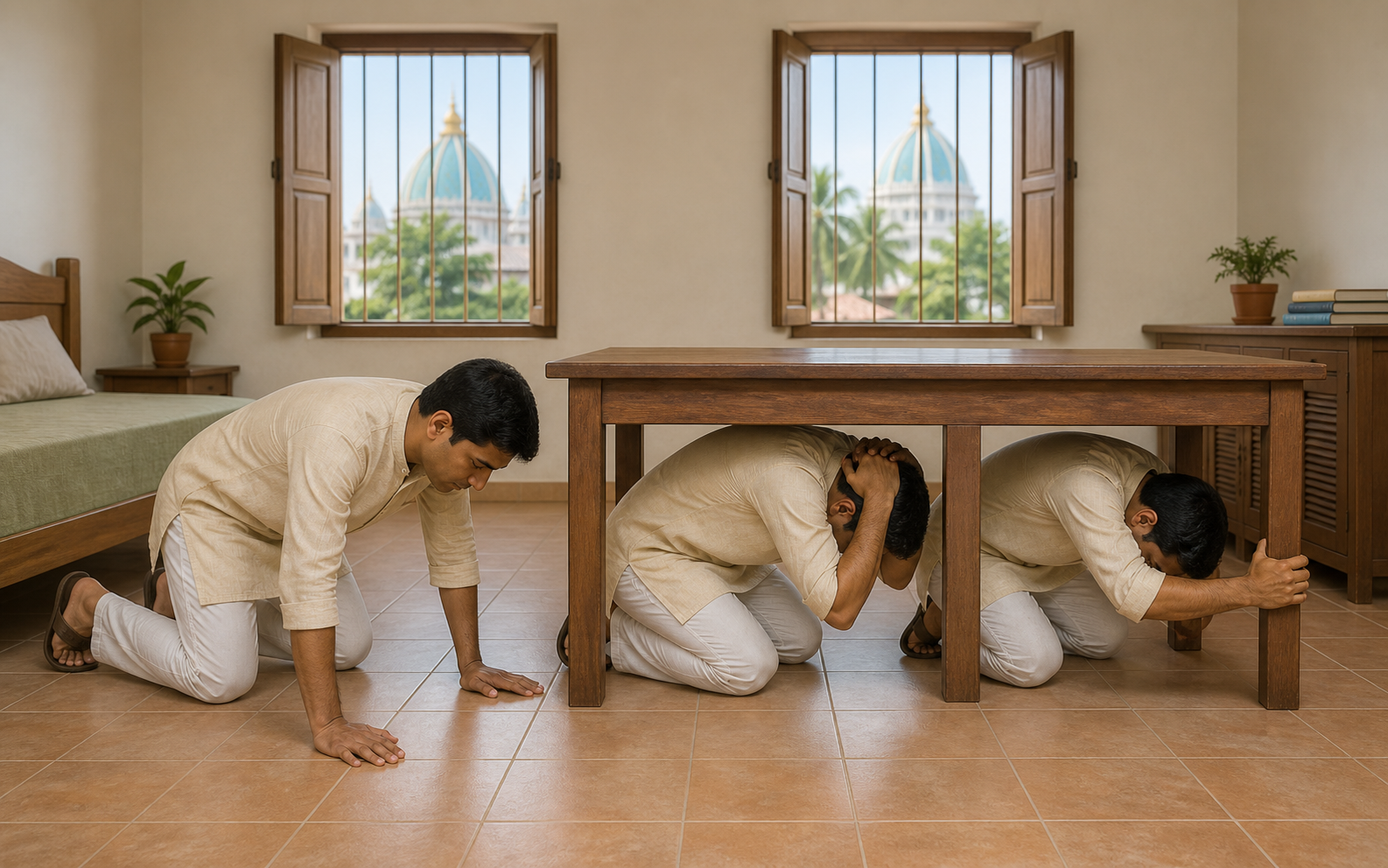
An aftershock can begin before you have time to debate where to go. Everyone in your household or institution should therefore know the same short sequence before another tremor occurs.
- Drop, cover, and hold on. Act when the shaking begins. Do not wait for someone to confirm that it is an earthquake.
- Keep away from glass and unsecured shelves. Windows, glass-fronted cabinets, and objects that can fall deserve immediate attention.
- Do not use an elevator. Avoid elevators during the tremor and immediately after it, even if they appear to be operating normally.
- Check for hazards once the movement stops. Look for fallen material, broken glass, blocked access, and visible structural cracks before allowing routine activity to resume.
- Remain ready to repeat the procedure. Further shaking is possible after an earthquake. Keep safe cover locations accessible rather than filling them with bags or furniture.
In a temple hall, classroom, dining area, or guesthouse, contradictory instructions can create more confusion than the brief tremor itself. Decide in advance who will give the safety instruction, who will assist elders or people with limited mobility, and who will account for students, residents, or visitors after the shaking stops. The instruction should be short enough to understand immediately: drop, cover, hold on, and stay away from glass.
Check people and premises before resuming activity
A useful post-tremor check begins with people, not property. Make sure children, elders, students, visitors, and anyone who relies on essential medicine have been accounted for. Ask whether anyone was struck by a falling object or needs assistance. Then examine the immediate surroundings without crowding an area where material has fallen.
- People: Account for residents, pilgrims, staff, students, and visitors. Identify anyone who needs help moving safely or obtaining essential medicine.
- Falling hazards: Look for broken glass, displaced objects, and unsecured shelves or cabinets that could fall during another tremor.
- Visible building condition: Check for cracks, loose material, or other changes that were not present before the shaking.
- Access: Keep ordinary exits usable and continue to avoid elevators immediately after the tremor.
- Readiness supplies: Put water, a torch, essential medicines, and key contact details where they can be reached without searching.
A visible crack cannot be reliably classified as harmless or dangerous merely by glancing at it. If cracking, loose material, or another hazard raises doubt about an area, keep people away and seek direction from local authorities or a qualified building professional before using that space again. Do not let the absence of major damage elsewhere in Mayapur overrule what you can see in front of you.
The emergency kit can remain small. Its purpose is to cover the immediate interruption caused by shaking or a temporary loss of normal access. Water, a working torch, necessary medicines, and written contact information address the most practical needs. Check the torch rather than assuming it works, and make sure medicines are current and accessible to the person who needs them.
Turn dharmic neighbourliness into an operating plan
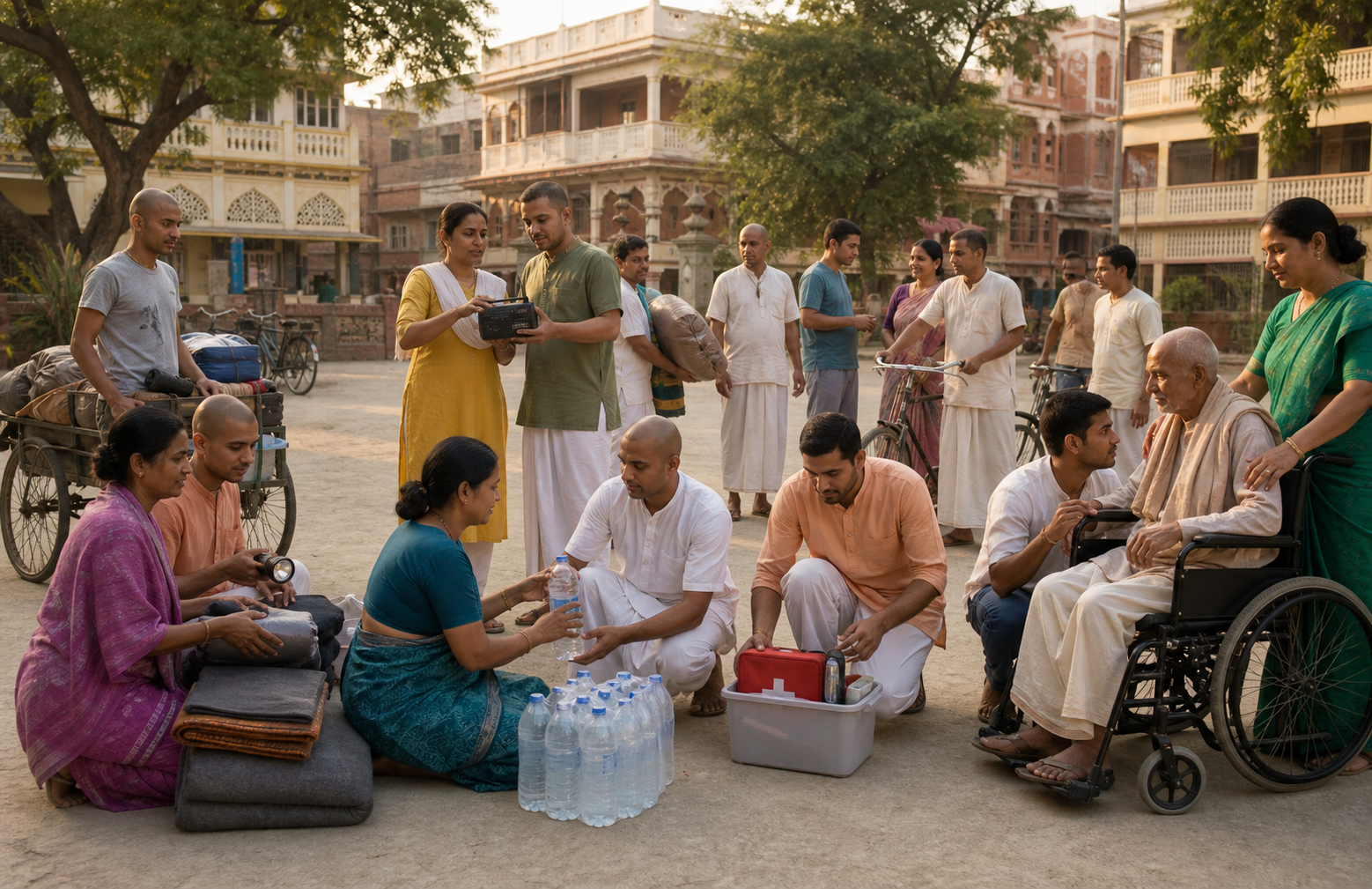
Mayapur’s strength is not only individual preparedness. Temples, ashrams, viharas, gurdwaras, Jain sanghas, schools, and neighbourhood groups already connect people who may need to find one another quickly. That network becomes genuinely useful when compassion is translated into assigned responsibilities.
- Choose one information lead to monitor the India Meteorological Department, the Bangladesh Meteorological Department, and local administration.
- Choose one welfare lead to check on elders, students, people living alone, and anyone dependent on regular medication.
- Choose one premises lead to record visible hazards and prevent people from entering a questionable area.
- Use one factual message format: state the location, what was directly observed, whether anyone needs help, and which official instruction is being followed.
Seva in an emergency includes restraint. A dramatic forwarded message without a time, place, or official basis can send families searching for answers when they should be checking on people nearby. Separate what you observed from what you received second-hand. Label early casualty figures as preliminary, and replace them when verified information changes.
Shared dharmic values are most visible here through disciplined care: ahimsa in preventing avoidable injury, seva in checking vulnerable neighbours, and responsibility in refusing to spread uncertain claims. Hindu, Buddhist, Jain, and Sikh institutions do not need identical rituals to cooperate on a list of residents, an emergency kit, or a verified public message.
Key takeaways for Mayapur residents and visitors
- The magnitude 5.5 earthquake was centred near Narsingdi, roughly 300 kilometres from Mayapur, where the reported shaking was mild and brief.
- No significant damage was identified in Mayapur during the initial assessment, but that does not replace a check of the building you are using.
- If shaking returns, drop, cover, and hold on; stay away from glass and unsecured shelves; and do not use an elevator.
- After the movement stops, account for people first, then check for immediate hazards and visible cracks.
- Keep water, a torch, essential medicines, and key contacts ready, and follow IMD, BMD, and local administrative updates.
- Treat casualty and damage information as preliminary until the responsible authorities confirm it.
Before the next gathering, ask one practical question: does everyone know who gives the safety instruction and who checks on vulnerable people? Settle those roles now, place the small emergency kit where it is reachable, and keep official updates separate from forwarded speculation.
References
