
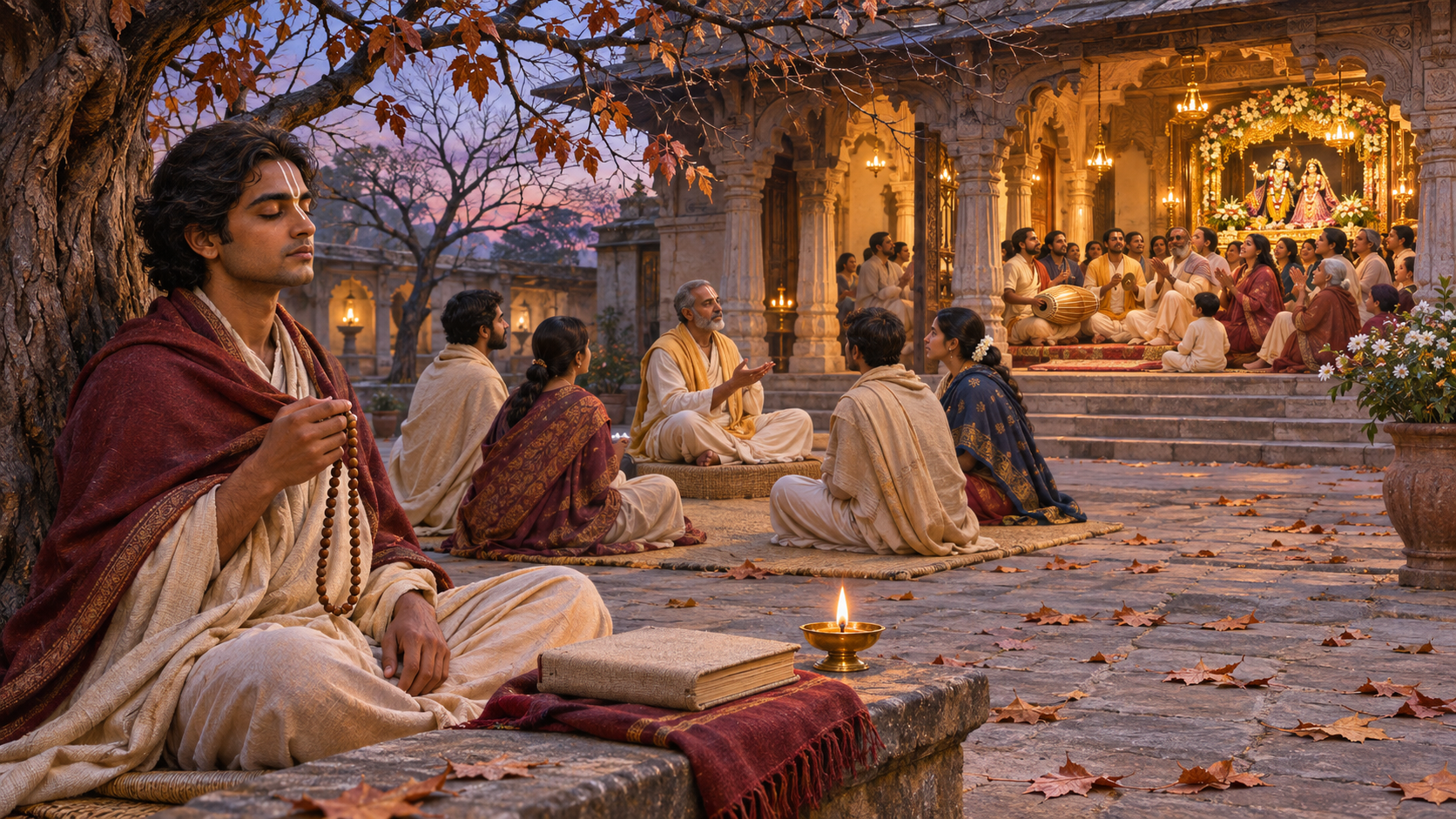
You may be deciding whether late November calls for a temple visit, additional japa, a Bhagavatam class, or a remembrance of Srila Prabhupada at home. You don’t need to treat these as competing choices. The ISKCON programmes around 28-29 November 2026 connect remembrance, attentive hearing, mantra practice, service and shared celebration.
The practical aim is to build one coherent observance rather than sample a long stream of devotional content. Choose what you will hear, how you will chant, where you will participate and what you will do differently afterward.
Read the week as a sequence, not a menu

On 28 November, the programme included a special japa transformation session in Mombasa at 4:30 p.m. EAT, the PRERANA Festival in Mumbai and a class on Srimad Bhagavatam 11.5.49. The 29 November schedule continued with classes on Srimad Bhagavatam 6.17.16-17 at GEV, 11.5.50 in Vrindavan and 11.11.9 in a session titled Beyond the Senses and Material Desires. A separate featured class addressed Srimad Bhagavatam 3.30.1 with Guruprasad Swami.
That breadth gives you an important clue. Late November was not organised around passive commemoration alone. The rhythm moved between chanting, systematic study, remembrance of the acharya and participation in a living community. A session making NOD easier to approach also sat within this rhythm, offering another route from devotional principle to daily practice.
The events came from Mombasa, Mumbai, Auckland, Denver, GEV and Vrindavan. Treat them as a map of shared emphases, not proof that every temple followed an identical schedule. Check your local temple’s calendar before travelling, especially if you are looking for a disappearance-day programme or a live class.
- If you can attend a temple, choose the programme that combines hearing, chanting and service rather than arriving only for its most public moment.
- If you are observing at home, select one Prabhupada glorification, one scripture class and one uninterrupted period of japa.
- If your time is limited, complete one cycle of hearing, reflection and application. Opening many recordings without finishing any of them creates familiarity, not necessarily understanding.
Make Prabhupada’s disappearance day an act of discipleship

The 49th Disappearance Day of Srila Prabhupada was marked through separate glorifications by Narayani Mataji and Bhurijana Prabhu. In Gaudiya Vaishnava practice, such a day is neither a birthday-style celebration nor merely an occasion for bereavement. It is a time to remember the acharya, hear about his service and test whether his instructions are still shaping our conduct.
This distinction matters because admiration can remain safely emotional. Discipleship asks for transmission. You hear about a quality or instruction, identify its claim on your life and carry it into a concrete act.
- Choose one glorification and hear it from beginning to end without browsing other feeds at the same time.
- Write down one quality of Srila Prabhupada that the speaker illustrates, one instruction that is actually stated and one question you still have.
- Turn the instruction into a commitment you can complete within the following week. That might mean protecting your existing japa period, finishing a class you have postponed or contacting your temple about a service already available to you.
- End with gratitude and chanting. The point is to let remembrance enter sadhana rather than remain a collection of biographical facts.
Avoid measuring the observance by the number of talks you consume. One carefully heard remembrance that changes your next week is more useful than a queue of unfinished videos. The relevant question at the end is simple: what will you now preserve, correct or serve?
Let japa and Bhagavatam hearing correct each other
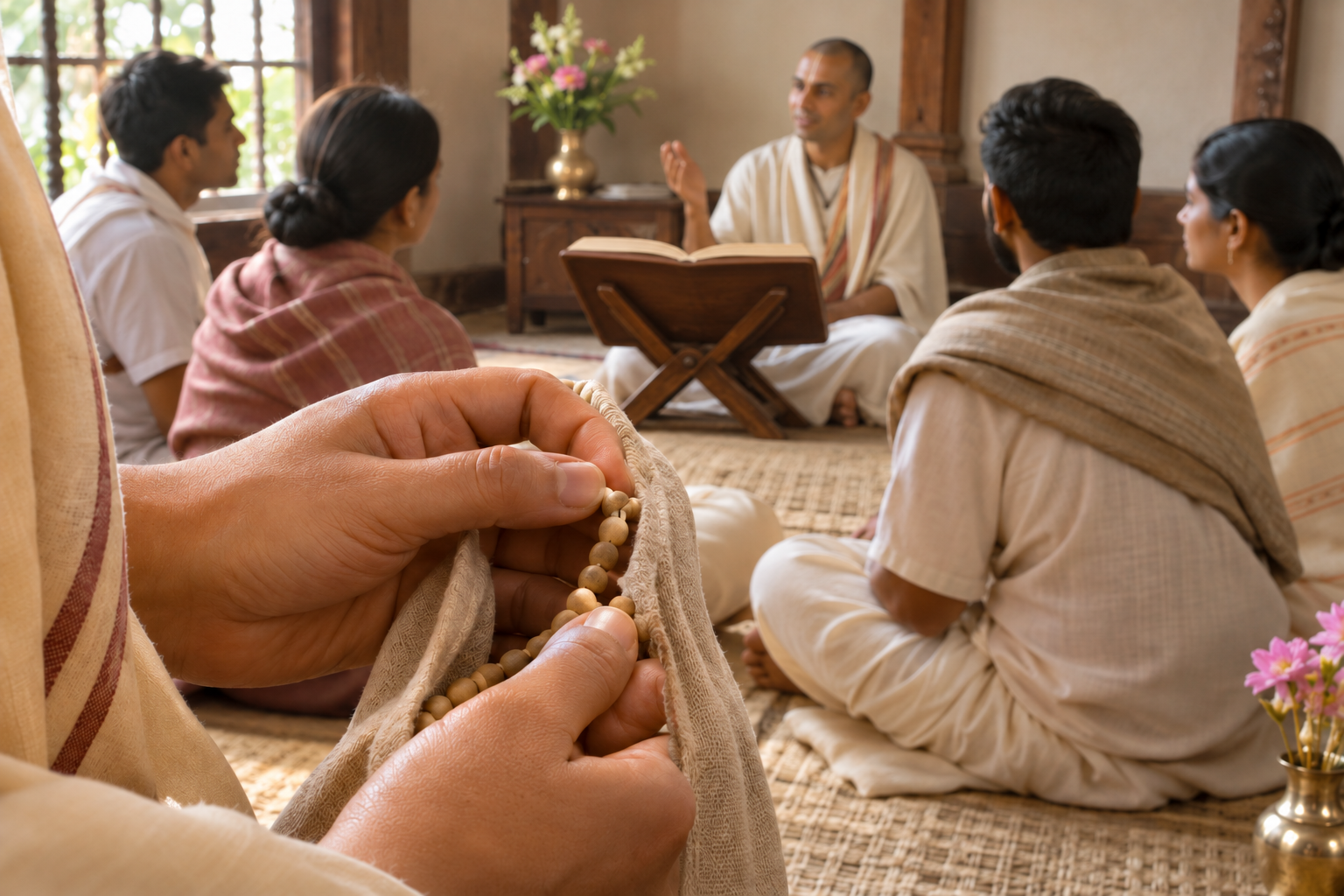
A dedicated japa transformation session appeared beside several Bhagavatam classes. That pairing is worth keeping. Japa reveals whether the mind can remain present before Krishna’s names; scripture supplies the understanding that keeps chanting from becoming mechanical. Hearing without practice can remain conceptual, while practice without attentive hearing can lose direction.
For your late-November observance, don’t inflate your number of rounds to create a dramatic anniversary gesture. Chant the commitment you can honour attentively and continue afterward. Use the occasion to diagnose one recurring obstacle: rushing, multitasking, inconsistent timing, indistinct pronunciation or allowing the phone to govern every pause.
- Before japa, name the one obstacle you are addressing. Keep the diagnosis narrow enough to observe.
- During japa, return to the sound whenever you notice the mind has left it. Don’t turn distraction into a second meditation by arguing with yourself about it.
- After japa, hear one complete Bhagavatam class. Begin with a question you genuinely want the passage to answer.
- In your notes, separate three things: what the cited verse says, what the speaker explains and what you infer for your own life. This protects you from attributing your assumption to scripture or teacher.
- Choose one application for the next day and revisit it after your following japa period.
You have several useful routes through the week’s hearing. Srimad Bhagavatam 11.5.49 and 11.5.50 form an adjacent pair across 28 and 29 November. Srimad Bhagavatam 11.11.9 was presented through the practical theme of moving beyond the senses and material desires. Srimad Bhagavatam 6.17.16-17 and 3.30.1 offer separate passages if you want to follow a speaker or canto already familiar to you.
Don’t infer a verse’s complete teaching from a programme title. Hear the explanation, inspect how the speaker uses the text and write your application in modest terms. A sound note says what you intend to practise; it doesn’t pretend that one class has settled every question surrounding the passage.
Complete private practice through community participation

The same late-November devotional field included an Auckland Rathayatra, the 50th anniversary programme for Sri Sri Radha Govinda in Denver and the PRERANA Festival at ISKCON Chowpatty. These are different forms of community life: public procession, institutional remembrance and festival gathering. Their presence beside japa and scripture classes prevents a common mistake – treating inward practice and outward participation as unrelated paths.
If you have access to a local gathering, attend as a participant rather than a spectator. Arrive in time for the substantive programme, listen without using the event mainly as background for photographs and accept an appropriate service when one is available. If you are with family or a small group, hear one glorification or class together, let each person state one practical takeaway and then chant together. If you are participating online, remove the avoidable distractions that you would not bring into a temple room.
The test is continuity. Your public participation should strengthen the discipline you carry home, while your private chanting should make you more dependable in community service. If either side becomes an escape from the other, the observance has lost its balance.
Key takeaways
- Treat remembrance, japa, scripture and community service as one devotional sequence.
- For Srila Prabhupada’s 49th Disappearance Day, extract one instruction from a complete glorification and act on it within the following week.
- Use japa to identify one specific weakness in attention; don’t make a larger vow merely because the date feels significant.
- When hearing Bhagavatam, distinguish the verse, the speaker’s explanation and your personal application.
- Verify your local temple’s schedule because the late-November programmes came from several communities rather than one universal timetable.
Write a four-line plan before your observance: the remembrance you will hear, the passage you will study, the japa period you will protect and the community or service commitment you will make. Then keep one instruction alive during the following week. That is how a date on the devotional calendar becomes sustained sadhana.
References
- Dandavats – Weekly Feed Archive – November 29, 2026
- YouTube – Today’s Featured Video: Srimad Bhagavatam Text 3.30.1, Speaker HH Guruprasad Swami Maharaj

Leave a Reply
You must be logged in to post a comment.