
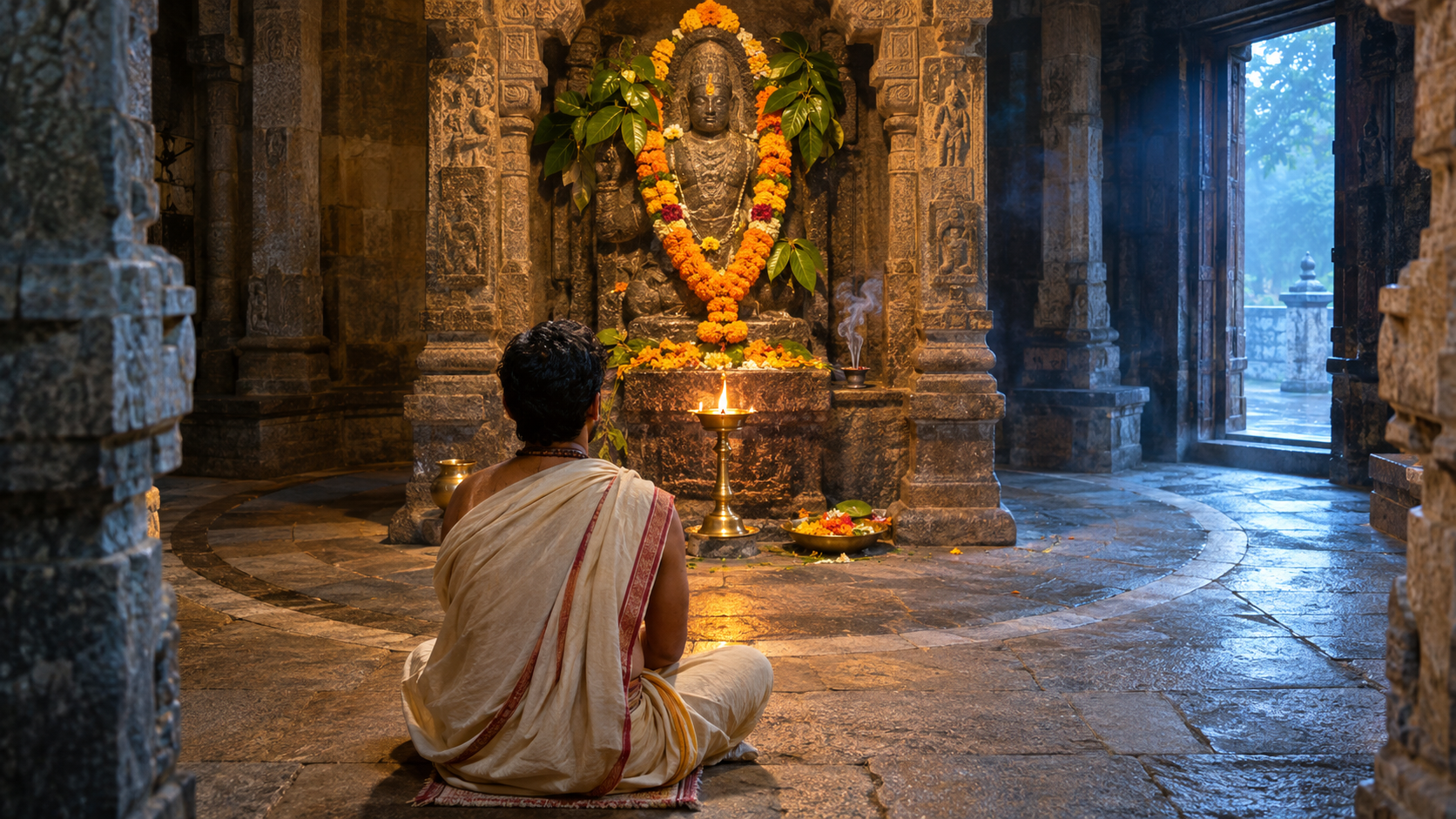
You may complete a puja, bow before the murti, or walk around a temple and still wonder whether anything truly happened. Or you may glimpse a quiet insight during prayer but have no way to tell whether it was spiritual recognition, passing emotion, or imagination.
The answer is not to force a dramatic experience. Let insight reveal what the ritual means, and let ritual train your attention until that meaning reaches your conduct. This gives you a practical way to approach divinity without reducing it either to a feeling or to a mechanical performance.
Change what you mean by experiencing divinity
If you expect divine experience to arrive only as a vision, an extraordinary sensation, or an unmistakable sign, you may overlook quieter forms of recognition. An intense experience can be meaningful, but intensity by itself cannot tell you whether you have encountered truth, amplified a mood, or followed your own expectations.
The proposition that God exists within you changes the direction of the search. Instead of treating the divine as an object that must appear before you, begin by examining the awareness with which you are already seeing, choosing, loving, resisting, and acting.
Within does not mean that every desire, opinion, or emotional impulse is divine. If it did, spirituality would merely confirm whatever the ego already wanted. Insight requires discrimination: you notice a thought without automatically obeying it, observe an emotion without making it an oracle, and ask what remains when self-display and personal advantage are set aside.
Dharmic traditions and Hindu sampradayas do not all describe the ultimate reality in identical terms. Some devotees relate to a beloved personal deity; other practitioners emphasize presence, consciousness, or the reality underlying appearances. You do not have to erase those distinctions to practise well. Begin within the language and discipline of your own tradition.
For practical purposes, treat divine experience as a reordering of attention before you treat it as a special sensation. Ask whether the sacred has become more real in the way you see another person, restrain a harmful impulse, accept a duty, or release the need to be praised. That test is slower than chasing signs, but it is much harder to counterfeit.
See what pradakshina teaches through the body
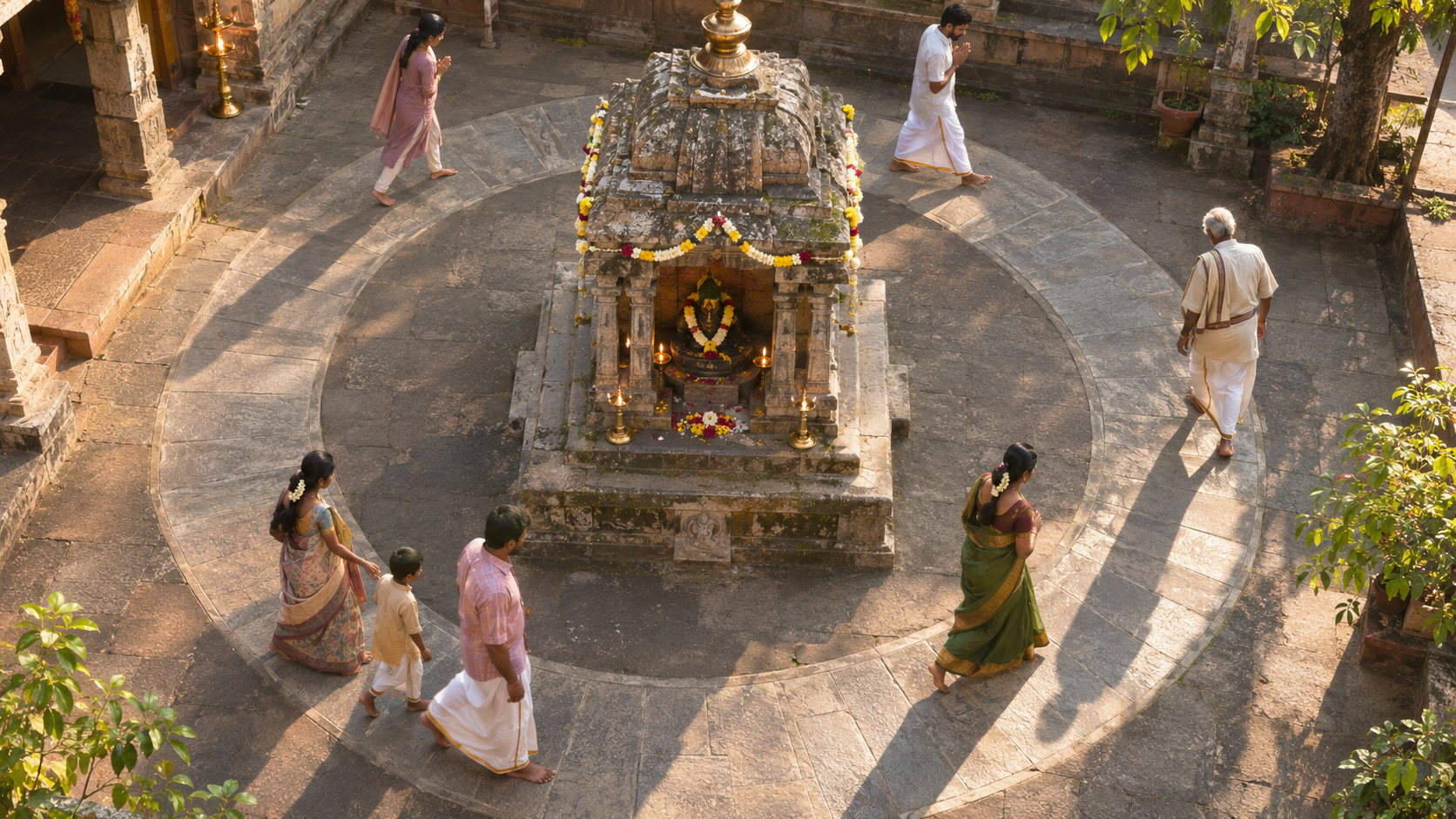
Pradakshina is the circumambulation of a temple, with the same principle expressed on a larger scale in Girivalam around the sacred mountain Arunachala. Its visible grammar is simple: the sacred centre remains steady while you move around it.
That bodily arrangement gives you something precise to contemplate. Most of the day, the mind places its own plans, fears, injuries, and ambitions at the centre. During pradakshina, your body enacts a correction. You are not asking the deity to revolve around your preferences. You are placing yourself in relation to something greater than them.
The walking alone does not guarantee this shift. Your feet can circle the sanctum while your mind continues circling an argument, a purchase, or a grievance. That does not make the ritual worthless; it reveals exactly where your attention is being claimed. Each time you notice the wandering, return to the deity, divine name, prayer, or sacred presence at the centre. The return is part of the practice, not evidence that you have failed.
Use three questions to join the outer action to inner insight:
- Before beginning: What am I deliberately placing at the centre?
- While walking: What repeatedly pulls my attention away from that centre?
- After completing the observance: What has actually occupied the centre of my life this week?
Follow the temple’s customary route, prescribed count, and restrictions rather than improvising your own version in a sacred space. If walking is not accessible to you, ask the temple how you can participate appropriately. A physical limitation is not a spiritual deficiency.
Turn one ritual into disciplined attention
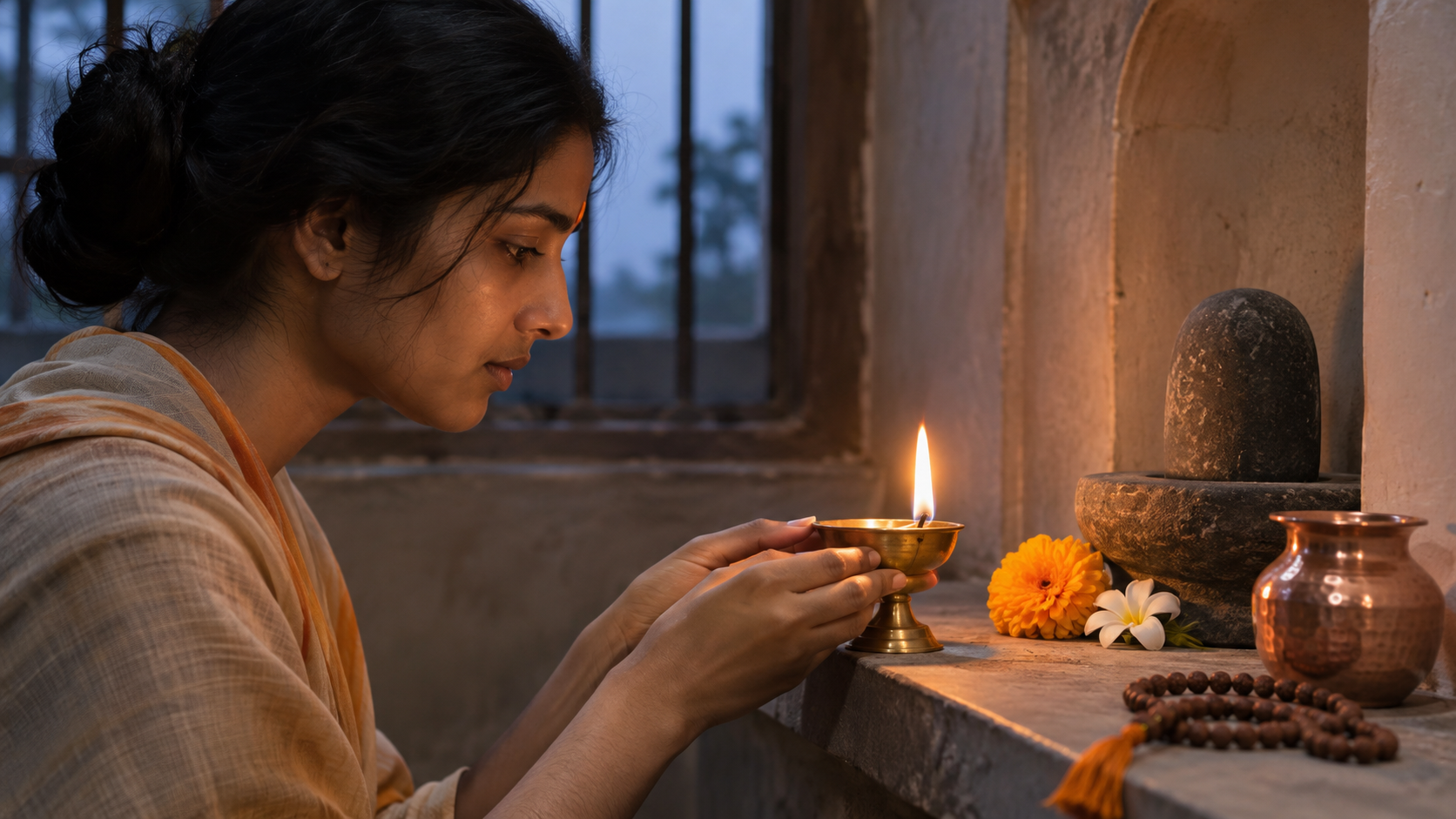
You do not need to accumulate many practices at once. Choose one observance you can approach steadily, such as pradakshina during temple visits, daily puja, or aarti. Work with it deeply enough to notice how attention changes before adding more complexity.
- Form one clear intention. Name the quality you want to cultivate, such as patience, truthfulness, gratitude, courage, or freedom from resentment. An intention directs the practice; a demand for a supernatural sign tries to control its result.
- Learn the actual form. Follow the custom of your family, sampradaya, or temple. Ask a knowledgeable priest or teacher when you do not know the appropriate sequence. Precision can support attention when it serves meaning rather than anxiety.
- Choose one anchor. Keep returning to the deity’s form, a familiar divine name, a prayer you understand, or the meaning of the action. Do not introduce an unfamiliar or restricted mantra merely to make the practice feel more advanced.
- Notice distraction without dramatizing it. When the mind wanders, identify the pull plainly and return. Neither condemn yourself nor follow the distraction into a private story.
- Remain still when the action ends. Give the observance a quiet closing rather than reaching immediately for your phone or conversation. Notice one bodily sensation, one recurring thought, and one moral demand that became clearer.
- Translate the ritual into one action. Complete a neglected duty, speak truthfully, make amends, restrain a cruel response, or offer help where it is genuinely needed. Choose an action appropriate to your situation rather than an impressive gesture.
A simple three-line record can keep the practice honest: name the ritual, write what you noticed, and state what you will do. Do not record only unusual feelings. Also note resistance, boredom, recurring distractions, and the duties you would prefer not to see. Over time, those entries show whether the ritual is educating your attention or merely occupying a few minutes.
Judge the practice by its fruits, not its drama
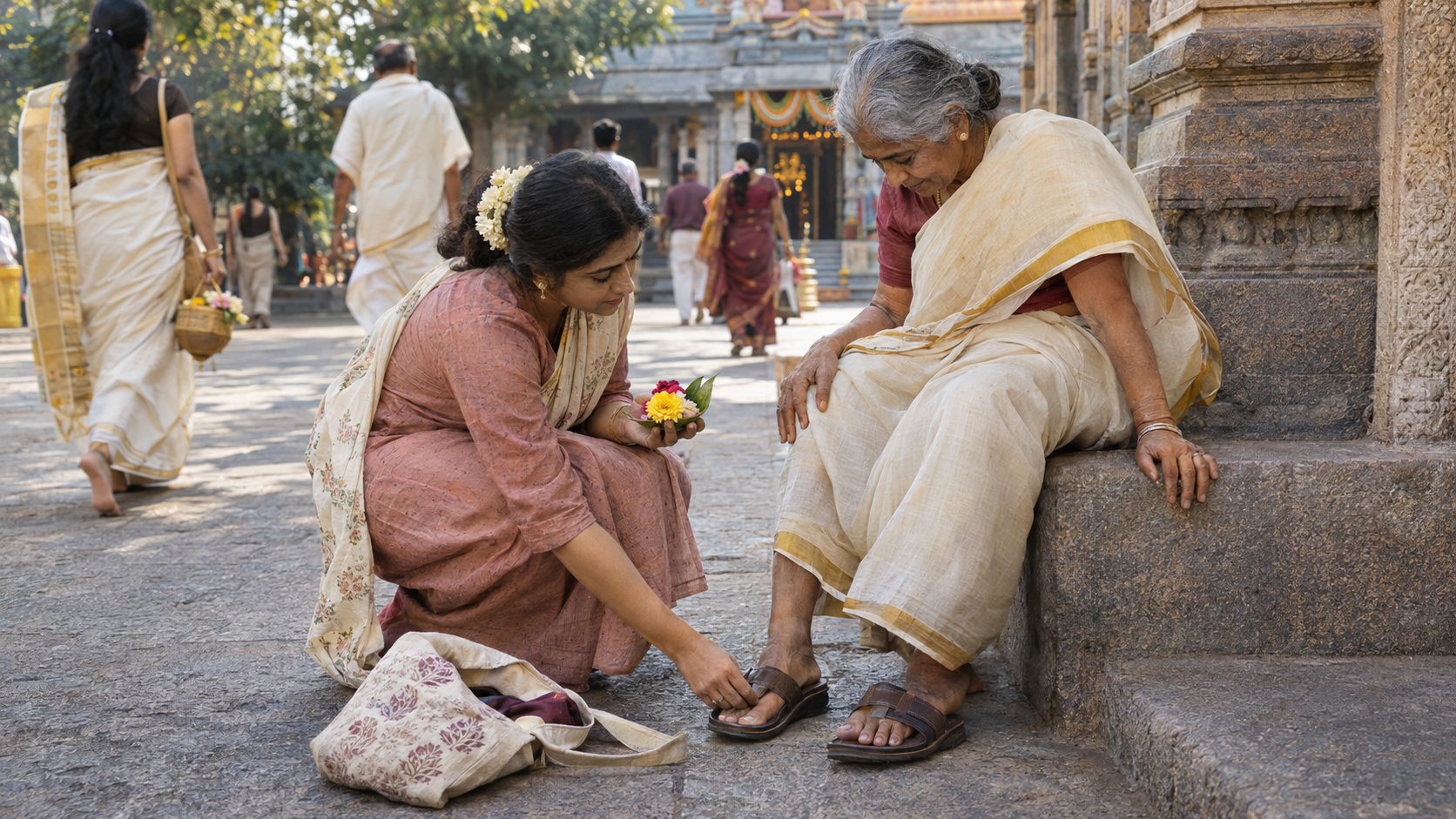
No private feeling can serve as unquestionable proof of a metaphysical claim. You can, however, examine what your practice is producing. Four tests are especially useful:
- Attention: Can you notice distraction and return without abandoning the practice or indulging in self-condemnation?
- Humility: Are you becoming less eager to advertise experiences, rank devotees, or treat yourself as specially chosen?
- Dharma: Does worship make your actual duty clearer, especially when that duty is inconvenient?
- Integration: Does remembrance of the sacred return outside the temple, when you are working, speaking, deciding, or facing provocation?
These tests do not measure devotion as though it were an examination score. They help you distinguish spiritual formation from stimulation. A powerful mood that leaves vanity and conduct untouched deserves caution. A quiet observance that gradually makes you more truthful, attentive, and responsible may be doing deeper work.
Do not mistake emotional dryness for automatic failure. Ritual gives your body and time to the sacred even when feeling is absent. But do not use perseverance as an excuse for permanent inattention either. If you always rush, never learn the meaning, or treat completion as the only goal, correct the way you practise. Slow down, simplify the observance, and reconnect each action to its purpose.
Ritual also needs ethical boundaries. It should not become a reason to neglect dependants, humiliate someone who follows a different custom, or imagine that correct performance cancels harmful conduct. When ritual enlarges fear, superiority, or obsession with mistakes, return to trustworthy guidance and recover the relationship between worship and dharma.
Key takeaways
- Do not use extraordinary sensation as your only test of divine experience.
- Insight clarifies what the sacred means; ritual gives that insight a bodily, repeatable form.
- Pradakshina places the sacred at the centre while revealing what usually occupies your attention.
- Use one intention, one attentional anchor, and one concrete action after each observance.
- Evaluate practice through attention, humility, dharma, and its effect on ordinary conduct.
At your next temple visit, make one observance complete rather than trying to make it spectacular. Set an intention before it, return to the sacred centre during it, remain quiet after it, and carry one clear response into the rest of your day.
You do not have to manufacture divinity through perfect performance. Your task is smaller and more demanding: become present enough to notice what the ritual reveals, then become disciplined enough to live by it.
References
- Hindu Pad — Does God really exist? If yes, then how can we experience the God?
- Hindu Pad — Pradakshina | Circumambulation | Why we do Pradakshina in Temples

Leave a Reply
You must be logged in to post a comment.