

You may have opened the Brahma Purana hoping to understand what its goddess narratives actually ask of a dharmic reader. A list of divine attributes will not get you far. Begin instead with the order that has already gone wrong before the Goddess becomes central.
Sati enters a sacrifice founded on exclusion. Lakshmi manifests in a world marked by defeat and the need for recovery. These are not two versions of the same lesson. One tests ritual authority against dignity and right relationship; the other tests whether prosperity means private possession or restored capacity. Reading the crises first keeps both narratives from collapsing into slogans.
Sati reveals the difference between ritual prestige and dharma
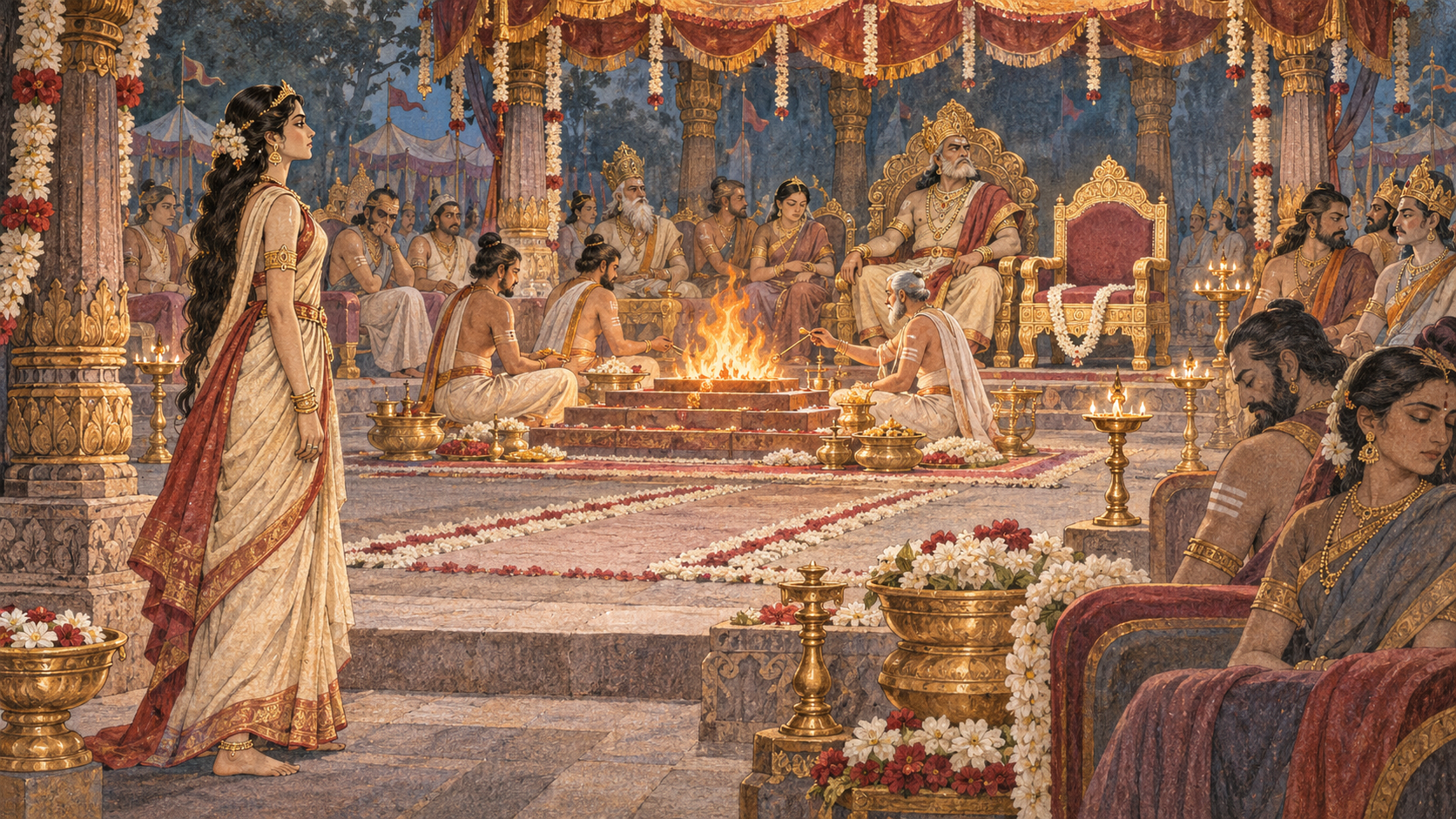
Bhishma asks Pulastya why Sati gave up her life. Yet the causal chain begins before her final act. Daksha Prajapati arranges a grand yagya and invites everyone except Shiva. The exclusion is not a minor detail added to an otherwise sound ceremony. It is the decision on which the moral tension of the entire event rests.
The yagya even has the visible marks of authority. It is presided over by four prominent sages: Vashishtha, Angika, Brihaspati and Narada. That detail sharpens the problem. Ritual expertise, celebrated participants and public grandeur cannot by themselves repair a premise damaged by deliberate exclusion. A ceremony can be impressive in form while remaining disordered in relationship.
When you read this episode, resist reducing it to a quarrel between relatives. Look at three things: who controls admission to the sacred space, whom that person excludes, and whether ritual status conceals rather than corrects the breach. These questions reveal why Daksha’s invitation list matters as much as the visible performance of the yagya.
Sati’s death must also be read with care. A severe narrative consequence is not automatically a command for conduct. The episode does not require you to treat self-destruction as an acceptable response to humiliation, nor does it make a woman’s erasure the measure of loyalty. Its severity shows how completely honour, kinship and sacred responsibility have broken down. The useful dharmic question is not whether Sati’s final act should be copied. It is what kind of disorder makes such an ending conceivable within the narrative.
For a close reading, make two columns. Under outer form, record the grand scale, distinguished officiants and assembled participants. Under inner condition, record the intentional exclusion, damaged relationship and consequence. The gap between those columns is the teaching: sacred form does not excuse adharmic intent.
Lakshmi appears when power has failed

The setting of Lakshmi’s manifestation is very different. After demons defeat the deities, the deities approach Vishnu for help. Vishnu does not merely erase the crisis for them; he gives them instructions about what they must gather next. Lakshmi’s manifestation therefore belongs to a sequence of defeat, acknowledged insufficiency, guidance and preparation.
This setting corrects a common narrowing of Lakshmi into a symbol of money alone. Wealth may be one part of how devotees understand her, but the narrative frame is larger. The deities have lost the capacity to maintain their position and cannot recover through pride or wishful thinking. Prosperity here can be read as restored capability, auspicious order and the conditions under which life can flourish again.
Do not begin this episode by asking what material benefit Lakshmi will grant. Ask four more revealing questions: What is absent before she manifests? Who admits that the existing condition is untenable? What action is required after guidance is received? What kind of order must be restored? Those questions move the reading from acquisition to responsibility.
The order of events matters. Defeat comes before appeal, appeal before instruction, and preparation before manifestation. That sequence warns against treating abundance as an isolated object that can be seized without the discipline needed to sustain it. When seeking Lakshmi in your own life, the narrative directs attention not only toward what you want to receive, but toward the disorder you must recognize and the work you must be ready to undertake.
Read the two crises together without collapsing the goddesses
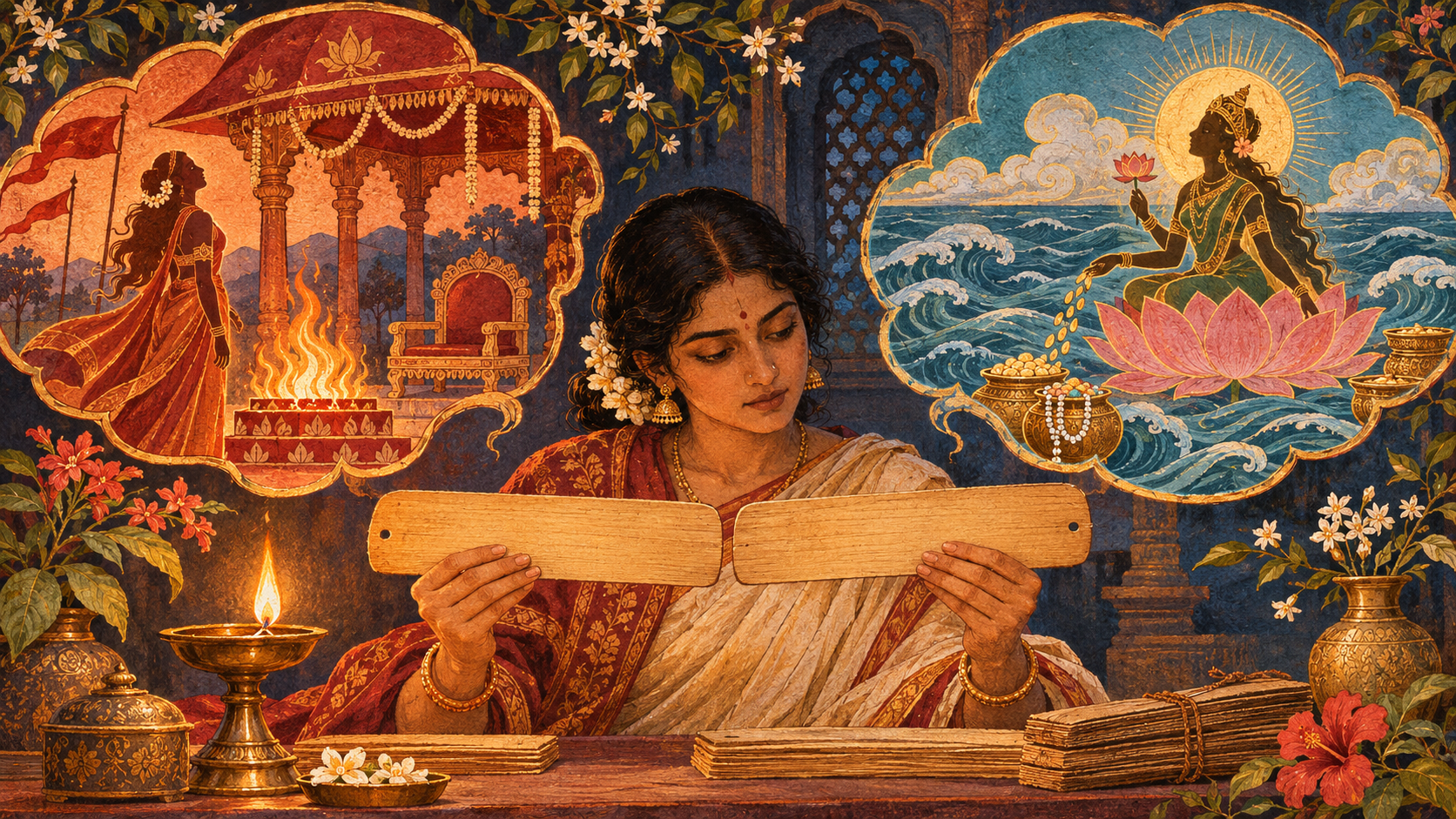
Comparison becomes useful only when the differences remain visible. Sati and Lakshmi are not interchangeable figures, and these episodes do not establish a single personality, chronology or theological formula for every form of the Goddess. They do, however, show how goddess narratives expose the condition of an order that appears unable to correct itself.
| Narrative | Opening disorder | Interpretive test |
|---|---|---|
| Sati | Daksha builds exclusion into a grand yagya | Can sacred form remain dharmic when right relationship is deliberately violated? |
| Lakshmi | The deities suffer defeat and seek Vishnu’s help | Is prosperity merely possession, or does it require recovered capacity and order? |
If your reading of Sati speaks only about private hurt, it cannot explain why the offence is embedded in a public religious act. If your reading of Lakshmi speaks only about personal money, it cannot explain why her manifestation is framed by the collective defeat of the deities. Let the opening crisis determine the scale of your interpretation.
The contrast is precise. Sati’s narrative asks whether a rite can remain sacred after its organiser has severed ritual from rightful relationship. Lakshmi’s narrative asks what recovery requires after power and confidence have proved insufficient. Sati exposes the corruption that grandeur can hide. Lakshmi exposes the lack that apparent power cannot overcome.
The shared principle lies at the level of dharmic order, not in an assertion that the two goddesses are identical in every respect. In both episodes, the Goddess prevents you from judging the world by appearances alone. The crowded yagya is not necessarily whole, and defeated deities are not restored merely because they desire restoration.
A five-step method for reading these narratives closely
- Locate the question and narrator. In these tellings, Bhishma asks and Pulastya answers. Recording that frame reminds you that each episode responds to a particular question: why Sati relinquished her life, or how Lakshmi manifested.
- Write the opening rupture in one sentence. For Sati, it is Daksha’s deliberate exclusion of Shiva from the yagya. For Lakshmi, it is the defeat of the deities and their appeal to Vishnu. Do this before interpreting symbols.
- Track verbs rather than collecting attributes. Daksha organises and excludes; Sati gives up her life; the deities lose and seek help; Vishnu instructs. Agency becomes clearer when you follow decisions and responses.
- Separate consequence from command. A character’s action may reveal the gravity of a crisis without functioning as conduct that every devotee should reproduce. This distinction is indispensable when reading Sati’s death.
- Test the interpretation against the whole sequence. If an explanation of Sati makes the public yagya irrelevant, it is too narrow. If an explanation of Lakshmi makes defeat, guidance and preparation irrelevant, it is also too narrow.
When working from an edition, translation or oral retelling, keep its actual wording beside your notes. Familiar versions can blend details drawn from different tellings. Mark what the passage explicitly states, what you infer from its sequence, and what you remember from elsewhere. That simple separation prevents a popular retelling from silently replacing the text you intended to study.
Key takeaways
- The Sati episode tests whether ritual splendour can compensate for deliberate exclusion. It cannot be read responsibly without confronting the gap between ceremonial form and dharmic relationship.
- Sati’s death communicates the extremity of the breakdown; it should not be converted into a general instruction to imitate self-destructive conduct.
- Lakshmi’s manifestation is framed by defeat, appeal, guidance and preparation. That setting makes prosperity broader than private financial gain.
- The narratives can be compared through the order each one examines, but their goddesses should not be flattened into one undifferentiated character.
- A sound reading follows the crisis, the agents and the consequences before assigning a symbolic meaning.
When you return to either passage, write three lines before consulting a commentary: what has broken, who acts, and what changes. Those answers will usually take you closer to the narrative’s dharmic concern than a page of disconnected divine epithets.
References

Leave a Reply
You must be logged in to post a comment.